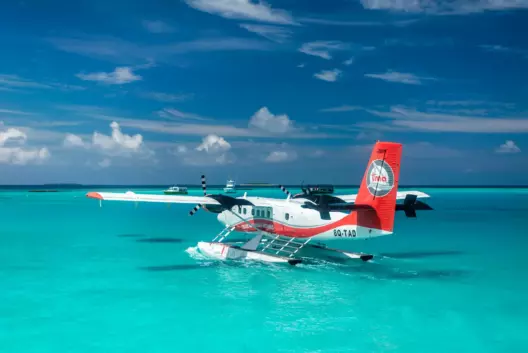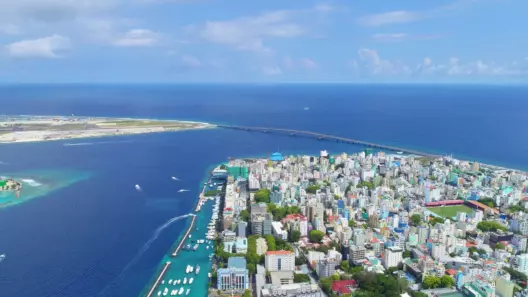
North Malé Atoll is where Maldives tourism was born — and more than fifty years later, it remains the most logistically forgiving and scenically diverse corner of the archipelago. Unlike the remote southern atolls that demand seaplane hops timed to daylight and weather windows, every resort here is reachable by speedboat in under an hour from Velana International Airport. That single fact reshapes the entire trip: late-night arrivals don’t strand you in a Hulhumalé hotel waiting for dawn. Budget that would have gone to a 30-minute seaplane ride can stay in your holiday.
But convenience alone does not explain why North Malé draws repeat travellers year after year. The atoll stretches roughly 69 km long and 39 km wide across approximately 50 islands, and its reef systems rank among the healthiest and most biologically dense in the country. It also holds something the deeper atolls cannot replicate: compressed variety. Within the same lagoon zone you will find the Maldives’ most celebrated house reef, one of the world’s first underwater spa treatment rooms, an all-overwater resort where shoes are literally taken at arrival, and an artificial island campus where three international luxury brands share a marina village. No other Maldivian atoll offers that range in a single speedboat zone.
This guide cuts through the marketing noise. Each resort profile below includes a clear statement of what it actually does best, what it does not offer, and which traveller profile it suits — including the cases where it does not suit at all.
Why North Malé Atoll Stands Apart from the Rest of the Maldives
The atoll’s defining advantage is transfer time. Most properties sit between 10 and 50 minutes by speedboat from the airport, and speedboats operate around the clock, meaning arrival time does not dictate your resort choice. Resorts in Ari, Baa, or Lhaviyani atolls often require seaplanes that only fly between 06:00 and 16:00, adding a mandatory overnight in Malé for late international connections.
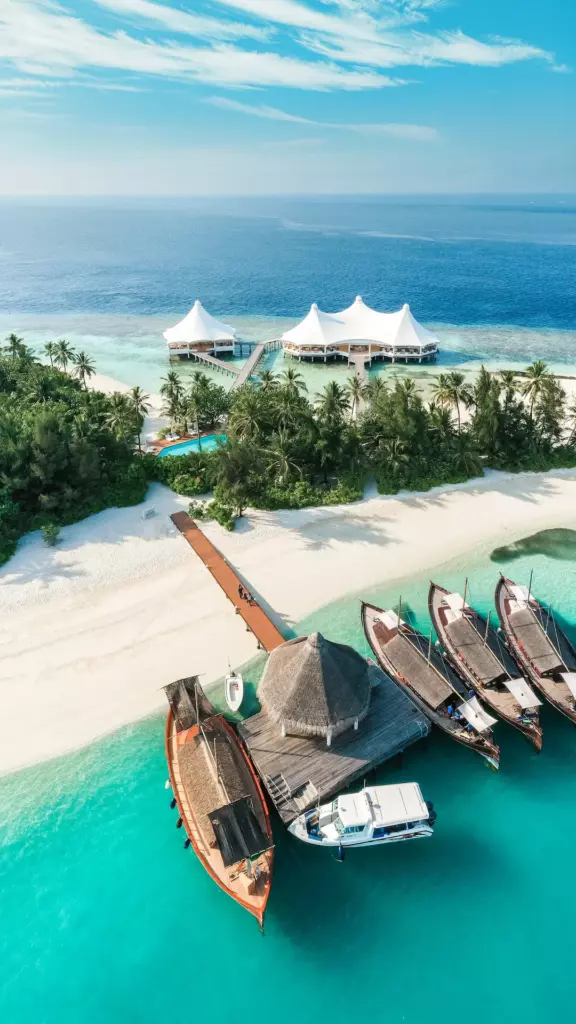
North Malé also holds the greatest concentration of mature coral ecosystems close to a major airport anywhere in the Indian Ocean. The atoll’s position along well-established ocean currents keeps water temperatures stable, typically between 28°C and 30°C year-round, and supports an unusually high density of resident marine life: reef sharks, eagle rays, sea turtles, and schooling pelagics are documented at multiple house reefs within the atoll.
For surfing, the atoll’s north and east flanks face exposed Indian Ocean swells between March and October, producing reef breaks that have attracted international surf competitions. Gili Lankanfushi is the primary resort base for surfers accessing these breaks, with board hire and guides available on-site.
Getting There: Transfers, Times, and What to Expect
All North Malé Atoll resorts operate their own speedboat transfers coordinated to meet international flight arrivals. The process is standardised: a resort representative meets you in the arrivals hall, escorts you to the jetty, and loads luggage directly onto the boat.
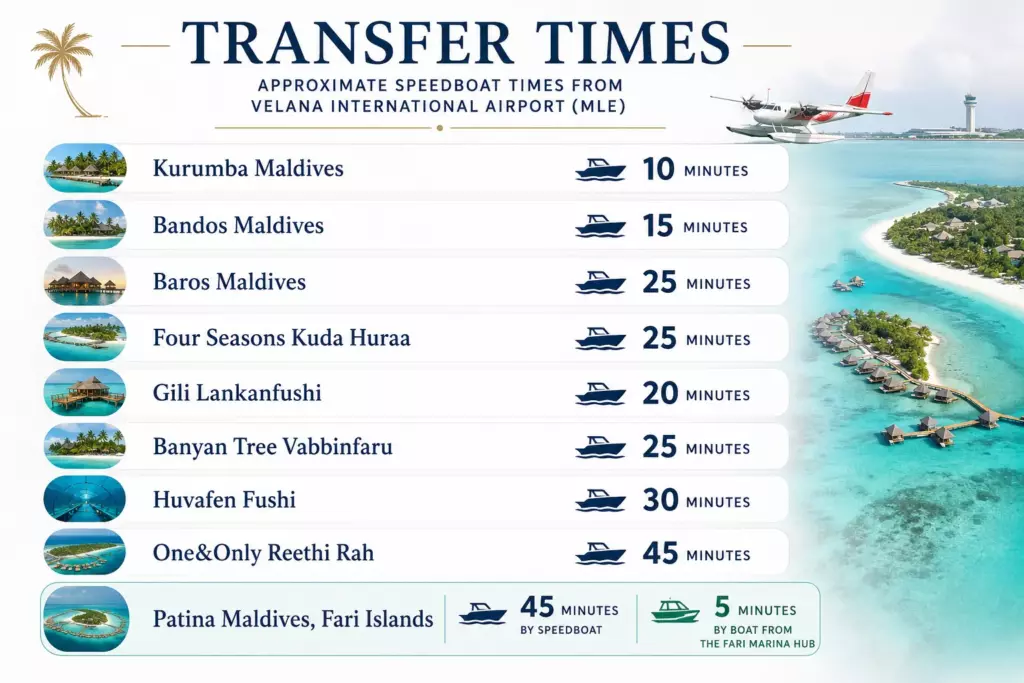
Transfer durations by resort (approximate speedboat times from Velana International Airport):
- Kurumba Maldives — 10 minutes
- Bandos Maldives — 15 minutes
- Baros Maldives — 25 minutes
- Four Seasons Kuda Huraa — 25 minutes
- Gili Lankanfushi — 20 minutes
- Banyan Tree Vabbinfaru — 25 minutes
- Huvafen Fushi — 30 minutes
- One&Only Reethi Rah — 45 minutes
- Patina Maldives, Fari Islands — 45 minutes by speedboat, or 5 minutes by boat from the Fari Marina hub
Shared group transfers are typically included in room rates at higher-end resorts. For properties like Patina Maldives and the Waldorf Astoria, private yacht options are available at significant premium — expect $3,800–$7,600 round-trip for a private boat — but the group speedboat option remains practical and comfortable for most travellers.
One practical note: shared transfers may involve 1–2 hours of waiting at the airport lounge while guests from other flights clear immigration. If you are arriving on a red-eye or a late connection, factor this into your first-day plans.
The Resorts: What Each One Actually Does Best
<iframe src="https://www.google.com/maps/d/embed?mid=1mImtek1tZo6voUA23mV8hiNE6mhvRGVL&ehbc=2E312F" width="640" height="480"></iframe>Gili Lankanfushi — Where Overwater Living Began
Gili Lankanfushi holds a legitimate historical claim: it was the first all-overwater villa resort in the Maldives, and the format it pioneered in its earlier incarnation as Soneva Gili has since been replicated across hundreds of properties worldwide. The original, however, still carries something the copies rarely manage — a coherent philosophy rather than just an aesthetic.
The resort’s operating principle is “No News, No Shoes.” Guests surrender their footwear on arrival. Wi-Fi exists but is gently discouraged. The 45 villas and residences — every single one built over the water on stilts — are crafted from teak, palm timber, and light linens. Rooftop terraces, private sundecks with direct ladder access to the lagoon, and open-air bathrooms are standard. The world’s largest overwater residence sits within the collection for those with budgets to match.
What distinguishes Gili from the newer design-forward properties is its combination of ecological credibility and genuine informality. The resort holds EarthCheck Gold certification and runs a pioneering coral restoration programme. Dining at Kashiveli, the main overwater restaurant, balances local seafood with global techniques in a setting that feels genuinely relaxed rather than performatively casual. The Japanese fusion restaurant By The Sea is consistently ranked among the best resort dining rooms in the atoll.
Best for: Couples seeking an intimate, eco-conscious escape. Surfers — the island sits within easy reach of quality breaks. Anyone who wants overwater living without the branded-luxury formality.
Not ideal for: Families with young children (limited kids’ infrastructure). Guests who need a beach villa option (there are none — every villa is overwater).
Speedboat transfer: 20 minutes from airport.
Baros Maldives — The Reef-First Choice
Baros is one of the Maldives’ original resorts, approaching its sixth decade of operation, and it has made a clear strategic choice that distinguishes it from almost every competitor: the house reef comes first. The coral ecosystem encircling the island is a 360-degree living structure that begins just a few metres from the shoreline, requiring no boat, no guide, and no tidal timing. More than 20 identified resident sea turtles, nurse sharks, white-tip reef sharks, and dense schools of reef fish are accessible to a snorkeller within minutes of entering the water.
The resort operates a PADI 5-Star Gold Palm Dive Centre — one of the highest accreditations available — with access to 30 dive sites and an ancient shipwreck within a 50-minute speedboat radius. A fluorescent night-diving experience is available at the house reef itself, which is operationally rare and particularly striking.
With only 75 villas, Baros intentionally maintains boutique scale. The property does not accept children under eight years old, which is a deliberate positioning decision rather than an oversight. The result is an atmosphere that consistently draws couples and honeymooners. The Lighthouse Restaurant, Baros’ fine-dining anchor, has maintained a strong reputation for presentation and seafood quality over multiple years. Private sandbank dining and sunset dhoni cruises are among the most consistently praised experiences across the property.
Best for: Divers and serious snorkellers. Couples and honeymooners. Guests who want quiet, reef-first luxury without a large resort footprint.
Not ideal for: Families with children under eight. Guests seeking a wide activity programme or multiple dining venues (three restaurants is the full offering).
Speedboat transfer: 25 minutes from airport.
One&Only Reethi Rah — Scale, Sport, and Twelve Beaches
Reethi Rah is built on one of the largest private islands in the Maldives. The scale is genuine: twelve distinct beaches fringe the coastline, connected by palm-shaded cycling paths that guests use to explore the property. This is not a resort where you exhaust the geography in a single afternoon.
The 118 villas span both beach and overwater categories, with beach villas positioned discreetly along stretches of shoreline and water villas extending over the lagoon. Six restaurants and bars cover a range from Japanese-Peruvian fusion at Tapasake — which has earned a loyal returning clientele including guests who say they book the resort annually in part for the food — to the garden-lit Botanica for farm-to-table cuisine.
The activity infrastructure is unusually comprehensive for a Maldivian property. Club One manages a rock-climbing wall, two floodlit tennis courts, a full water sports centre, and an artist studio. The One&Only Spa includes treatments from a resident French podiatrist at Pedi:Mani:Cure Studio. For families, the programming depth is a genuine differentiator.
One note that appears consistently in traveller reviews: service quality has been mixed relative to the price point, which is among the highest in the atoll. The island and infrastructure are consistently praised; the personalisation that guests expect at this rate has been reported as inconsistent. The house reef, located on a partly artificial island, draws realistic expectations: marine life density is decent — turtles, fish, and occasional reef sharks — but the coral health is not at the level of Baros or Huvafen Fushi.
Best for: Active families. Couples who want resort breadth rather than intimacy. Tennis players and water-sports enthusiasts.
Not ideal for: Guests primarily driven by snorkelling or diving quality. Those seeking an intimate, low-key experience.
Speedboat transfer: 45 minutes from airport.
Four Seasons Kuda Huraa — Family Sophistication, No House Reef
Four Seasons Kuda Huraa is frequently cited as the benchmark for consistent, brand-guaranteed service delivery in the atoll. Arriving guests are greeted by Four Seasons representatives, transferred by waiting speedboat, and introduced to a property that reads like a traditional Maldivian village redesigned with full luxury infrastructure: thatched bungalows, private pool villas, lush garden paths, and an overwater Island Spa accessible only by boat.
The resort’s strengths are family-friendliness and service consistency. Guided reef-shark and turtle encounters, a well-run kids’ programme, and an overwater spa with starlit treatment rituals are reliable offerings. The family water villas with pools are a practical choice for parents travelling with children who want shared space and lagoon access.
One important practical note that every prospective guest should know: Four Seasons Kuda Huraa does not have a functional house reef. This is a widely documented limitation, noted by dive and snorkelling travellers as a significant differentiator versus properties like Baros and Huvafen Fushi. Guests with snorkelling or diving as a primary motivation should consider this seriously before booking. The resort’s underwater experiences are available as excursions rather than walk-in reef access.
Best for: Families seeking Four Seasons-level service consistency. Couples who prioritise spa experiences and sophisticated dining over reef access.
Not ideal for: Dedicated snorkellers and divers. Guests who expect direct house reef access.
Speedboat transfer: 25 minutes from airport.
Huvafen Fushi — The Wellness Pioneer
Huvafen Fushi opened in 2005 and established an identity that has proved genuinely difficult to replicate: the world’s first underwater spa treatment rooms. The LIME spa’s subaqueous treatment suites — where guests receive massages and therapies with coral gardens visible through floor-to-ceiling glass — remain structurally unique in the Maldives and have not been meaningfully copied.
The resort’s house reef is exceptional, consistently rated among the best in North Malé Atoll by dive and snorkelling travellers. It is both healthy and accessible, with strong coral density and a high frequency of encounters with reef sharks and large pelagics. The intimacy of the resort — smaller in footprint than One&Only Reethi Rah or Four Seasons Kuda Huraa — gives it an atmosphere closer to Baros and Gili Lankanfushi.
The property operates as adults-only in all but name (it accepts children but its design and positioning are clearly oriented toward couples and wellness-seeking adults). Water villas are spacious and well-appointed, with the service maintaining a personalised character that several repeat visitors note as a primary reason for returning.
Best for: Wellness-focused travellers. Divers and snorkellers. Couples seeking an intimate resort with a distinctive concept.
Not ideal for: Families with young children seeking dedicated kids’ programmes. Guests looking for large-scale activity infrastructure.
Speedboat transfer: 30 minutes from airport.
Patina Maldives, Fari Islands — The Design-Led New Generation
Patina Maldives represents a different model entirely: not a single private island, but a position within the Fari Islands archipelago, a multi-resort destination shared with the Ritz-Carlton Maldives and the Waldorf Astoria Maldives Ithaafushi. The Fari Marina Village — accessible in five minutes by boat from the Ritz-Carlton jetty — houses a collection of restaurants, boutiques, an art studio, and cultural programming that effectively functions as a shared amenity zone for all three properties.
Patina itself occupies a substantial island with only 110 villas, ensuring meaningful privacy across a large footprint. Every villa features a 270-degree ocean view and a private infinity pool. The design signature is Brazilian modernism via Marcio Kogan’s studio, with an emphasis on clean lines, natural materials, and integration with the landscape. A solar-powered children’s club and an on-island farm supplying fresh produce for the restaurants reflect a sustainability positioning that is integrated into operations rather than decorative.
The resort is positioned at the upper tier of North Malé Atoll pricing. Access to the Fari Marina Village gives it a social and cultural richness that genuinely distinguishes it from the isolated-island model: guests can dine at another hotel’s restaurant, browse an actual art gallery, and participate in programming that extends beyond any single resort’s offering.
Best for: Design-conscious travellers. Couples and families who want resort living with a social and cultural dimension. Those who appreciate architecture as part of the holiday experience.
Not ideal for: Guests seeking the purest form of remote island isolation. Those who prioritise dive/snorkelling focus above all else.
Speedboat transfer: 45 minutes from airport.
Kurumba Maldives — The Original, Modernised
Kurumba holds the distinction of being the very first tourist resort to open in the Maldives, in 1972. It sits closer to the airport than any other resort in the atoll — just ten minutes by speedboat — and has undergone extensive modernisation while maintaining a heritage positioning. It is now owned and operated under the Universal Resorts group and targets a broad market that includes families, honeymooners, and travellers who want Maldivian luxury without the very highest price tier.
The property is larger and more varied in villa category than boutique options like Baros. Nine restaurants and bars give it a dining breadth that few North Malé properties match. The reef situation is functional rather than exceptional: serviceable snorkelling is available, though serious divers will find the reef quality below Baros or Huvafen Fushi standards.
Best for: Travellers seeking value at an accessible luxury level. Families wanting variety in dining. Guests with late flights or early departures who need minimal transfer time.
Not ideal for: Reef-focused divers. Those who prioritise intimacy and boutique scale.
Speedboat transfer: 10 minutes from airport.
Banyan Tree Vabbinfaru — Eco-Romance, Quietly Excellent
Banyan Tree Vabbinfaru occupies a small, lush island with a strong environmental record: EarthCheck Gold certified, with active coral restoration and a marine conservation programme guests can participate in. The resort is adults-oriented, intimate in scale, and sits within the premium tier — though slightly below the extreme luxury ceiling of One&Only Reethi Rah or Patina Maldives.
The spa credentials are well established: Banyan Tree has built its global brand around spa experiences, and Vabbinfaru is a consistent performer within that context. The dining is solid without being exceptional. The house reef supports decent snorkelling with resident turtle and ray encounters.
Recent awards include a Forbes 4-Star Travel Guide recognition and inclusion in DestinAsian’s Top 10 Best Hotels in Maldives for 2024, giving it verified third-party credibility for the quality level it represents.
Best for: Eco-conscious couples. Spa-focused guests. Those seeking a quiet, mid-scale luxury option with genuine environmental substance.
Not ideal for: Families. Guests seeking large-scale activity programming or multiple dining choices.
Speedboat transfer: 25 minutes from airport.
Resort Comparison at a Glance
| Resort | Transfer | Scale | House Reef | Best For |
|---|---|---|---|---|
| Kurumba | 10 min | Large | Moderate | Families, value luxury |
| Gili Lankanfushi | 20 min | Boutique | Good | Eco-couples, surfers |
| Baros | 25 min | Boutique | Exceptional | Divers, honeymooners |
| Four Seasons Kuda Huraa | 25 min | Mid | None | Families, service focus |
| Banyan Tree Vabbinfaru | 25 min | Boutique | Good | Eco-romance, spa |
| Huvafen Fushi | 30 min | Mid | Exceptional | Wellness, dive couples |
| One&Only Reethi Rah | 45 min | Large | Moderate | Active families, sport |
| Patina Maldives | 45 min | Large | Moderate | Design, culture, pools |
When to Visit North Malé Atoll
The dry northeast monsoon from November through April brings the clearest skies, calmest seas, and best underwater visibility. This is high season, and room rates reflect it — expect peak pricing from December through March. February and March offer an excellent balance of weather quality and marginally lower demand compared to the Christmas–New Year peak.
The southwest monsoon from May through October brings more cloud and occasional rain, but not the all-day storms that Maldives marketing sometimes implies. Snorkelling and diving remain excellent on most days. Surf breaks are at their best during this period, which makes it the preferred window for surfers staying at Gili Lankanfushi or on Thulusdhoo island. Room rates drop meaningfully, and many resorts offer half-board or full-board inclusions during this shoulder season.
FAQ
Do I need a seaplane to reach any North Malé Atoll resort? No. Every resort in North Malé Atoll is accessible by speedboat at any hour. Seaplanes are typically required for resorts in Baa, Ari, Noonu, and more distant atolls, where speedboats are not practical.
Which North Malé Atoll resort has the best house reef for snorkelling? Baros Maldives is consistently cited as having one of the finest house reefs in the entire Maldives — not just the atoll — with healthy coral, resident sea turtles, reef sharks, and direct shore access without needing a boat. Huvafen Fushi is the close second with excellent reef quality and strong marine life density.
Is North Malé Atoll good for surfing? Yes, particularly during the southwest monsoon (May–October). Gili Lankanfushi is the best-positioned resort for surf access, with guides and board hire available on-site and proximity to the atoll’s main break zones.
Which resort is best for families with children? One&Only Reethi Rah offers the most comprehensive family programming, including a rock-climbing wall, kids’ facilities, and extensive beach and water-sports access. Four Seasons Kuda Huraa provides the reassurance of brand consistency and a strong kids’ programme. Patina Maldives’ solar-powered children’s club is a genuine differentiator for eco-minded families.
What is the best time to visit for diving? Both monsoon windows offer good diving in North Malé Atoll. The northeast monsoon (November–April) provides better visibility on most sites. The southwest monsoon (May–October) can bring stronger current-driven channels with higher pelagic encounter rates, which experienced divers often prefer.
Can I visit North Malé Atoll on a budget? Relative to the Maldives as a whole, North Malé Atoll is more accessible, and Kurumba Maldives sits at a noticeably lower price point than the luxury tier while still delivering a full Maldivian resort experience. Local island stays on Thulusdhoo and other inhabited islands bring costs down considerably further, trading resort facilities for a genuine window into Maldivian community life.