What to Pack for the Maldives: Dress Codes, Banned Items & the Rules Most Guides Forget
Most packing guides for the Maldives focus on what swimsuit to bring. This one focuses on what happens when you get it wrong — confiscated luggage at customs, a fine on a local island street, or an awkward moment at a resort restaurant. The Maldives is a Muslim-majority nation operating under a dual system: world-class private resort islands with almost zero restrictions, and inhabited local islands with strict Islamic customs that are actively enforced. Knowing which rules apply where — before you zip up your suitcase — is the difference between a seamless arrival and an expensive lesson.
Resort Island vs. Local Island: The Rule That Changes Everything
The single most important thing to understand about the Maldives is that it runs on two separate sets of rules depending on where you are standing.
Private resort islands operate under special government tourism licenses. Guests can wear bikinis on the beach, drink alcohol at the bar, and walk around in shorts all day. The resort functions as its own self-contained world — what Maldivians often describe as a “tourist bubble.”
Local inhabited islands — including the capital Malé, popular budget destinations like Maafushi, and any island with a permanent Maldivian community — are governed by Islamic law. Here, the dress code is strictly enforced, alcohol is completely absent, and behaviors that feel normal at a resort (going shirtless, showing bare shoulders in town) can attract fines or police attention.
If your trip is purely resort-based, most of the cultural restrictions below apply only if you leave for an excursion. If you plan to island-hop, stay in guesthouses, or explore local life — every single rule in this guide applies to you directly.
Dress Code at Private Resort Islands
On your resort island, you have significant freedom. Bikinis, boardshorts, sundresses, and bare feet are the default.
That said, even resorts have internal rules that many travelers discover too late:
Fine dining and specialty restaurants almost universally prohibit swimwear, wet clothing, and gym attire. The expected standard is smart casual — a sundress or maxi skirt for women, a collared shirt and chinos or neat shorts for men. Some upscale resorts enforce a slightly stricter code for dinner (no flip-flops at the main restaurant, for instance). Check the specific policy when making your dinner reservation, not on the night itself.
Public areas and transfers — even the speedboat or seaplane jetty — are not beaches. Wearing a sarong or cover-up over your swimwear when moving between your villa and the beach, pool, and restaurant is not just courteous; at some resorts it is required.
Practical packing list for a resort-only stay:
- 2–3 swimsuits or bikinis (one dries while you wear the other)
- Light cover-ups: sarongs, kaftans, or beach dresses
- Casual daywear: tank tops, shorts, linen shirts
- Smart casual evening wear: sundresses, maxi dresses, collared shirts, linen trousers
- Sandals or flip-flops (stilettos and dress shoes are impractical on sandy paths)
- A light jacket or layer for air-conditioned restaurants and rainy-season evenings
What to leave out: heavy formal wear, dark synthetic fabrics (unbearable in tropical heat), and anything you would not want to ruin in salt water.
Dress Code on Local Islands and in Malé (Non-Negotiable Rules)
On any inhabited Maldivian island, modest dress is not a guideline — it is the law, and enforcement is increasing.
As of early 2026, local councils have been formally introducing fines for dress code violations in communities including Baa Fulhadhoo. Petitions to the People’s Majlis have called for clearer enforcement guidance nationally. This is no longer an informal cultural expectation — it is shifting toward active regulation.
For women:
- Shoulders and chest must be covered in all public spaces (streets, markets, mosques, ferry docks)
- Tops must have sleeves — tank tops, crop tops, and bikini tops are restricted to designated beach areas only
- Skirts, dresses, and shorts should reach at least the knee
- Sheer or see-through cover-ups do not count as modest dress in town
For men:
- No going shirtless in town
- Shorts should reach at least to the knee
- T-shirts are fine; vest tops are not acceptable on streets
Practical note: A light linen shirt and long shorts or trousers cover everything required. Pack at least two outfits suitable for local island visits — these are also what you need for the airport transit and any day trips booked through your resort.
Bikini Beaches on Local Islands: The Exception Explained
Local islands with active tourism infrastructure — Maafushi being the most well-known — typically designate a “bikini beach”: a fenced area where swimwear is permitted. This is the only place on a local island where bikinis and beach attire are appropriate.
The key word is fenced. These areas are physically separated from the community. Walking from the bikini beach back through town in swimwear, even briefly, is a violation of local law. Carry a cover-up every time you leave the designated beach zone — there is no grey area here.
Not every local island has a bikini beach. If your excursion includes a stop on an island you have not researched, assume swimwear is not permitted anywhere until confirmed otherwise.
Prohibited Items at Customs: What Gets Confiscated Immediately
The Maldives Customs Service enforces a firm list of items that may not be imported into the country under any circumstances. Ignorance of these rules is not accepted as a defence at Velana International Airport.
Absolutely prohibited items — no exceptions:
- Alcohol — this is the one that surprises the most travellers. You cannot bring wine, beer, spirits, or any alcoholic beverages into the country. This includes purchases made at duty-free shops during your transit. Maldives Customs advises explicitly: “It is advised not to purchase liquor and alcoholic products on the flight or duty-free shops while en route to the Maldives, as these items will be confiscated upon arrival.” Alcohol is freely available at resort bars — you simply cannot bring it in yourself.
- Pork and pork-derived products — applies to all pork products including charcuterie, processed foods containing pork, and gelatin-based products with pork origin where clearly labelled.
- Pornographic or sexually explicit material — in any format: print, digital, DVDs. The definition of “pornographic” is interpreted under Maldivian law and is broader than in many Western countries. Even items considered mainstream or artistic elsewhere may be treated as prohibited material at customs.
- Sex toys — classified under the pornography ban and subject to confiscation.
- Non-Muslim religious materials intended for public use or proselytisation — personal prayer items (a Bible, a rosary) for private use generally pass without issue. Materials in quantities suggesting distribution, or items with explicit proselytisation intent, are prohibited.
- Narcotic, psychotropic, and controlled substances — penalties for drug smuggling are extremely severe, including lengthy imprisonment.
- Weapons and ammunition — including replica weapons, stun guns, and knives beyond standard personal use.
- Coral, turtle shells, and protected marine specimens — prohibited under both Maldivian and international law.
The 2024 Vaping Ban: A Rule Most Guides Still Miss
From November 15, 2024, the Maldives introduced a comprehensive ban on vaporizer devices. This is one of the most significant customs changes in recent years and is still underrepresented in travel guides.
The ban covers:
- All e-cigarettes and vaping devices
- Vape accessories and components (coils, tanks, pods)
- Parts used for assembling or maintaining vaping equipment
The ban applies equally to tourists and residents, with no exceptions for personal use.
What happens if you arrive with a vaping device: The device will be confiscated at the border. Customs will issue a receipt, and you may collect the device upon your departure. You will not be denied entry. However, bringing a vaping device for “just a short trip” still results in losing it for the duration of your stay.
If you are a regular vaper, plan alternative nicotine management before travel — cigarettes remain available at resorts and on local islands within licensed premises.
Restricted Items: What Requires Documentation
Some items are not outright banned but will be flagged at customs unless you carry the correct paperwork.
Prescription medications: Bring a valid doctor’s prescription clearly stating your full name, the medication name, and dosage. Bring only the quantity required for your trip duration. Common medications like tramadol, some antidepressants, and controlled sleep aids fall under scrutiny. Without documentation, even widely available medicines can be confiscated or create delays at the border.
Professional camera and video equipment: If you are travelling with substantial gear (cinema cameras, multiple lens kits, professional audio equipment), notify your resort in advance and carry a detailed inventory including serial numbers. Arriving with equipment that looks commercial without prior notification can trigger questions about professional usage fees.
Drones: Not banned outright, but require prior permission from the Civil Aviation Authority of Maldives and often from individual resort management. Arrive without this and the drone will likely be held at customs until departure. If drone photography is a priority, apply for permits weeks before travel, not on arrival.
Cash over $20,000 USD: Must be declared upon entry. There is no tax or seizure, but failure to declare can lead to complications.
Alcohol at the Resort: What You Can and Cannot Do
To be clear: alcohol is widely available at private resort islands. This is not a dry destination for resort guests. Every resort holds a licence to import and serve alcohol within its premises.
What is not permitted:
- Carrying alcohol off the resort island to a local island or onto a public ferry
- Consuming alcohol in public spaces on any inhabited island (including Malé)
- Purchasing alcohol from a local shop — there are none
- Importing any alcohol yourself, including from duty-free transit purchases
The rule is simple: drink freely at your resort, but treat the alcohol as tied to the resort property. It does not travel with you.
Ramadan Rules for Tourists: What Changes During the Holy Month
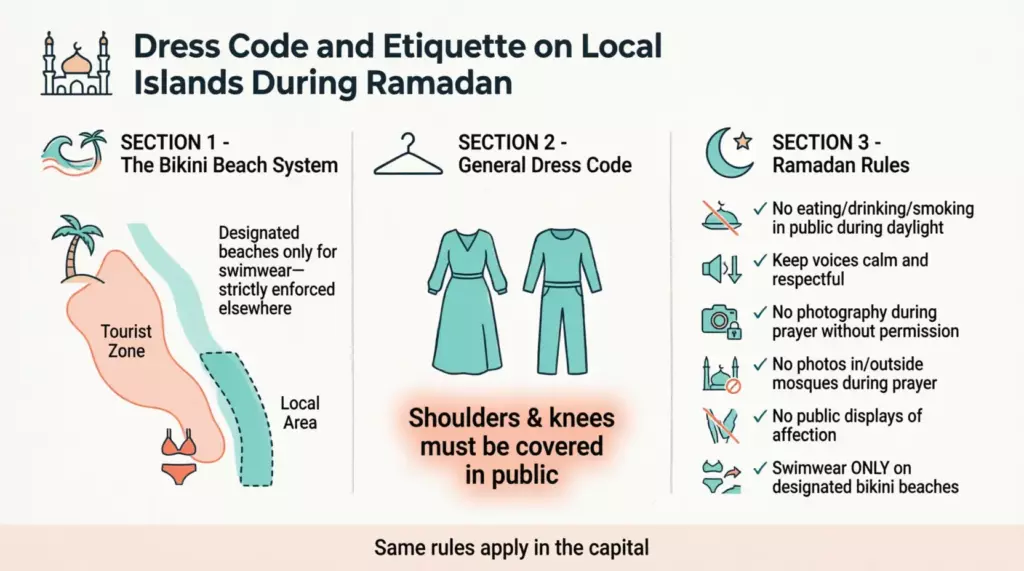
If your trip coincides with Ramadan, additional rules apply when visiting local islands or the capital:
- Eating, drinking, and smoking in public during daylight hours is prohibited on local islands. This restriction covers tourists as well as residents.
- Resort dining operates normally throughout Ramadan — there is no disruption to your meals or bar service within the resort.
- Some services on local islands may run on reduced hours.
- Iftar meals (the evening meal to break the fast) are often available at local restaurants and guesthouses and are considered one of the most culturally rich experiences available to tourists — elaborate, communal, and genuinely worth seeking out.
Adjust your island excursion timing during Ramadan. Plan your local island visits for after sunset when possible, or be prepared to limit eating and drinking to spaces where it is explicitly permitted.
Practical Packing Notes: Weight, Seaplane Limits, and What You Cannot Buy On-Site
Seaplane and domestic flight luggage: Many Maldives resorts are only accessible by seaplane or small domestic aircraft. Luggage limits are strict — typically 20 kg checked baggage and 5 kg carry-on per person on seaplanes. Excess baggage fees are high and there is little flexibility on small aircraft. This is a genuine constraint that affects packing decisions, not a formality.
What to bring because you cannot buy it (or it costs far more) on resort islands:
- Reef-safe sunscreen — regular sunscreens are sold at resorts but reef-safe formulations may not be. Some resorts are moving toward prohibiting sunscreens containing oxybenzone and octinoxate near coral.
- Prescription medications — resort medical facilities are limited and cannot substitute your specific prescriptions
- Motion sickness tablets — seaplane and speedboat transfers can be choppy, especially during the wet season (May–October)
- Insect repellent — mosquitoes are present on vegetated local islands, less so on open resort islands
What to leave behind:
- Formal business wear — there is no occasion for it
- Heavy or dark synthetic fabrics — the year-round temperature sits between 28°C and 32°C with high humidity
- Duty-free alcohol — as covered above, it will be confiscated
Quick Reference: Resort vs. Local Island Rules

| Rule | Private Resort Island | Local Inhabited Island |
|---|---|---|
| Bikini / swimwear | Permitted on beach and pool | Only at designated bikini beach (if available) |
| Topless sunbathing | Prohibited everywhere | Strictly prohibited |
| Shorts / bare shoulders | Permitted | Must cover knees and shoulders |
| Alcohol | Served at resort bars | Completely prohibited |
| Eating in public | No restrictions | Restricted during Ramadan daylight hours |
| Photography of locals | No restrictions | Ask permission first |
| Smart casual for dinner | Required at most restaurants | N/A |
Frequently Asked Questions
Can you wear a bikini in the Maldives? Yes — but only in specific places. On private resort islands, bikinis are completely fine at the beach and pool. On local inhabited islands, bikinis are restricted to designated “bikini beaches” — fenced areas set apart from the community. Wearing a bikini anywhere else on a local island, including walking through town or on public streets, is illegal and can result in a fine.
Can you bring alcohol to the Maldives? No. Alcohol is strictly prohibited from being imported into the Maldives by tourists. This includes bottles purchased at duty-free shops during your transit — they will be confiscated at customs on arrival. Alcohol is widely available at licensed resort bars, so there is no need to bring your own. Simply do not purchase it before you land.
Are vapes allowed in the Maldives? No. Since November 15, 2024, the Maldives has enforced a complete ban on importing, possessing, and using vaping devices and accessories — for tourists and residents alike, with no exceptions. If you arrive with a vaping device, it will be confiscated at the border. Customs will issue a receipt and you can collect the device when you depart. Plan alternative nicotine management before your trip.
What happens if you bring prohibited items to the Maldives? It depends on the item. For alcohol, vaping devices, and pornographic materials, confiscation is the standard outcome. Customs will typically issue a receipt for items held, which can be retrieved upon departure. For narcotics or weapons, the consequences are far more serious — including arrest and imprisonment. The Maldives applies its customs laws consistently, and ignorance is not a valid defence at Velana International Airport.
Do you need to cover up at a Maldives resort? Not on the beach or at the pool — bikinis and swimwear are perfectly fine there. However, most resorts require smart casual dress (no swimwear, no wet clothing) for fine dining restaurants and some public areas. The standard is a sundress or collared shirt for dinner. Check your resort’s specific restaurant policy when booking, not on the night.
Can you drink alcohol anywhere in the Maldives? Only at licensed resort islands and liveaboard vessels. Alcohol is completely banned on all local inhabited islands — there are no bars, no liquor stores, and no exceptions in Malé or any Maldivian community. You cannot carry alcohol off a resort island onto a ferry or local island, even in a sealed container. The rule: alcohol stays on resort grounds.
What is the luggage limit for Maldives seaplane transfers? Seaplane transfers — the only way to reach many resorts — typically allow 20 kg of checked baggage and 5 kg of carry-on per passenger. Soft-sided bags are strongly preferred, as hard-shell suitcases are difficult to load into small seaplane holds. Excess baggage fees are high and space is genuinely limited. Pack light, or arrange with your resort in advance to ship additional luggage by cargo boat.
Is the Maldives safe for non-Muslim tourists? Yes. The Maldives is a well-established tourism destination that welcomes millions of international visitors each year. Non-Muslim tourists are not required to practise Islam or fast during Ramadan, and private resort islands have no religious restrictions on guests. The key is respecting the rules that apply to public spaces: dress modestly on local islands, do not eat or drink in public on inhabited islands during Ramadan daylight hours, and do not bring prohibited items. Within those boundaries, non-Muslim travellers face no issues.