
What Maafushi Maldives Is Really Like: Bikini Beach, Honest Prices and the Rules Nobody Warns You About
Type “Maafushi Maldives resort” into a search box and the results will happily sell you one. There is no resort on Maafushi. The island is a working Maldivian town of roughly 4,500 people, with a mosque, a school, a harbour, a prison and around fifty guesthouses stacked along sandy lanes.
That gap between expectation and reality is why some travellers leave Maafushi disappointed and others call it the best value in the Indian Ocean. This guide covers what the island is actually like, what a night costs after tax in 2026, how to reach it without losing a day, and who should book somewhere else instead.

A town on an island, not a resort with a village nearby
Maafushi is an inhabited island in Kaafu Atoll, not a resort with a village nearby, on the eastern rim of South Malé Atoll, about 26 kilometres south of the capital. It measures roughly 1.28 kilometres long and 260 metres wide. You can walk across Maafushi from the harbour to the northern beach in a quarter of an hour, and around the whole island in about forty minutes.
The population figure matters more than it looks. Older guides still print “around 2,000 residents”, which was the count at the 2006 census. The 2022 census recorded 4,471 people on Maafushi: 3,195 Maldivians and 1,276 foreign residents, most working in construction and hospitality. Maafushi more than doubled in sixteen years on the same 0.35 square kilometres.
That density is the texture of the place. Guesthouse tourism arrived after a 2009 policy change legalising tourist accommodation on inhabited islands, and Maafushi moved first. Travel and Tour World reported in July 2025 that the island now holds more than fifty guesthouses and over 600 rooms — the highest concentration of tourist accommodation on any local island in the country.
Roughly 135,000 visitors a year pass through that community of 4,471. The model has since gone national: Ministry of Tourism figures reported in August 2026 show Maldivian guesthouses hosting 291,113 visitors, 22.3% of all arrivals, from 947 operational properties, against 179 resorts taking 73.3%. Maafushi is where that second column began.
What the guesthouse lanes look like at ground level
Maafushi has no rental cars and no taxis. Everything moves on foot or by scooter, and the main lanes are compacted sand and paving between three- and six-storey blocks. Bougainvillea spills over the entrances. Shoes come off outside restaurants and homes, which is why a small pile of sandals sits by most doorways.
Construction is constant, and you should expect to hear it. New guesthouses have gone up continuously since the mid-2010s, and traveller reviews through 2025 and 2026 repeatedly mention building work near the northern beach. That is not a failure of hospitality. It is evidence of what Maafushi is: a place still being built by the people who live on it.
Between the blocks on Maafushi sit dive shops, excursion desks, souvenir stalls, cafés, a gym, two spas and a supermarket. Most shops close around 22:00, and restaurant kitchens take last orders by roughly 21:30. Nightlife on Maafushi means a beach, a sky full of stars and possibly a card game.


The bikini beach is real, small, and mostly engineered
This section is worth reading twice, because it is where expectations break.
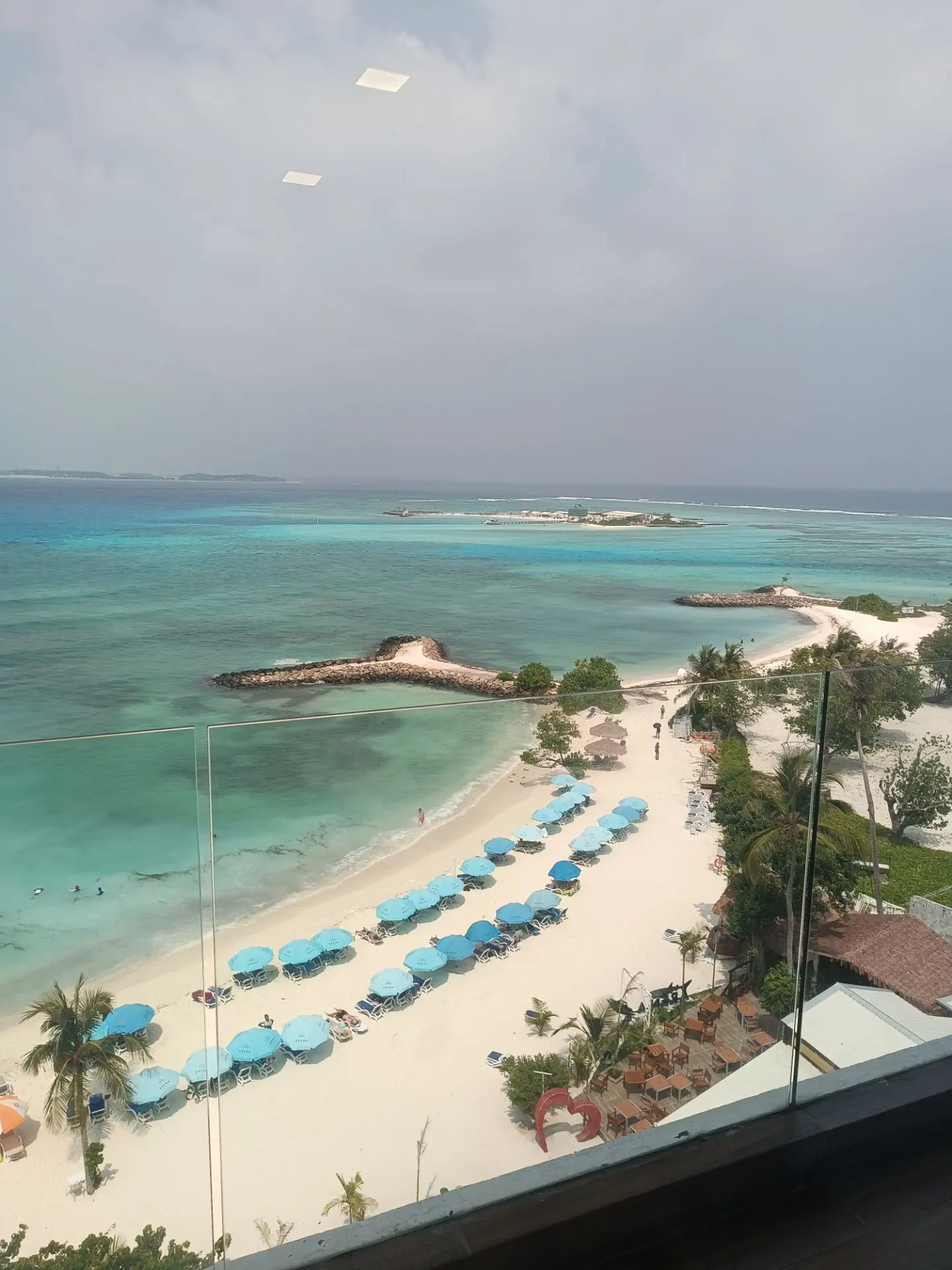
Swimwear is legal in exactly one place on Maafushi: a designated tourist beach at the northern tip, in front of the Arena Beach and Kaani Grand Seaview hotels. It is a strip, not a bay, and at peak times in February it fills. Free loungers sit in front of the hotels for their own guests, and independent visitors are typically quoted USD 5–6 for a sunbed for the day.
The shoreline has been heavily modified. Rock groynes and a breakwater were built to hold the sand in place, and they changed how water moves through the shallows. Reviewers consistently report sharp coral and stone underfoot at the entry, water so shallow you walk a long way before it deepens, and no showers or changing rooms anywhere on the beach. Bring aqua shoes.
Two more things the brochure copy omits. The Arena Beach restaurant plays music toward the sand for most of the day, and noise-sensitive travellers consistently recommend setting up on the Kaani side instead. And the naming is genuinely confusing: “No Bikini Beach” is a separate, quieter public beach on the eastern shore where swimwear is not permitted at all.
None of this makes the beach bad. Early mornings on Maafushi bring baby reef sharks and eagle rays into water you can stand up in. It is a public urban beach with superb water colour rather than a private resort lagoon, and travellers who arrive expecting the second thing write the angry reviews.

Rules that apply the moment you step off the sand
Maafushi is not a tourist bubble with local colour attached. It is a Maldivian island governed by Maldivian law, and the rules are simple, non-negotiable and easy to follow once you know them.
On Maafushi, cover shoulders and knees everywhere except the designated beach. Walking the lanes in swimwear is not an arrestable offence, but it reads to residents roughly the way underwear in a supermarket would read at home. A T-shirt and shorts is enough. A cover-up over a swimsuit is enough.
Alcohol is illegal on inhabited islands, and nothing on Maafushi serves it. The workaround is a floating bar moored offshore, reached by a short tender from the island, where a can of beer runs around USD 5. A resort day trip from Maafushi is the other option. Do not try to bring alcohol through the airport: it is confiscated at customs, along with pork products and anything read as religious material. Our guide to dress codes, banned items and customs rules has the full list.
During Ramadan, daytime cafés largely close and the atmosphere changes markedly. Excursions still run and guesthouses still feed their own guests, but plan for a quieter, more restrained week. If your dates fall at the end of it, read up on Eid al-Fitr, because the celebration is worth witnessing.
One more piece of geography surprises people. The country’s main prison occupies a fenced compound at the southern end of Maafushi. It is unmissable on a walk south, entirely uneventful, and a straightforward reminder that you are on a real island doing real island business.
Eating on the island: cafés, short eats and what a meal costs
Food on Maafushi is where the budget either holds or quietly collapses. Hotel restaurants on the beach charge USD 20–30 for a main course. Local cafés a hundred metres inland charge USD 5–12 for the same fish, cooked better.
Ask for garudhiya, a clear tuna broth eaten with rice, lime and chilli, or mas huni, shredded smoked tuna with coconut and onion served at breakfast with roshi flatbread. Hedhikaa — the short eats sold in the afternoon — are the cheapest good meal on Maafushi: fried fish parcels, samosas and sweet pastries for well under a dollar each.
Most Maafushi guesthouses sell a half-board add-on. Do the arithmetic before you accept it, because on this island the walk to an independent café is short and the saving is real. Tap water is not for drinking; bottled water is sold everywhere and costs a fraction of the resort equivalent.

What a stay actually costs in 2026, tax lines included
Rooms on Maafushi run roughly USD 60–100 a night for a double with breakfast at a mid-range property, with basic rooms below that and the four-star beachfront hotels above. That number is not what you pay.
Two government charges sit on top, and both changed recently enough that most published guides still print the old figures.
Green tax. The fourteenth amendment to the Maldives Tourism Act took effect on 1 January 2025. Guesthouses and hotels with 50 rooms or fewer on inhabited islands charge USD 6 per person per night, doubled from USD 3. Properties with more than 50 rooms charge USD 12 — the same rate as resorts. Children under two are exempt.
That second sentence catches people out on this particular island. Maafushi has genuinely large hotels: one four-star beachfront property is listed by booking distributors at 78 rooms. If your hotel sits over the 50-room line, your green tax doubles, and five nights for two goes from USD 60 to USD 120. Ask the property how many rooms it operates before assuming the guesthouse rate applies.
TGST. Tourism goods and services tax rose from 16% to 17% on 1 July 2025 under the seventh amendment to the GST Act. It applies to accommodation, excursions, transfers and meals sold by licensed tourism businesses.
Here is a realistic five-night stack for two people on Maafushi, using mid-range assumptions and 2026 rates.
| Line item | Basis | Two people, five nights |
|---|---|---|
| Room, mid-range guesthouse | USD 85 per night | USD 425 |
| TGST at 17% | On room and services | USD 72 |
| Green tax, property under 50 rooms | USD 6 per person per night | USD 60 |
| Green tax if property has 50+ rooms | USD 12 per person per night | USD 120 |
| Shared speedboat, return | USD 20–40 per person each way | USD 80–160 |
| Excursions | Two half-days plus one full day | USD 200–300 |
| Meals outside the guesthouse | USD 15–25 per person per day | USD 150–250 |
| Realistic total | Excluding flights | USD 990–1,290 |
Compare that with a mid-tier resort in the same atoll, where the transfer alone often exceeds the entire Maafushi total. That is the trade, stated plainly. Our transfer cost comparison shows how fast the resort side of the equation moves.

Getting there: two boats, and one problem called Friday
There is no airport on Maafushi and no seaplane service to it. Everyone lands at Velana International Airport and continues by boat. Two options exist, and they are not equivalent.
Shared speedboat. Thirty to forty-five minutes, USD 20–40 per person depending on operator, leaving from a jetty a short walk outside the arrivals hall. Three operators run the route. In mid-2026 the cheapest charged around USD 20 and the dearest around USD 40 for the same crossing, so the spread rewards two minutes of comparison. Speedboats to Maafushi run every day, Fridays included. Our speedboat transfer guide explains how shared boats are priced nationally.
MTCC public ferry. MVR 22, about USD 1.50, plus MVR 15 for the airport ferry into Malé first. Route 309 leaves the capital at 15:00 every day except Friday, calls at Gulhi, and reaches Maafushi around 16:40. Route 306 leaves at 10:00 on Sundays, Tuesdays and Thursdays, arrives about 11:30 and continues to Fulidhoo — the only single-ticket way to combine the two islands. Return sailings leave Maafushi at 07:30 daily except Friday, with an additional early-afternoon departure on most days.
Three things about the Maafushi ferry cost people real money:
- It does not sail on Fridays. If your flight lands on a Friday, the ferry is not an option, and arriving early changes nothing.
- The Malé departure point moved. Long-standing guides still send travellers to the Villingili terminal in the southwest of the city. Public ferries have not left from there for years, and as of 1 June 2026 the usual Henveiru terminal was itself temporarily relocated. Confirm the current jetty with your guesthouse the night before you travel.
- Afternoon landings do not work. The 15:00 sailing means clearing immigration, crossing to Malé, finding the terminal and buying a cash ticket before 14:45. A flight landing at 13:00 does not comfortably make it.
Going home, allow a minimum of three hours between leaving Maafushi and your flight boarding. A pre-dawn departure usually means a private boat at USD 150–300 for the whole vessel rather than per person. If your inbound flight lands late in the evening, do not improvise: read what to do about a late arrival in Malé and book a night near the airport instead. The broader picture of how Maldivian transfers work sits in our transfers guide.


Excursions from the island: sandbanks, nurse sharks and whale shark days
Nobody stays five nights for the beach alone. The real product on Maafushi is excursions, sold from a dozen competing desks at prices that would be a rounding error on a resort activity sheet.
Sandbank half-days run around USD 35–50 and leave you on a bare spit of sand with a cool box and a horizon. Nurse shark and shipwreck snorkelling, usually combined with dolphin watching and a barbecue, runs around USD 60–70 for a full day. Night fishing with handlines is cheap and chaotic, and ends with the crew grilling whatever came aboard.
Whale sharks are the one excursion where geography works against Maafushi. The reliable aggregation sits in South Ari Atoll, a long day trip rather than a local outing — worth doing, but book it knowing the boat hours involved, and read our whale shark season guide first. The same applies to mantas: the Hanifaru Bay aggregation is in Baa Atoll and cannot be reached in a day from here.
Closer in, the water sports centre rents jet skis, paddleboards, kayaks and parasailing slots from around USD 10, and dive operators work South Malé Atoll’s channel sites — the same reef system that draws divers to neighbouring Vaavu Atoll. On a moonless night, ask about the plankton: the bioluminescence that lights up Maldivian beaches is seasonal and unpredictable, but it does appear on this stretch of the atoll.

Book with an independent desk on Maafushi rather than through your guesthouse reception if price matters. The same boat frequently costs USD 10–15 less per person two doors down.


The resort day pass, and why plenty of people book both
Forty-five minutes away, the other Maldives runs a completely different business. Resort islands in the same atoll are private, uninhabited, alcohol-licensed and built around overwater villas. Adaaran Club Rannalhi, for one, sits 34 kilometres from the airport on the southern rim of the atoll, all-inclusive, with bungalows on stilts above the lagoon.
Guests on Maafushi reach that world two ways. A day pass buys a resort’s beach, pool, lunch and often a drinks package for a fixed fee, and the excursion desks sell them daily. Terms vary widely by property, so establish what is included before paying — particularly whether drinks and the boat transfer are in the price.
The practical shape of the day is worth knowing. Resorts within reach of Maafushi sit twenty to forty-five minutes away by speedboat, and most cap daily visitor numbers, so passes are booked a day or two ahead rather than on the morning. You arrive at a jetty, hand over your pass, and swim, eat and drink inside someone else’s business model until mid-afternoon. Then the boat takes you back to a town with a mosque and no bar, which is the whole point of the contrast.
The second route is a split stay: three or four nights on Maafushi for excursions and cost control, then two nights at a resort for the villa and the quiet. Book the resort leg second, so a delayed transfer costs you guesthouse time rather than villa time.
Couples do this constantly, and it solves the island’s honest weakness. Maafushi is many things, but private and romantic is not among them. If a honeymoon is the occasion, our Maldives honeymoon guide sets out where the split works and where it wastes a day in transit. For the resort-heavy alternative on the other side of the capital, see North Malé Atoll.


Who the island suits, and who should book elsewhere
The honest verdict on Maafushi fits in a table.
| Maafushi will probably suit you if | Book somewhere else if |
|---|---|
| Your budget is USD 100–200 a day for two | You want a beach with nobody else on it |
| You want excursions every day at local prices | Alcohol with dinner is non-negotiable |
| You are travelling solo and want company | You are on honeymoon and want privacy |
| You are curious how Maldivians actually live | Construction noise ruins a holiday for you |
| You want the Maldives without a five-figure bill | You want to walk from your room into deep water |
If the right-hand column describes you but a resort is out of budget, the answer is usually a quieter local island rather than a resort. Gulhi and Guraidhoo sit on the same ferry route and are far smaller. Fulidhoo is reachable on route 306. Thoddoo, Ukulhas and Dhigurah trade convenience for better beaches and fewer people.
Our atoll decision guide works through those trade-offs by traveller type, and the complete atolls guide explains how the administrative map fits together. For context on where Maafushi sits nationally, Kaafu Atoll is the most developed atoll in the country by a wide margin. If you want its opposite, we have written about the atolls with no resorts at all and the atolls we would skip.
When to go, and what the sea does to the crossing
High season on Maafushi runs with the northeast monsoon, roughly December to April, bringing the calmest seas, the clearest water and the highest prices. It is the easy season, and the speedboat crossing to Maafushi in February or March is usually flat.
From May to October the southwest monsoon brings more cloud, more rain and choppier crossings. The transfer stays safe in normal monsoon conditions but gets bumpy, and operators do delay departures in genuinely bad weather. Rates fall accordingly: June, July and September are the value months, while August sits higher because of European school holidays.
Two dates to check against your own Maafushi plans. Ramadan moves roughly eleven days earlier each year and changes daytime life on the island considerably. And if you are considering New Year, expect steep guesthouse rates and the island at its fullest. October and November are the transition months — variable, cheaper, and frequently better than their reputation.

Questions travellers ask before booking
Is there a resort on Maafushi? No. Maafushi is an inhabited local island with guesthouses and hotels, some of them four-star and beachfront, but no resort in the Maldivian sense. Resorts occupy their own uninhabited islands. Several sit within day-trip distance and sell day passes.
Can I wear a bikini on Maafushi? Only on the designated tourist beach at the northern tip, and on excursion boats and sandbanks away from the island. Everywhere else, cover shoulders and knees. The nearby beach confusingly called No Bikini Beach is exactly what its name says.
Can I drink alcohol on Maafushi? Not on the island. Alcohol is prohibited on every inhabited island in the Maldives. The legal alternatives are the floating bar moored offshore and a resort day trip, both arranged through any excursion desk.
How much is the ferry from Malé to Maafushi? MVR 22, about USD 1.50, plus MVR 15 for the airport ferry into Malé. Route 309 departs the capital at 15:00 daily except Fridays and takes about 100 minutes via Gulhi. Tickets are cash only, sold at the terminal, and cannot be booked online.
Does the boat run on Fridays? Speedboats do; the public ferry does not. If you land on a Friday, budget USD 20–40 per person for a shared speedboat. This is the most common and most expensive planning mistake on this route.
How many days do I need on Maafushi? Four to five nights suits most people: two or three excursion days, a beach day, and a day of doing nothing. Two nights works only if excursions are booked in advance.
Is Maafushi safe? Yes, including for solo women travellers, with the ordinary caveats about swimming near breakwaters and walking into unlit construction areas after dark. The island is small, busy and well used to visitors.
Is there an ATM, and does mobile data work? Yes to both. Maafushi has a bank branch and an ATM, most guesthouses accept cards, and mobile coverage across the island is good. Keep cash in rufiyaa for ferry tickets, sunbeds and small shops.
Five things to remember before you book
- Maafushi is a town of about 4,500 residents with fifty-plus guesthouses, not a resort. Book it for the price, the excursions and the atmosphere, never for privacy.
- The bikini beach is one engineered strip at the northern tip. Bring aqua shoes; there are no showers or changing rooms.
- Budget the tax lines properly: 17% TGST since July 2025, plus green tax at USD 6 per person per night — or USD 12 if the property exceeds 50 rooms.
- The public ferry costs about USD 1.50 and does not sail on Fridays. The speedboat costs USD 20–40 and sails every day.
- If privacy or alcohol matters, split the trip: a few nights on Maafushi, a couple of nights on a resort island in the same atoll.
Next step: set your dates against the monsoon calendar, then get two answers in writing from your guesthouse before paying — how many rooms the property operates, and which jetty your boat leaves from. Those two answers prevent most of what goes wrong on this island.