

First Trip Mistakes: Thirty Ways to Get the Maldives Wrong
Almost none of these Maldives mistakes is a disaster. They are the ordinary errors that cost a day, a few hundred dollars, or the specific thing you came for — and every one of them is avoidable in the two minutes it takes to read the line.
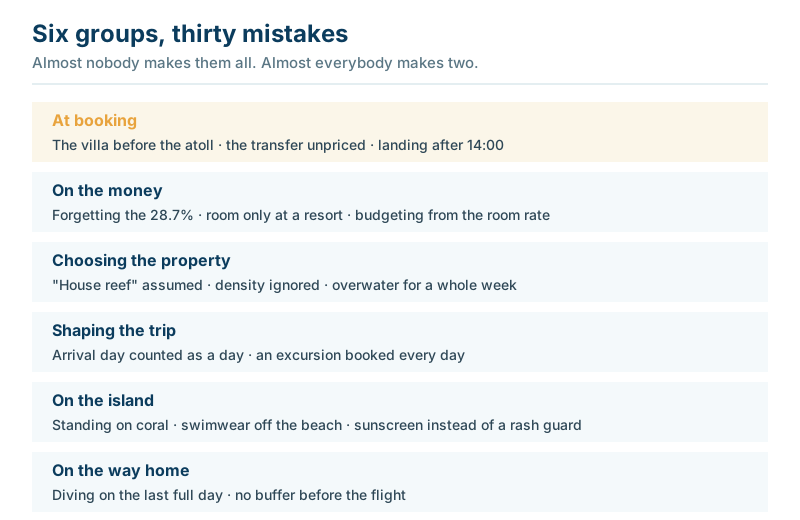
The mistakes are grouped by when they happen: at booking, on the money, in choosing the property, in shaping the trip, on the island, and on the way home. Each one links to the article that explains it, because this page is an index rather than an argument.
The single most common of all is at the top of the first group, and it causes more of the others than anything else on the list.
The mistakes people make choosing the country
Before any of the above, and it is worth naming because it is the largest one.
Booking the Maldives when you wanted somewhere to explore. The country is water, isolation and the absence of decisions. If you want a place with roads, towns, food and things to do, our comparison hub sets out which of five structural facts you are objecting to and where each one points.
Booking it for four nights from a long-haul market. Two full days after eleven hours of flying is an expensive way to see a reef.
Booking it in the European summer expecting the postcard. That is the wet season. It is a good trade for the price rather than a bad month, and it should be a choice rather than a surprise.
And booking a resort when the honest answer was a village. Almost every disappointed review in this country was written by somebody who wanted the other format, which our comparison of resort and inhabited islands exists to prevent.
None of those is fixable on arrival, which is why they matter more than the thirty below them.
At booking
1. Choosing the villa before the atoll. The atoll sets the transfer, and the transfer sets both the budget and how many usable days you have. The villa constrains almost nothing. The order that works is in our trip planner.
2. Not pricing the transfer for everybody. It is charged per person including children — USD 100 to 400 by speedboat, USD 400 to 820 by seaplane. For a family of four that can exceed USD 3,000, as our transfers guide sets out.
3. Booking a flight that lands after 14:00 when the resort needs a seaplane. Seaplanes stop between 15:30 and 16:00, immigration takes 75 to 90 minutes, and you have lost a day — the rule is in our guide to choosing a flight.
4. Booking the transfer after the room. It is a separate contract from both the flight and the accommodation, and nobody owns the joins — the sequence is in our booking timeline.
5. Buying insurance the week before travelling. Cancellation cover generally runs from purchase, so a late policy forfeits most of its value — the clauses to read are in our guide to travel insurance.
On the money
6. Forgetting the 28.7%. A 10% service charge then 17% tax, compounding on almost every resort line. A USD 250 spa treatment bills at about USD 322 — the mechanism is in our guide to money in the Maldives.
7. Booking room only at a resort. There is no other restaurant on the island, so three meals a day at resort prices usually exceeds the half-board supplement — the arithmetic is in our guide to budget and all-inclusive.
8. Assuming all-inclusive is cheaper. The supplement runs USD 80 to 150 per person per day, and the break-even is roughly lunch plus four to six drinks each. Light drinkers do better on half board.
9. Budgeting from the room rate. It is about half of a resort week once the transfer, the tax, green tax, excursions and drinks are added — the full itemisation is in our budget guide.
10. Not knowing the guesthouse islands exist. A week for two on an inhabited island runs USD 1,100 to 1,900, on the same reefs the resorts use — the format is in our guesthouse guide.
Choosing the property
11. Assuming “house reef” means something specific. It covers four different arrangements, one of which is a sandy lagoon with the reef four hundred metres out. The satellite check takes thirty seconds and is in our guide to reading a house reef.
12. Ignoring density. Villa count divided by usable island area predicts how busy a property feels better than any photograph. Under five per hectare is spacious; above fifteen you will hear your neighbours — the method is in our guide to island size.
13. Booking an overwater villa for the whole week. The premium is 40 to 100 per cent, the water beneath most of them is sand, and the novelty settles by night three. Two or three nights inside a longer beach stay is the pattern — our villa comparison explains why.
14. Not checking which side the reef is on. The sheltered side swaps twice a year with the monsoon, so a reef that is superb in January can be choppy and cloudy in July.
15. Choosing a resort for children with a close drop-off. A great house reef is worse for small children, not better. They need a wide shallow lagoon, and the inversion is in our family guide.
Shaping the trip
16. Treating arrival day as a day. It is a half day at best, and departure day is worse. Subtract two before planning anything — the arithmetic is in our itineraries guide.
17. Booking four nights on a seaplane island. The transfer takes a quarter of the trip. Under five nights, stay near the airport, as our guide to staying near the airport sets out.
18. Scheduling an excursion every day. Two or three across a week is the right number. Five is a week of boats, and the reef in front of you goes unswum — the case is in our activities overview.
19. Booking excursions months in advance. Wind cancels boats, and the forecast three days out is worth more than the forecast three months out. Book on arrival.
20. Too many bases in a fortnight. Three is the maximum and two is usually better. Every move costs a transfer and half a day.
On the island
21. Standing on the coral. One foot kills growth that took years, and it is by far the commonest damage visitors do. Never stand on it — not to rest, not to adjust a mask, not for a photograph, as our snorkelling guide sets out.
22. Wearing swimwear off the designated beach on an inhabited island. Shoulders and knees are covered elsewhere, including on the walk back from the water — the rules are in our guide to dress codes.
23. Bringing alcohol through customs. It is confiscated on arrival and returned on departure. Every inhabited island is dry, and only resorts are licensed — the arrangement is in our guide to alcohol rules.
24. Relying on sunscreen instead of a rash guard. The equatorial sun burns in under twenty minutes, snorkelling exposes your back for hours, and sunscreen washes off — the reasoning is in our packing list.
25. Touching things. Turtles must surface to breathe and hovering above one prevents it; nothing should be fed, chased or handled — the etiquette is in our guide to snorkelling with turtles.
26. Assuming there is a pharmacy. There is not, on a resort island, and the shop stocks very little at a large markup. Bring what you rely on, and check what medical provision the property actually has before you need it.
On the way home
27. Diving on the last full day. Standard guidance is 18 to 24 hours between the last dive and altitude, and it applies to the seaplane as well as the flight home — our diving guide sets it out.
28. No buffer on departure. Three hours before an international flight, four in the southwest monsoon if any part of the journey is by sea. A cancelled transfer against a fixed flight is the expensive version of this problem, as our guide to missed connections explains.
29. Buying duty-free outbound. Alcohol cannot be imported, so anything bought on the way out is taken at Velana and sits in a locker for the whole trip. Buy it on the way home instead.
30. Forgetting IMUGA on the return leg. The traveller declaration is required within 96 hours of travel in both directions, and the second one catches people — the form is covered in our IMUGA guide.
The three that cost the most
If the list of mistakes is too long, these are the three to fix.
The transfer, in every one of its forms — priced per person, booked separately, and capable of costing a family more than a week of villa upgrades.
The arrival time, because landing after 14:00 with a seaplane resort booked is an entirely predictable lost day and a night nobody budgeted for.
And over-scheduling, because it is the only mistake here that ruins a trip which otherwise went perfectly. Five excursions in seven days is a week spent on boats, and the thing you flew eleven hours for is fifty metres from your room.
Why these mistakes happen at all
Worth a short section, because the pattern behind them is more useful than the list.
The Maldives is marketed at one end and sold across three. The images are overwater villas at the top of the market; the country also contains accessible resorts, guesthouse islands and liveaboards. A first-time visitor plans from the images and prices from the images, which produces several of the errors above at once.
The pieces are separate contracts. Flight, transfer, accommodation — three bookings, three parties, and no one responsible for the joins. Almost every logistical mistake on this list lives at one of those joins.
And there is no correction mechanism on arrival. In most destinations a bad decision is fixed by walking somewhere else. On a resort island there is nowhere else, which converts small planning errors into week-long consequences.
Which is why the checks are worth the ten minutes. Not because the country is difficult, but because it is unusually unforgiving of assumptions made from photographs.
What is not a mistake, whatever you have read
Five things called mistakes that are fine, and one nobody warns about that genuinely is.
Staying on a guesthouse island is not a downgrade. Same reefs, same excursion sites, a third of the price, and a village attached — our guide to choosing a local island sets out how to pick one.
The wet season is not a write-off. Rain arrives in squalls and passes. What actually gets cancelled is boat trips, and the reef is at its most alive — the trade is in our guide to high and low season.
A beach villa is not the consolation prize. It is cooler, quieter, cheaper and frequently closer to the reef than an overwater one.
Not diving is fine. Snorkelling from a good house reef shows you most of what a first-time diver would see, at no cost and with no certification.
And doing nothing is not a wasted day. It is the product. The country is organised around it.
What people are not warned about, and should be: that there is nowhere to go if the property is wrong. On a resort island you cannot leave, which is why the checks in this list are worth ten minutes rather than five.
Mistakes specific to divers
A separate short list, because divers make different errors.
Booking a property before asking the dive centre anything. Reservations will tell you the resort has a five-star centre; every resort has one. Ask how many sites are within thirty minutes, and how many divers per guide — the eight questions are in our guide to choosing a resort for divers.
Certifying in the Maldives. Open Water costs substantially more here than at home, and the theory can be done online before travelling.
Flying gear that could be rented. A BCD and regulator set consume most of a 20 kg seaplane allowance, and rental runs about USD 15 a day. Bring the mask and the computer; rent the rest.
Assuming the insurance covers it. Many standard policies exclude diving or cap it below the depths the country is known for.
And putting a liveaboard after the resort rather than before it. Boat first, land second, so the no-fly interval falls at the end of the trip.
What people worry about, and what actually happens
Worth separating, because the anxieties and the actual mistakes are different lists.
People worry about sharks. Reef sharks are present, harmless to snorkellers, and one of the better things you will see — our safety guide covers the real picture.
People worry about crime. It is not the issue.
What actually goes wrong is sunburn, coral cuts, seasickness, a missed transfer and a bill larger than expected. Four of those five are on the list above.
And the fifth, seasickness, is solved by taking something before boarding rather than after — particularly on a night fishing trip, which is anchored, dark and involves looking down.
Which is the honest summary of Maldivian risk: it is a safe country with real distances, and almost everything that goes wrong is logistical or financial rather than dangerous.
The five-minute version
If you do nothing else on this page, these five checks prevent most of the mistakes above.
Check the water colour on a satellite map of the island you are considering. Pale turquoise is sand; dark blue-green is reef.
Check the density — villa count divided by island area.
Check the transfer, for everybody travelling, both ways.
Check the arrival time against 14:00 if a seaplane is involved.
And book two excursions, not five.
Those five checks take ten minutes and remove most of what appears above.
A note on the length of this list
Because thirty items can read as a warning, and it is not one.
This is an index, not a caution. Every entry links to the article that explains it, and the page exists so that a reader can scan for the two or three that apply to their trip rather than absorb all of them.
The country is easy to visit. The visa is free and granted on arrival, the people are welcoming, crime is not a concern, and nothing here requires expertise.
What it is not is forgiving of assumptions, because a resort island removes the correction mechanism every other destination has. That is the whole reason a list like this exists for the Maldives and would be unnecessary for a European beach town.
And most of the thirty are one decision. Get the atoll before the villa, land before two, book the transfer with the room, and leave half the days empty — and roughly two thirds of this list stops applying.
Which is a better use of ten minutes than reading thirty separate warnings, and it is why the five-minute version above exists as its own section.
Questions travellers ask
What is the biggest mistake first-time visitors make? Choosing the villa before the atoll. The atoll sets the transfer, and the transfer sets both the budget and how many usable days the trip has. The villa constrains almost nothing.
What do people most often forget to budget for? The transfer, charged per person including children; the service charge and tax compounding to about 28.7%; green tax; and the excursions and diving, which no board basis includes.
Is it a mistake to book an overwater villa? Not in itself, but a whole week of one usually is. The premium is 40 to 100 per cent, the water beneath most of them is sand, and two or three nights inside a longer beach stay gets you the experience for a fraction of the cost.
How many excursions should I book? Two or three across a week, booked on arrival rather than months ahead. Five is a week spent on boats.
Is a local island a mistake if I want a nice holiday? No. Same reefs, same excursion sites, roughly a third of the price, and a village attached. What you give up is alcohol, seclusion and the villa.
What is the worst timing error? Landing after about 14:00 with a seaplane resort booked. Seaplanes stop between 15:30 and 16:00, so you lose a day and pay for a night near the airport.
What do people get wrong on the island itself? Standing on coral, wearing swimwear off the designated beach on an inhabited island, and relying on sunscreen instead of a rash guard.
What is the most common departure mistake? Diving on the last full day. Standard guidance is 18 to 24 hours before altitude, and it applies to the seaplane as well as the flight home.
What to take away
- Choose the atoll before the villa. It sets the transfer, and the transfer sets the budget and the usable days.
- Land before 14:00 if a seaplane is involved, and book the transfer with the room rather than after it.
- The room rate is about half a resort week. Add the transfer, the 28.7%, green tax, excursions and drinks.
- “House reef” means four different things. Check the water colour on a satellite map before you book.
- Book two or three excursions, not five — and do it on arrival, when the forecast exists.
Next step: pick the three items above that apply to the trip you are currently planning, and fix those. The list is long because it is an index rather than a warning, and nobody makes all thirty. But almost everybody makes two or three, and they are almost always the ones about the transfer — which is the piece nobody thinks of as part of the holiday until it takes a day of it away.