
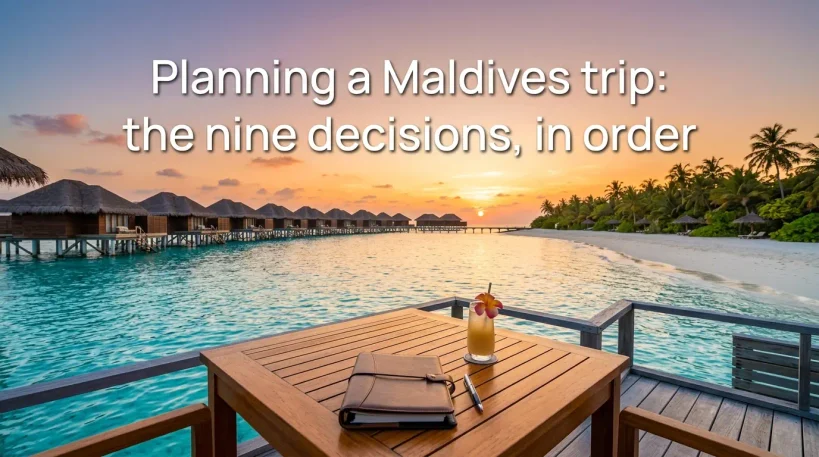
How to Plan a Maldives Trip: Nine Decisions, and the Order They Go In
Most people plan a Maldives trip in the wrong order. They find a villa they like, book it, and then discover the transfer costs USD 820 a head, only flies in daylight, and does not connect with the flight they have already paid for.
The decisions in this country are unusually constrained by each other. The month you travel decides what is in the water. The atoll decides the transfer. The transfer decides your arrival time and a large part of the budget. The island decides the reef. And the villa — the thing most people start with — decides almost nothing.
This guide sets out the nine decisions in the order that works for planning, with what each one constrains, and a link to the page that answers each in full.
Before decision one: is it the Maldives at all?
Worth thirty seconds before the nine, because the answer is not always yes and this is the cheapest point at which to change your mind.
The Maldives is unusual in five specific ways, and every one of them suits some travellers and not others. One island and one property, which you cannot leave. No roads between islands, so every movement is a boat or an aircraft priced per person. Alcohol only inside resorts. A service charge and tax compounding to about 28.7%. And nothing to drive to, because there is nothing to drive on.
If those five read as the appeal, the nine decisions below are your planning process.
If any of them read as a problem, other destinations resolve them differently. Mauritius has roads and towns, Zanzibar has a city attached, Thailand has everything and costs a third as much. Our guide to alternatives to the Maldives compares them on those five points rather than on which is prettier.
Everything after this assumes you are.
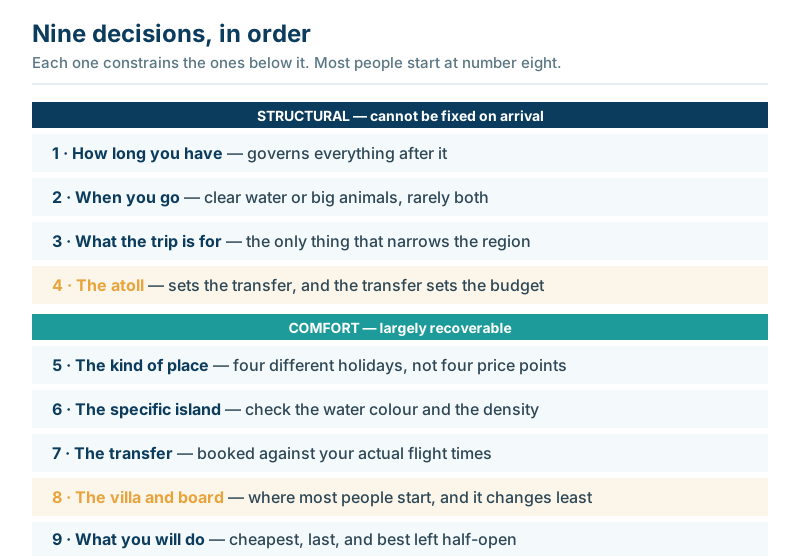
The order, in one list
- How long you have, which decides everything else
- When you go, which decides what is in the water and what it costs
- What the trip is for, which decides the region
- The atoll, which decides the transfer
- The kind of place you stay, which is four different holidays
- The specific island, which decides the reef
- The transfer, booked against your actual flight times
- The villa and the board basis, which is where most people start
- What you will actually do, which is the cheapest decision and the last one
Planning decisions one to four are structural. Getting them wrong costs money and days, and they cannot be fixed on arrival.
Decisions five to nine are comfort. Getting them wrong costs enjoyment and is largely recoverable.
The single most common planning error is starting at eight.
1. How long you have
The constraint that governs the whole plan, and the one people treat as fixed and unexamined.
Under five nights. Stay near the airport. A distant transfer takes six to ten hours out of a 96-hour trip, and it takes them from the arrival and departure days — the arithmetic is in our guide to staying near the airport.
Seven nights. The standard trip, and enough for one island done properly or a cautious split.
Ten nights or more. The transfer stops mattering, a split stay becomes obviously right, and the more distant atolls come into play.
Fourteen nights. Two islands minimum, and the point at which a guesthouse island stops being a budget choice and becomes the reason the trip is affordable at all.
Add the flight time. Most visitors are eight to eleven hours from home, which makes anything under five nights an expensive way to spend two days in transit — the routes are in our guide to getting here.
Our patterns for each length are set out in the itineraries guide.
2. When you go
Second in the plan, because it decides both the price and what you will see — and the two pull in opposite directions.
The dry season, December to April. Clear water at twenty-five to forty metres, calm seas, and the highest prices of the year.
The wet season, May to November. Fifteen to twenty-five metres of visibility, wind that occasionally cancels a boat, substantially lower prices, and the plankton that brings manta aggregations and feeding activity generally.
The trade cannot be escaped: clear water or big animals, rarely both. Our guide to high and low season sets out the price difference and the monsoon guide explains the mechanism.
What has no season: whale sharks, resident year-round in South Ari, and turtles, present every month.
Check the dates against Ramadan if any part of your trip is on an inhabited island, and against the public holidays calendar for domestic transport around Eid.
And book the season before the property. A perfect resort in the wrong month is the wrong resort.
3. What the trip is for
Third, because it is the only thing that makes the regional choice non-arbitrary.
Be specific. “A beach holiday” does not narrow anything — every island in the country has one. “Diving daily”, “whale sharks”, “surf”, “our honeymoon”, “two adults and a five-year-old” all narrow it immediately.
If it is diving, the sites choose the region and the format follows from how much you dive. A liveaboard delivers twelve to eighteen dives a week against six to ten at a resort.
If it is surf, the property decides the wave, and two of the best are surfable only by guests of the resorts in front of them — our guide to choosing a resort for surfing covers the access question.
If it is a honeymoon or a milestone, the honeymoon guide covers what changes.
If it is a family trip, the lagoon matters more than the kids’ club. A close house reef is worse for small children rather than better, and our family guide explains the inversion.
And if the honest answer is “to lie on a beach and do nothing” — which is a perfectly good answer — then this decision is free, and you should optimise the rest for cost and travel time.
4. The atoll
Fourth, and it is the decision that quietly sets the budget.
The atoll determines the transfer. Kaafu and the near atolls are a speedboat at USD 100 to 400 per person. Baa, Noonu and the outer atolls are a seaplane at USD 400 to 820. For a family of four that difference is over a thousand dollars before anybody has eaten anything.
It also determines the arrival window. Seaplanes fly in daylight only and stop between about 15:30 and 16:00. A speedboat runs at any hour.
And it determines what is reachable. Whale sharks are in South Ari; manta season is in Baa; channel diving is Vaavu.
Our atoll decision guide matches regions to travellers, and the atolls guide explains the naming, which is more confusing than it should be.
Do this before shortlisting properties, not after. It is the step people skip and the one that produces the “we found a lovely resort but the transfer is USD 3,200” conversation.
5. The kind of place you stay
Four options, and they are four different holidays rather than four price points.
A resort island — private, sealed, alcohol served, from about USD 350 a night before transfers and before the service charge and tax that compound to roughly 28.7%.
A guesthouse on an inhabited island — the same reefs and the same excursions at a third of the price, from about USD 60 a night, and no alcohol anywhere on the island.
A liveaboard — twelve to eighteen dives a week, and the only accommodation in the country that sails away from bad weather.
A hotel near the airport — for the night either side of a flight, which half of all visitors end up needing and almost none plan for.
Our where to stay pillar compares all four with week costs, and the split stay — a few nights in a village, a few at a resort — is what most first visits should do.

6. The specific island
Sixth, and this is where two checks do more than an hour of reading descriptions.
Check the water colour on a satellite map. Pale turquoise is sand; dark blue-green is reef; deep blue is the drop-off. A dark ring hugging the shoreline means a close house reef, and a broad pale halo means the reef is a four-hundred-metre swim. Every property says it has a house reef, and the phrase covers four different geometries — our guide to reading a house reef explains the method.
Measure the island and divide by the villa count. Under five villas per hectare feels spacious; above fifteen you will hear your neighbours. No property publishes this and anybody can calculate it — the method is in our guide to island size.
Then email two questions. How many metres from the beach is the drop-off, and where is the entry point? A property with a close reef answers immediately.
Five minutes, both checks, and between them they tell you more than every photograph on the booking page.
7. The transfer
Seventh, and it is booked against your actual flight times rather than assumed.
Get your flight numbers first. The transfer is a separate contract from the international ticket, and nobody owns the connection between them — which is the whole subject of our guide to missed connections.
The 14:00 rule. Seaplanes stop between about 15:30 and 16:00 and immigration takes 75 to 90 minutes at peak. Land after roughly 14:00 and you have missed the last flight. Book the airport-area night deliberately rather than at seven in the evening in an arrivals hall — our guide to hotels in Malé and Hulhumalé covers where.
The baggage limit is set by the smallest aircraft in the chain, not by your airline: 20 kg checked plus 5 kg cabin on a seaplane, whatever your long-haul ticket allowed.
Shared or private on a speedboat changes with group size — private usually wins at four people, on the arithmetic in our speedboat guide.
And build a buffer on departure. Three hours before an international flight, four in the monsoon if any part of the journey is by sea. Our transfers guide covers the modes.
8. The villa and the board basis
Eighth. This is where most people start, and it is the decision that changes least.
Overwater or beach. The premium is 40 to 100 per cent, and the water under most overwater villas is sand rather than reef, because jetties are built over shallow calm water. Beach villas are cooler, quieter and frequently closer to the reef — our villa comparison sets out the trade, and recommends two or three overwater nights inside a longer beach stay.
The board basis matters more than the villa. Room only on an island with one restaurant is a false economy; all-inclusive excludes diving, excursions, the spa and the transfer, and the break-even is roughly lunch plus four to six drinks per person per day. The arithmetic is in our guide to budget and all-inclusive.
And the tax applies to both. A 10% service charge and 17% TGST compound to about 28.7% on almost everything, as our guide to money in the Maldives explains.
9. What you will actually do
Last, cheapest, and the one people over-plan.
Two or three excursions across a week is the right number. The commonest first-timer mistake is booking five and spending the trip on boats — our activities overview makes the case.
Book on arrival, not in advance, for almost everything. The exceptions are Hanifaru in season, liveaboards, and anything with a permit.
The best hour of most weeks is free: the house reef at seven in the morning, before anyone else is in the water.
And the price gap is large. The same trip from a guesthouse island costs a third of the resort version — the comparison is in our excursion price guide.
The budget, which runs alongside all nine
Not a planning step, because it constrains every one of them.
| Week for two, excluding flights | Rough total |
|---|---|
| Guesthouse island | USD 1,100–1,900 |
| Mid-range resort | USD 4,500–8,000 |
| Luxury resort | USD 12,000+ |
| Liveaboard | from USD 2,100 |
The lines people forget: the transfer for everyone travelling, the 28.7% on almost everything at a resort, green tax per person per night, and the excursions.
The full breakdown, with four budget tiers and every line, is in our guide to what a Maldives trip costs.
When to book what
The planning sequence, compressed. The full version is in our booking timeline.
Six to twelve months ahead: flights for peak season, liveaboards, the access-controlled surf properties, and resorts over Christmas and New Year.
Three to six months: resorts in peak season, and the seaplane-served islands, which have finite daily capacity.
Weeks ahead: guesthouse islands outside the December to April peak, and low-season resorts.
On arrival: almost every excursion.
Never last: the transfer, which should be confirmed at the same time as the accommodation rather than afterwards.
What to carry
Briefly, because the full list is in our packing guide.
The four things that matter most: a long-sleeved rash guard, reef-safe sunscreen, a dry bag and reef shoes. Sunburn is the commonest injury of a Maldives trip and the rash guard prevents it better than anything you can apply.
What the country’s rules require: modest clothing for inhabited islands, covering shoulders and knees — our guide to dress codes has the detail.
What weighs against you: the seaplane allowance, if any part of your trip is by air.
And what you cannot bring at all, which is a genuine customs matter rather than a formality.
Before you leave
Five things, none of which takes long.
The visa is free and granted on arrival to almost everyone. There is nothing to apply for.
The IMUGA declaration must be submitted within 96 hours of travel, in both directions. It catches people out.
Insurance that actually covers what you will do — many standard policies exclude diving and motorised water sports, and chamber treatment runs into thousands of dollars.
Health, which for most visitors means nothing more than what you already carry, and is worth checking rather than assuming.
And a local SIM or eSIM, bought at the airport, because guesthouse and boat wifi is real and variable.
The five errors that cost the most
Compressed here; the full list with fixes is in our guide to first-trip mistakes.
Booking the villa first. It is decision eight, and starting there means redoing the seven above it.
Ignoring the transfer until after booking. It is a day and a large share of the budget.
Landing after 14:00 with a seaplane resort booked. An entirely predictable lost day.
Over-scheduling. Five excursions in seven days is a week spent on boats.
And assuming “house reef” means something specific. It covers four geometries, one of which is a sandy lagoon.
What planning cannot fix
Worth saying, because a well-planned trip and a good one are not the same thing.
The weather. No amount of research produces a forecast that does not exist yet, and a wet week in the dry season happens.
Wild animals. Mantas, whale sharks and turtles are not scheduled. Any operator implying otherwise is overselling.
Other guests. A wedding party on a small island is a wedding party on a small island, whatever you booked.
And your own expectations. The commonest disappointment in this country is not a bad property. It is a good property that was the wrong kind of place for the person who booked it — a village when they wanted seclusion, or a resort when they wanted a country.
Which is what decision three is for. Answering “what is this trip for” honestly, before anything is paid for, prevents more disappointment than every other step combined.
Two ways to plan this well
The efficient plan. Work down the nine in order, spending five minutes on the satellite checks and one email on the transfer and reef questions. Most trips are fully planned in two evenings.
The better plan. Do the same, then deliberately leave the last two decisions open. Book the island, the transfer and the board basis; leave the excursions and half the days unplanned. The country rewards attention rather than scheduling, and the best afternoons are the ones nobody booked.
What both plans have in common is that the structural decisions are made deliberately and early, and the comfort ones late and lightly. That is the whole method, and it is the opposite of how a booking site presents the choice.
Questions travellers ask
How do I start planning a Maldives trip? Start the plan with the length of the trip, then the month, then what the trip is for, then the atoll. Those four are structural and constrain everything else. The villa — where most people start — is the eighth decision and changes least.
How far ahead should I book? Six to twelve months for peak-season flights, liveaboards and Christmas or New Year. Three to six months for peak-season resorts. Weeks for guesthouse islands and low season. Excursions on arrival.
What is the biggest planning mistake? Choosing the property before the atoll, and therefore before the transfer. A resort booked without checking the transfer can add USD 3,200 for a family and cost a day at each end.
How much does a week cost? Roughly USD 1,100 to 1,900 for two on a guesthouse island and USD 4,500 to 8,000 at a mid-range resort. A luxury property runs USD 12,000 upward and a liveaboard from about USD 2,100, all excluding international flights.
Do I need a visa? No. A free visa is granted on arrival to almost all nationalities. You do need to submit the IMUGA traveller declaration within 96 hours of travel, in each direction.
When is the best time to go? December to April for clear water and calm seas at the highest prices; May to November for lower prices, more marine life and some weather risk. Whale sharks and turtles are year-round.
How many nights do I need? Five is the minimum that justifies the flight. Seven is the standard. Ten or more makes a split stay obviously worthwhile and brings the distant atolls into play.
Should I book excursions in advance? Mostly no — book on arrival, when you know the weather and the tides. The exceptions are Hanifaru in season, liveaboards, and anything requiring a permit.
What to take away
- Nine decisions, in order. Length, month, purpose and atoll are structural; the villa is eighth and changes least.
- The atoll sets the transfer, and the transfer sets both a large share of the budget and your arrival window.
- Two checks take five minutes and beat an hour of reading: the water colour on a satellite map, and villa count divided by island area.
- Land after 14:00 with a seaplane resort booked and you have lost a day. Book the airport-area night deliberately.
- Two or three excursions a week is the right number. The best hour of most weeks is free and unbooked.
Next step: before you open a booking site, write down four things — how many nights, which month, what the trip is for, and what you can spend in total. Those four answers eliminate about ninety per cent of the properties in the country, and everything after them is a choice between good options rather than a guess.