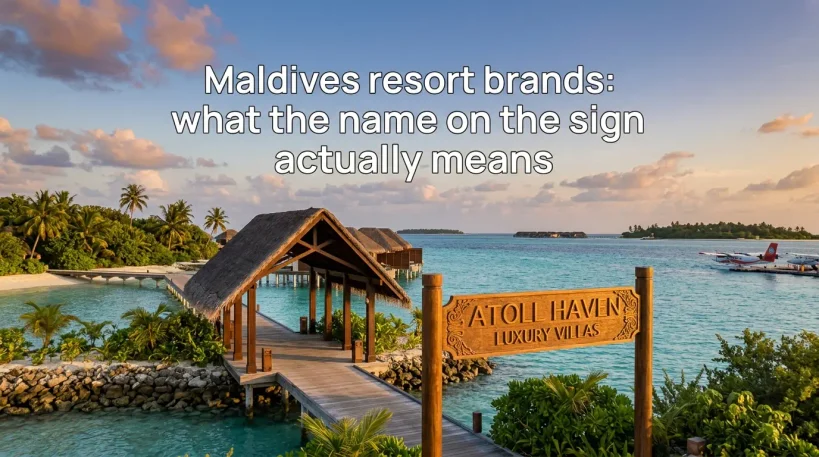
Resort Brands in the Maldives: The Name on the Sign Is a Contract
A branded resort in the Maldives is frequently not owned by the brand. It is owned by somebody else — often a Maldivian company, sometimes an investment vehicle — and operated under a management agreement that runs for a fixed term.
Which means the name on the arrival jetty is a contract rather than a fact about the island. Contracts end. The island stays, the reef stays, the staff largely stay, and the sign changes.
That single structural point explains why brand-based recommendations date faster than anything else in Maldivian travel writing, and it is the reason this article describes how to read a brand rather than ranking them.
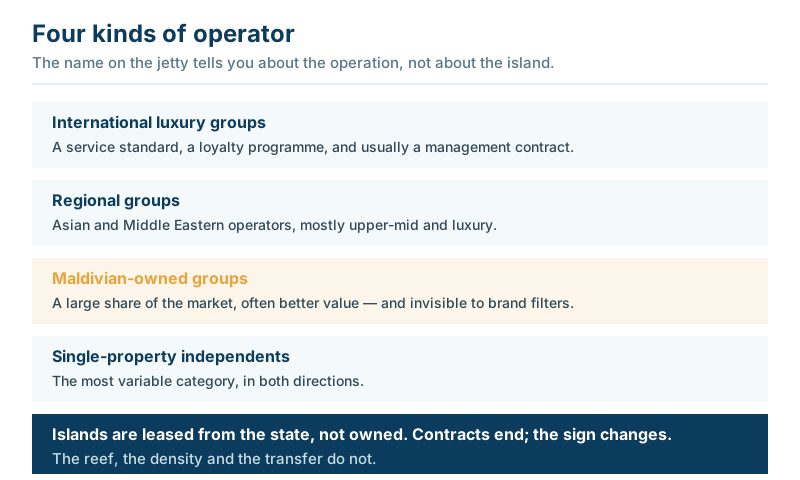
Four kinds of operator
International luxury groups. Global hotel companies operating one or several properties here, usually under management agreements, bringing a service standard, a loyalty programme and a booking channel.
Regional groups. Asian and Middle Eastern operators with a Maldivian presence, frequently at the upper-mid and luxury tiers.
Maldivian-owned groups. Domestic companies operating multiple islands, and collectively a very large share of the market. They are the least visible internationally and frequently the best value.
Single-property independents. One island, one owner, no group behind it. The most variable category in both directions — and the one where the island-level checks matter most.
What this tells you practically: the operator type predicts the booking experience, the loyalty benefits and the consistency of the service standard. It predicts very little about the island, the reef or the transfer.
A short history, which explains the market
Two paragraphs, because the shape of the industry is not accidental.
Tourism began here in 1972 with a single resort, and the model was set immediately: one island, one property, no residents. That structure meant the country was leasing islands from the start rather than selling land.
Islands are leased, not owned. Resort operators hold long leases from the state, which is why the same island can carry three different names across thirty years while remaining the same asset.
The international brands arrived later, into a market that Maldivian companies had already built. That sequence explains why domestic groups hold the position they do, and why so many branded properties sit on islands leased by somebody else.
And it explains the rebrand cycle. A lease outlasts a management contract, so the churn happens at the level of the name rather than the island.
The wider history of how the country got here is in our guide to what the Maldives runs on, and the geography of where the islands are is in our atolls guide.
What a brand actually buys
Three things, and they are real.
Reduced variance. A branded property at a given tier will be broadly what you expect: the room standard, the service protocol, the check-in process, the tone. On a once-in-a-lifetime trip with no second attempt, reducing variance is worth something specific.
A complaints route. If something goes badly wrong, a group with a head office and a reputation behaves differently from a single property that will never see you again.
Loyalty value. Points earning and — more usefully — points redemption, which is covered below.
And what it does not buy: a better island. Brands lease islands; they do not make them. The reef, the lagoon, the size and the transfer are geography, and the checks in our guides to reading a house reef and island size apply identically whatever the sign says.
Why consistency is weaker here than elsewhere
The observation that distinguishes Maldivian brand behaviour from brand behaviour anywhere else.
A city hotel can standardise almost everything. The building, the rooms, the restaurant, the location relative to a business district.
A Maldivian resort cannot standardise the island. Two properties under the same brand, in the same country, can differ completely in reef quality, density, transfer mode and atmosphere — because those are set by which island the group leased.
Staffing dominates the experience, and staffing is local. Service is largely the work of people who live here, many of whom have worked at several islands under several names — including on guesthouse islands.
Which produces the practical rule: the brand narrows the range of outcomes rather than determining the outcome. A weak island under a strong brand is a well-run week in the wrong place.
And the corollary: research the island first and the brand second. Every other article in this block describes how to do the first part.
Management contracts, and why the sign changes
Worth understanding, because it explains a category of unpleasant surprise.
Many branded resorts are owned by one company and operated by another under a management or franchise agreement with a fixed term.
When a contract ends, the property rebrands. New sign, new website, new booking channel, frequently a refurbishment — and the same island, the same reef and much of the same staff.
Which matters if you booked on the brand. A booking made a year ahead can be for a property that has changed name by the time you arrive. Reservations are honoured; the experience you researched may not be the one described.
And it matters for reviews. Reviews from before a rebrand describe a different operation on the same island, which is why review dates matter more here than in most markets.
How to check: search the property name plus “rebrand” and plus “formerly”. A property that has changed hands recently will show it immediately.
This is not a warning against branded properties. It is a reason to know what you are actually booking: an island, operated under a name, for now.
Maldivian-owned groups
The category international travellers overlook, and it deserves a proper hearing.
Domestic companies operate a large share of the resorts in this country, several of them across multiple islands, and they have been doing it since the industry began in the 1970s.
What they tend to offer: better value at equivalent quality, deeper local staffing, and management rooted here rather than rotating through — including properties suited to families.
What they tend to lack: an international loyalty programme, a familiar name, and the marketing budget that puts a property in front of you in the first place.
Which is precisely why they are undervalued. A traveller filtering by recognisable names will never see them, and the filter is doing the work of a recommendation without any of the reasoning.
How to find them: search by atoll and transfer time rather than by brand — our atoll decision guide covers the regions — then assess each property on the island-level criteria.
And the wider point about where money goes, which our guide to what the country runs on covers: a domestically-owned property keeps more of what you spend in the Maldives.

Loyalty programmes
The one area where brand genuinely changes the arithmetic, and it works in one direction more than the other.
Earning points on a Maldives stay is unremarkable — you accrue on a high-value night like any other.
Redeeming points here is where the value is. The Maldives is among the most expensive redemption markets in the world in cash terms, which means a points night can be worth several times what the same points return in a European city.
Which makes it a redemption destination rather than an earning one, and worth planning around if you hold a balance.
Elite status delivers real benefits here. Breakfast included where it otherwise is not, upgrades that are genuinely large, and occasionally a waived transfer — which at USD 400 to 820 per person by seaplane is the most valuable perk available.
Two cautions. Award availability is limited and books out far ahead, particularly in the dry season. And the transfer is almost never included, which surprises people who redeemed for a “free” week then paid USD 1,600 for a couple to reach it.
Ask before redeeming: is the transfer covered, and are resort fees and the service charge payable on an award stay?
Brand or independent
The decision, framed as a trade rather than a hierarchy.
Book a brand if: it is a once-in-a-lifetime trip, you hold points or status, or you want a predictable standard. Also if you are booking far ahead and want a counterparty with a head office.
Book an independent if: you are a repeat visitor, you value character over consistency, or the property is domestically owned and the value is obvious.
Book either if the island is right. That is the actual answer, and why this article sits after the ones about reefs and density.
What tips it toward a brand: honeymoons and milestone trips, where the downside of a disappointing week is larger — as our honeymoon guide notes.
What tips it toward an independent: budget sensitivity, a second or third visit, and any interest in the country rather than in a resort — the argument our comparison of the two island types makes at length.
How to read a brand before booking
Six checks, and none of them involves the marketing.
How many properties does the group run in the Maldives? One is a project; several is an operation with a country-level management structure and staff who move between islands.
How long has this property carried this name? Recent rebrands mean reviews describe a different operation.
Is the property owned or managed? Frequently findable, and it explains the incentive structure.
What is the sub-brand? Large groups run several tiers under related names, and the difference between them is substantial. A familiar parent name attached to an unfamiliar sub-brand is a different product from the flagship.
How long has the general manager been in post? Long tenure in this market is a genuine signal, because the alternative is a rotation that resets the property every two years.
And what does the property say about its island — the reef, the density, the transfer? A group that answers those questions specifically is running the property rather than marketing the name, and the questions themselves are in our where to stay pillar.
The sub-brand problem
Worth its own section, because it is the commonest way a brand booking disappoints.
Large hotel groups operate multiple tiers, from accessible to ultra-luxury, under related names sharing a parent.
Travellers read the parent, which they recognise, and book the tier, which they do not.
The difference is not cosmetic. Villa density, staff ratio, food and the number of restaurants all move between tiers, on the pattern our guide to what the luxury tier buys describes.
How to check: find the group’s tier structure and locate the property in it. Then check the rate against the bands in our budget guide — price tells you the tier more reliably than the name.
And the reverse trap: an unfamiliar name at a high price point is frequently an independent property that is genuinely excellent and simply does not advertise.
What actually varies between properties
Ranked, because this is the list a brand cannot change and the one that decides a week.
The reef, which our guide to reading a house reef shows how to check in thirty seconds.
The density, measurable from a satellite map and a villa count — the method is in our guide to island size.
The transfer, which is set by the atoll and covered in our guide to staying near the airport.
The board basis and what it excludes, which varies by property rather than by group — and the spa and excursion pricing with it.
The dive centre, which is frequently a third-party operator with its own standards regardless of whose name is on the resort — as our guide to choosing a resort for diving explains.
And the villa type, on the overwater or beach question.
Six variables, none of them determined by the brand, and all of them checkable before booking. That is the argument of this whole block in one list.
What brands cannot fix
Short, and it is the list that decides most weeks.
The reef. Geography, not management.
The transfer. Set by which atoll the island is in, and covered in our guide to staying near the airport.
The density. Set by how many villas were built on how much land, and measurable before you book.
The weather. Set by the monsoon.
The other guests. A wedding party on a small island is a wedding party on a small island, whatever the sign says — and the same applies to an adults-only policy.
And the 28.7%. A service charge of 10% and 17% TGST compound on every bill at every property, branded or not, as our guide to money in the Maldives explains.
Booking direct or through the brand
A practical point that saves money more often than it does not.
Brand websites frequently match or beat third-party rates, and they control the room allocation — which means a direct booker is more likely to be placed well within a category.
Loyalty benefits usually require a direct booking, or a booking through a partner the programme recognises. A cheap rate through an unrecognised channel can cost more than it saves in forfeited status benefits.
Independent properties negotiate more, particularly for longer stays and repeat guests, and an email frequently produces something a booking engine will not.
Agencies earn their fee on complex trips — a split stay, a seaplane island and a domestic flight in one itinerary — because they hold the pieces together when something moves, which our guide to missed connections explains the value of.
And always ask what is included. Board basis, transfer and resort credit vary between channels for the same room — the arithmetic is in our budget guide.
One thing worth valuing in a brand
Fair balance, because most of this article has been arguing the name matters less than the island.
Recovery is what a brand is actually for. When a transfer fails, a villa floods or somebody falls ill, what matters is whether the property has a process and an incentive to fix it.
A group with a head office has both. Its reputation is worth more than the margin on your week, and complaints escalate to somebody whose job depends on them.
A well-run independent frequently does better, because the owner is on the island and decisions are made in an afternoon rather than referred upward.
A poorly-run independent has nothing. No process, no escalation, and no reason to care after you have paid.
Which is why the variance argument matters most on a trip you cannot repeat. For a honeymoon, a milestone or a first visit, narrowing the downside is worth paying for — and that, rather than thread count or the name on the toiletries, is the genuine case for a brand in this country.
Why this site does not rank brands
Stated plainly, because a reader arriving on this page may have expected a list.
We have not stayed at a Maldivian resort overnight, as the where to stay pillar sets out. Ranking operators on service, food or atmosphere would require exactly that.
Brand rankings date faster than any other travel content, because management contracts end, sub-brands are repositioned and properties change hands.
And the ranking answers the wrong question. A traveller does not need to know which group is best; they need to know whether this island, at this price, with this transfer and this reef, is right for their trip. The brand is one input and rarely the deciding one.
What this article offers instead is the structure: four operator types, six checks, and the reasons a name on a jetty tells you less than a satellite image does.
Questions travellers ask
Which is the best resort brand in the Maldives? The question is less useful than it looks. Brands narrow the range of outcomes rather than determining them, because the island — its reef, size, density and transfer — is geography rather than management, and no brand can standardise it.
Are branded resorts owned by the brand? Frequently not. Many are owned by another company, often Maldivian, and operated under a management agreement with a fixed term. When the contract ends the property rebrands, keeping the same island and much of the same staff.
Are Maldivian-owned resorts worth considering? Yes. Domestic groups operate a large share of the market, frequently at better value for equivalent quality, and they are invisible to anybody filtering by recognisable international names.
Is it worth using loyalty points in the Maldives? Redeeming, yes — it is among the most valuable redemption markets in the world. Earning is unremarkable. Note that the transfer is almost never included in an award booking, which can mean USD 1,600 for a couple to reach a “free” week.
What is a sub-brand and why does it matter? Large groups run several tiers under related names. Travellers recognise the parent and book the tier, and the difference in density, staffing and food between tiers is substantial. Check the price against tier bands rather than trusting the name.
Should I book direct or through an agency? Direct for most trips: rates usually match, room allocation is better and loyalty benefits typically require it. An agency earns its fee on complex multi-part itineraries.
How can I tell if a property has recently rebranded? Search the name with “formerly” and “rebrand”. It matters because reviews from before the change describe a different operation on the same island.
Does a brand guarantee a good house reef? No. Reef quality is island geography and entirely independent of the operator. Check the satellite image regardless of the name.
What to take away
- A branded resort is frequently an island owned by one company and operated by another under a fixed-term contract. Contracts end and signs change; the island does not.
- A brand narrows the range of outcomes. It does not determine them, because the reef, density, transfer and weather are geography rather than management.
- Maldivian-owned groups run a large share of the market, frequently at better value, and are invisible to anyone filtering by familiar names.
- The Maldives is a redemption market rather than an earning one — but the transfer is almost never included in an award booking.
- Check the sub-brand, not just the parent. The price band tells you the tier more reliably than the name does.
Next step: take the property you are considering and find out two things — who owns it, and how long it has carried this name. Then go back to the satellite image. The first two tell you what kind of operation you are booking; the third tells you what kind of week you will have, and only one of those is on the website.