Travel Insurance for the Maldives: Your Policy Probably Excludes the Diving
Standard travel insurance covers a beach holiday well. The Maldives is not a beach holiday in the sense an underwriter means, and three things about it fall outside what most off-the-shelf cover contemplates.
Diving is excluded or depth-limited in a great many standard insurance policies. Chamber treatment for a decompression injury runs into thousands of dollars, and the nearest chamber may be a long way away. And the boat or seaplane that takes you to your island is not a connecting flight in policy terms, which means missing it may not be a covered event at all.
This guide sets out what to check in a Maldives travel insurance policy, in the order that matters. It is not advice on which insurance to buy — terms vary enormously between insurers and countries, and the only reliable source is the wording in front of you.
1. Diving
The insurance exclusion that catches the most people, and the most expensive one to discover late.
Many standard policies exclude scuba diving entirely. Others include it with conditions: a depth limit, a requirement to be with a qualified instructor or guide, or a requirement to hold a recognised certification.
Depth limits are the usual sticking point. A policy capped at eighteen metres does not reach the channel diving the Maldives is known for. The sites are in our diving guide, the seasons in our diving calendar.
“Guided only” is a common condition. It matters at the small number of properties where certified guests may dive the house reef unguided, as our guide to choosing a resort for diving explains.
Specialist diving schemes exist as a category, sold by organisations that focus on the sport, and designed around exactly these gaps.
And many dive centres require proof of insurance. They ask for it alongside certification, so the question is frequently answered at the desk rather than in an emergency.
What to check: whether diving is covered at all, to what depth, under what supervision, and whether chamber treatment is named explicitly.
2. Chamber treatment and evacuation
The reason diving insurance matters more here than at most destinations.
There are four hyperbaric chambers in the country, all at resorts, and none south of Dhaalu Atoll — a fact this site repeats across the diving, safety and liveaboard articles because it is materially different from a destination with hospitals.
Treatment is expensive. A decompression illness case can run to several thousand dollars and considerably more with complications.
Getting to the chamber is a separate cost. From a resort island that means a boat or a seaplane, and from a southern itinerary it can mean a domestic flight — the geography is in our safety guide.
Repatriation is a third cost, and the one with the largest headline figure on any policy schedule.
What to check in the insurance: whether the medical section names hyperbaric treatment, what the emergency evacuation limit is, and whether the insurer runs a 24-hour line that can coordinate a transfer from an island.
And note the practical detail: an evacuation from a small island is arranged by the property and the operator, not by you. An insurer that requires pre-authorisation before treatment needs to be reachable at three in the morning from a place with no hospital.
3. The transfer, which is not a connecting flight
The insurance gap almost nobody checks, and the one most likely to be tested.
Travel disruption insurance is generally written around flights. Missed departure, delayed departure, missed connection — all defined in terms of scheduled air services.
Your speedboat or seaplane is neither of those. It is a separate contract with a separate operator. In most standard wordings it is not a “connection” that triggers a claim — the structural problem our guide to missed connections sets out.
Which means the classic Maldives failure may be uninsured. Your flight lands at 15:00, the last seaplane has gone, the resort books you a hotel, and you pay for it.
What to check: how the policy defines a missed connection. Whether it covers onward travel arranged separately from the flight, and whether the accommodation clause has conditions you can meet.
And the practical mitigation is not insurance at all. Land before 14:00, choose a speedboat-served property, or book the airport-area night deliberately — the arithmetic is in our guide to choosing a flight.
4. Water sports beyond diving
The second-commonest insurance exclusion, and the least expected.
Motorised water sports are excluded from many standard insurance policies — jet skis in particular, and sometimes anything with an engine.
Some policies exclude parasailing, kitesurfing and wakeboarding or place them in an adventure-sports tier that costs extra.
Snorkelling is almost always included, and it is what most visitors actually do — the free and paid options are in our guide to water sports.
Surfing is usually included but reef breaks with no sand bottom produce cuts and worse, and our guide to choosing a resort for surfing is explicit about the conditions.
What to check: the activity list, and whether the property will ask you to sign a waiver that affects your cover.
And a note on children. Insurance for a child’s activities is not automatic, and family policies vary on what a minor may do — our guide to choosing a resort for a family covers what a family week involves.
5. Medical, in a country with no hospital nearby
Different from most destinations, and the difference is distance rather than quality.
Larger resorts have a doctor or a nurse. Smaller ones have neither, and a guesthouse island has whatever the island has.
Serious cases go to Malé, which is a transfer away — the same transfer that brought you.
Which makes the evacuation limit the number that matters, more than the headline medical figure.
There is no pharmacy on a resort island. Bring what you rely on, as our packing list and our guide to health before you go both set out, and declare pre-existing conditions.
What to check: the evacuation and repatriation limits, whether pre-existing conditions are covered after declaration, and whether the assistance line is genuinely 24-hour.
And the general point about the country: it is a safe place with a real constraint, which our safety guide sets out honestly. The risk is not danger; it is distance.
Why the Maldives is unusual for insurers
Worth setting out, because it explains every insurance exclusion above rather than listing them.
There is no hospital where you are staying. Not a small one, not a clinic in the next town — nothing, on most islands. Every serious medical event becomes a transport problem before it becomes a treatment problem.
Transport is by boat or aircraft, at operator schedules, and a seaplane cannot fly after dark. A medical evacuation at midnight from a distant atoll is a different operation from an ambulance.
The activity mix skews toward the excluded end. Diving, motorised water sports and reef breaks are what a large share of visitors come for, and they are precisely the categories standard cover treats as optional extras.
And the journey has three contracts rather than one. Flight, transfer, accommodation, with no party responsible for the joins. That is a structural gap rather than an insurance one, and the reason our booking timeline insists the transfer is booked with the room.
Which is why insurance that suits a Mediterranean beach week may not suit this. The risk profile is not higher; it is differently shaped.
6. Cancellation, and when to buy
The section that decides how much your insurance is worth.
Cancellation protection generally runs from the date of purchase, not from the date of travel. A policy bought the week before you fly does almost nothing on that side.
Which means insurance belongs in the booking sequence, at the same time as the flight and the room — the full calendar is in our booking timeline.
Maldivian cancellation terms are strict, particularly in the festive fortnight, and the sums involved are set out in our budget guide. That is precisely the exposure cancellation cover exists for.
But read what counts as a covered reason. Illness, injury and specified family events usually do. Changing your mind does not, and neither does most weather.
And a flexible rate is not the same thing. Free cancellation on the airport-area night is worth paying for on its own terms, as our guide to hotels in Malé and Hulhumalé notes, because that is the booking most likely to change.
The three formats, and how insurance differs for each
Not obvious, and it changes what to look for.
A resort island. The property has staff, sometimes a doctor, and an established relationship with transport operators. Evacuation is arranged for you, and the insurer’s role is authorisation and payment — the range of properties is in our where to stay pillar.
A guesthouse island. A village with a health centre of varying capability, and a ferry or speedboat to Malé. Cheaper in every respect, and further from a resort’s logistics.
A liveaboard. Diving several times a day, frequently far from a chamber, and the format where specialist diving cover matters most. Some operators require it outright.
The common thread is distance rather than danger, and the number that reflects distance on a schedule is the evacuation limit rather than the medical maximum.
And on a split stay, check that the policy covers the whole trip rather than a single booking — which sounds obvious and is worth confirming when the accommodation is two separate reservations, as our itineraries guide describes.
Weather, and what is not covered
Worth a short section, because expectations here are frequently wrong.
The Maldives does not get tropical cyclones. It lies too close to the equator for them to form, which is a genuine structural advantage over destinations like Fiji that sit in a cyclone belt.
What it does get is monsoon wind, which cancels boats — the distinction our guide to rainy days draws between rain and wind.
A cancelled excursion is not usually a claimable loss. Operators refund or reschedule, and that is the remedy.
A cancelled transfer is a different matter and returns you to the definitional question in section three.
And a week of grey weather is not a claim. It is the wet season, which is why it costs less — the trade is in our guide to high and low season.
Baggage, cameras and dive gear
The section that matters to a specific minority and matters a great deal to them.
Single-item limits are the trap. A policy with a generous total baggage figure may cap any one item well below the value of a camera housing or a regulator set.
Specified-item cover is the usual remedy, and it requires listing values in advance.
Dive gear travels badly. It is heavy, it is expensive, and it consumes most of a seaplane baggage allowance — which is one argument for renting rather than insuring, at about USD 15 a day.
Underwater camera equipment is frequently excluded while in use, which is exactly when it is at risk. Check the wording rather than the summary — our guide to underwater photography covers the equipment involved.
And keep receipts and serial numbers somewhere that is not the bag.
Where the policy meets the property
Three practical interactions worth knowing before you arrive.
Dive centres ask for insurance as well as certification, and some will not take you without it. Have the document available offline.
Waivers do not replace anything. Signing a property’s liability waiver for a water sport does not create protection for you; it removes theirs.
And the property arranges the evacuation, not you. Your insurer’s role is to authorise and pay, which is why an unreachable assistance line is a real problem rather than an administrative one.
Two documents worth having offline: the policy number with the emergency line, and your certification card if you dive — alongside the IMUGA confirmation and your transfer booking.
Because the one thing every account of a Maldivian medical incident has in common is that it happened somewhere with no signal, no hospital and no way to look anything up.
If something does go wrong
Practical sequence, and it is short.
Tell the property first. They arrange transport, they know which chamber or clinic is nearest, and on an island they are the only operational resource you have.
Then the assistance line, not the claims department. Emergency authorisation and claims are different functions and different numbers.
Keep everything. Receipts, medical reports, the incident report from a dive centre, the property’s written record of a cancelled transfer.
Photograph documents as they are issued, because paper on a boat does not survive the week.
And expect to pay first in some situations and claim afterwards, which is why the credit limit on a card matters more here than at destinations with direct-billing hospitals.
The one thing not to do is wait until you are home to report a serious incident. Most policies require notification during the event, and a late report is the commonest reason a valid claim is reduced.
One more clause worth reading
Short, and it is the one that turns a valid claim into a reduced one.
Most policies require notification during the event, not after you get home. A serious incident reported three weeks later is the commonest reason a legitimate claim is cut.
Many also require pre-authorisation for anything beyond a modest sum, which is why the assistance line matters more than the schedule of limits.
And several exclude claims arising from alcohol, which in a country where drinking happens almost exclusively at resorts is worth reading carefully rather than assuming.
None of that is unusual for travel insurance. It is unusual to be applying it somewhere with no hospital, no pharmacy and a boat between you and both.
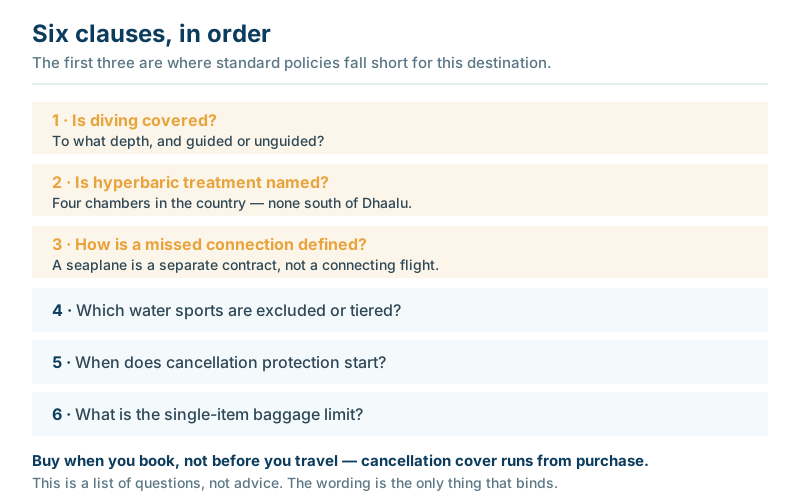
What to check, in order
The compressed insurance checklist, and it takes ten minutes with a policy wording.
1. Is diving covered, to what depth, and under what supervision?
2. Is hyperbaric treatment named, and what is the evacuation limit?
3. How does the policy define a missed connection, and does it cover separately-booked onward travel?
4. Which water sports are excluded or tiered?
5. When does cancellation cover start, and what counts as a covered reason?
6. What is the single-item baggage limit?
And a seventh that is not about the policy: does the assistance line answer, and can it coordinate from an island? A number that rings out at three in the morning is not cover.
What this article is not
Stated plainly, because insurance is a regulated product and this site is not a broker.
We do not recommend insurance policies or insurers. We have not assessed any, we earn nothing from any, and terms differ by country, age, medical history and activity.
Everything above is a list of questions, not answers. The answers are in the wording of the specific policy you are considering, and the wording is the only thing that binds.
Where this site has first-hand knowledge it says so. On insurance it has none, and the value here is knowing which clauses to read rather than which product to buy.
And the one thing worth repeating: buy it when you book, not before you travel. That single decision is worth more than any comparison of features.
Questions travellers ask
Do I need travel insurance for the Maldives? There is no legal requirement for most visitors, but the practical case is strong: no hospital nearby, evacuation by boat or aircraft, and hyperbaric treatment that runs into thousands if you dive. Many dive centres require proof of cover.
Is diving covered by standard travel insurance? Frequently not, or only with conditions — a depth limit, a supervision requirement, or a certification requirement. Check whether hyperbaric treatment is named explicitly, and consider specialist diving cover.
How much does chamber treatment cost? Several thousand dollars for a decompression illness case, and more with complications, before the cost of reaching the chamber. There are four in the country, all at resorts, and none south of Dhaalu Atoll.
Does insurance cover a missed seaplane? Often not. A speedboat or seaplane transfer is a separate contract and is usually not a “connection” as travel disruption cover defines it. Check the wording, and mitigate by landing before 14:00 or choosing a speedboat property.
Are water sports covered? Snorkelling almost always. Motorised sports, parasailing and kitesurfing are frequently excluded or placed in a paid adventure tier. Check the activity list rather than assuming.
When should I buy the policy? When you book, not before you travel. Cancellation cover generally runs from purchase, so buying it late forfeits most of its value.
Will my camera and dive gear be covered? Only up to the single-item limit, which is frequently lower than the equipment is worth. Specified-item cover requires listing values in advance, and underwater equipment is often excluded while in use.
Is bad weather covered? Generally not. The Maldives does not get cyclones, but monsoon wind cancels boats, and a cancelled excursion is refunded or rescheduled by the operator rather than claimed.
What to take away
- Many standard policies exclude diving or cap it at a depth shallower than the diving the Maldives is known for.
- Four hyperbaric chambers in the country, all at resorts, none south of Dhaalu. Treatment and the journey to it are both expensive.
- A seaplane or speedboat transfer is usually not a “connection” in policy terms, so the classic missed-transfer failure may be uninsured.
- Cancellation cover runs from purchase. Buy the policy when you book, not the week before you fly.
- Check the single-item baggage limit if you carry a camera or dive gear, and check whether the assistance line actually answers.
Next step: open the policy wording rather than the summary page, and search it for four words — diving, hyperbaric, connection and evacuation. Those four searches take five minutes, and they will tell you more about whether the insurance suits this destination than any comparison table or star rating will.