
Missed Transfers and Delays in the Maldives: Nobody Owns the Whole Chain
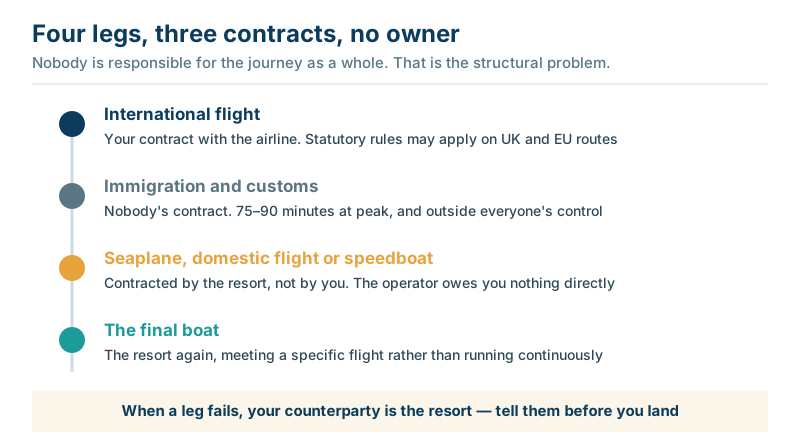
A Maldives arrival is three or four separate contracts sold as one journey. An international airline flies you to Velana. A seaplane operator, contracted by your resort, flies you onward. A boat meets you at the far end.
None of them has a contract with the others. When your inbound runs two hours late and the last seaplane has gone, no single party is responsible for putting it right. The cost of that gap is usually a night in a hotel you did not book.
This guide sets out who is liable for what, the cutoff times that decide everything, and how to build an itinerary that cannot fail in the first place.
The chain, and who is contracted to whom
Leg one: your international flight. A contract between you and the airline. If they delay you, their obligations are set by the ticket conditions and, on some routes, by law.
Leg two: immigration and customs. Nobody’s contract. Takes 75 to 90 minutes at peak, as our guide to the arrival sequence explains, and it is entirely outside anyone’s control.
Leg three: the seaplane, domestic flight or speedboat. Usually a contract between the resort and the operator, with you paying the resort. You are not the airline’s customer; the resort is.
Leg four: the final boat, where a domestic flight is involved. The resort again.
That third point is the one that matters. When a seaplane is missed, your counterparty is the resort, not the seaplane operator. The resort decides whether to rebook you on the next flight, whether to charge for it, and whether to help with a hotel.
The cutoff times that decide everything
Four numbers explain almost every missed connection in the country.
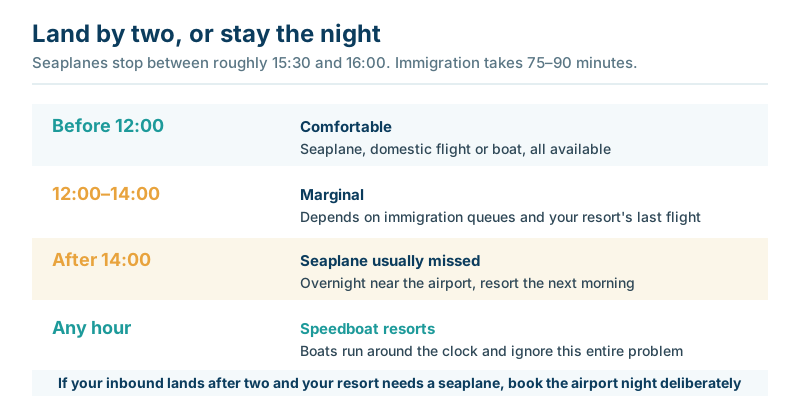
Seaplanes fly in daylight only, roughly 06:00 to somewhere between 15:30 and 16:00. There is no exception, no waiver and no late flight. Our seaplane guide covers why.
Domestic flights thin out in the evening and stop entirely on many routes — which atolls depend on them is in our guide to airports by atoll.
Speedboats run around the clock, which makes them the only transfer mode immune to this whole category of problem.
Immigration takes 75 to 90 minutes at peak arrival times.
Work backwards and you get the practical rule: an international arrival after about 14:00 will usually miss the last seaplane of the day. Land at 13:00 and you are marginal. Land at 15:00 and you are staying near the airport, in Hulhumalé or on the airport island itself.
That is not a failure of anything. It is arithmetic, and it is knowable at the moment you book the flight.
Scenario one: your inbound is late and the seaplane window closes
The most common failure by a wide margin.
What happens. Your flight lands at 16:30 instead of 13:00. The seaplane has stopped for the day. The resort representative meets you and explains that you will fly tomorrow morning.
Who pays for the night. It depends entirely on the resort, and there is no industry standard.
- Some properties absorb the airport-hotel cost as a goodwill gesture, particularly at the luxury end.
- Some charge you for the hotel and for the room you are not using on the island.
- Many sit in between: they arrange the hotel, you pay for it, and the resort night is charged as booked.
What is not in dispute is that the seaplane operator owes you nothing. You were never their customer.
What to do: contact the resort the moment you know your inbound is delayed, not on landing. If they know three hours ahead, they can sometimes hold a later seaplane, move you to a speedboat if the geography allows, or book the airport hotel before it fills. Our guide to a late arrival in Malé covers the options once you are on the ground.
Scenario two: the seaplane is cancelled for weather
Less common, more disruptive.
Seaplanes do not fly in poor visibility or heavy weather, and the decision is the operator’s. It is most likely in the southwest monsoon, roughly June through September, as our monsoon guide sets out.
A cancellation late in the day becomes an overnight, because there is no later flight to be moved to.
Your baggage may already be with the operator, which is a specific problem covered in our guide to seaplane baggage rules. Ask to retrieve it before you accept a hotel.
The reverse direction is worse. A weather cancellation on departure day, from an island, can put your international flight at risk. This is the single strongest argument for the buffer described below.
Scenario three: the domestic flight is delayed
Domestic aviation in the Maldives runs to a tight schedule with limited aircraft, and delays cascade.
A delayed domestic arrival can miss the resort boat, which for many properties runs to meet specific flights rather than continuously.
A delayed domestic departure can miss your international flight, which is the failure with real financial consequences.
Rebooking is at the airline’s discretion and is usually handled reasonably, but the connection to your international ticket is not protected. Our guide to domestic flights covers how the network operates.
Scenario four: you miss the boat leaving your island
The departure-day failure, and the one travellers cause themselves most often.
Shared transfers leave on a schedule built backwards from flights. They will not wait, because waiting makes forty other people late.
The clock trap. Many resorts run an hour ahead of Malé time. If your transfer was quoted in resort time and you converted it wrongly, you are an hour late for a boat that has gone. Our guide to the time zone covers it, and this is the situation it exists for.
The fix costs money. A private speedboat at short notice, if the geography allows, or a seat on the next scheduled service if there is time. If neither works, you are rebooking an international flight.
On a guesthouse island the equivalent is missing the morning speedboat and discovering the next one is tomorrow, particularly if it is a Friday and the public ferry is not running either.
Scenario five: the ferry does not appear
The cheapest transfer carries the least protection.
No connection guarantee, no rebooking, no liability. A public ferry that is cancelled, full or rescheduled leaves you to make your own arrangements.
Weather suspends sailings, and the decision comes late — most often in the monsoon months.
Friday stops most routes entirely.
This is why our ferry guide says plainly that a ferry should never be your last connection before a flight. The saving is USD 40; the exposure is a missed international departure.
The guesthouse island version
Everything above is written around resorts, because that is where the money is at stake. Inhabited islands have their own version of the problem, with different failure modes.
No one is coordinating for you. A guesthouse will help, but it does not have a transfer department, a contract with an airline or a duty manager. Our Maafushi guide describes what that means in practice.
The scheduled speedboat is the safety net, running several times a day to established islands at USD 25 to 50 per person. When the ferry fails, this is the fallback, and it is cheap enough to be a real option rather than a theoretical one.
Friday removes the ferry entirely, and a Friday arrival with a ferry plan is not a plan.
The last boat is early. Scheduled speedboats to many guesthouse islands stop in the evening. A late landing means a night in Hulhumalé whether you are heading to a resort or a local island, which is why our ferry guide insists on verifying departures the day before.
The upside: costs are small. A missed connection on a guesthouse trip costs a hotel night and a boat ticket, not a four-figure charter and an unused villa. On the resort and local island comparison, this is one of the few lines where the inhabited island wins outright.
Who actually pays
The honest answer is: it depends on which leg failed, and travellers consistently guess wrong.
If your international airline caused the delay, their obligations govern. On flights departing the UK or EU, or operated by a UK or EU carrier into them, statutory rules on care and compensation may apply — meals, accommodation and in some cases cash. Those rules do not extend to the Maldivian legs of your journey.
If the seaplane was cancelled for weather, nobody is at fault and nobody owes compensation. This is where travel insurance matters.
If you missed the boat, that is on you, and the resort will help at your cost.
If the resort mis-scheduled the transfer, they will generally fix it without argument, and they will fix it faster if you have the times in writing.
Separate tickets are the underlying risk. Where the international flight and the transfer are on one booking, there is at least a chain of responsibility. Where they are separate contracts — which is almost always the case in the Maldives — each party’s obligation stops at its own leg.
What travel insurance actually covers
Worth reading your policy before you need it, because the wording is specific.
Missed connection cover usually requires a minimum delay, commonly three to six hours, and frequently applies only to connections booked on a single itinerary. A seaplane contracted by a resort is rarely on your airline ticket.
Travel delay cover typically pays for meals and accommodation after a threshold, and is the clause most likely to help with an unplanned Malé night.
Trip interruption may cover the unused resort night, subject to the cause being insured.
Weather cancellations are usually covered under delay clauses. Missing your own boat is usually not.
Keep everything. Written confirmation of the delay from the airline, the hotel receipt, the transfer invoice and the correspondence with the resort. Claims fail on evidence more often than on wording, and our guide to safety and insurance covers what else a Maldives policy needs to include.
Building a schedule that cannot fail
Five rules, and they remove almost all of this risk.
Land before 14:00 if your resort needs a seaplane. Earlier is better. This is the single most effective decision in the whole itinerary.
If you cannot, book the airport-area night deliberately. A planned night in Hulhumalé is cheap, calm and eliminates the failure mode entirely. It is far better than an unplanned one, and our guide to getting into Hulhumalé covers the five-minute journey.
Allow three hours minimum on departure day, from leaving your island to international check-in closing. Four in the monsoon.
Choose a Kaafu or other speedboat-served resort if your flights are awkward. Boats run at any hour, which makes the whole seaplane cutoff irrelevant — one more argument in our shared versus private speedboat comparison, and a factor in the atoll decision itself.
Never make a public ferry your last connection. Ever.

What to check before you book anything
Six questions, all answerable in advance, and each one removes a category of risk.
What transfer mode does the resort use, and is there an alternative? Some properties within borderline range offer both a seaplane and a speedboat. The boat removes the daylight constraint entirely.
What is the last seaplane departure of the day, for my resort specifically? The general window is 15:30 to 16:00; individual routes end earlier.
What is the resort’s policy if I miss the transfer through a flight delay? Ask it as a direct question and get the answer in writing before you pay. The answers vary enormously and nobody volunteers an unfavourable one.
Is the transfer refundable if I do not use it? Usually not, which is worth knowing before an overnight forces the question.
Does my insurance cover a resort-contracted transfer? Read the missed-connection clause specifically, not the summary.
How does the return leg work, and at what time? The number you want is hours before your flight, not a clock time you will misconvert. Our guide to transfers generally explains how the chain fits together, and the transfer comparison shows how the modes differ by atoll.
What to do in the moment
A checklist, in order, for when something has already gone wrong.
1. Tell the resort immediately. Before you land if you can, from the aircraft wifi or a layover. The resort is the only party who can move the pieces, and time is the resource they need.
2. Get a local connection working. A local SIM or eSIM is worth twenty dollars for exactly this moment. Have some cash too, for a taxi you did not plan.
3. Ask three specific questions. Can I still travel today by any mode? If not, who books the hotel and who pays? Will the resort night be charged?
4. Get the answers in writing. A WhatsApp message is fine and is evidence.
5. Retrieve your hold baggage if it has already gone to the seaplane operator.
6. Ask about the speedboat option. For resorts within range it is sometimes possible at a cost, and it beats losing a night.
7. Keep every receipt. Hotel, taxi, meals. Insurance claims live on paper.
8. Do not argue at the counter. The person in front of you did not cancel the flight and cannot restart it. The resort’s duty manager is the person who can act.
The departure-day version
Everything above runs in reverse, with higher stakes, because the failure ends with a missed international flight.
Confirm the transfer time in Malé time, in writing, the day before.
Watch the weather if you are on a seaplane island in the monsoon, and ask the resort about bringing the transfer forward.
Be findable. The single most common cause of a missed departure boat is a guest on the far side of the island with a dead phone when the schedule changed.
Allow for the airport. Terminal 1 processes a large volume into a small number of counters, and three hours is the working figure our airport guide recommends.
Have a plan B priced. For a seaplane island, that is a private charter. For a speedboat island, a private boat. Knowing the cost in advance turns a crisis into a purchase.
Why the country is built this way
Context, because the fragmentation looks like carelessness and is not.
No airline can serve a resort island. There is no runway, so the last leg has to be a different operator with a different aircraft or a boat. That break in the chain is geographic rather than commercial.
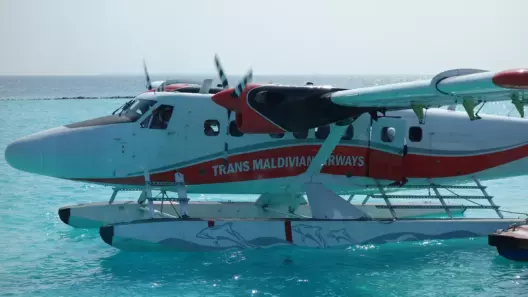
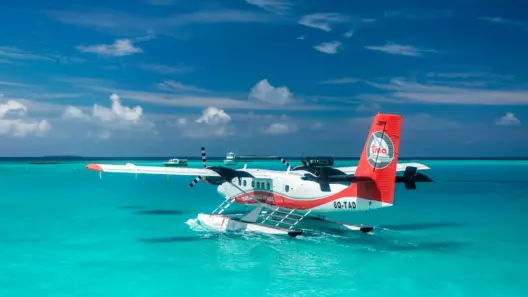
Seaplane capacity is finite and daylight-bound. Trans Maldivian runs one of the largest seaplane operations in the world and it still cannot fly at night onto unlit water.
Resorts buy transfers in bulk and resell them, which is why your contract is with the property. It also means the resort has leverage with the operator that you do not — a good reason to let them handle a problem rather than trying to fix it yourself at a counter.
The alternative would be worse. A single through-ticket covering an international flight and a seaplane would be priced for the risk, and the risk is weather over an equatorial ocean.
Understanding that changes how you approach a delay. Nobody is fobbing you off. There genuinely is no party who owes you the whole journey, which is precisely why the buffer is your responsibility and worth building.
Questions travellers ask
What happens if my flight is delayed and I miss the seaplane? You will fly to the resort the next morning and spend the night near the airport. Who pays varies by resort — some absorb it, some charge for both the hotel and the unused resort night. Contact the resort as early as possible, because they can sometimes hold a flight or switch you to a boat.
Who is responsible for a missed transfer in the Maldives? Usually nobody in a single chain. The international airline’s duty ends at Velana, and the seaplane is contracted by your resort rather than by you. Where the resort scheduled the transfer, the resort will fix it, generally at your cost if the cause was outside its control.
What time do I need to land to reach my resort the same day? Before about 14:00 if a seaplane is involved. Seaplanes stop flying between roughly 15:30 and 16:00 and immigration takes 75 to 90 minutes at peak.
Do speedboat resorts have this problem? No. Speedboats run around the clock, which is why an awkward flight schedule is a strong argument for choosing a resort within boat range.
Does travel insurance cover a missed seaplane? Sometimes. Delay clauses often cover accommodation after a threshold of three to six hours. Missed-connection cover frequently applies only to legs on a single itinerary, and a resort-contracted seaplane usually is not.
What if the seaplane is cancelled because of weather? Nobody is at fault and no compensation is owed. The operator rebooks you on the next available flight, and insurance is your route to recovering the overnight cost.
Can I be compensated under EU or UK air passenger rules? Possibly for the international leg, if it departed the UK or EU or was operated by a UK or EU carrier into them. Those rules do not extend to Maldivian domestic legs or to seaplane transfers.
How much buffer should I leave on departure day? Three hours minimum from leaving your island to international check-in closing, and four during the southwest monsoon.
What to take away
- A Maldives arrival is three or four separate contracts, and no single party is responsible for the whole journey.
- Seaplanes stop flying between roughly 15:30 and 16:00. An international arrival after about 14:00 will usually miss the last one.
- The seaplane operator owes you nothing, because your contract is with the resort. Contact the resort the moment you know you are delayed.
- Weather cancellations are nobody’s fault and nobody’s liability, which is what travel insurance delay clauses are for.
- Speedboat resorts are immune to the whole problem, and a deliberately booked airport-area night removes it for everyone else.
Next step: look at your inbound arrival time and your resort’s transfer mode, together, before you pay for either. If the answer is a seaplane and an afternoon landing, book the Hulhumalé night now — at a hundred dollars planned, rather than three hundred in an arrivals hall at seven in the evening.