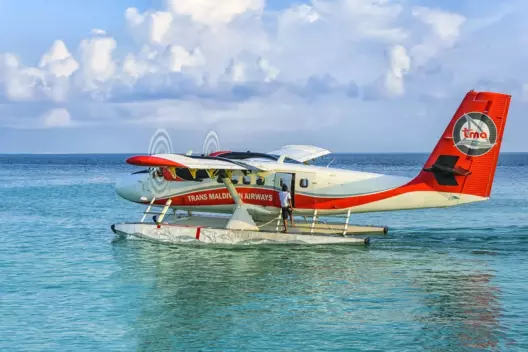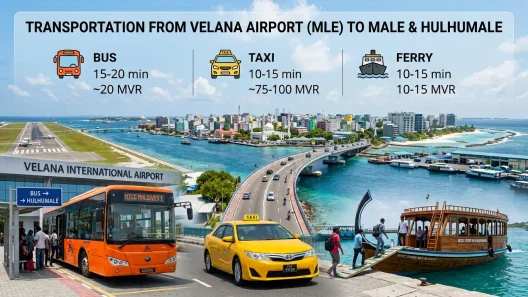


Seaplane, Speedboat or Domestic Flight: the Maldives Transfer Decision That’s Usually Already Made for You
Search for a Maldives transfer comparison and you will find page after page weighing seaplane against speedboat against domestic flight, as though you get to pick. For most guests, you do not. The resort assigns the transfer, the atoll narrows the resort, and the decision closed the moment you chose your island.
A real choice does hide inside the false one. A growing list of atolls is now served by both a seaplane and a runway, and on those routes the two transfer options price differently, weigh your bags differently, and deliver you to the island at different hours. This page maps that overlap, prices it against published 2026 rate cards, and says which side to take.
The three modes side by side: cost, journey time and the constraint that decides
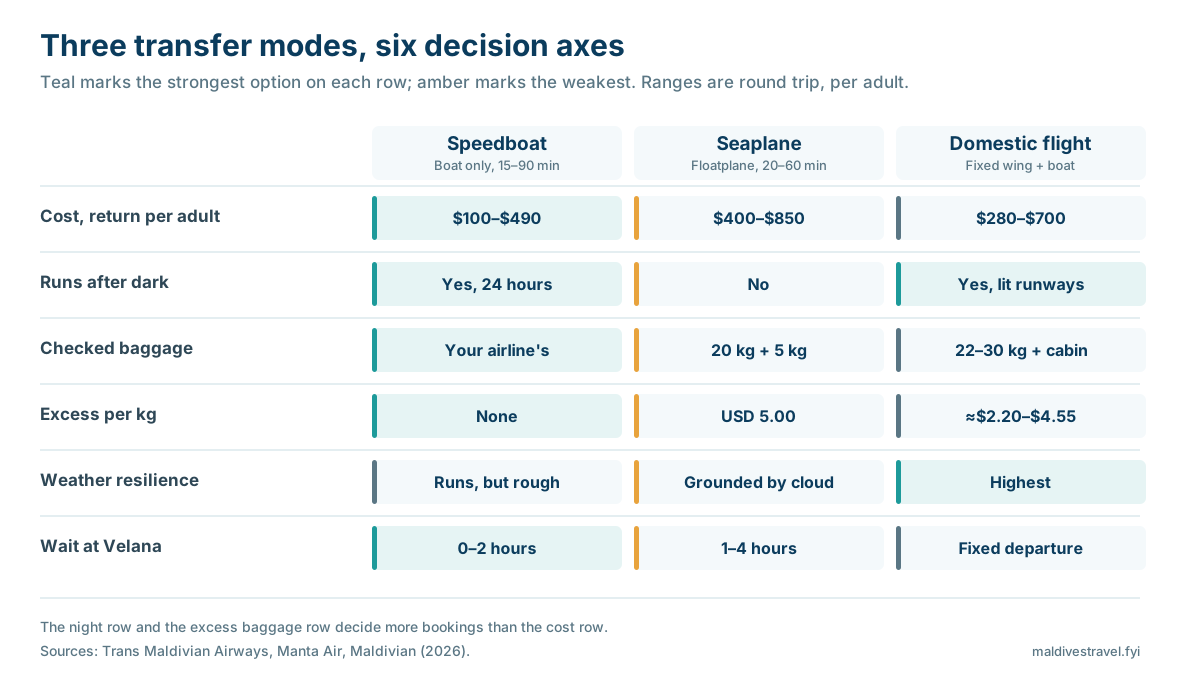
Here is the whole comparison in one screen. Every figure below is a round-trip, per-adult range. Your own transfer quote comes from the resort, not from a national price list.
| Speedboat | Seaplane | Domestic flight + boat | |
|---|---|---|---|
| Typical journey | 15–90 min | 20–60 min in the air | 25–80 min flying, then 10–60 min by boat |
| Transfer cost, per adult | $100–$490 | $400–$850 | $280–$700 |
| Runs after dark | Yes, around the clock | No | Yes, at lit airports |
| Checked baggage | Your international allowance | 20 kg + 5 kg cabin | 22–30 kg + cabin |
| Excess baggage | None | USD 5 per kg | MVR 34–70 per kg (≈$2.20–$4.55) |
| Weather sensitivity | High in swell, low in cloud | High in cloud, wind and rain | Lowest of the three |
| Waiting at Velana | Often shared, 0–2 hours | Commonly 1–4 hours | Fixed departure, wait can be longer |
| What ends the transfer | You step onto the jetty | You step onto the jetty | A second boat leg |
Two rows in that table do most of the work. The night row rules out the seaplane for anyone landing late. The excess baggage row quietly costs families more than they expect, and almost no transfer comparison prices it at all.
Why the “versus” question is answered before you ask it
The premise of every comparison article is that you are choosing. You are almost never choosing. Trans Maldivian Airways states plainly that resort transfers are reserved through its partner resorts, not by passengers. Wego’s July 2026 guide puts it the same way: the transfer mode is assigned by the property, based on your flight timing and its contracted operators.
That matters because it moves the decision one step upstream. You are not picking a transfer at the arrivals hall. You are choosing between islands months earlier, and the transfer arrives attached to the island like a fixed cost. A resort in North Malé Atoll comes with a boat. A resort on an outer reef in Baa comes with a floatplane. Nobody at Velana International Airport hands you a menu.
So the honest version of the question is narrower and far more useful. Which atolls give you two working routes to the same island, and how do you tell which transfer to book? That list exists, it has grown since 2022, and it is where the rest of this page lives.
Where a genuine choice exists: the atolls with a runway and a lagoon
An atoll offers a real transfer choice when it has a domestic airport close enough to its resorts that the boat leg stays short. When the final boat runs 90 minutes, the choice is theoretical. Nobody picks a route that ends with an hour and a half of open water after a long-haul flight.
Nine of the 26 atolls currently clear that bar, and the full national picture sits in our domestic airports by atoll breakdown and in the count of how many airports the Maldives has.
| Atoll | Domestic airport | Flight from Malé | Seaplane also serves it | Night transfer |
|---|---|---|---|---|
| Baa | Dharavandhoo (DRV) | ~25 min | Yes | Yes |
| Lhaviyani | Madivaru (LMV) | ~25 min | Yes | Yes |
| Raa | Ifuru (IFU) | ~30 min | Yes | Yes |
| Noonu | Maafaru (NMF) | ~40 min | Yes | Yes |
| Dhaalu | Kudahuvadhoo (DDD) | ~35 min | Yes | Yes |
| South Ari | Maamigili (VAM) | ~30 min | Yes | Yes |
| Haa Alifu | Hoarafushi (HRF), Hanimaadhoo (HAQ) nearby | ~60 min | Rarely | Yes |
| Shaviyani | Funadhoo (FND) | ~40 min | Yes | Yes |
| Thaa | Thimarafushi (TMF) | ~40 min | Rarely | Yes |
Lhaviyani shows how fast this list moves. The atoll was seaplane-only until Madivaru Airport opened on 18 February 2022, built by Kuredu Holdings on reclaimed lagoon with a 1,200-metre runway. The flight from Malé takes about 25 minutes and it operates after dark. The Crown & Champa islands — Kuredu, Komandoo, Hurawalhi, Kudadoo, Innahura — sit a 10 to 25 minute boat ride from the apron.
One airport turned five floatplane-only resorts into resorts you can reach at midnight. Guides written before 2022 still list the whole atoll as seaplane territory, and so do plenty written since. Note also that some sources date the Madivaru opening to February 2025. The President’s Office recorded the inauguration in February 2022, with scheduled flights following within days.
Everywhere else, the answer is fixed. North and South Malé are boat country. Addu, Laamu, Gaafu and Fuvahmulah sit beyond floatplane range and are reached only by fixed wing. If your island is in one of those, stop comparing and read the speedboat transfer guide or the relevant airport page instead.
The cost inversion: the domestic flight is not automatically the cheap transfer
This is the finding that changes bookings, so it goes here rather than at the bottom.
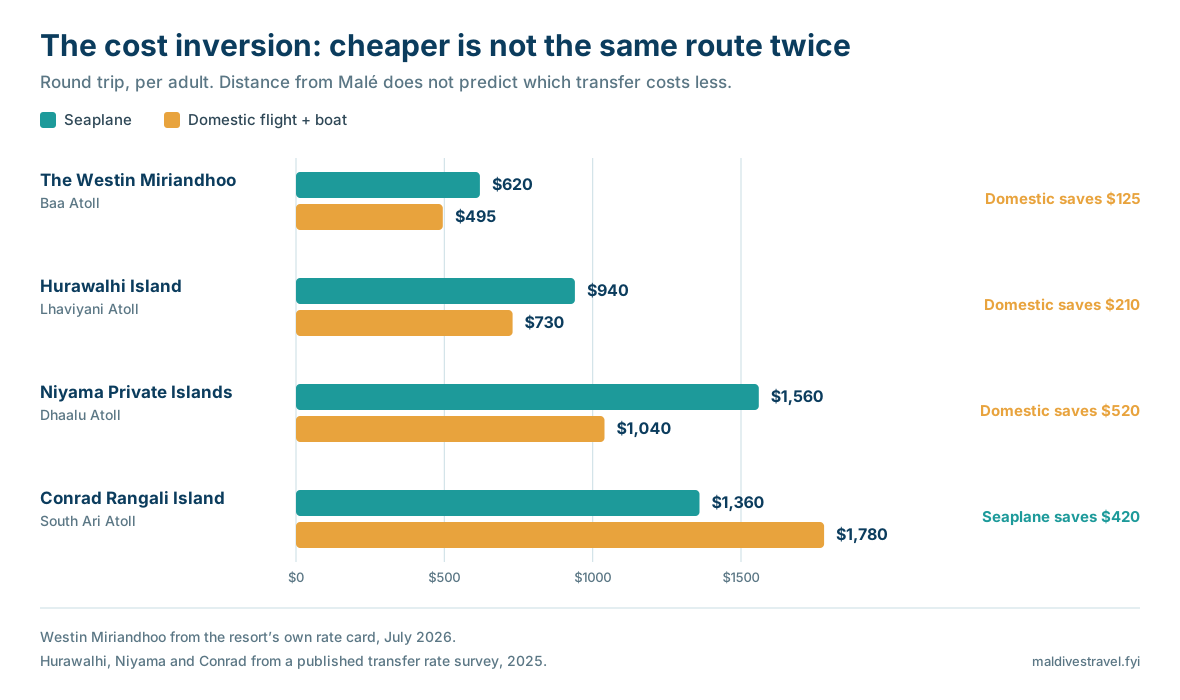
Travel writing treats the fixed-wing route as the budget transfer and the seaplane as the splurge. On roughly half the dual-route resorts we priced, that is backwards. The two products are sold by different contractors on different commercial terms. No rule forces the runway to undercut the lagoon.
| Resort | Atoll | Seaplane, RT per adult | Domestic + boat, RT per adult | Cheaper transfer |
|---|---|---|---|---|
| The Westin Maldives Miriandhoo | Baa | $620 | $495 | Domestic, by $125 |
| Hurawalhi Island Resort | Lhaviyani | $940 | $730 | Domestic, by $210 |
| Niyama Private Islands | Dhaalu | $1,560–$1,700 | $1,040 | Domestic, by $520+ |
| Conrad Maldives Rangali Island | South Ari | $1,360 | $1,780 | Seaplane, by $420 |
| Ifuru Island | Raa | not offered | $282 | Only route |
Westin Miriandhoo figures come from the resort’s own site as recorded by Wego in July 2026. The Hurawalhi, Niyama and Conrad pairs come from Wiotto’s transfer rate survey of summer 2025. The Ifuru figure is the resort’s published Malé–Ifuru round trip, with children at $141.
Conrad Rangali is the case worth staring at. The resort sits in South Ari, barely twenty minutes’ flying from Maamigili, and the fixed-wing transfer still costs $420 more per adult than the floatplane. Meanwhile Niyama in Dhaalu — further from Malé — saves over $500 per adult by going fixed wing. Distance does not predict the answer. Only the rate card does.
Run it for a family of four at the Westin, where children pay half. The seaplane transfer is two adults at $620 plus two children at $310, or $1,860. The domestic route is two adults at $495 plus two children at $247.50, or $1,485. The runway saves $375 — a night at a decent property — and costs one extra boat leg of about twenty minutes.
Run the same arithmetic at the Conrad and it hands you a $1,680 transfer bill instead of $1,360 for two adults, for a slower journey. Nobody should ever assume this one.
Ask for both rate cards in writing before you book the room. Resorts quote the transfer they default to. The second number usually exists, and usually is not volunteered.
Baggage: the axis nobody puts in the comparison table
Every transfer comparison lists cost and journey time. Almost none price the bags, and for families this is where the difference lands.
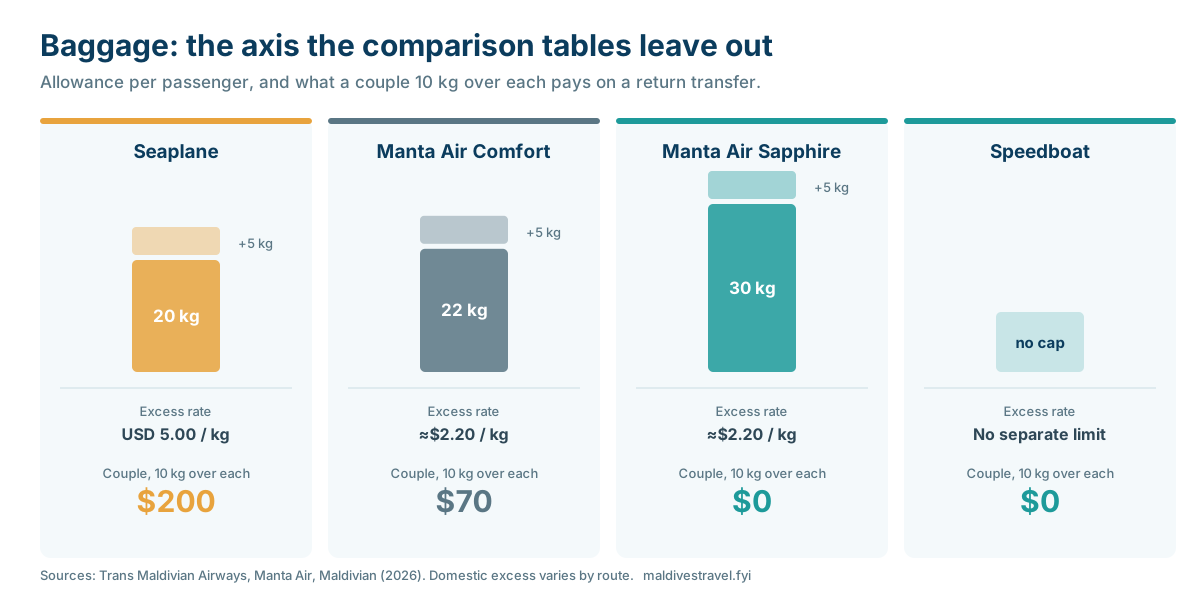
Trans Maldivian Airways allows 25 kg per person on a seaplane transfer: 20 kg checked plus 5 kg of hand luggage. Single bags are capped at 32 kg, infants get no allowance at all, and excess runs at USD 5 per kilogram plus tax. Manta Air applies the same 20 plus 5 on its floatplanes.
The fixed-wing side is more generous and the excess is cheaper. Manta Air’s Comfort Class carries 22 kg checked plus cabin baggage, and Sapphire Class carries 30 kg. Maldivian charges excess by route distance rather than a flat rate. It is MVR 34 per kilogram to Dharavandhoo or Thimarafushi, and MVR 58 to the southern trio of Kooddoo, Kaadedhdhoo and Kadhdhoo. The long run to Gan costs MVR 70. At the pegged rate those are roughly $2.20, $3.76 and $4.54.
| Seaplane | Manta Air Comfort | Manta Air Sapphire | Speedboat | |
|---|---|---|---|---|
| Checked allowance | 20 kg | 22 kg | 30 kg | International ticket |
| Cabin | 5 kg | 5 kg | 5 kg | Unrestricted in practice |
| Excess per kg | USD 5.00 | route-based, from ≈$2.20 | route-based, from ≈$2.20 | none |
| Hard cases | May follow on a later flight | Normal hold | Normal hold | No issue |
Two travellers packing 30 kg each are 10 kg over on a floatplane. That is $50 per person per leg, so $200 across a return transfer. The same pair flying to Dharavandhoo on Maldivian pays about $88. In Manta Air’s Sapphire Class they pay nothing. Add that to a route where the fixed-wing fare was already lower, and the gap stops being marginal.
One more seaplane-only quirk is that rigid suitcases do not always fit the float hold on the same aircraft as their owner, and bags can follow on a later rotation the same day. Soft-sided luggage travels more reliably, and a change of clothes belongs in the 5 kg you carry on.
Daylight, night flying and what each mode does to your first day
The seaplane fleet flies under visual rules. It launches around sunrise and stops at sunset, with no exceptions. Trans Maldivian Airways advises international passengers to be on the ground in the Maldives by 15:30 if they want to reach the island the same day. Resorts often set an earlier internal cutoff, so treat 15:30 as the outer edge rather than a target.
The consequence is blunt. Land after the cutoff with a floatplane resort booked and your transfer options are a night in Malé or Hulhumalé followed by the first morning departure, or nothing at all. That costs a hotel, a meal, two extra ground transfers and — the expensive part — the first day of a holiday you paid resort rates for.
Fixed-wing removes the constraint, because lit runways at Madivaru, Ifuru, Maafaru, Dharavandhoo and the rest accept aircraft after dark, which is precisely why Lhaviyani’s operators pushed for an airport. Speedboats never had the constraint in the first place.
The return leg carries its own arithmetic, and it is the one people forget. TMA looks after guests whose international departure is scheduled after 09:00. If your flight home leaves earlier, the seaplane cannot reach Velana in time, and the last night may be spent in Malé rather than in the villa. Anyone building a honeymoon itinerary around a dawn departure should check this before booking flights, not after.
A practical sequence: fix your international arrival window first, then filter islands by what can actually collect you at that hour. Doing it the other way round is how people pay for a transit hotel on night one.
Weather, cancellations and which transfer fails most gracefully
All three modes are weather-exposed, but they fail differently. On a bad week, that difference is worth more than the price gap.
Seaplanes are the most fragile of the three, because visual rules mean low cloud, heavy rain and gusting wind stop the operation, and during the southwest monsoon from May to October those conditions arrive in blocks rather than moments. When the fleet is grounded everyone waits, and an aircraft that missed a morning rotation is still behind by afternoon.
Speedboats keep running in weather that halts floatplanes, but the ride changes character. A 45-minute crossing in monsoon swell is a hard hour for anyone prone to seasickness, and no amount of cabin air conditioning fixes it.
Fixed-wing is the sturdiest transfer of the three. Pressurised turboprops with instrument approaches shrug off cloud that grounds a Twin Otter, and the boat leg at the far end is usually short and inside the atoll rather than across open ocean. Several properties formalise this: Finolhu in Baa lists a domestic flight plus speedboat as its stated alternative for guests arriving outside the seaplane window or in poor conditions.
That fallback clause is the single most useful thing to ask for. If your resort has one, a cancelled floatplane becomes a delayed evening rather than a lost day.
Who each mode is wrong for
Comparison tables tell you what each transfer does. This is the part that decides bookings.
A seaplane is the wrong transfer if you land after mid-afternoon, fly home before 09:00, are travelling with 30 kg suitcases you will not repack, need a wheelchair-accessible boarding process, or are visiting during the monsoon on a short trip where losing a day to weather matters. The cabin is unpressurised, noisy and hot on the ground, and the flight can include a stop at another island.
A speedboat is the wrong transfer if anyone in the party gets motion sick, you are pregnant, you have a spinal or back condition, you are travelling with an infant under a year old, or the crossing runs beyond about 45 minutes in the southwest monsoon. Sitting in the rear third of the hull helps. It does not solve it.
A domestic flight is the wrong transfer if the schedule does not line up with your arrival and the next departure is five hours away, if the boat leg at the far end runs over an hour, or if the aerial descent over the reef is the thing you were buying. Fixed-wing cruises higher, and the view is ordinary by comparison.
When none of it works: if your only route is a floatplane, you land at 19:00, and the resort will not discount the forced transit night, the honest answer is a different island. Swapping to a boat-transfer property in North or South Malé costs less than a wasted day plus a hotel, and our best atolls ranking sorts them by what actually changes for the traveller.
Four questions that settle it
Work through these in order, because the first one that returns a hard constraint ends the process.
- What time do you land, and what time do you leave? Anything after roughly 15:30 in, or before 09:00 out, removes the seaplane. This filter alone resolves most cases.
- Does your island have two routes? Check it against the nine-atoll table above. If not, there is nothing to compare and the transfer comes with the room.
- What do both rate cards actually say? Request the seaplane price and the fixed-wing price in writing, for adults and children separately. Assume nothing about which is lower.
- How much are you carrying? Total the checked weight for the whole party, subtract 20 kg per person, and multiply the remainder by $5. If that number is uncomfortable, the runway transfer pays for itself.
Everything else — the view, the champagne on the jetty, the lounge — is preference. These four are arithmetic.
What to take away
- The transfer is assigned by the resort, not chosen at the airport. Your real decision is the island, made months earlier.
- Nine atolls now offer two working routes to the same resort. Baa, Lhaviyani, Raa, Noonu, Dhaalu and South Ari are the strongest cases.
- The fixed-wing transfer is cheaper about half the time and dearer the other half. Conrad Rangali costs $420 more per adult by domestic flight than by seaplane.
- Baggage is the hidden line item. A couple 10 kg over pays $200 extra on a floatplane and nothing in Manta Air’s Sapphire Class.
- Daylight is the only truly hard rule. Land after 15:30 or depart before 09:00 and the seaplane leaves the table regardless of budget.
Next step: email the resort and ask for both transfer rate cards, both baggage allowances, and its written fallback if the seaplane cannot fly. Do it before you buy the international ticket. Once flights are booked, the transfer stops being a comparison and becomes a constraint. For the wider mechanics of each mode, our full transfers guide covers the arrival process end to end, and the Getting Around section collects the airport-by-airport detail.
Frequently asked questions
Can I choose between a seaplane and a domestic flight myself? Not directly. Resorts reserve every transfer through their contracted operators and assign the mode from your flight times. What you can do is ask, before booking, whether both routes exist for your island and what each costs. On dual-route atolls, resorts will usually accommodate a stated preference.
Which is cheaper, a seaplane or a domestic flight? It depends entirely on the resort. The Westin Miriandhoo in Baa lists $620 per adult by seaplane against $495 by domestic flight and boat. Conrad Rangali in South Ari runs the other way, at $1,360 by seaplane against $1,780 by domestic flight. Distance from Malé does not predict it.
What happens if my flight lands after the seaplane cutoff? You overnight in Malé or Hulhumalé and take the first departure next morning, unless your resort offers a fixed-wing fallback. Trans Maldivian Airways advises arrival by 15:30 for a same-day transfer, and individual resorts often set an earlier limit.
Is a domestic flight slower than a seaplane? Usually yes, door to door. Flying times are comparable, but the fixed-wing transfer adds a terminal move at Velana, a second check-in, baggage reclaim at the regional airport and a boat leg of 10 to 60 minutes. Budget two to three hours from landing to jetty.
How much luggage can I bring on each transfer? Seaplanes allow 20 kg checked plus 5 kg cabin, with excess at USD 5 per kilogram. Manta Air’s domestic Comfort Class allows 22 kg and Sapphire Class 30 kg. Maldivian charges excess by route, from MVR 34 per kilogram to Dharavandhoo up to MVR 70 to Gan, while speedboats impose no separate limit at all.
Which transfer is most reliable in bad weather? The domestic flight. Pressurised turboprops with instrument approaches operate in cloud and rain that ground seaplanes, and the connecting boat runs inside the atoll rather than across open ocean. Speedboats keep going in most conditions but become uncomfortable in monsoon swell.
Do children and infants pay for transfers? Children aged 2 to 11 typically pay half the adult fare on both seaplanes and domestic flights. The Westin quotes $310 and $247.50 respectively. Infants under 2 generally travel free, but receive no baggage allowance of their own on a seaplane transfer.
Are there atolls where only one option exists? Yes, most of them: North and South Malé are speedboat-only. Addu, Laamu, Gaafu Alifu, Gaafu Dhaalu and Fuvahmulah sit beyond seaplane range and are reached only by fixed-wing flight plus boat. The genuine transfer choice sits in the nine atolls listed above.
Sources for this article
- Trans Maldivian Airways — Frequently Asked Questions (transfer booking, daylight operation, baggage): https://www.transmaldivian.com/faq/
- Manta Air — Baggage Allowance & Add-Ons: https://mantaair.mv/baggage-allowance
- Manta Air — Madivaru Airport destination page: https://mantaair.mv/destinations/madivaru-airport
- Maldivian (Island Aviation Services) — Baggage Policy: https://www.maldivian.aero/flying-with-us/before-you-fly/baggage-policy.html
- Wego Travel Blog — Maldives Resort Transfer: Understanding the Speedboat, Seaplane or Flight Options, 15 July 2026: https://blog.wego.com/maldives-resort-transfer/
- Wiotto — Transfer costs in the Maldives: boat, seaplane, domestic airlines, 2 October 2025: https://wiotto.com/en/article/maldives-transfer-rates
- Travel Trade Maldives — Madivaru Airport Officially Inaugurated, 18 February 2022: https://www.traveltrademaldives.com/madivaru-airport-officially-inaugurated/
- TravelDailyNews Asia — New domestic airport opens in the Maldives’ Lhaviyani Atoll: https://www.traveldailynews.asia/asia-pacific/new-domestic-airport-opens-in-the-maldives-lhaviyani-atoll/
- Corporate Maldives — Kuredu Holdings signs agreement with IASL to operate Madivaru Airport: https://corporatemaldives.com/kuredu-holdings-pvt-ltd-has-signed-an-agreement-with-iasl-to-operate-madivaru-airport-in-lhaviyani-atoll/
- Finolhu, a Seaside Collection Resort — Terms and Conditions (fixed-wing fallback): https://www.finolhu.com/terms-and-conditions/
- Marriott — The Westin Maldives Miriandhoo Resort, Getting Here: https://www.marriott.com/en-us/hotels/mlewi-the-westin-maldives-miriandhoo-resort/overview/
- Wikipedia — Trans Maldivian Airways (fleet and destination count): https://en.wikipedia.org/wiki/Trans_Maldivian_Airways