
The Best Atolls in the Maldives — Ranked by What Actually Matters for Your Trip
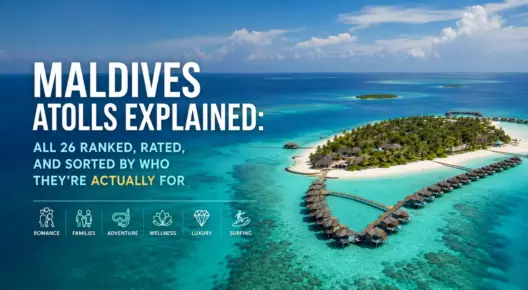
Every guide to the best Maldives atolls tells you the same thing: they’re all beautiful. That’s true, and it’s useless. The water is the same colour in all twenty-six of them, and any of them produces the photograph you have in mind. What actually differs is whether the transfer eats a day and $800 per person before you’ve paid for a room, whether the atoll gives you thirty-five resorts to choose from or two, and whether the animal you flew nine hours to see is present in the month you booked.
This ranking is built on those differences, using 2026 transfer costs, resort counts and protected-area data. Five atolls make the shortlist, four get honourable mentions, and the ones that don’t appear are explained rather than skipped over. Some verdicts are unflattering. One entry on the list is a place most travellers should not book at all.
How We Ranked the Atolls: Four Criteria That Change Your Trip
Rankings collapse when the criteria stay hidden. Four things decide whether an atoll suits you, and they pull against each other constantly.
Transfer time and cost. Everything reaches you through Velana International Airport. From there it’s a speedboat, a seaplane, or a domestic flight plus a boat. That choice adds $100–$820 per person, round trip, before you’ve paid for a night’s accommodation. It also decides whether an evening arrival costs you a night in Malé.
Marine life you can rely on. Not “excellent snorkelling” — a specific animal, at a specific site, in months you can name. Two atolls in the Maldives clear that bar convincingly. Most don’t.
Resort density. An atoll with thirty resorts gives you price competition, arrival flexibility, and a fallback if your first choice is full. An atoll with two gives you a take-it-or-leave-it price.
Budget range. Not the headline nightly rate. Every resort bill carries 17% tourism GST, a 10% service charge, and a flat green tax of $12 per person per night — the last of which doubled on 1 January 2025, and still shows as $6 in a lot of older planning tools.
One correction before the list, because it shapes everything below. The Maldives is routinely described as twenty-six atolls, and travellers reasonably assume twenty-six choices. Those twenty-six are natural formations, grouped into twenty administrative atolls — and as of 2026 every one of those twenty has at least one resort operating in it. The problem is not empty atolls. It’s lopsided supply, which the last section unpacks.

#1 North Malé Atoll: The Benchmark, and Its Downsides
North Malé wins on the criterion that beats every other one: you are in your villa within an hour of clearing customs. A speedboat runs 15 to 45 minutes to most islands, operates around the clock, and costs a fraction of a seaplane seat. Land at 11pm and you still sleep at the resort.
The supporting numbers hold up. Luxury comparison site LuxAtolls counted 35-plus resorts across every price band here in its 2026 atoll guide. That is the widest choice in the country, spanning simple four-star islands and One&Only Reethi Rah. Banana Reef sits minutes from dozens of resorts, alongside HP Reef and Okobe Thila. It was one of the first Maldivian dive sites to gain an international reputation and is now a protected area. Ten named surf breaks work the eastern rim from March to October, Pasta Point among them.
Lankan Manta Point runs a cleaning station from May to November, so even the manta season has a foothold here.
One caveat specific to this atoll: house reef quality varies enormously between islands here, far more than in Baa or South Ari. Some North Malé resorts have a wall of coral you can swim to from the beach. Others have a lagoon of sand and a boat ride to anything worth seeing. Check the house reef on the specific island, not the atoll.
The downside is the same fact stated differently. This is the most heavily trafficked water in the Maldives. Malé’s skyline is visible from southern islands, boat traffic is constant, and Banana Reef in particular gets busy enough that dive operators advise going early. The famous overwater villas here often look across a channel at another resort’s overwater villas.
Choose it if it’s a short trip, a first trip, or you’re arriving late. Skip it if the mental image driving your booking is an empty horizon. Our full breakdown of properties and house reefs is in the North Malé Atoll resorts guide.
#2 Baa Atoll: Unbeatable for Marine Life, Expensive to Reach
Baa Atoll has something no other atoll can match, and it’s worth being precise about what it is. Hanifaru Bay, inside a UNESCO Biosphere Reserve, is the largest known manta ray feeding aggregation on the planet. In peak conditions dive operators report up to 200 reef mantas feeding simultaneously in a bay of roughly seven hectares.
The rules matter as much as the spectacle. It is snorkelling only — scuba is prohibited inside the bay to avoid disturbing feeding animals. Entry costs $20 per person per day at the ranger station, sessions run about 45 minutes, and daily visitor numbers are capped at roughly 80. Season runs May to November, with the strongest odds from July to October, and sightings spike around the full and new moon when tidal currents concentrate plankton.
That’s the case for. The case against is arithmetic. Baa is a seaplane atoll: 30 to 35 minutes from Malé, with return transfers quoted around $600–$750 per adult at properties like Vakkaru and Dusit Thani for 2026. Seaplanes fly in daylight only, so an afternoon arrival can mean a night at an airport hotel. And if you book Baa outside manta season, you have paid a seaplane premium for an atoll whose main argument is currently absent.
There is a cheaper door. Dharavandhoo, the nearest inhabited island, is a roughly 31-minute domestic flight from Malé, and a guided manta-snorkel trip from there runs around $60 per person including the conservation permit. Staying on a local island rather than a resort island also halves the green tax.
Out of season, Baa is not empty — it simply becomes a very good atoll rather than a unique one. Soneva Fushi and Anantara Kihavah both sit on strong house reefs, and Kihaa is about nine kilometres from the bay for the moment the season opens. But you are then paying a Baa premium for reef quality you can find for less elsewhere.
Choose it if you’re travelling between July and October and the mantas are the point. Skip it if your dates fall in the dry season and you’re paying seaplane rates anyway.
#3 South Ari Atoll: Whale Shark Paradise With Real Value
South Ari does something Baa cannot: it delivers a headline animal every month of the year. The South Ari Marine Protected Area, designated in 2009, runs about 14 kilometres along the atoll’s southern outer reef between Maamigili and Dhigurah. It holds the only documented resident aggregation of whale sharks anywhere in the world.
The research behind that claim is unusually solid for a tourism statistic. Maldives protected-area documentation records more than 726 individually identified whale sharks and over 8,000 encounters within the MPA, with many animals returning repeatedly — the highest re-sighting rate of any whale shark site globally. Operators report encounters on roughly 70–90% of trips across all seasons. You pick a week; you don’t time a migration.
Value is the second argument, and it’s the one competitors underplay. South Ari carries roughly fifteen to seventeen resorts spanning the entire market, from Conrad Rangali at the top to mid-market islands like Vilamendhoo. Critically, it also has guesthouse islands. Dhigurah and Maamigili put you on the whale shark reef for a fraction of resort money. The smaller-establishment green tax rate is $6 per person per night rather than $12, which compounds over a week.
The atoll has a second, quieter draw. Ithaa at Conrad Maldives Rangali Island, five metres below the lagoon surface, was the world’s first all-glass undersea restaurant when it opened in 2005 and still takes non-resident bookings.
Now the honest caveat. These are juvenile whale sharks cruising at 5–15 metres, usually seen from a boat trip rather than off your own beach. Excursions can get crowded, with several operators queuing for the same animal. Ranger-monitored contact rules exist precisely because of that pressure — which is worth remembering if your mental image is a private encounter.
Choose it if you want one unforgettable wildlife encounter without seasonal roulette, at a price you can control.
#4 Noonu Atoll: Best Ultra-Luxury, Worst Budget
Noonu is the clearest example in this ranking of an atoll that is genuinely the best at something and genuinely wrong for most people.
Three of the most expensive resorts on earth sit in one quiet lagoon system: Soneva Jani, with overwater retreats that have retractable roofs and slides into the water; Velaa Private Island, laid out in the shape of a turtle; and Cheval Blanc Randheli, LVMH’s island maison, opened in 2013 with 45 villas across six islands. No other atoll concentrates that much top-end ambition into so little development, and the empty lagoon between the properties is part of what you’re buying.
The infrastructure matches the clientele. Maafaru International Airport opened in 2019 and, since its runway extension, has handled wide-body aircraft including A330s and 787s flying direct from the Gulf and southern Europe. Maldives Independent reported in February 2026 that Maafaru has become the country’s private jet hub, with guests bound for Raa and Baa now routing through it too. Seaplane from Malé takes 40 to 45 minutes; a domestic flight into Maafaru plus a 15-minute speedboat is the alternative.
Now the downside, which is severe. Below the flagships there is very little. The supporting cast — Noku, Sun Siyam Iru Fushi, Siyam World, Kuredhivaru — is decent but thin, and there is no meaningful budget tier on the resort side. Guesthouses exist on local islands such as Velidhoo and Fodhdhoo from roughly $40–$80 a night, but you are then on a local island in an atoll built for people arriving by private jet, and the excursion economics reflect that.
Choose it if the trip is a milestone and the budget is genuinely open. Skip it if you’re optimising value — the same money buys more resort in Raa.

#5 Vaavu Atoll: Divers Only — Skip It If You Don’t Dive
Vaavu is on this list for one reason, and the reason is exceptional enough to override everything else about the place.
Fotteyo Kandu is widely cited by dive operators and dive publications as the finest channel dive in the Maldives, and it appears in international rankings of the world’s best channels. The reef runs between roughly 8 and 35 metres, with overhangs, caves and soft-coral swim-throughs along the walls. Incoming tide pulls grey reef sharks, eagle rays and schooling jacks into the channel mouth. Miyaru Kandu — “shark channel” in Dhivehi — sits alongside it, and Alimatha’s house reef delivers what many divers rate the best night dive in the country, with nurse sharks and stingrays in numbers.
Vaavu is also easy to reach for a remote-feeling atoll: 70 to 90 minutes by scheduled speedboat, running after sunset, so no seaplane premium and no forced overnight in Malé.
Here is why it ranks fifth, and why it comes with a warning. Vaavu is officially the least populous administrative atoll in the Maldives, with five inhabited villages across nineteen islands. It runs on a very small handful of resorts — Alimatha and Dhiggiri under the NAKAI brand, plus Cinnamon Velifushi and Cocogiri. There is no full-spectrum resort pampering here and no meaningful choice of island.
The headline dives are also not beginner sites. Dive centres typically want Advanced Open Water with a drift speciality and around 30 logged dives before signing you off for Fotteyo, and they will run a check-out dive first. Newer divers still have options — the house reefs and the gentler Devana Kandu — but the sites that justify the trip need current experience. Anything overhead-environment here needs its own certification on top.
Choose it if you are a certified, current diver and the diving is the holiday. Skip it if anyone in your party is there for the beach — this is the clearest skip on the list.
Your Dates Can Re-Rank These Atolls Entirely
No ranking of Maldives atolls survives contact with a fixed set of dates, and this is where most lists mislead by omission.
The country runs on two monsoons. The northeast monsoon, roughly December to April, is the dry season: calmer seas, less rain, and the best underwater visibility of the year. The southwest monsoon, roughly May to November, brings more wind and rain — and, with it, the plankton that drives the biggest wildlife events.
That flips the order above depending on when you fly. Book July to October and Baa arguably outranks everything, because Hanifaru is running and nothing else in the Maldives compares. Book January to March and Baa’s central argument is dormant, while North Malé’s dive sites hit peak visibility and Vaavu’s channels sit in their best window.
South Ari is the exception that earns its ranking. Because the whale sharks are resident rather than migratory, its headline draw does not have an off-season. Sightings are marginally more reliable in the dry season thanks to better surface visibility, but operators report encounters in every month.
The practical rule: if your dates are fixed, rank the atolls by what’s actually happening in those weeks. If your dates are flexible, pick the event first and the atoll second.
Honourable Mentions: Raa, Lhaviyani, Laamu and Addu
Four atolls narrowly miss the shortlist, each for a different reason, and each of them beats a top-five entry on some specific measure.
Raa Atoll is the value answer to Noonu. Around thirteen resorts, a 40–50 minute seaplane or a domestic flight into Ifuru, and a genuinely premium tier led by JOALI — which LuxAtolls named its overall top pick for 2026 — plus InterContinental Maamunagau. Mandarin Oriental is due to enter the atoll, which will push the ceiling higher. It ranks below the top five only because it lacks a single defining natural draw.
Lhaviyani Atoll is the turtle atoll. Kuredu Express is known for large aggregations of green sea turtles feeding, and the atoll carries roughly nine resorts including Atmosphere Kanifushi and Le Méridien, reachable in 35–45 minutes by seaplane or by domestic flight plus boat.
Laamu Atoll is the eco-adventure choice and demands commitment. It is effectively a one-five-star-resort atoll — Six Senses Laamu — with Yin Yang, one of the country’s great right-hand reef breaks, Buddhist-era ruins at Isdhoo, and lagoons that stood in for the planet Scarif in Rogue One. Wonderful, and completely wrong for a casual beach week.
Addu Atoll is the outlier. It’s the southernmost atoll, crossed by the equator, and its islands are joined by a 14-kilometre British-built causeway you can cycle — an experience available nowhere else in the country. Gan International Airport makes it the most accessible of the southern atolls. Underwater it holds the 140-metre British Loyalty wreck, scuttled by the Royal Navy in 1946 after being torpedoed during the war, and a year-round reef manta cleaning station at Maa Kandu. Shangri-La Villingili reopened on 31 December 2025 after nearly six years closed, restoring the atoll’s five-star tier.
The Atolls That Don’t Appear Here — and Why
This is where most ranked lists quietly stop, and where the real planning problem lives.
The framing that causes the trouble is the number twenty-six. Twenty-six natural atolls sounds like twenty-six destinations. In practice those twenty-six are administered as twenty atolls, and every one of those twenty currently hosts resorts. Nowhere in the Maldives is genuinely closed to visitors.
What is true — and much more useful — is that supply is extremely lopsided. Roughly 179 resorts were operating nationally in early 2026, and they are not spread evenly. Kaafu, the administrative atoll containing North and South Malé, holds something in the region of fifty of them on its own. South Ari, Baa and Raa together account for a large share of the rest. Meanwhile a Malé-based agency’s public inventory in August 2026 listed single-resort holdings for atolls including Thaa, Meemu and Vaavu, and two apiece for Laamu and Haa Alifu.
The consequence for you is not “there’s nothing there.” It’s that in roughly half the country’s atolls, choosing the atoll means choosing the resort, because there is only one at your price point. You lose price competition, you lose a fallback if it’s full, and you lose the option to change your mind after seeing the rate.
There’s a second, less obvious cost. In a single-resort atoll the property also controls the transfer, the excursions and the only restaurant, so the published nightly rate tells you even less about the final bill than usual. In North Malé or South Ari, a resort that overprices its transfer is competing against twenty others that don’t. That competitive pressure is a real feature of the top-ranked atolls, and its absence is a real reason atolls with excellent reefs sit outside this ranking.
Several of them are worth a look once you understand that constraint. Dhaalu offers mid-range luxury at better value than the central atolls. Gaafu Dhaalu has the country’s most serious surf. Fuvahmulah has built a global reputation on tiger sharks. Faafu, Meemu, Thaa, Shaviyani, Haa Alifu, Haa Dhaalu and Gaafu Alifu each have a case, covered atoll by atoll in the complete Maldives atolls guide.
FAQ: Which Atoll Is Best for First-Timers, Honeymoons, Divers and Budget
Which atoll is best for first-timers? North Malé. Short speedboat transfer, resorts at every price, and the widest margin for error if a flight is delayed. South Malé is the quieter alternative at 30–60 minutes.
Which atoll is best for a honeymoon? Noonu if the budget is open — Soneva Jani, Velaa and Cheval Blanc Randheli are there and the lagoons between them are empty. Raa if you want most of that feeling for materially less. A common ten-night structure is Raa first, Noonu to finish.
Which atoll is best for divers? Vaavu for channel diving, on the strength of Fotteyo Kandu, provided you hold Advanced Open Water and have current experience with drift. South Ari if the goal is whale sharks specifically. Baa between July and October for mantas, remembering that Hanifaru itself is snorkelling only.
Which atoll is best on a budget? South Ari, via the guesthouse islands of Dhigurah and Maamigili. You get the country’s most reliable big-animal encounter, and small establishments carry the $6 green tax rate rather than $12.
Is a seaplane worth it over a speedboat? Only when it buys you an atoll you actually want. A seaplane adds roughly $300–$400 per person over a speedboat and restricts you to daylight arrivals. If the atoll’s draw is generic, that money is better spent on nights. Transfer mechanics by atoll are covered in getting around the Maldives.
How much do taxes add? 17% tourism GST plus a 10% service charge on the bill, and a flat $12 per person per night green tax at resorts. On a seven-night stay for two, green tax alone is $168.
The Short Version
- North Malé wins on access and choice, and loses on solitude — it’s the busiest water in the country.
- Baa has the world’s best manta aggregation at Hanifaru Bay, but only May to November, and the seaplane costs $600–$750 per person return.
- South Ari is the strongest overall value: whale sharks every month of the year, plus guesthouse islands that let you see them cheaply.
- Noonu is the best ultra-luxury atoll in the Maldives and the worst place to look for a bargain.
- Vaavu is a diver’s atoll and nobody else’s — Fotteyo Kandu is world-class, the resort choice is minimal, and the headline dives need experience.
Your next decision isn’t the atoll, it’s the transfer. Look up how your shortlisted resorts get you from Velana, add that number to the nightly rate, and re-rank. Plenty of trips change atoll at exactly that moment — and it’s a much cheaper time to change your mind than after booking.
Sources for This Article
- Maldives Ministry of Tourism / Maaldif — operational tourist facility statistics, February 2026 (179 resorts operating; arrivals data). https://en.maaldif.com/11791/
- Ministry of Environment, Maldives — South Ari Marine Protected Area management plan, version May 2025 (SAMPA boundary, 726+ identified whale sharks, 8,000+ encounters, year-round residency). https://protectedareas.environment.gov.mv/
- Visit Maldives — whale sharks, South Ari Atoll (aggregation period, re-sighting rate). https://visitmaldives.com/en/places/whale-sharks-south-ari-atoll
- Maldives Inland Revenue Authority (MIRA) / Travel Trade Maldives — green tax increase to $12 per person per night effective 1 January 2025; TGST increase to 17% effective 1 July 2025. https://www.traveltrademaldives.com/maldives-increases-tourism-taxes-with-tgst-to-17/
- Maldives Independent — “The Noonu corridor: Maafaru emerges as Maldives’ private jet hub,” February 2026 (runway capability, resort cluster, 2025 arrivals and receipts). https://maldivesindependent.com/economy/the-noonu-corridor-maafaru-emerges-as-maldives-private-jet-hub-7ca1
- Resortlife Travel — Maldives transfer costs, March 2026, and Vaavu Atoll guide, May 2026 (transfer ranges, Fotteyo Kandu certification requirements, Vaavu resort inventory). https://resortlife.travel/insights/maldives-transfers-speedboat-seaplane-domestic-flights
- IM Maldives — transfer cost ranges, May 2026, and Hanifaru Bay manta season guide, July 2026 (season window, session length, daily cap, excursion pricing from Dharavandhoo). https://immaldives.com/hanifaru-bay-manta-season-guide/
- aMaldives — Hanifaru Bay diving guide and manta ray season 2026 (snorkelling-only rule, $20 ranger-station fee, seaplane access). https://amaldives.com/activities/diving/hanifaru-bay-diving
- LuxAtolls — atoll guides for North Malé, South Ari, Noonu and Laamu, and Maldives map, 2026 (resort counts, dive sites, surf breaks, “20 atolls currently host resorts”). https://luxatolls.com/maldives-map/
- Travel Connection Maldives — resorts-by-atoll inventory, accessed August 2026 (illustrative distribution of resorts across atolls). https://www.travelconnectionmaldives.com/atolls
- Dreaming of Maldives — Shangri-La Villingili reopening announcement, 31 December 2025. https://www.dreamingofmaldives.com/shangri-la-villingili-reopening/
- Maldives Magazine — North Malé Atoll diving guide, May 2026, and whale shark diving guide, July 2026 (dive site descriptions, SAMPA context). https://maldives-magazine.com/diving/north-male-atoll.htm