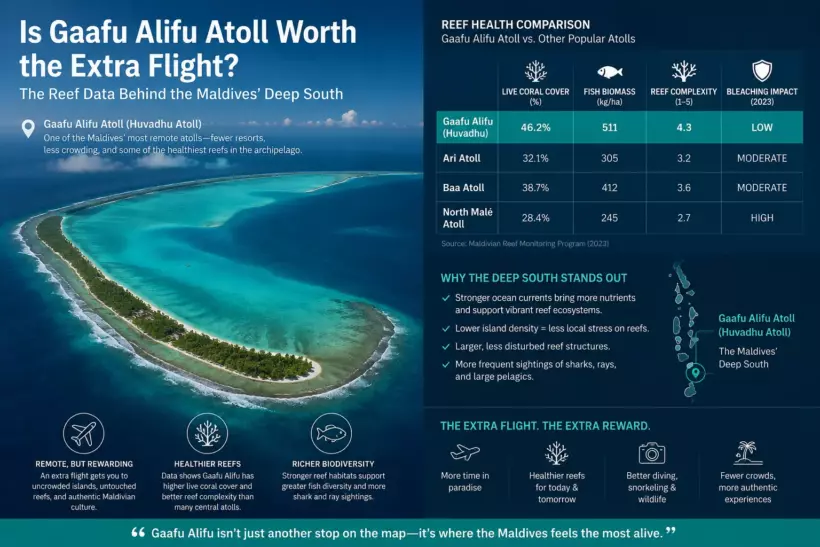
Is Gaafu Alifu Atoll Worth the Extra Flight? The Reef Data Behind the Maldives’ Deep South
Most articles about the Maldives’ Deep South call its reefs “pristine” and leave it there. In March 2026, a peer-reviewed survey put a number on it. After the worst marine heatwave ever recorded, reefs in the central atolls lost more than 40% of their live hard coral on average. Reefs in Huvadhu — the atoll whose northern half is Gaafu Alifu Atoll — lost none. They gained.
That single contrast is the honest answer to whether this remote corner of the Maldives justifies a second flight. Below: what the Deep South actually is, what the reef data says, which sharks and manta rays you can realistically expect, how the domestic flight to Kooddoo works, and — just as important — who should book somewhere else.
What the “Deep South” of the Maldives actually means
The Maldives runs roughly 870 km north to south, and the chain is not continuous. Broad, deep channels slice it into segments, and two of them define the Deep South.
The One and a Half Degree Channel (Huvadhu Kandu, also called the Suvadiva Channel) is about 97 km of open ocean separating Huvadhu Atoll from everything to the north. South of Huvadhu, the Equatorial Channel — roughly 49 km wide — separates it from Fuvahmulah, with Addu beyond that, straddling the equator.
So the Deep South Maldives is a three-part region: Huvadhu (administratively Gaafu Alifu and Gaafu Dhaalu), Fuvahmulah (Gnaviyani), and Addu (Seenu). Laamu and Thaa get called “southern” in resort marketing, but they sit north of that 97 km gap and belong to a different logistical and ecological world.
That gap matters for three reasons. It isolated the region culturally — Huvadhu has its own dialect, Huvadhoo Bas, distinct enough that Maldivians from Malé notice immediately. It isolated it commercially, which is why the atoll has a handful of resorts rather than dozens. And, as the reef data now suggests, it isolates it oceanographically in ways that appear to protect coral.
Gaafu Alifu is North Huvadhu Atoll — and the “world’s largest atoll” claim needs a correction
Gaafu Alifu Atoll — Huvadhu Atholhu Uthuruburi in Dhivehi, North Huvadhu Atoll in English — is an administrative division created on 8 February 1962, when the single natural atoll of Huvadhu was split into two districts. Gaafu Alifu is the northern half, with Villingili as its capital; Gaafu Dhaalu is the southern half. There is no reef wall between them: they are two halves of one continuous natural structure.
Here is where most travel writing gets it wrong, and it’s worth fixing because the true version is a better hook.
Huvadhu is routinely described as the world’s largest natural atoll. It isn’t. Its area is about 2,900–3,150 km², which makes it roughly the tenth largest atoll on Earth. It isn’t even the largest in the Maldives: that title goes to Boduthiladhunmathi, the vast northern structure formed by Thiladhunmathi and the Miladhunmadulu group, which today covers four administrative atolls — Haa Alifu, Haa Dhaalu, Shaviyani and Noonu. Thiladhunmathi spreads a smaller number of islands across a larger area. Huvadhu is the runner-up by size.
What Huvadhu does hold is a record that is undisputed and far more interesting: Guinness World Records lists it as the atoll containing the most islands in the world — roughly 255 of them, inside a single reef rim, with only about 38.5 km² of that being dry land. It measures around 79 km north to south and 65 km at its widest. Its lagoon is the deepest in the Maldives, averaging deeper than any other and dropping to soundings of about 80–91 m.
So the accurate framing for Gaafu Alifu is: half of the most island-dense atoll on the planet, wrapped around the country’s deepest lagoon. That’s a stronger claim than the false one, and it’s the physical setup that explains everything in the next section.
| Claim you’ll see online | What’s actually true |
|---|---|
| Huvadhu is the world’s largest atoll | ~10th largest by area; largest by island count (Guinness: ~255 islands) |
| Huvadhu is the Maldives’ largest atoll | Second — Boduthiladhunmathi (Thiladhunmathi + Miladhunmadulu) is larger by area |
| Gaafu Alifu is its own atoll | It’s the northern administrative half of one natural atoll, split in 1962 |
| Huvadhu has the deepest lagoon in the Maldives | Correct — around 80 m, with soundings to roughly 91 m |
The coral evidence: what a 2026 survey found in Huvadhu versus the central atolls
This is the part of the story almost nobody quotes, and it’s the strongest reason to consider the Deep South.
In March 2026, the journal Coral Reefs published an open-access study by Montefalcone, Bianchi, Morri, Ahmed and Pancrazi on the outcomes of the fourth global coral bleaching event (2023–2024) in the Maldives. The team re-surveyed 18 reef stations — nine lagoon, nine ocean — across the central atolls of North Malé, South Malé, Felidhoo and Ari, plus the southernmost atoll, Huvadhu. Crucially, every station had been surveyed before the heatwave, so the comparison is like-for-like at the same sites.
The heat itself was record-setting. Sea surface temperatures peaked at 31.5 °C in April 2024 and stayed above the Maldives’ 30.5 °C bleaching threshold from March into July, pushing accumulated heat stress past 9 degree heating weeks — comfortably above the level at which ecologically significant mortality is expected.
The outcomes diverged sharply by latitude:
| Reef type | Central atolls (before → after) | Huvadhu (before → after) |
|---|---|---|
| Lagoon reefs | 63.8% → 36.8% live hard coral | 64.3% → 76.7% |
| Ocean reefs | 76.3% → 35.3% live hard coral | 42.3% → 65.8% |
| Net change | Mortality up to 57% at a single Ari lagoon reef | No detectable mortality; +12.3% lagoon, +23.4% ocean |
Read that again. In the central atolls, ocean reefs that had been sitting at three-quarters live coral cover came out at roughly a third, and dead coral, rubble and sand rose to over half the substrate. In Huvadhu, coral cover went up across four years, and the increase was driven by branching and tabular Acropora — the fast-growing, structurally complex, thermally sensitive corals that died first everywhere else.
Two details make this directly relevant to Gaafu Alifu rather than “the south” in the abstract. The Huvadhu survey stations included the house reef at Villingili — the capital island of Gaafu Alifu — and Kooddoo Beyru, the outer reef off the island that holds Gaafu Alifu’s airport. These aren’t distant proxies. They’re the reefs at the front door of the atoll’s two most-used islands.
There’s an honest caveat the authors flag themselves: the Huvadhu baseline was recorded in 2021, while the central atolls were last surveyed in 2023–2024, which introduces some uncertainty from year-to-year variation. What isn’t ambiguous is the 2025 endpoint — high coral cover and intact reef structure in the south, flattened rubble fields in the centre.
Why Gaafu Alifu’s reefs survived: the mechanism, not the marketing
“Pristine coral” is a brochure adjective. The study proposes concrete reasons, and they’re worth understanding because they tell you what to expect underwater.
Water movement. Huvadhu is ringed by broad channels that move oceanic volumes of water on every tide, and its lagoon is the deepest in the country. Central atolls have smaller, more enclosed lagoons with longer water residence times, which lets heat accumulate. In Huvadhu, water turns over constantly, and stronger oceanic mixing buffers temperature extremes.
Low anthropization. The paper cites lower tourism pressure and reduced development in Huvadhu compared with the central atolls, where dredging, land reclamation, sedimentation, anchoring and wastewater load impose chronic stress that erodes a reef’s ability to survive a heat spike.
That second point is measurable. As of late 2025, Kaafu Atoll alone held 57 resorts and over 320 guesthouses and accounted for roughly 45% of all tourist arrivals in the country. Gaafu Alifu has about seven resorts and a handful of guesthouses across an atoll half you could lose a small country inside. That gap between low tourist density and reef condition is not a coincidence — it’s the working hypothesis of the researchers.
For a visitor, the practical translation is this: what you see on a Gaafu Alifu reef is three-dimensional. Table corals, branching thickets, vertical relief, and the fish density that structural complexity supports. In much of the central Maldives right now, you’re snorkelling over encrusting and massive corals on a flattened surface — alive, but architecturally a different place.
One more thing to keep straight: this is a snapshot from 2025, not a permanent state. Bleaching is shifting from an episodic event to a near-annual one. Southern reefs are being described in the literature as a potential climate refugium, which is a statement about relative odds, not immunity.
Diving Gaafu Alifu: sharks, manta rays and the kandus
Gaafu Alifu’s diving is channel diving. In Dhivehi a channel is a kandu, and the atoll’s reputation rests almost entirely on them — the gaps in the rim where tidal exchange between the deep lagoon and the open Indian Ocean concentrates pelagic life.
Villingili Kandu is the signature site: strong current, and dozens of grey reef sharks holding station in the flow, alongside whitetips, eagle rays and dense schools of jacks and tuna.
Nilandhoo Kandu is the drift most often cited by liveaboard operators. The current bites hardest at the channel entrance and the drop-off. Grey reef and silky sharks, leopard sharks, barracuda walls, eagle rays and turtles on the sand are the standard cast.
Kooddoo Kandu is technical and rewarding — grey reef and blacktip sharks, with occasional hammerhead sightings.
Gemanafushi is the gambler’s dive: enter in the blue, drift the outer reef, and in strong current cover three to four kilometres. Early morning is when hammerheads or silkies are most likely to rise from the deep for a look.
Manta rays are the honest weak point, and any article that promises them is overselling. Gaafu Alifu has cleaning stations — Maa Kandu and the site local operators call Manta Point among them — but this is seasonal, not the reliable aggregation you get at Hanifaru Bay in Baa or the year-round cleaning station in neighbouring Addu. Treat manta rays here as a good chance, not a booking reason.
Whale sharks are a genuine Deep South speciality with a specific window. Between January and April, liveaboards anchor in the atoll’s northeast and run spotlights into the water at night. The lights draw plankton, the plankton draw whale sharks, mantas and mobulas to the surface, and guests slide in alongside them. It’s one of the few whale shark encounters in the Maldives that isn’t a daytime boat chase.
Conditions: water at 27–30 °C year-round, visibility frequently over 30 m, a 3 mm suit or less. The peak window is the northeast monsoon, roughly December through April or May, which is also the only period liveaboards reliably run Deep South crossings — outside it, the open-water passages between atolls get unpredictable swell.
A word on skill level. Several of these dives involve serious current, and Deep South liveaboard itineraries commonly ask for around 100 logged dives with drift experience. If you’re newly certified, the resort house reefs are exceptional and the channels can wait.
Getting there: the domestic flight to Kooddoo
This is the filter that keeps Gaafu Alifu quiet, and it’s less painful than its reputation suggests.
The gateway is Kooddoo Airport (GKK) on Kooddoo island in Gaafu Alifu, opened on 10 September 2012. Before it existed, reaching these resorts meant an hour-plus flight followed by an hour or more of speedboat. Now:
- Land at Velana International (MLE), Malé. Domestic operations moved to the modernised Terminal 2 in February 2026.
- Domestic flight MLE → GKK, about 55–65 minutes, roughly 386 km, operated by Maldivian on ATR 72 and Dash 8 turboprops, with multiple rotations daily.
- Speedboat, typically 10–40 minutes depending on which island you’re heading to.
Third-party estimates put the domestic leg at roughly US$400–500 return per person all-in, and evening rotations make same-day international connections workable rather than a gamble. Budget a transfer day at each end anyway — the combined journey from a European or Asian gateway is long.
Two logistics notes that trip people up. Scheduled seaplanes generally don’t serve this far south, so the domestic-flight-plus-speedboat routing is the norm rather than the seaplane hop people associate with the Maldives — although The Halcyon Private Isles markets a direct 90-minute seaplane transfer from Malé as its headline option, with the Kooddoo or Kaadedhdhoo domestic routing as the alternative. And Kaadedhdhoo (KDM) serves Gaafu Dhaalu, the southern half; make sure your booking specifies the right airport for your island.
Where to stay in Gaafu Alifu: seven islands, no crowds
For an atoll half this size, the resort bench is small, deliberate, and unusually varied in price — which is rare in the far south, where most atolls offer either five-star or nothing.
| Resort | Island | Notes |
|---|---|---|
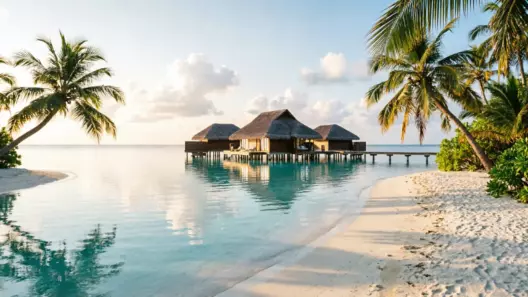
| The Halcyon Private Isles, Autograph Collection | Meradhoo | 38 villas across two islands — a beach island plus a separate overwater enclave — all with private pools |
| Park Hyatt Maldives Hadahaa | Hadahaa | Opened the deep south to the luxury market; reef-edge villa curve, ~50 rooms |
| The Residence Maldives | Falhumaafushi & Dhigurah | Twin resorts linked by a kilometre-long bridge over the lagoon |
| Pullman Maldives Maamutaa | Maamutaa | 122 villas, all-inclusive flagship, 18 hectares |
| Mercure Maldives Kooddoo | Kooddoo | Adults-only, 69 villas, closest to the airport |
| Robinson Maldives | Funamadua | Club format; the atoll’s genuine mid-market option |
Halcyon Private Isles deserves a factual footnote, because briefs and listings frequently describe it as a new resort. It isn’t a new build. The island opened as Jumeirah Dhevanafushi in 2011, became Raffles Maldives Meradhoo under Accor in 2019, and rebranded as The Halcyon Private Isles on 1 November 2025 under a Marriott franchise agreement — Autograph Collection’s debut property in the Maldives. The island, the reefs and the villa architecture predate the name by well over a decade. That’s a point in its favour, not against it: the house reefs are mature and the property has an operating history, which matters more than a launch date.
Who Gaafu Alifu is wrong for
The most useful section in any destination article is the one that talks people out of it. Gaafu Alifu is a poor fit if:
- It’s your first Maldives trip and you have a week. Two transfer days out of seven is a heavy tax when Kaafu and Baa deliver a good version of the same postcard 25 minutes from the airport.
- Manta rays are the reason you’re going. Baa’s Hanifaru Bay in season, or Addu’s year-round cleaning station, are the honest answers.
- You want local-island guesthouse travel. Nearly half the country’s guesthouse beds sit in Kaafu Atoll; the four best-connected atolls hold roughly 81% of them. Gaafu Alifu’s independent-traveller infrastructure is thin.
- You’re a new diver hoping to dive the famous sites. The kandus that make the atoll’s reputation are current-driven and unforgiving.
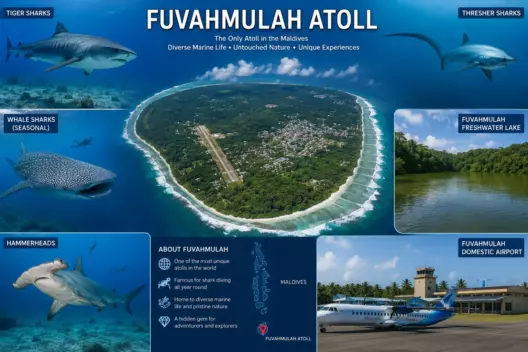
- You want tiger sharks. That’s Fuvahmulah, one channel to the south — 80 minutes’ flight from Malé and a completely different proposition.
Gaafu Alifu is right if you’re a diver or serious snorkeller who cares more about what’s on the reef than how fast you get to it, if you want an atoll where a dive site isn’t shared with four other boats, and if reef condition genuinely factors into your choice of destination.
Best time to visit Gaafu Alifu Atoll
December to April is the window, for reasons that stack neatly. It’s the northeast monsoon, so the seas are calmest. It’s when liveaboards can reliably cross the open channels. It overlaps the January–April whale shark period in the atoll’s northeast. And channel visibility is at its best.
May through November brings the southwest monsoon: more rain, more swell, fewer boats making the crossing, and lower rates at the resorts, which stay open year-round and can be excellent value if house-reef snorkelling rather than channel diving is your priority.
FAQ
Is Gaafu Alifu Atoll the same as Huvadhu Atoll? Not quite. Huvadhu is one natural atoll; Gaafu Alifu is its northern administrative half, created in 1962. Gaafu Dhaalu is the southern half.
Is Huvadhu really the world’s largest atoll? No. It’s roughly the tenth largest by area and second in the Maldives after Boduthiladhunmathi. It does hold the Guinness World Record for the most islands within a single atoll — around 255.
How long is the flight from Malé to Gaafu Alifu? About 55–65 minutes by domestic flight to Kooddoo Airport (GKK), then a 10–40 minute speedboat.
Is the coral in Gaafu Alifu actually better than the central atolls? On the 2025 evidence, yes, and by a wide margin. Huvadhu reefs showed no detectable mortality after the 2024 bleaching and gained 12–23% coral cover, while central atoll reefs lost more than 40% on average.
Can I see manta rays and whale sharks in Gaafu Alifu? Whale sharks are a real January-to-April draw, particularly on night encounters in the atoll’s northeast. Manta rays are seasonal and not guaranteed — Baa and Addu are the more reliable options.
Are there guesthouses in Gaafu Alifu? A few, on islands such as Dhaandhoo and Maamendhoo, but the atoll is resort-dominated and independent-traveller infrastructure is limited compared with the central atolls.
The short version
Gaafu Alifu Atoll is the northern half of Huvadhu — the atoll with more islands than any other on Earth, wrapped around the deepest lagoon in the Maldives, and separated from the rest of the country by 97 km of open ocean. That isolation is the whole story: it kept the resorts few, the dive sites uncrowded, and — on the evidence of the 2025 surveys — the coral alive through the worst bleaching event on record while the central atolls lost roughly half of theirs.
It costs one extra domestic flight and roughly a day of travel at each end. If reef condition is what you actually came for, that’s the best value transfer in the Maldives right now.
Primary source: Montefalcone M., Bianchi C.N., Morri C., Ahmed H., Pancrazi I. (2026). Outcomes of the fourth global coral bleaching (2023–2024) in the Maldives. Coral Reefs, published 13 March 2026, open access. DOI: 10.1007/s00338-026-02850-x