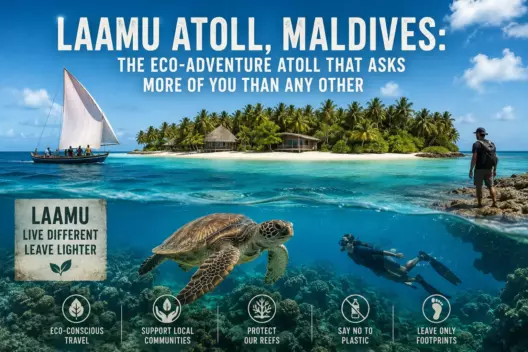
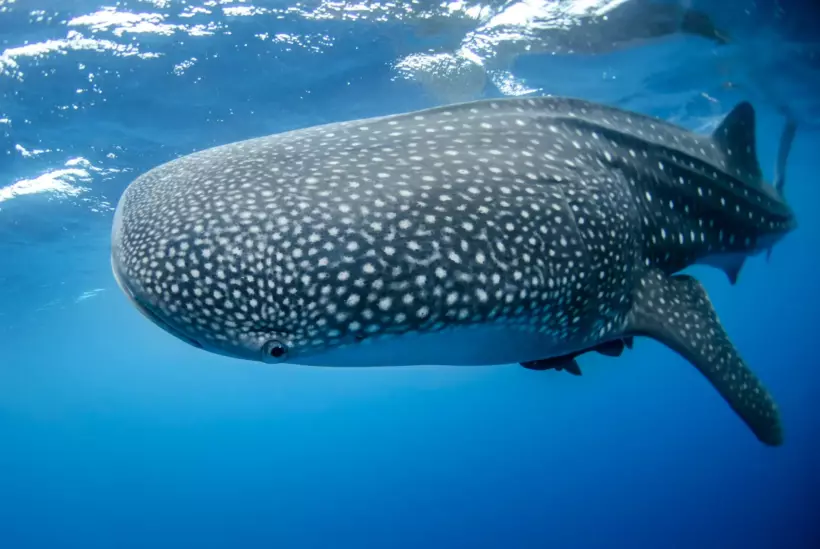
Every travel article about the Maldives says the same thing: “Whale sharks can be seen from May to November.” It’s not wrong, exactly. It’s just describing the wrong atolls.
In South Ari Atoll, the calendar is irrelevant. The whale sharks there are not seasonal visitors responding to a monsoon cue — they are residents. The same juvenile males cruise the same 14-km reef shelf in January as they do in August. Operators report sightings on 70–90% of all trips across every month of the year. This isn’t a lucky statistic; it reflects a biological reality that most planning guides quietly gloss over.
Understanding why South Ari works year-round — and where the seasonal logic does apply — is the difference between booking a trip that delivers and booking one that doesn’t. This guide covers every atoll worth knowing about, explains the science simply, and gives you the concrete planning data to make the right call for your travel window.
Why the “May to November” Rule Applies to Mantas, Not Whale Sharks
The confusion starts with Hanifaru Bay, and it’s been repeated so many times that it has calcified into received wisdom.
Hanifaru Bay in Baa Atoll is a UNESCO Biosphere Reserve and the single most famous marine spectacle in the Indian Ocean. During the southwest monsoon (roughly May to November), plankton blooms funnel into the bay’s bowl-shaped lagoon, creating concentrated feeding aggregations of reef manta rays. Sometimes hundreds of mantas are present simultaneously. Whale sharks also appear during these blooms, drawn by the same food source.
The problem is that this seasonal event — dependent on monsoon-driven upwelling — gets conflated with whale shark sightings generally. Write “best time to see whale sharks in the Maldives” and the answer almost always returns “May to November.” That answer is accurate for Hanifaru Bay. It is actively misleading for South Ari Atoll, which operates on entirely different biology.
South Ari Atoll: Why Whale Sharks Live Here Year-Round
The Developmental Habitat Theory
The whale sharks in South Ari are overwhelmingly juvenile males, typically ranging from 4 to 8 metres in length. The scientific consensus, built from over 15 years of research by the Maldives Whale Shark Research Programme (MWSRP), treats the South Ari Marine Protected Area (SAMPA) as a developmental habitat — the equivalent of a nursery ground for young sharks.
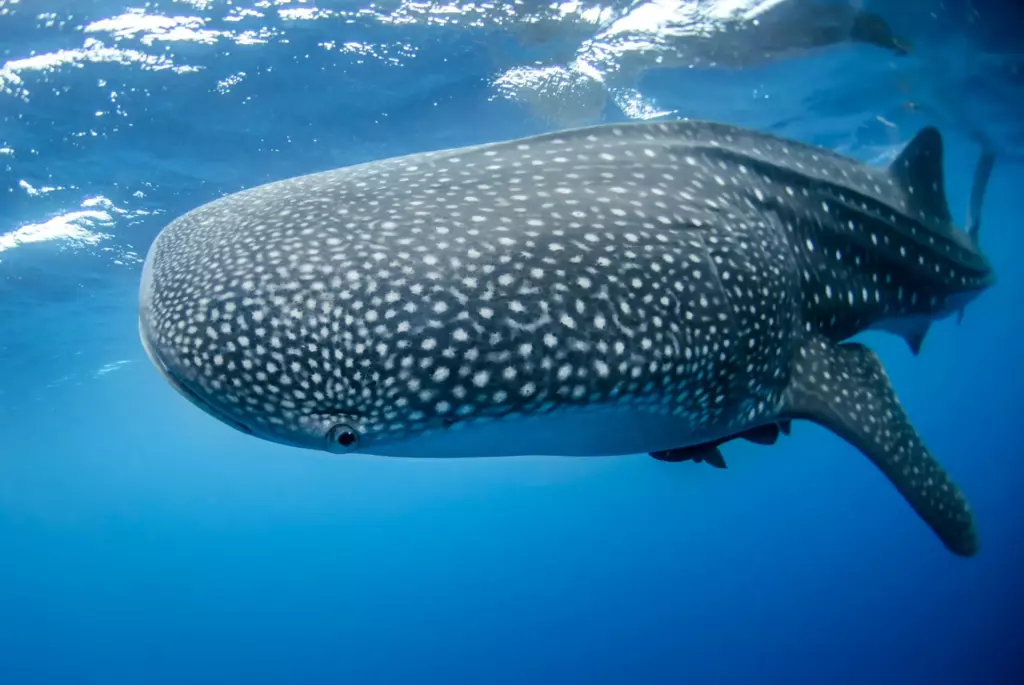
Juvenile whale sharks in developmental habitats behave differently from the adults that make long oceanic migrations. They have not yet reached sexual maturity, have no reason to follow spawning or mating cues across ocean basins, and appear to have lower energy requirements that allow them to exploit a single rich feeding ground over extended periods. South Ari’s western reef shelf gives them exactly that: a shallow (5–15 m) plankton-rich gradient where they can feed near the surface with minimal energetic cost.
This is why the sharks don’t leave. They are not migrating. They are growing up.
The Oceanographic Advantage
The deeper explanation is geography. South Ari Atoll sits at the junction of Indian Ocean currents that deliver a consistent upwelling of cool, nutrient-dense water to the atoll’s western rim. This fuels persistent phytoplankton and zooplankton blooms that don’t switch off between monsoons — they shift character. During the dry northeast monsoon (December to April), surface visibility improves and feeding aggregations thin slightly. During the southwest monsoon (May to November), plankton blooms intensify, drawing more sharks and concentrating them in tighter feeding clusters.
The practical implication: dry season gives cleaner water and calmer logistics; wet season gives denser sightings. Both are excellent. Neither is bad.
SAMPA: The Protected Area That Made Encounters Possible
The South Ari Marine Protected Area was declared in June 2009, following several years of lobbying by the MWSRP working alongside local island councils and the Maldivian government. The protected zone covers the southern rim of the atoll, running roughly 14 km from Maamigili in the west to Dhigurah in the east.
Before SAMPA existed, boat traffic was unregulated and multiple operators could descend on a single whale shark simultaneously. The protection designation enforced guide certification requirements, vessel speed limits, and rules on simultaneous encounters — changes that research subsequently showed had measurable effects on shark residency and behaviour.
This is also what makes South Ari the only documented year-round resident aggregation of whale sharks anywhere in the world. Other globally famous sites — Ningaloo Reef in Western Australia, Isla Holbox in Mexico, the Belize Atolls, the Galápagos — are all seasonal. Their whale sharks pass through on migrations and are gone for months at a time. South Ari’s sharks are there when you arrive, regardless of when you arrive.
Maamigili: The Whale Shark Research Capital
The island of Maamigili, on the western edge of SAMPA, is the closest point of land to the heart of the whale shark aggregation and is home to the operational base of the Maldives Whale Shark Research Programme.
The MWSRP began as an independent scientific expedition in 2006, tasked with answering questions so basic that the researchers started without even knowing whether a resident whale shark population existed in the Maldives. It did. Over the following two decades, the programme grew into the only long-term organisation dedicated to whale shark research in the country, and became one of the principal data providers behind the creation of SAMPA itself.
The research methodology is based on photo-identification. Whale sharks have unique spot patterns behind their gills — as distinctive as a human fingerprint — that remain stable throughout their lives. The MWSRP has catalogued over 500 individual whale sharks through photo-ID since 2006 and has logged more than 8,000 encounters with the species in Maldivian waters. These records feed into global databases including the Wildbook for Whale Sharks (now run by the non-profit Wild Me), allowing the Maldives data to contribute to global population assessments.
Current research priorities include understanding injury prevalence and survival rates. A 2021 study published in Scientific Reports found that sharks with major injuries — most caused by boat propellers — actually spent more time in SAMPA, suggesting injury impairs their ability to forage widely and prolongs residency in the developmental habitat. The finding has been used to argue for speed limit zones and propeller-exclusion corridors in the MPA — measures that are now being implemented under the 2024 regulatory update.
Visitors can support the MWSRP directly by submitting underwater photographs through the Big Fish Network platform. Every recognisable image adds a data point.
The 2024 National Regulation: What Changed and Why It Matters
In October 2024, the Maldivian government published Regulation No. 2024/R-96 — the seventh amendment to the Protected Species Regulation and the most substantive update to the whale shark code of conduct since 2009.
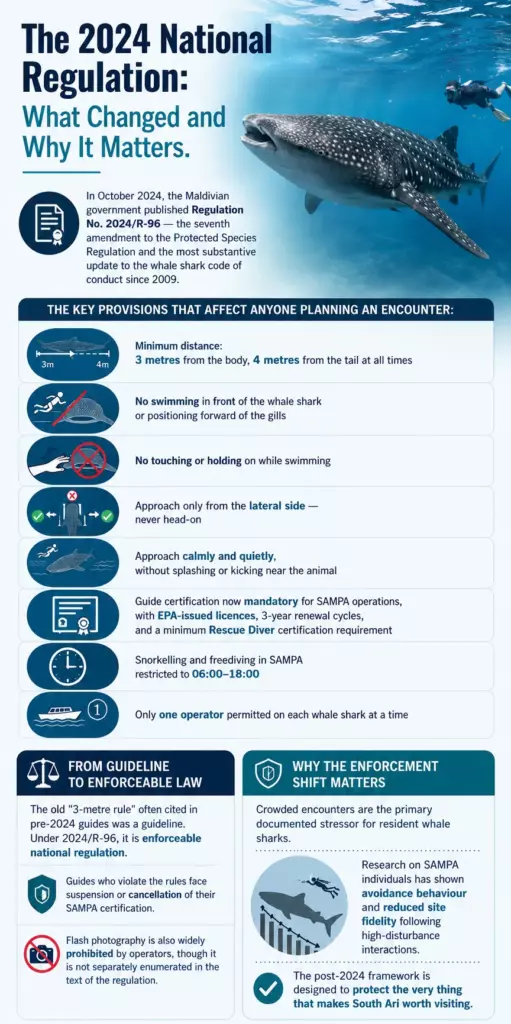
The key provisions that affect anyone planning an encounter:
- Minimum distance: 3 metres from the body, 4 metres from the tail at all times
- No swimming in front of the whale shark or positioning forward of the gills
- No touching or holding on while swimming
- Approach only from the lateral side — never head-on
- Approach calmly and quietly, without splashing or kicking near the animal
- Guide certification now mandatory for SAMPA operations, with EPA-issued licences, 3-year renewal cycles, and a minimum Rescue Diver certification requirement
- Snorkelling and freediving in SAMPA restricted to 06:00–18:00
- Only one operator permitted on each whale shark at a time
The old “3-metre rule” often cited in pre-2024 guides was a guideline. Under 2024/R-96, it is enforceable national regulation. Guides who violate the rules face suspension or cancellation of their SAMPA certification. Flash photography is also widely prohibited by operators, though it is not separately enumerated in the text of the regulation.
The enforcement shift matters because crowded encounters are the primary documented stressor for resident whale sharks. Research on SAMPA individuals has shown avoidance behaviour and reduced site fidelity following high-disturbance interactions. The post-2024 framework is designed to protect the very thing that makes South Ari worth visiting.
Atoll-by-Atoll Breakdown: Seasonality, Crowds, Access, Price
South Ari Atoll — Year-Round
Whale shark reliability: Very high. Sightings on 70–90% of tours in all months.
Peak timing: September to October slightly edges out other months for sighting density, but no month is poor.
Crowd levels: High — this is the most popular whale shark destination in the Maldives, and boat traffic in SAMPA is real. Certified guides and regulated encounters mitigate impact.
Getting there: Seaplane from Velana International Airport (Malé), approximately 25 minutes. Alternatively, a 90-minute speedboat transfer or a domestic flight to Maamigili Airport (Villa International), which some resorts and guesthouses use as the primary transfer point.
Price range: Guesthouse-based snorkel day tours from Dhigurah or Maamigili run USD 80–150 per person including boat, snorkel equipment and lunch. Resort-based excursions run USD 120–250. Scuba-inclusive whale shark dives from South Ari resort dive centres run USD 130–200 per tank.
Who it suits: Anyone who wants a high-probability encounter, families with children old enough to snorkel, non-divers, and travellers on flexible schedules who want multiple attempts built into their stay.
Baa Atoll (Hanifaru Bay) — May to November
Whale shark reliability: Variable and dependent on monsoon conditions. Peak manta aggregations July to September; whale sharks appear opportunistically during the same plankton blooms, but are not residents and can be absent for weeks at a time.
Peak timing: August to September for the largest combined manta/whale shark aggregations.
Crowd levels: Very high at Hanifaru Bay during peak season. Permits are issued by the Baa Atoll Council and numbers are capped, but the site is heavily visited. Encounters outside peak months are less crowded and often more intimate.
Getting there: Seaplane from Malé, approximately 30 minutes. Baa Atoll holds UNESCO Biosphere Reserve status, designated in 2011.
Important caveat: Hanifaru Bay is snorkel-only — scuba diving has been prohibited since 2012. The mantas feed at the surface and SCUBA bubbles disrupt the aggregation.
Who it suits: Travellers who want the world’s most spectacular manta aggregation alongside opportunistic whale shark encounters, and who are travelling between June and October.
Lhaviyani Atoll — May to October
Whale shark reliability: Moderate. Whale sharks appear at channel dive sites like Fushifaru Kandu during southwest monsoon conditions, drawn by the same current-driven plankton as Baa Atoll. Encounters are less predictable than South Ari but generally uncrowded.
Peak timing: June to September.
Crowd levels: Low to moderate. Lhaviyani sees significantly less whale shark tourism traffic than South Ari or Baa Atoll, which means encounters when they happen are often shared with fewer boats.
Getting there: Seaplane or domestic flight (Kudadhoo Airport) from Malé. Transfer times are longer and logistics more complex than central atolls.
Who it suits: Divers who want a quieter experience and are comfortable with lower certainty; liveaboard routes that pair Lhaviyani with Baa Atoll during the northern itinerary season.
North Malé Atoll — August to November
Whale shark reliability: Low to moderate. Opportunistic sightings at channel sites and outer reef walls, primarily during the northwest monsoon transition. Not a dedicated whale shark destination.
Peak timing: October to November.
Crowd levels: High for general diving, but whale shark encounters specifically are uncommon enough that crowd dynamics are less relevant.
Getting there: 15–20 minutes by speedboat from Malé — the most accessible atoll in the country.
Who it suits: Travellers based in North Malé for other reasons (wreck dives, manta cleaning stations, budget options) who want to take an opportunistic whale shark trip without moving resorts. Worth adding to a longer liveaboard but not worth booking a resort around.
Meemu Atoll — May to November
Whale shark reliability: Moderate. The deep kandu (channel) systems like Mulaku Kandu act as marine highways for pelagic species including whale sharks during the southwest monsoon. Encounters are genuinely possible but not systematically reliable in the way South Ari is.
Peak timing: June to October.
Crowd levels: Very low. Meemu is among the least visited atolls in the Maldives for whale shark tourism, making it excellent for travellers who value solitude over reliability.
Getting there: Longer liveaboard routes south from Malé, or domestic flight connections. Not a quick trip.
Who it suits: Experienced divers on southern liveaboard itineraries; travellers who want excellent diving in uncrowded conditions and are content with whale sharks as a bonus rather than a guarantee.
Quick Reference: Atoll Comparison at a Glance
| Atoll | Season | Reliability | Crowd Level | Access Ease | Price Point |
|---|---|---|---|---|---|
| South Ari | Year-round | Very High | High | Moderate | Budget–Luxury |
| Baa (Hanifaru) | May–Nov | Variable | Very High (peak) | Moderate | Mid–Luxury |
| Lhaviyani | May–Oct | Moderate | Low | Moderate | Mid–Luxury |
| North Malé | Aug–Nov | Low | High | Very Easy | Budget–Luxury |
| Meemu | May–Nov | Moderate | Very Low | Difficult | Mid–Luxury |
Snorkelling vs Diving: Which Gives the Better Encounter?
This question comes up constantly, and the answer in the Maldives is more specific than most people expect.
For South Ari Atoll, snorkelling is optimal. The juvenile whale sharks in SAMPA cruise the shallow reef shelf at 5–15 metres during the day, routinely breaking the surface with their dorsal fin. This is within easy freediving range and well within snorkel sight lines from the surface. Scuba divers see the same sharks, but the bubble noise from regulators is a known disturbance factor, and the 2024 regulations reflect an operator consensus that snorkel-first encounters are less disruptive. Most South Ari dive resorts run scuba-specific whale shark programmes, but they are structured around locating sharks by snorkel first and sending divers in secondarily.
For Hanifaru Bay, snorkelling is the only option. SCUBA is prohibited inside Hanifaru Bay specifically because bubbles interrupt the manta feeding aggregation. No exceptions.
For deeper channel sites in Lhaviyani, Meemu and North Malé, scuba is required. Whale shark encounters at these sites happen at depth during channel dives — they are pelagic encounters with passing individuals, not surface interactions with residents. Without scuba, you will not see them.
The short summary: if your primary goal is whale sharks, book for South Ari and snorkel. If your primary goal is diving and you want whale sharks as a bonus, the channel sites work on scuba but require flexibility and patience.
Best Resorts and Liveaboards for Whale Shark Access
For Resort Stays in South Ari (Inside or Adjacent to SAMPA)
Lily Beach Resort & Spa sits directly inside the Marine Protected Area and runs near-daily whale shark excursions. Their Platinum All-Inclusive plan covers most excursion costs and makes the per-encounter pricing effectively invisible — a genuine advantage for travellers who want multiple attempts. The dive centre is operated by Prodivers, one of the more respected operators in the atoll.
Constance Moofushi takes an all-inclusive approach anchored in dive-led programming, with a strong track record on both whale shark and manta encounters given its position adjacent to the MPA’s western edge. The resort’s partnership with the MWSRP means excursion guides are trained to SAMPA certification standards.
Conrad Maldives Rangali Island sits at the northern tip of SAMPA and is one of the MWSRP’s oldest partners. The resort’s “Whale Shark Talk and Tour” programme, run several times weekly, combines a marine biology briefing with a 3-hour snorkel excursion. The two-island property connected by a 500-metre footbridge offers one of the most distinctive architectural experiences in the Maldives alongside the marine access.
Vilamendhoo Island Resort is a PADI 5-Star dive resort with a 2-km house reef inside the MPA. It runs at a more moderate price point than the above three, making it one of the better value options for dive-focused travellers who want maximum time in the water without the ultra-luxury premium.
Dhigurah (local island guesthouses) is the budget baseline. Guesthouses on Dhigurah charge USD 60–120 per night for accommodation and run shared whale shark snorkel tours from the island’s southern reef edge, where sightings are nearly daily. This is the most affordable way to access SAMPA and works well for independent travellers.
For Liveaboards
Liveaboards offer the flexibility to position precisely in SAMPA during peak sighting windows and to chase conditions across multiple atolls. Standard liveaboard itineraries through South Ari run USD 2,500–4,000 per person per week.
For dedicated whale shark focus, look for itineraries that include multiple nights anchored in SAMPA rather than passing through. Explorer Ventures, Master Liveaboards operators, and Spirit Liveaboards all run central atoll routes with South Ari time built in. Northern itineraries (Lhaviyani–Baa, July to October) are the better choice if manta aggregations at Hanifaru Bay are the priority, with whale sharks as a secondary goal.
Underwater Photography Tips for Beginners
Whale shark photography is technically demanding in ways that are not obvious until you are in the water.
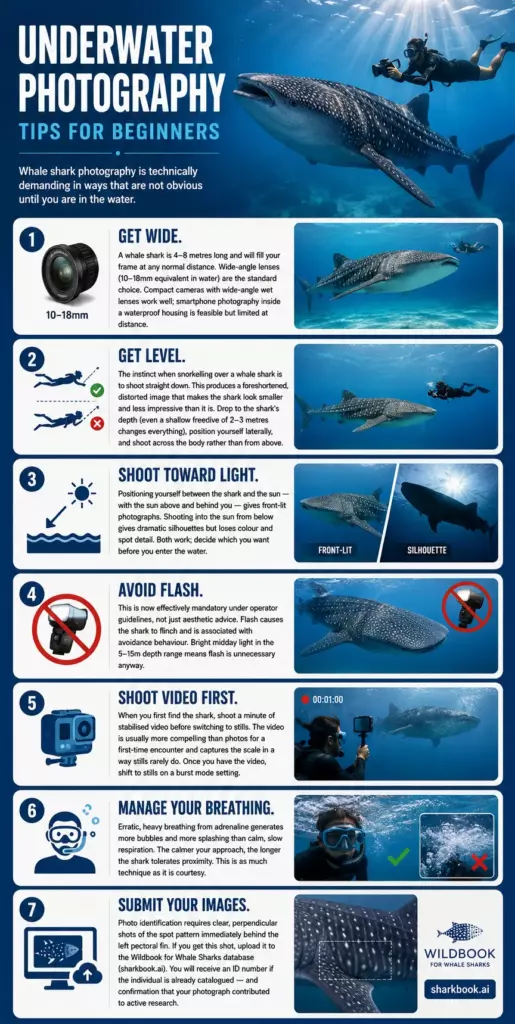
Get wide. A whale shark is 4–8 metres long and will fill your frame at any normal distance. Wide-angle lenses (10–18mm equivalent in water) are the standard choice. Compact cameras with wide-angle wet lenses work well; smartphone photography inside a waterproof housing is feasible but limited at distance.
Get level. The instinct when snorkelling over a whale shark is to shoot straight down. This produces a foreshortened, distorted image that makes the shark look smaller and less impressive than it is. Drop to the shark’s depth (even a shallow freedive of 2–3 metres changes everything), position yourself laterally, and shoot across the body rather than from above.
Shoot toward light. Positioning yourself between the shark and the sun — with the sun above and behind you — gives front-lit photographs. Shooting into the sun from below gives dramatic silhouettes but loses colour and spot detail. Both work; decide which you want before you enter the water.
Avoid flash. This is now effectively mandatory under operator guidelines, not just aesthetic advice. Flash causes the shark to flinch and is associated with avoidance behaviour. Bright midday light in the 5–15m depth range means flash is unnecessary anyway.
Shoot video first. When you first find the shark, shoot a minute of stabilised video before switching to stills. The video is usually more compelling than photos for a first-time encounter and captures the scale in a way stills rarely do. Once you have the video, shift to stills on a burst mode setting.
Manage your breathing. Erratic, heavy breathing from adrenaline generates more bubbles and more splashing than calm, slow respiration. The calmer your approach, the longer the shark tolerates proximity. This is as much technique as it is courtesy.
Submit your images. Photo identification requires clear, perpendicular shots of the spot pattern immediately behind the left pectoral fin. If you get this shot, upload it to the Wildbook for Whale Sharks database (sharkbook.ai). You will receive an ID number if the individual is already catalogued — and confirmation that your photograph contributed to active research.
Responsible Encounter Checklist
Before entering the water:
- Confirm your guide holds a valid SAMPA certification (required under 2024 Regulation R-96)
- Remove any sharp or protruding jewellery or equipment that could snag
- Confirm there is no flash unit attached to your camera
In the water:
- Maintain 3 metres from the body, 4 metres from the tail
- Never position yourself forward of the gills or block the shark’s path
- Approach from the lateral side only
- No touching, no holding on, no riding
- Move slowly and breathe calmly
After the encounter:
- Report any injuries or unusual behaviour to your guide
- Submit your photographs to sharkbook.ai
- If you visited South Ari, consider a donation to maldiveswhalesharkresearch.org
Frequently Asked Questions
Can children snorkel with whale sharks? Yes, at South Ari. Most operators require children to be at least 8 years old and accompanied by an adult in the water. Children do not need scuba certification for snorkel-only excursions. Ensure your child is a comfortable swimmer before booking.
Is the encounter guaranteed? Nothing underwater is guaranteed. South Ari is the closest the Maldives gets to a guarantee — operators achieve 70–90% encounter rates across all months. Booking 2–3 excursions during a week’s stay makes a no-show extremely unlikely. Other atolls have materially lower reliability.
Do I need to be a diver? Not for South Ari. The resident whale sharks cruise at snorkel-accessible depths. You need to be a competent swimmer and comfortable snorkelling in open water, but scuba certification is not required.
Are there whale sharks elsewhere in the Maldives outside the main atolls? Yes, sporadically. Fuvahmulah, the isolated atoll in the deep south, is known for tiger sharks and oceanic manta rays as primary attractions, but whale shark sightings occur. Huvadhoo Atoll and Thaa Atoll (Kolhumadulhu) are increasingly mentioned in liveaboard reports as productive southern itinerary stops. These are not yet in the same reliability tier as South Ari but are worth noting for experienced divers planning longer liveaboard routes.
What is the difference between the MWSRP and Marine Savers? Marine Savers is a separate marine conservation organisation based at Holiday Inn Kandooma in South Malé Atoll, primarily focused on coral reef restoration and nurse shark research. The MWSRP (now rebranded as Maldives Whale Shark Research — MWSR) is the specialist whale shark organisation based in South Ari Atoll. For whale shark-specific encounters and research contributions, MWSR is the relevant organisation.
Plan Your Trip: Three Scenarios
Scenario 1 — Maximum whale shark certainty, minimum planning complexity. Book a South Ari resort inside SAMPA (Lily Beach, Constance Moofushi, Vilamendhoo, or Conrad Rangali) for any month of the year. Include 3 whale shark excursions in your stay. Success rate is very high regardless of when you go.
Scenario 2 — Whale sharks plus the world’s best manta aggregation. Travel between July and September. Base yourself in South Ari for whale sharks, then do a day trip or short transfer to Baa Atoll for Hanifaru Bay mantas. Both atolls are serviced from Malé; moving between them adds a seaplane leg but is logistically straightforward.
Scenario 3 — Uncrowded encounters, flexible schedule, experienced diver. Book a southern or northern liveaboard itinerary during the southwest monsoon season (May to October). Include South Ari nights for resident whale sharks plus channel dives in Lhaviyani or Meemu for pelagic encounters. Accept that certainty is lower but the underwater variety — whale sharks, mantas, reef sharks, hammerheads at Rasdhoo — compensates.
The Maldives Whale Shark Research Programme can be found at maldiveswhalesharkresearch.org. To submit whale shark photographs for population research, visit sharkbook.ai.