


Maldives in May: Is It Worth Going? The Honest Guide to Weather, Atolls, Wildlife and Real Deals
Most travel guides will tell you that May is “shoulder season” — a polite way of saying the good weather is over. Here’s what they rarely mention: May is when the Maldives becomes genuinely interesting. The crowds thin. The prices drop by 30–50%. And the ocean, stirred by the arrival of the southwest monsoon, delivers one of the most spectacular wildlife events on the planet — the start of the manta ray aggregation season at Hanifaru Bay.
So is May a good time to visit the Maldives? The honest answer is: it depends entirely on what you’re going for — and which part of the archipelago you choose. This guide separates the reality from the marketing and gives you the tools to decide whether May is your perfect window or the wrong month for your trip.
Maldives Weather in May: The Honest Picture
May marks the arrival of the southwest monsoon, locally called Hulhangu. The Maldives Meteorological Service recorded the 2024 onset over the southern atolls on 9 May, reaching the north by 17 May. In 2022, the monsoon arrived on 8 May. This means the first week or two of the month often still behaves like late dry season — calmer, clearer, sunnier.
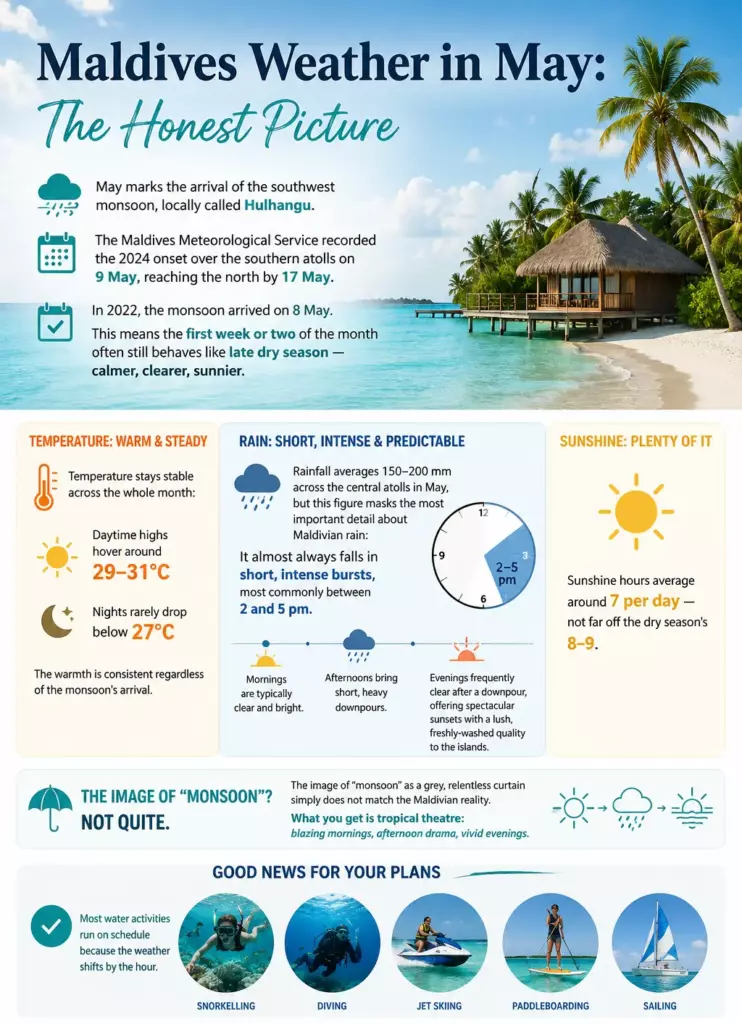
Temperature stays stable across the whole month: daytime highs hover around 29–31°C, nights rarely drop below 27°C. The warmth is consistent regardless of the monsoon’s arrival. What changes is humidity, wind, and — crucially — rain.
Rainfall averages 150–200 mm across the central atolls in May, but this figure masks the most important detail about Maldivian rain: it almost always falls in short, intense bursts, most commonly between 2 and 5 pm. Mornings are typically clear and bright. Evenings frequently clear after a downpour, offering spectacular sunsets with a lush, freshly-washed quality to the islands.
Sunshine hours average around 7 per day — not far off the dry season’s 8–9.
The image of “monsoon” as a grey, relentless curtain simply does not match the Maldivian reality. What you get is tropical theatre: blazing mornings, afternoon drama, vivid evenings. Most water activities run on schedule because the weather shifts by the hour.
North vs. South: The Atoll Difference Nobody Tells You
The Maldives stretches over 800 km from north to south, and May weather is not uniform across the archipelago. This is the detail that most generic travel articles skip, and it can make a significant difference to your trip.
The northern atolls — including Haa Alif, Haa Dhaalu, Shaviyani, and Noonu — receive noticeably more intense rain during the southwest monsoon. In May 2022, the Hanimaadhoo meteorological station in the north recorded 511 mm of rainfall for the month alone. Wind speeds in central atolls average 14–16 mph from the west during May and intensify further north. Northern atolls are also subject to more violent storm events during this season compared to the south.
The southern atolls — Laamu, Gaafu Alif, Gaafu Dhaalu, Addu, and Fuvahmulah — see slightly shorter rain spells and less intense storm activity during the wet season, even though their annual rainfall total is higher overall. If weather consistency matters to you in May, consider the southern islands.
The central atolls — Malé Atoll, South Malé, Ari, Baa, Lhaviyani — sit in the middle ground and also offer the best concentration of resorts and the most significant marine events of the month. For most travellers, this is the practical sweet spot.
The 4 Best Atolls to Visit in May (and One to Think Twice About)
1. Baa Atoll — The Manta Ray Capital
If you visit the Maldives in May for one reason, let it be Baa Atoll. Designated a UNESCO Biosphere Reserve in 2011 specifically to protect its manta aggregation, this atoll hosts Hanifaru Bay — a funnel-shaped lagoon where the monsoon current sweeps plankton into a concentrated pocket, triggering one of the most astonishing wildlife events in the Indian Ocean.
The season for manta rays at Hanifaru runs May to November, with sightings confirmed from the very start of May as the southwest monsoon brings its first plankton blooms. On an average day inside the bay, you share the water with 5–10 manta rays; on exceptional tidal cycles, that number can reach 50–70, and in peak season occasionally over 200. Whale sharks frequently join the feeding events.
Important practicalities: Hanifaru Bay is strictly snorkel-only — no scuba diving permitted. Access is regulated through licensed operators with a maximum of 45 snorkellers per 45-minute slot. Tickets cost approximately $20–30 per session and go toward conservation funding. You must arrange access through your resort or a licensed operator in Baa Atoll; independent visits are not allowed.
The best-positioned resorts for Hanifaru access include Soneva Fushi, Four Seasons Landaa Giraavaru, Vakkaru Maldives, and Amilla Maldives. From most of them, the boat ride to the bay takes under 20 minutes when the tide is right.
2. South Ari Atoll — Year-Round Whale Sharks
While Hanifaru’s mantas migrate following the monsoon plankton, South Ari Atoll hosts a more permanent population of whale sharks — the world’s largest fish, which feed at the surface and are harmless to snorkellers. During May (wet season), whale sharks are concentrated around the eastern side of the atoll, particularly near Dhigurah and Maamigili. These encounters are available almost year-round but the wet season positions them predictably on the eastern reef edge.
South Ari also offers some of the best value mid-range resort options in the Maldives, with several properties offering strong dive programs and direct house reef access to varied coral gardens.
3. North Malé Atoll — Best for Surfers and Easy Access
For travellers who want to combine surf with luxury, May marks the peak launch of the swell season in North Malé Atoll. The Indian Ocean swell machine wakes up fully from May onward, and the classic breaks — Chickens, Cokes, Pasta Point, Lohis — start firing consistently. Crucially, May and early June offer clean conditions before the European summer influx of surf tourists. Wavehunters and other surf operators specifically recommend April–May for less-crowded lineups with good quality waves.
For non-surfers, North Malé’s proximity to Velana International Airport means seamless transfers: most resorts are reachable by 20–45 minute speedboat rather than a seaplane connection, which simplifies logistics and reduces transfer costs significantly.
4. Laamu and Gaafu Dhaalu — Remote, Quiet, Marginally Better Weather
These southerly, sparsely developed atolls offer what the Maldives used to feel like before mass tourism found it. Diving is exceptional — vibrant reef walls, hammerheads in Fuvahmulah, and almost no other boats. During May, the southern atolls experience the wet season’s rain in shorter, less intense bursts compared to the north. For travellers willing to take a domestic flight connection, the trade-off is a more remote paradise at the lower price point that May naturally brings.
One to Think Twice About: The Far Northern Atolls
Given the documented higher rainfall and storm intensity in the northernmost atolls during the southwest monsoon, choosing resorts in Haa Alif or Noonu in May is higher-risk if weather stability matters to you. The resorts there are world-class — but the weather unpredictability is measurably greater during this specific month.
Marine Wildlife in May: What the Dry Season Can’t Offer
The counterintuitive truth about Maldivian waters in May is that the dive conditions that appeal to most visitors — coral gardens, current dives, reef sharks — remain excellent, while a new layer of wildlife becomes accessible that simply doesn’t exist during December–April.
Manta rays at Hanifaru Bay. The manta aggregation is the headline act. The southwest monsoon creates the precise conditions — plankton density, tidal flow, bay geometry — that make Hanifaru Bay unique on earth. May is the opening of that season; July–October represents the peak, but May encounters are already extraordinary compared to anything available elsewhere.
Whale sharks in South Ari. Year-round residents, but May positions them predictably on the eastern reef edge. Water temperatures stay around 28°C — ideal for surface feeding, which is how most snorkel encounters happen.
Sea turtle nesting season. May and June mark the start of sea turtle nesting on Maldivian beaches. Green turtles and hawksbill turtles come ashore on quiet islands to lay eggs — something impossible to observe during the heavily-trafficked dry season high tide of tourists. Many eco-conscious resorts organise turtle monitoring walks in May.
Diving visibility. This is the genuine trade-off. During the southwest monsoon, plankton concentration reduces underwater visibility from the dry-season’s 25–40 metres to around 10–25 metres in some areas. On the western sides of atolls during May, visibility is often better than the averages suggest — many divers report 20–30m days. The eastern sides carry more plankton, but that is precisely where the manta rays and whale sharks are feeding. Experienced divers consistently describe the trade as more than worthwhile.
The May Price Advantage: What You Actually Save
This is where May makes a compelling practical argument. Resort rates across the Maldives typically drop 30–50% compared to peak season (December–April) during the wet season months. This is not a marginal saving — it is the difference between a trip that is financially impossible and one that is within reach.
A mid-range overwater villa that costs $1,200–$1,500 per night in January may be bookable in May for $650–$900. At the luxury end, properties like Four Seasons Landaa Giraavaru or Soneva Fushi run comparable discounts, with additional promotional packages — often including free half-board, spa credits, or complimentary excursions — that are not available during high season.
Budget-accessible guesthouses on local islands like Maafushi, Dharavandhoo (close to Hanifaru Bay), and Fulidhoo also benefit from the May rate drop, often at 20–30% below their own already-modest prices.
Beyond accommodation, May travel means fewer guests competing for dinner reservations, dive slots, and water sports bookings. Resort staff who spend December–March managing hundreds of guests simultaneously give May visitors a qualitatively different level of attention and flexibility.
The all-inclusive calculation. May is the best month to book all-inclusive packages. Resorts actively discount bundled packages to maintain occupancy, and many include excursions and spa credits that would cost $200–400 per person as add-ons in high season. If you plan to dive, snorkel at Hanifaru, and use the spa, an all-inclusive package in May often costs less than room-only in December — even counting the resort’s own food markup.
Activities in May: What Works, What to Plan Around
What works without compromise:
Snorkelling in calm lagoons is excellent in May. House reefs on most resort islands sit inside protected lagoons where ocean swell has no effect, and the water temperature of 28°C is perfect. Whale shark and manta encounters require a boat ride but operate normally.
Diving continues across virtually all sites. The dive operators have adjusted their routing to favour western-facing reefs and atoll channels where May visibility is strongest. Every major dive centre operates a full program throughout May.
Kayaking, paddleboarding, and glass-bottom boat tours run on normal schedules — the calm lagoons are unaffected by the offshore conditions.
Cultural island hopping is arguably better in May than in high season. Local islands like Maafushi, Fulidhoo, and the inhabited parts of Dharavandhoo are less crowded with day-trippers, and locals have more time for interaction. The Maldives National Museum and the historic Hukuru Miskiy mosque in Malé are accessible and quiet.
Surfing in North and South Malé Atolls begins its peak season in May. Chickens, Cokes, Sultans, and Jailbreaks are all active, with clean swell conditions and less crowded lineups than June–August.
What to plan around:
Sunset excursions and dolphin cruises sometimes reschedule due to afternoon squalls, but operators typically offer morning alternatives. Keep your activity schedule flexible, particularly for the 2–5 pm window.
Seaplane transfers only operate in daylight hours and can face delays in poor visibility. If your resort requires a seaplane connection, build an extra half-day buffer at either end of your trip.
Photography for aerial drone work or sunset overwater villa shots is weather-dependent. May offers genuinely beautiful light — dramatic clouds, vivid greens, intense blues — but requires flexibility rather than fixed golden-hour plans.
Early May vs Late May: A Week That Changes Everything
This distinction is the most underreported piece of practical information about a May trip to the Maldives. The southwest monsoon does not arrive on a fixed calendar date — it arrives progressively, typically beginning over the southern atolls in the first or second week of May and reaching the northern atolls one to two weeks later.
In 2024 the onset was declared on 9 May over the south and 17 May in the north. In 2022 it arrived on 8 May. This means the first 5–10 days of May frequently behave like late April — predominantly dry, with conditions very close to high season quality.
If your travel dates are flexible, aim for May 1–12. You gain the price advantage of off-season rates while encountering weather that is often indistinguishable from March or April. The first Hanifaru Bay manta sightings of the season typically begin in this window too, adding the wildlife bonus without the full monsoon weather pattern.
If you’re travelling in the second half of May, the weather is more genuinely mixed — but still not the washout that the word “monsoon” might suggest. Plan for a morning-heavy activity schedule and embrace the theatrical afternoon weather as part of the experience.
What Real Travellers Say About May in the Maldives
The dominant pattern across traveller accounts of May trips is one of surprise at how good the conditions actually were. Travellers who booked expecting “some rain” frequently report multiple consecutive clear days. Those who experienced a heavy afternoon storm typically describe it as brief — an hour of tropical intensity followed by clear skies and vivid sunsets.
The most consistent specific praise in May accounts focuses on the resort experience: staff attentiveness that would be impossible to replicate during peak season, uncrowded beaches, and spontaneous upgrades that resorts offer freely when occupancy is low. The phrase “felt like we had the island to ourselves” appears repeatedly.
The consistent caveat: those who visited specifically for perfect photography — golden-hour drone shots, consistently glassy water surfaces — sometimes found the unpredictable afternoon weather frustrating. May rewards flexibility; it does not suit rigidly pre-planned itineraries.
Divers are almost uniformly positive. The shift to plankton-rich water is a known trade-off in the dive community, and those who came specifically for manta rays or whale sharks report May as meeting or exceeding expectations.
Should You Go to the Maldives in May? The Honest Decision Framework
May is right for you if:
You want a genuine luxury Maldives experience — overwater villa, excellent food, attentive service — and the cost difference between peak and shoulder season is meaningful to your budget. The 30–50% saving is real and significant.
You’re a diver or snorkeller who wants to encounter manta rays and whale sharks. May opens the Hanifaru Bay season and positions whale sharks predictably in South Ari. You will not find these experiences in January.
You’re a surfer. North Malé’s surf season peaks from May onward. Clean swell, fewer crowds than June–August, and the full luxury resort experience alongside the waves.
You want a quieter, more intimate version of the Maldives. May delivers fewer guests per beach, more staff per guest, and a pace of island life that peak season never allows.
You’re interested in sea turtle nesting. May–June is when green and hawksbill turtles come ashore. Eco-tourism programs at several resorts make this accessible.
May may not be right for you if:
You need guaranteed uninterrupted sunshine for a specific occasion — a honeymoon with precisely planned photography, for example. The weather is good but not predictable to the hour.
You’re travelling with very young children who would find a sudden afternoon thunderstorm distressing or who require reliable outdoor activity windows every day.
You’re booking the far northern atolls and weather is your primary concern. The northern islands carry meaningfully higher storm risk in May compared to central and southern atolls.
You’re a diver with a strong preference for visibility above 30 metres throughout an entire trip. May averages 15–25m in most spots, with higher variance than dry-season diving.
8 Practical Tips for Visiting the Maldives in May
Book early May for best weather. Aim for arrival before the 10th if your dates have any flexibility. The pre-monsoon window is often indistinguishable from high season in terms of conditions.
Choose your atoll based on purpose. Baa for mantas, South Ari for whale sharks, North Malé for surf and easy access, southern atolls for seclusion and marginally calmer wet weather.
Pack light, quick-dry clothing. Cotton feels heavier in the humidity. Quick-dry travel fabrics, a light waterproof layer, and reef-safe SPF 50+ sunscreen are the practical essentials.
Book all-inclusive. May is the month when all-inclusive packages offer their best value, often bundling excursions and spa credits at prices below what those items cost individually.
Schedule diving and Hanifaru Bay for mornings. Most afternoon squalls develop after 2 pm. Mornings are consistently clearer. The tide timing for Hanifaru Bay feeding events varies, but operators know the pattern and book accordingly.
Allow buffer days at either end of seaplane connections. Seaplanes operate in daylight only and can face weather delays. A half-day buffer removes the risk of a missed connection.
Get travel insurance with weather clauses. Standard cancellation policies at many Maldives resorts are more flexible in May than December, but specific activity cancellations are not always covered by default.
Use reef-safe sunscreen. Not just an environmental point — the Maldives customs authority and several resorts actively ask for it. Chemical sunscreens with oxybenzone and octinoxate are banned at many protected sites.
Frequently Asked Questions
Is May a good time to visit the Maldives? Yes, with qualifications. May offers significant cost savings, far fewer crowds, the opening of the manta ray season at Hanifaru Bay, and warm temperatures throughout. The trade-off is higher rainfall and reduced but still very good diving visibility. Early May (first 10 days) is particularly favourable, as the monsoon typically hasn’t fully established.
How much does it rain in the Maldives in May? Average rainfall in the central atolls is 150–200 mm in May, but this almost exclusively falls as short, intense bursts — most commonly between 2 and 5 pm. Mornings are typically clear. The northern atolls can receive significantly more, with extremes recorded above 500 mm in some years.
What is the best atoll to visit in May? Baa Atoll for the start of the manta ray season at Hanifaru Bay. South Ari Atoll for whale shark encounters. North Malé Atoll for surf and convenient airport access. For the best weather stability during the wet season, central and southern atolls are preferable to the far north.
Can you dive in the Maldives in May? Yes. All dive centres operate normally throughout May. Visibility averages 15–25 metres — less than the dry season’s 25–40 metres, but still excellent conditions. The trade-off is more marine wildlife: manta rays and whale sharks are now following the plankton to the eastern sides of atolls.
How much cheaper is the Maldives in May? Resort rates typically run 30–50% below peak season (December–April). An overwater villa that costs $1,500/night in January can be booked for $750–$900 in May. All-inclusive packages in May frequently include excursions and spa credits that would cost $200–400 extra in high season.
Are manta rays guaranteed at Hanifaru Bay in May? Nothing in wildlife is guaranteed, but Hanifaru Bay’s manta ray season officially runs May to November, with sightings confirmed from the start of May each year as the monsoon brings plankton blooms. The peak of the aggregation — when 100+ mantas feed simultaneously — typically occurs July to October.
Is it safe to travel to the Maldives in May? Yes. The Maldives has no serious safety concerns during the wet season. All resorts and domestic airlines operate normally. The southwest monsoon brings rain, not dangerous conditions at most resort islands, though some excursions may be rescheduled due to weather.
Summary
May in the Maldives is not the compromise season — it is a different season with a different set of advantages. The weather is warm, the rain is manageable, the discounts are real, and the marine wildlife calendar shifts to offer encounters that the dry-season crowds never see.
The key is knowing what May rewards: early-month timing for the calmest weather, the central atolls for the best marine events, flexible planning for activities, and an all-inclusive package to make the most of the value window. Go in knowing the afternoon rain is part of the experience, and you will almost certainly be pleasantly surprised by how much the Maldives delivers in its quieter season.


