

Eid al-Adha in the Maldives: The Holiday That Reveals a Different Country
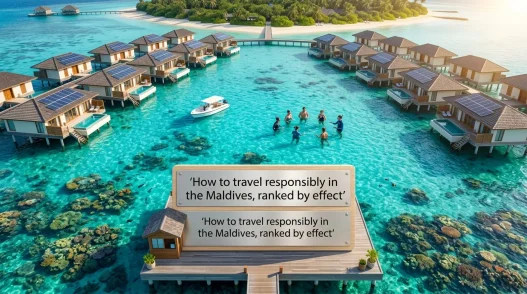
Most people picture the Maldives as a backdrop: overwater villas, bioluminescent tides, breakfast floating on the sea. That picture is real — and it is also about a third of the story. The other two-thirds are out there on nearly 200 inhabited islands where families share enormous lacquered serving dishes of rice and curry, where streets fill with drumming after sunset, and where a hand-carved fish made of woven coconut palm leaves passes through a neighborhood in a pantomime older than the resort industry itself.
Eid al-Adha is when that second country opens its doors. For travelers staying on local islands, it can be the most unexpectedly moving experience the archipelago offers — and almost none of the major travel media has thought to cover it.
This guide explains what actually happens during Eid al-Adha in the Maldives, how the holiday differs from Eid al-Fitr in atmosphere and meaning, what food you will encounter, how tourist-facing services are affected, and why Muslim travelers in particular are increasingly choosing this window to visit.
What Is Eid al-Adha? The Sacrifice at the Heart of It
Eid al-Adha — the Feast of Sacrifice — marks the moment in the Quran when God tested the prophet Ibrahim (Abraham) by asking him to sacrifice his son Ismail. Ibrahim prepared to obey. At the last moment, God replaced Ismail with a ram, showing that faith, not blood, was the point. The story is one of the most powerful in Islamic theology: absolute trust in divine will, and mercy that meets it.
The holiday falls on the 10th day of Dhu al-Hijjah, the final month of the Islamic lunar calendar, coinciding with the end of the Hajj pilgrimage in Mecca. For Muslims unable to perform Hajj, Eid al-Adha is the closest they come to participating in that annual gathering of the global faith. This connection to Hajj gives the day a gravity that Eid al-Fitr — the joyful celebration marking the end of Ramadan — does not carry in quite the same way.
Families with means perform Qurbani, the ritual animal sacrifice. The meat is divided into three portions: one for the family, one for friends and neighbors, and one for those in need. In the Maldives, where fresh tuna is the center of daily cooking but red meat is a relative luxury, the appearance of sacrificed goat or lamb during Eid al-Adha carries particular meaning and a distinct flavor shift in the kitchen.
Bodu Eid: Why Maldivians Call This the “Big” One
In the Maldives, Eid al-Adha is universally known as Bodu Eid — Big Eid — while Eid al-Fitr is called Kuda Eid, or Little Eid. The names reflect real differences in scale, duration, and cultural weight.
Religiously, Eid al-Adha carries higher status: it spans four days in Islamic tradition, compared to one for Eid al-Fitr, and its link to both Ibrahim’s sacrifice and the Hajj gives it a more solemn significance. In purely practical Maldivian terms, Bodu Eid also tends to generate longer community celebrations, more elaborate preparations, and a greater migration of people across atolls as families return to their home islands.
The name “Bodu Eid” also comes from the Bodu Mas tradition — the Big Fish parade — one of the most recognizably Maldivian customs in the entire holiday calendar. More on that shortly.
What Actually Happens on Local Islands
The morning: prayer, food, and open doors
On Eid day, islands wake before sunrise. Men, women, and children walk to the mosque or an open prayer ground dressed in new or carefully pressed clothes — white shirts, embroidered dresses, sandals along coral-dust roads. The Eid prayer is a congregational event, and on small islands, nearly the entire population attends.
Immediately after prayer, the visiting begins. Maldivian Eid hospitality operates on a principle of open-door generosity: homes remain accessible throughout the day, and neighbors cycle in and out bringing and receiving food. The first dish served in many households is kulhi boakibaa, a dense, spiced fish cake made from smoked tuna, ground rice, grated coconut, ginger, and fresh green chili. It is served warm, sliced into squares, alongside black tea.
The Thakbeer parade — a procession of religious recitations led by community members — has become increasingly central in recent years, moving through streets while participants chant Allahu Akbar. Island councils have increasingly organized these processions as a way of anchoring the celebration in its spiritual origin.
The Bodu Mas: the parade that defines the afternoon
Perhaps the most distinctive Maldivian tradition during Bodu Eid is Bodu Mas, or “Big Fish.” A large fish shape — sometimes three meters long — is constructed from woven coconut palm leaves and carried through the streets by a group of men operating it from inside. The fish is animated, its tail and fins moving as it passes through neighborhoods.
The performance reenacts an old legend: a monstrous fish terrorizes an island community until a holy man arrives and helps the villagers catch it. The pantomime ends with the fish being “caught” amid cheering from the crowd. It is theater, community ritual, and living folklore at once — and it cannot be purchased or staged for resort guests.
Alongside Bodu Mas, the afternoon often includes Maali Neshun, a traditional performance where participants paint themselves and dress in handcrafted coconut-leaf costumes as mythical spirits and demons. The effect is simultaneously eerie and festive. On some islands, the Vedhuma Dhiyun ceremony takes place, in which residents formally seek permission from elders before beginning the celebrations — a small, remarkable act of community deference that has survived modernization.
The evening: Boduberu until midnight
By evening, the drumming starts. Boduberu — literally “big drums” — is the most widespread traditional music in the Maldives, and Eid al-Adha is its natural occasion. Performers in traditional wear play large goatskin drums, sing, and dance, beginning at a slow tempo and building to something close to a frenzy. Other traditional forms include Ban’diyaa jehun, a dance for women using metal water pots, and Dhan’di jehun, a stick dance performed in formation.
On some islands, performances continue well past midnight. Children weave through crowds carrying balloons and glow sticks. Near harbor fronts, families sit in the sea breeze watching the celebrations unfold. The atmosphere is communal, warm, and entirely unglamorous in the best possible sense.
The Table That Defines Eid al-Adha: Traditional Foods
Maldivian cooking is built from a tight set of foundations — tuna, coconut, curry leaves, roshi flatbread, rice — and Eid al-Adha does not abandon that base so much as it expands it into forms that rarely appear at other times of year.
Kulhi Boakibaa is the most recognized Eid food, a savoury fish cake made from smoked tuna blended with ground rice, grated coconut, onion, ginger, and Githeyo Mirus (Scotch bonnet chili). It is baked in a flat pan and cut into squares. In older island practice, it was baked over coconut-shell fire using a flat-lidded pot — a technique still used in some households. It is served at the start of the first meal and again throughout the day as visitors come and go.
Maskurolhi is a spiced rice porridge traditionally associated with Eid al-Adha specifically. Made with dried tuna flakes, peppercorns, dried chili, onion, garlic, ginger, curry leaves, and coconut, it is ground to a rough paste and served with roshi. The dish is warming and intensely flavored — what comfort food means in the atoll context.
Malaafaiy is not a dish but a vessel: a large round wooden serving tray with a domed lid, decorated with traditional lacquerwork in black, red, and yellow. Inside it, a full feast is assembled — rice dishes, curry, salads, pickled sides, and bananas. The Malaafaiy is brought to the table wrapped in cloth and untied as guests sit together. It is the centerpiece of the formal Eid lunch, and a household that brings out the Malaafaiy is signaling that the gathering matters.
Mas Riha (tuna curry) and Dhon Riha (a coconut milk-based tuna curry) appear in abundance at Eid tables, served with steamed rice. Red meat curry — goat or lamb from the Qurbani — also appears in households where sacrifice has been performed, giving the Eid al-Adha table a flavor profile genuinely distinct from the rest of the year.
For sweets, families prepare Foni Boakibaa, a sweet rice flour and coconut cake, and Dhonkeyo Kajuru, deep-fried banana fritters with coconut and vanilla. Huni Hakuru, a coconut sweet snack made with freshly grated coconut and palm treacle, is passed around between houses.
Eid al-Adha vs Eid al-Fitr in the Maldives: A Frank Comparison
This is the question most travelers don’t think to ask until they’re already there, and it matters more than any resort brochure would suggest.
| Eid al-Fitr (Kuda Eid) | Eid al-Adha (Bodu Eid) | |
|---|---|---|
| Local name | Kuda Eid — Little Eid | Bodu Eid — Big Eid |
| Religious origin | End of Ramadan, month of fasting | Ibrahim’s sacrifice; linked to Hajj |
| Duration (religious) | 1 day | 4 days |
| Atmosphere | Festive, celebratory, slightly lighter | More reflective, communal, spiritually weighted |
| Family dynamics | Sweet foods, new clothes, forgiveness-seeking | Sacrifice, sharing, deeper acts of generosity |
| Key ritual | Breaking the fast; Zakat al-Fitr (charity) | Qurbani (animal sacrifice); meat shared with the poor |
| Signature foods | Sweet cakes, dates, coconut snacks | Kulhi Boakibaa, Maskurolhi, Malaafaiy feasts, Qurbani meat |
| Traditional performances | Music and dance, but shorter | Bodu Mas, Maali Neshun, Boduberu well into the night |
| Community migration | High — people return home | Higher — more inter-island travel |
| For travelers | Festive but accessible | More intimate; harder to reach culturally without a local connection |
The clearest way to summarize the difference: Eid al-Fitr is a collective exhale after a demanding month — warm, celebratory, generous with sweets. Eid al-Adha is a slower, heavier, more deliberate celebration rooted in sacrifice and sharing. The mood on a local island during Bodu Eid is less like a street party and more like a long, unhurried family day that spills into an evening of music. The tourist who finds their way into it tends to come away saying they experienced something real — not curated, not staged.
How Tourist-Facing Services Are Affected — and for How Long
Travelers planning around Eid al-Adha in the Maldives should expect the following:
Government offices and banks close for the full public holiday period, typically two to three days. The core holiday is the day after Hajj Day (10th of Dhu al-Hijjah), but celebrations on local islands extend across three to four days.
Local shops, small businesses, and tea houses on inhabited islands close on Eid day and often the day after. Some reopen on the afternoon of day two or by day three. Resorts operate normally throughout, as their schedules are designed around international tourism rather than local holidays.
Ferry and inter-island transport operates on a reduced schedule. The days leading up to Eid see ferries filling rapidly as Maldivians return to home islands; departures may be oversubscribed. Book early if you plan to island-hop during this period.
Local island guesthouses remain open but owners and staff will be celebrating. Breakfast and basic services continue, but expect a quieter, less attentive atmosphere on the day itself — which, if you frame it correctly, is part of the experience.
What remains fully operational: international airport, resort transfers, seaplane services, dive centers, and all resort-level amenities.
Practical note for local island visitors: Buy supplies (water, snacks, toiletries) the day before Eid. On the holiday itself, shops may be closed for eight to twelve hours. This is not a hardship — it is a reason to knock on a door and accept what’s offered.
The Unscripted Invitation: What Money Cannot Buy
This deserves its own section because no other travel experience in the Maldives comes close to replicating it.
On local islands during Eid al-Adha, doors are genuinely open. Maldivian hospitality during Bodu Eid is not performative generosity for tourist consumption — it is a deep cultural obligation. Neighbors visit neighbors, strangers are fed, and a foreign face walking through a small island on Eid day is more likely to be waved inside than ignored.
Travelers who find themselves in this situation are typically served tea, fish cake, and rice — and are expected to stay long enough to be polite. The conversation may not go far if there is a language gap, but the gesture of sitting together at the Malaafaiy is its own form of communication.
This kind of access — sitting in a home kitchen on a Maldivian island during the most important holiday of the year — is not something any resort package can offer. It is not bookable. It happens because of where you are and how you present yourself: curious, respectful, and present.
The rule of thumb for travelers hoping to experience this: stay on a local island rather than a resort, dress modestly (for both men and women), and be visibly respectful of prayer times. Greet people you pass. Accept food when it is offered.
Why Eid al-Adha Is Increasingly Popular for Muslim Travelers
The global Muslim travel market has grown significantly. According to the 2025 Mastercard–CrescentRating Global Muslim Travel Index, international Muslim arrivals reached 176 million in 2024 — a 25 percent increase from 2023 — with projected spending reaching USD 230 billion by 2030. The Maldives consistently ranks among the top OIC destinations in this index, alongside Malaysia and Indonesia.
Several factors make Eid al-Adha in the Maldives particularly appealing for Muslim travelers from the GCC, Malaysia, Turkey, and beyond:
Religious alignment. The Maldives is a 100 percent Muslim country — the only one in South Asia. All food served anywhere in the country is halal by national law. Prayer facilities are available across the inhabited islands and, increasingly, at resorts. The Eid holiday is treated as the serious occasion it is, not quietly observed in the background while the resort schedule continues.
Authentic shared worship. Muslim travelers who want to experience Eid in a Muslim cultural context — attending communal prayers, hearing the call to prayer, watching the Thakbeer procession — can do so naturally here in a way that is simply not possible at a non-Muslim destination.
The halal tourism infrastructure. In June 2025, President Muizzu announced a policy to designate specific islands exclusively for halal tourism development, with five islands in Haa Alifu, Haa Dhaalu, Shaviyani, Thaa, and Laamu atolls offered to investors under preferential terms. This signals a significant acceleration in Maldives’ positioning toward Muslim-oriented travel.
GCC peak season timing. Eid al-Adha falls during a school holiday window for Gulf families. Resort availability during this period tightens significantly — for 2027 Eid al-Adha (mid-May), industry advisors recommend confirming villa categories up to 90 days in advance.
Practical Guidance for Visitors
Stay on a local island. If cultural immersion during Eid al-Adha is your goal, a resort will offer a curated version of the holiday — cultural performances, themed dinners, Boduberu shows. These are enjoyable. They are not the same as being on an inhabited island where Bodu Eid is simply life. The guest house network across atolls including Maafushi (Kaafu), Ukulhas (Alif Alif), Fulidhoo (Vaavu), and Thinadhoo (Gaafu Dhaalu) puts you inside community celebrations rather than outside them.
Time your arrival. Fly in two days before Eid to observe pre-festival preparations: tailors finishing Eid clothes, temporary lights going up near harbor fronts, shop windows filling with children’s toys and sweets. The buildup is part of the experience.
Dress modestly throughout. This applies everywhere in the Maldives beyond resort islands but matters more during Eid. Covered shoulders and knees for both men and women on local islands is both respectful and practical.
Respect prayer times. The five daily prayers shift the rhythm of island life during Eid more than on ordinary days. Cafés briefly close, streets quieten. These pauses are not inconveniences — they are the pulse of the holiday.
Photograph carefully. Ask before photographing families or prayers. Most Maldivians are welcoming of genuine interest, but treating community life as a photo opportunity reads poorly everywhere.
Five Things Eid al-Adha in the Maldives Is Not
- Not a beach festival. There are no illuminated floats, outdoor markets, or Instagram-ready light installations on local islands. The celebration is domestic, communal, and spread across living rooms and harbor fronts.
- Not a time when everything stays open. If you need a pharmacy, a sim card, or a decent café, plan for them to be closed on Eid day itself.
- Not the same in every atoll. Each island has its own customs. Bodu Mas is more elaborately observed in some atolls (Raa, Alif Alif) than others. The Fenkulhi water-throwing tradition — joyful chaos involving small packets of colored water — survives in some communities and has faded in others.
- Not inaccessible to non-Muslim visitors. Eid al-Adha in the Maldives is a cultural event as much as a religious one. Non-Muslim visitors who are respectful and curious are welcomed on local islands without reservation.
- Not a substitute for Eid al-Fitr if you want spectacle. Kuda Eid is livelier and more immediately festive. Bodu Eid is quieter, warmer, and more likely to leave you thinking about it weeks later.
Summary
Eid al-Adha in the Maldives is the country’s most important holiday and its least-documented one for English-language travelers. It is not about beach parties or resort packages. It is about a 100-percent Muslim nation gathered across its scattered islands, sharing food, watching an ancient fish parade, drumming until midnight, and operating according to a generosity ethic that pulls strangers into the feast rather than past it.
The difference from Eid al-Fitr is real and worth knowing: Bodu Eid is the heavier, more reflective, more dramatically Maldivian of the two celebrations, rooted in Ibrahim’s sacrifice and connected to the global pilgrimage in Mecca. The atmosphere on a local island during Bodu Eid is less a party than a slow, deep, days-long act of community.
For Muslim travelers, the Maldives during Eid al-Adha offers something genuinely rare: a Muslim country at full celebration, where your own observance fits naturally into the context around you. For any traveler who chooses a local island over a resort during this period, the same holds: the Maldives you find is the one most Maldivians actually live in.