Ramadan in the Maldives: The Resort vs. Local Island Divide — and Why It Changes Everything
Most guides treat “the Maldives during Ramadan” as one question. It isn’t. Where you stay determines whether the holy month is invisible background noise or the defining rhythm of your trip. Here’s the split no one explains clearly enough — and a practical framework to make the right call before you book.
The One Insight Almost Every Guide Misses
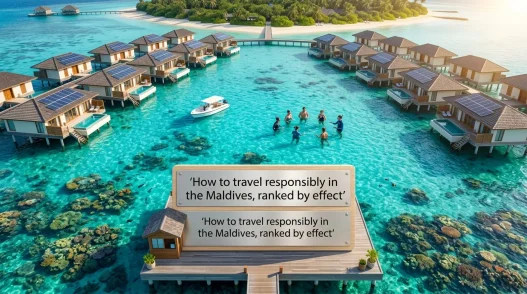
The Maldives runs on a dual-track tourism system unlike anywhere else in the world. Private resort islands operate as self-contained ecosystems, physically separated from Maldivian society by stretches of open ocean. Local islands — inhabited communities where Maldivian families live and work — operate under the country’s Islamic governance framework.
During Ramadan, those two tracks diverge sharply.
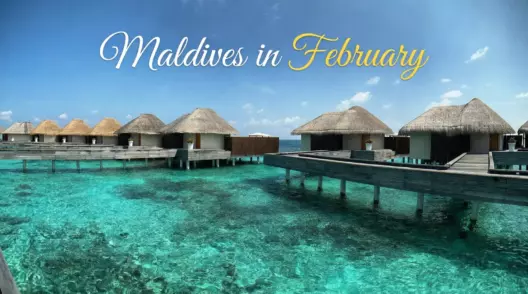
Resort guests staying at a private island resort during Ramadan will notice almost nothing unusual. Bars stay open. Full buffets run on schedule. Alcohol flows. Water sports operate without adjustment. The most noticeable change is that some staff may be quieter than usual, fasting through a long tropical day before breaking fast at sunset around 18:15.
Guests on local islands — staying at guesthouses in places like Maafushi, Dhigurah, Thulusdhoo, or Fulidhoo — enter a genuinely different travel experience. Restaurants close until after sunset. Public eating and drinking is strongly discouraged. Ferry services run reduced schedules around Iftar time. The entire island rhythm shifts.
Neither experience is better or worse. But they are different, and confusing the two leads to wasted expectations, frustrated itineraries, and missed opportunities in both directions.
Decision Matrix: Should You Stay at a Resort or Local Island During Ramadan?
| Factor | Resort Island | Local Island |
|---|---|---|
| Daytime dining | Fully open — all restaurants, all hours | Closed until Iftar (~18:15–18:30) |
| Alcohol | Available as normal | Prohibited on the island |
| Dress code | Resort-standard (beachwear on beach) | Shoulders and knees covered away from designated beach |
| Public eating/drinking | No restriction | Strongly discouraged during fasting hours |
| Ferry schedule | Private boat transfers — no disruption | Gaps around 17:30–19:00 on MTCC routes |
| Cultural immersion | Minimal — staff may be fasting, otherwise unchanged | Significant — Iftar energy, community gatherings, prayer calls |
| Price vs. peak season | 10–20% lower (Ramadan falls in shoulder period) | 20–30% lower guesthouse rates |
| Night scene | Resort entertainment as normal | Lively: restaurants open until 3 AM, Iftar streets, bazaars |
| Staff visibility | Fasting staff mostly invisible to guests | Fasting directly shapes service hours |
| Marine activities | Unaffected | Unaffected — dive centres operate normally |
Who Should Choose a Resort
You’re the resort type during Ramadan if: your trip priority is uninterrupted access to food and drink at any hour; you’re travelling with young children on fixed meal schedules; you’re on a short break (5–7 days) and don’t want schedule complexity; or this is your first Maldives trip and you’ve been planning specific dining experiences.
Who Should Choose a Local Island
Choose a local island if: you’re an experienced traveller comfortable adapting to a different pace; you want genuine cultural access that most tourists never get close to; you’re on a longer trip (10+ days) and can absorb some scheduling friction; or you want to eat Iftar with locals and explore Malé’s night bazaars.
The Best of Both: The Split Stay
The smartest approach — and one that almost no article recommends — is a deliberate split. Spend the first half of your trip at a resort island: decompress, snorkel, eat and drink on your schedule. Then spend the final 2–3 nights on a local island timed to coincide with the Iftar atmosphere. You arrive rested, orientated, and culturally curious rather than jet-lagged and confused.
What Actually Changes at Resorts (Almost Nothing)
The Maldives’ “one island, one resort” model was partly designed to resolve exactly this kind of cultural tension. Resorts have full exemptions from restrictions that apply on inhabited islands.
Dining: Restaurants and room service operate on regular hours. No adjustments are required of guests.
Alcohol: Served throughout the day and evening, same as any other month.
Entertainment: Pools, beach clubs, dive centres, water sports, and evening programmes run normally.
One real change: Some resorts shift dinner service slightly — by 30–45 minutes — so Muslim staff can break their fast before beginning the evening meal service. If you’re used to a strict 7 PM dinner slot, confirm with the resort ahead of time. This is not a disruption; it’s a shift.
Staff behaviour: Your waiter or diving instructor may be fasting. They’ll be professional and attentive, but it’s respectful to avoid eating openly in front of individual staff members who are observing the fast. This isn’t a rule — it’s a courtesy.
What Changes on Local Islands (More Than You Might Expect)
Food and Drink Access
Restaurants and cafés on local islands — including the ones that cater to tourists — typically close from around 16:00 to 19:00 to allow staff to prepare Iftar, pray, and break fast. Before 16:00, some local eateries may serve food to tourists discreetly (inside, away from public view). After 19:00–19:30, the island night food scene comes fully alive and restaurants are permitted to stay open until 3 AM.
Guesthouses with in-house kitchens generally continue to serve food to their guests during the day, though sometimes from a reduced menu. Always confirm with your guesthouse before arrival.
Practical fix: Keep a stash of snacks in your room for the late-afternoon gap between 16:00 and 19:00. It’s easy to get caught out after a day of water activities and find nothing open.
Alcohol
Alcohol is prohibited across all inhabited local islands during Ramadan — and outside it, too. This is the baseline rule of Maldivian law on inhabited islands. No change from the norm, but a meaningful constraint if you’re accustomed to resort drinking habits.
Public Behaviour
During daylight fasting hours, eating, drinking, and smoking in public spaces on local islands is strongly discouraged. The Maldivian Ministry of Tourism has issued formal guidance asking tourists to respect this. You won’t be arrested for sipping water on the street, but it’s considered disrespectful, and complaints have increased in recent years as local island tourism has grown.
Eat in your guesthouse room or in designated indoor spaces. The same rule applies to smoking.
Business Hours
Government offices and banks operate reduced hours: typically 09:00–13:00. Shops close at around 18:00 for Iftar and prayer, then reopen around 20:30–21:00. Most shops must close entirely by 01:00 but can reopen as early as 05:30. Post offices and public service counters close early and don’t reopen in the evening.
If you need to handle any official paperwork — immigration extensions, lost document reports — do it before noon.
The Transport Gap: The 6 PM Problem
This is the piece of information most articles bury in a footnote, but for local island travellers it can derail an itinerary.
During Ramadan, MTCC (the Maldives Transport and Contracting Company) suspends ferry services across several key routes around Iftar time. The gaps announced for Ramadan 2026 illustrate what to expect each year:
- Malé–Vilimale ferry: Suspended 17:50–19:00
- Malé–Thilafushi ferry: Suspended 17:00–19:00
- Malé–Gulhifalhu ferry: Suspended 16:15–17:00
- Hulhumalé–Malé ferry: Last service at 15:00 (no evening service resumption on this route)
- Malé–Hulhumalé bus, Airport bus routes: Suspended 17:00–19:00
- Hulhumalé Internal Bus: Suspended 17:15–19:15
- Malé Internal Bus and Vilimale Bus: Suspended 18:00–21:00
What this means practically: if you’re planning to arrive in Malé from an outer island on the public ferry system and connect to a transfer or onward guesthouse, do not schedule an arrival between 16:30 and 19:30. You will either find no ferry running, or find the connecting bus suspended. Plan to arrive before 16:00 or after 19:30.
Speedboat transfers operated by guesthouses are not subject to MTCC restrictions and generally run to modified but functional schedules. If you’re arriving at Velana International Airport between 17:00 and 19:00 and heading to a local island, pre-arrange a private speedboat pickup — your guesthouse can organise this, and it sidesteps the public ferry gap entirely.
Domestic flights (Maldivian Airlines, Trans Maldivian Airways seaplanes) run largely on normal schedules but may have minor changes; confirm directly with the operator within a week of travel.
Iftar After Sunset: The Cultural Highlight You Didn’t Plan For
The moment the call to prayer announces sunset — around 18:15 in the Maldives during Ramadan months — local islands transform. What was a quiet, unhurried afternoon becomes a communal event: families emerge, food appears, laughter fills the streets.
For tourists who’ve timed things right, this is the unexpected payoff.
On local islands, Iftar typically begins with dates and water (following Islamic tradition), then moves into a spread of traditional Maldivian food: fish curry (mas riha), coconut-tuna flatbread (mas huni), garudhiya (a clear tuna broth with lime and chili), and the deep-fried snacks known as hedhikaa — fish balls (gulha), tuna-stuffed pastry (bis keemiya), and fish cakes (kavaabu). Sweet coconut treats and chilled fruit juices appear everywhere.
Maldivian locals are known for their hospitality, and during Ramadan it intensifies. Tourists who make an effort to engage — greeting people, sitting nearby at an outdoor café after Iftar breaks — often find themselves invited to share food. You don’t need to seek this out. Simply be present and curious in the evening, and the culture opens.
In Malé specifically, the Iftar atmosphere is the most concentrated in the country. The capital’s waterfront areas, small parks, and local eateries come alive after sunset. Restaurants and cafés serve food until 03:00, making late evenings the optimal time to eat, explore, and watch the city at its most social.
Ramadan Bazaars in Malé: What to Try
In the weeks leading up to and throughout Ramadan, informal food stalls appear across Malé, particularly around the main market area and residential streets near the Masjid Al-Sultan Mohamed Thakurufaanu Al Auzam (the Friday Mosque). These aren’t formal “bazaars” on the scale of Malaysia’s Ramadan markets, but clusters of street vendors selling Iftar food from late afternoon onward.
These stalls operate from roughly 15:00–16:00, reaching peak activity from 17:30 until well after Iftar. This is the only window in Maldivian public life where street food culture is both abundant and accessible.
What to eat:
- Gulha — Deep-fried fish balls filled with tuna, coconut, chili, and onion, about the size of a ping-pong ball. The most iconic Maldivian snack and essential first stop.
- Bis keemiya — A samosa-style pastry filled with sautéed cabbage, egg, and tuna. Crispy exterior, savoury interior.
- Masroshi — Flatbread stuffed with smoked tuna, coconut, and spice, then lightly fried. Filling and cheap.
- Kavaabu — A dense, crunchy fish cake made with rice, lentils, and tuna. Addictive with the right chili sauce.
- Aluvi Boakibaa — A sweet cassava and coconut cake, most commonly prepared and sold during Ramadan specifically. If you see it, buy it.
- Bondi bai — Sweet sticky rice with coconut milk, rosewater, and cardamom. Festive, fragrant, and rarely available outside special occasions.
- Falooda — A sweet cold drink with basil seeds, rose syrup, and milk, often sold alongside food stalls.
Practical tip: Bring MVR (Maldivian Rufiyaa) in small denominations. Snacks range from MVR 5–15 each (roughly $0.30–$1.00 USD). Card payments are not standard at street stalls. Arrive between 16:30 and sunset to browse before the post-Iftar rush.
Dress Code and Etiquette on Local Islands During Ramadan
The Maldives has a formal “bikini beach” system on local islands — designated areas (usually a small beach at one end of the island) where tourists can wear swimwear. Outside of those zones, the general dress code is conservative: shoulders covered, knees covered.
During Ramadan, enforcement of these norms is stricter in practice, even if not formally codified differently. The Ministry of Tourism has explicitly requested that tour operators brief tourists, and local councils have been asked to monitor compliance.
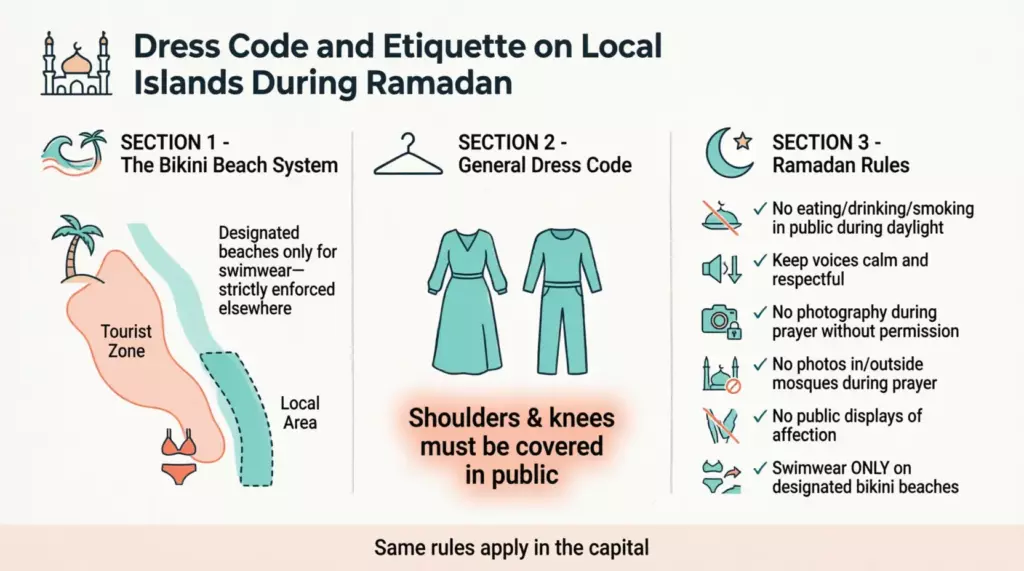
The actual rules:
- Cover shoulders and knees in all public areas (streets, markets, cafés, ferry terminals)
- No bikinis or shirtless walking outside designated bikini beach zones
- Avoid eating, drinking, or smoking in public spaces during daylight fasting hours
- Keep voices at a reasonable level — the daytime atmosphere is calm and contemplative
- Do not photograph people during prayer without explicit permission
- Avoid photography inside or directly outside mosques, particularly during prayer times
- Public displays of affection are not acceptable on local islands (this applies year-round, more so during Ramadan)
If you’re visiting Malé on a day trip from a resort, the same rules apply. The capital is an inhabited city, not a resort zone.
Ramadan Dates 2026–2030: Plan Before You Book
Ramadan follows the Islamic lunar calendar, shifting approximately 10–11 days earlier each solar year. Dates below are based on moon-sighting calculations and should be treated as reliable but subject to a 1-day adjustment based on the actual crescent moon sighting.
| Year | Ramadan Start | Ramadan End (Eid al-Fitr) | Duration |
|---|---|---|---|
| 2026 | 18 February (Wed) | ~19 March | 29–30 days |
| 2027 | 8 February (Mon) | ~9 March | 29–30 days |
| 2028 | 28 January (Fri) | ~26 February | 29–30 days |
| 2029 | 16 January (Tue) | ~14 February | 29–30 days |
| 2030 | 6 January (Sun) | ~4 February | 29–30 days |
Key pattern: Ramadan in the Maldives will fall in the January–March window through 2030, which is the heart of the dry season and historically the most popular (and expensive) tourist period. This overlap is not coincidental — Maldives peak season and Ramadan will coincide for the foreseeable future.
Eid al-Fitr: The three days following Ramadan are a public holiday. Government offices, banks, and some businesses close for 1–3 days. Resorts operate normally. If you’re booked on a local island during Eid, expect quiet daytime closures and festive evening energy in roughly equal measure.
The Unexpected Upsides: Fewer Crowds, Lower Prices, More Authentic Atmosphere
Here’s what the cautious articles don’t say clearly enough: Ramadan can be a good time to visit the Maldives, for the right traveller.
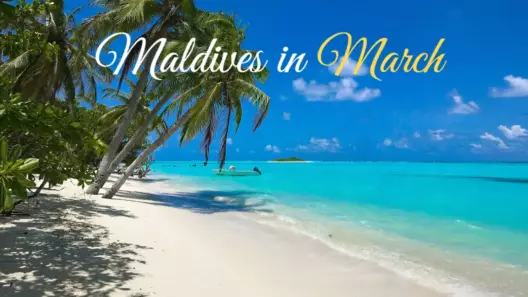
Fewer tourists. Visitor numbers drop meaningfully during Ramadan, even though the weather is excellent. Resort islands in February and March are quieter than the December–January peak. Local island guesthouses see particularly sharp drops in non-Muslim visitors. Beaches that are crowded in January have genuine empty stretches in late February.
Lower prices. Ramadan aligns with what some operators call a “soft shoulder” in their pricing. Resort rates in February are typically 10–20% lower than January peak, and some properties apply specific low-season pricing once past mid-February. Guesthouses on local islands often discount 20–30% compared to December–January rates, and the savings compound when combined with lower international airfares.
Better marine experiences. Water visibility in the Indian Ocean during February–March is excellent. Manta rays are active in Baa Atoll. Whale sharks are present around South Malé Atoll. Diving operations run on normal schedules. The dive boats, whale shark safaris, and snorkelling trips that run fully booked in December often have open spaces in late February.
Genuine cultural access. A Maldivian local island during Ramadan is one of the few situations in contemporary tourism where you can sit at a street café after dark, watch an entire community come to life simultaneously, share food you’ve never tried, and leave knowing something true about the place you visited. That experience is not available at a resort in any month.
Practical Pre-Trip Checklist
For resort stays:
- Confirm dinner service timing with your resort (most shift by 30–45 minutes)
- No other preparation needed — enjoy it
For local island stays:
- Book guesthouses with confirmed in-house kitchens or breakfast included
- Pack snacks for the 16:00–19:00 daily gap
- Bring modest clothing (light linen or cotton — covering shoulders and knees in heat is manageable)
- Carry small-denomination MVR for evening street food
- Pre-arrange speedboat or private boat transfers for any arrivals between 16:30 and 19:30
- If transiting through Malé, build in buffer time around the ferry suspension window
- Confirm ferry schedules with your guesthouse within 5–7 days of travel, as schedules are published close to the month start
- Check whether your target island has a designated bikini beach before booking if beach access in swimwear is a priority
For the split stay:
- Book resort first, local island second
- Time your local island arrival to begin in the evening — arriving at 18:30 lands you directly in the Iftar atmosphere
FAQ
Can I drink alcohol on a local island during Ramadan? No. Alcohol is prohibited on all inhabited local islands in the Maldives, during Ramadan and throughout the year. Alcohol is only legally available on private resort islands and on liveaboard boats in international waters.
Do I have to fast during Ramadan if I’m visiting as a tourist? No. Non-Muslims are not expected to fast. You are, however, expected to avoid eating, drinking, or smoking in public spaces on local islands during daylight hours out of respect for the community.
Will dive centres be affected? Diving operations at both resort and local island dive centres run normally. Your dive guide may be fasting, which they manage professionally and safely — fasting dive instructors are experienced at this. No adjustments to dive schedules are typically needed.
Is it safe to travel during Ramadan? Yes. The Maldives is one of the safest tourist destinations in the world. Ramadan does not create safety issues for visitors. If anything, the slower pace and more contemplative atmosphere on local islands during the day is pleasant.
Can I visit a mosque during Ramadan? Non-Muslims are generally not permitted inside mosques in the Maldives. You can view mosques from outside and walk respectfully nearby. During prayer times (five times daily), keep voices low and avoid obstructing access for worshippers.
What if my flight arrives during the ferry suspension window? Pre-arrange a private speedboat transfer through your guesthouse before departure. This is a common service, costs a known fixed rate, and eliminates schedule risk entirely.
Ramadan dates are based on lunar calendar projections and confirmed by the Maldives Islamic Ministry annually on sighting of the crescent moon. Specific ferry schedules are published by MTCC (Maldives Transport and Contracting Company) at the start of Ramadan each year — always verify exact times closer to travel.