Maldives or Bora Bora: The Overwater Villa Was Invented in the Other One
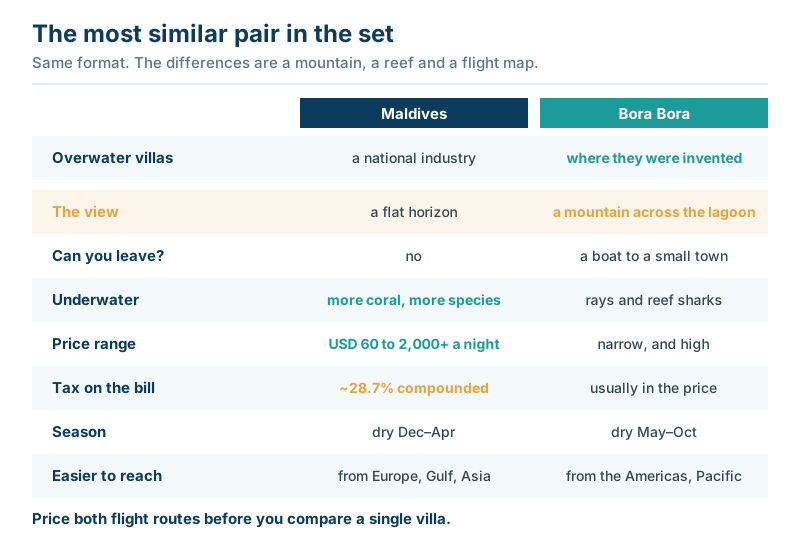
The Maldives is famous for the overwater villa. French Polynesia invented it — resort operators there built the first ones over a lagoon in the 1960s, and the format spread outward from the Pacific to the Indian Ocean.
That is not a piece of trivia. It is why Bora Bora is the only destination in this set whose structure genuinely resembles the Maldives. A lagoon inside a barrier reef, resorts on small islets, villas on stilts, a transfer by boat.
So the usual question in these comparisons — can you leave — is not the one that decides this. What decides it is a mountain, and a flight map.
1. What they have in common
Worth establishing first, because it is most of the picture.
A lagoon inside a barrier reef. Both are calm, shallow, turquoise water enclosed by a reef ring with deep ocean outside it.
Resorts on small islets. Bora Bora’s properties largely sit on motu — coral islets on the reef ring — which function much like Maldivian resort islands: one property, its own beach, reached by boat.
Overwater villas as the signature product, at a premium over a beach room. Our villa comparison describes the trade: the water beneath most of them is sand rather than reef.
A boat transfer on arrival, rather than a taxi — the Maldivian version is priced per person, as our transfers guide sets out.
And a price floor set by logistics. Both import almost everything and both run self-contained properties, which is why both are expensive — the argument our comparison hub makes about the Maldives generally.
Which means most of the differences below are matters of degree — with two exceptions that are not.
2. The mountain
The first exception, and it is the defining image of Bora Bora.
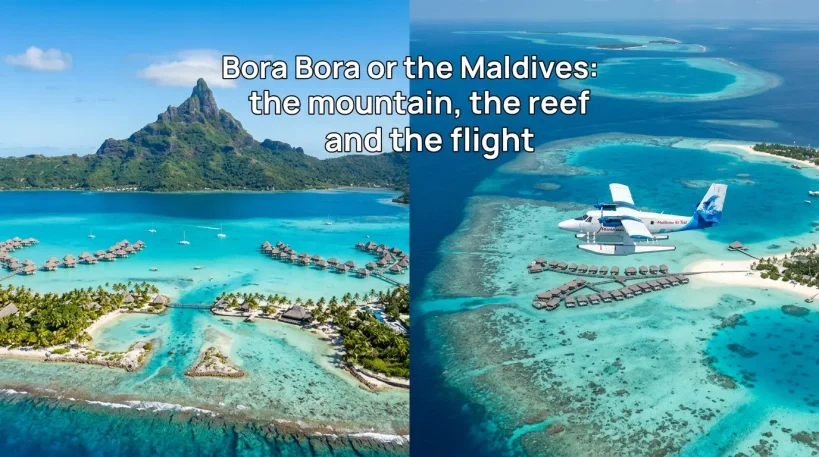
Mount Otemanu rises from the middle of the lagoon. Bora Bora is a volcanic island: a green peak with cliffs, wrapped by a reef ring. The resorts on the motu look back at it across the water.
That view is the product. An overwater villa in Bora Bora faces a mountain; an overwater villa in the Maldives faces the horizon.
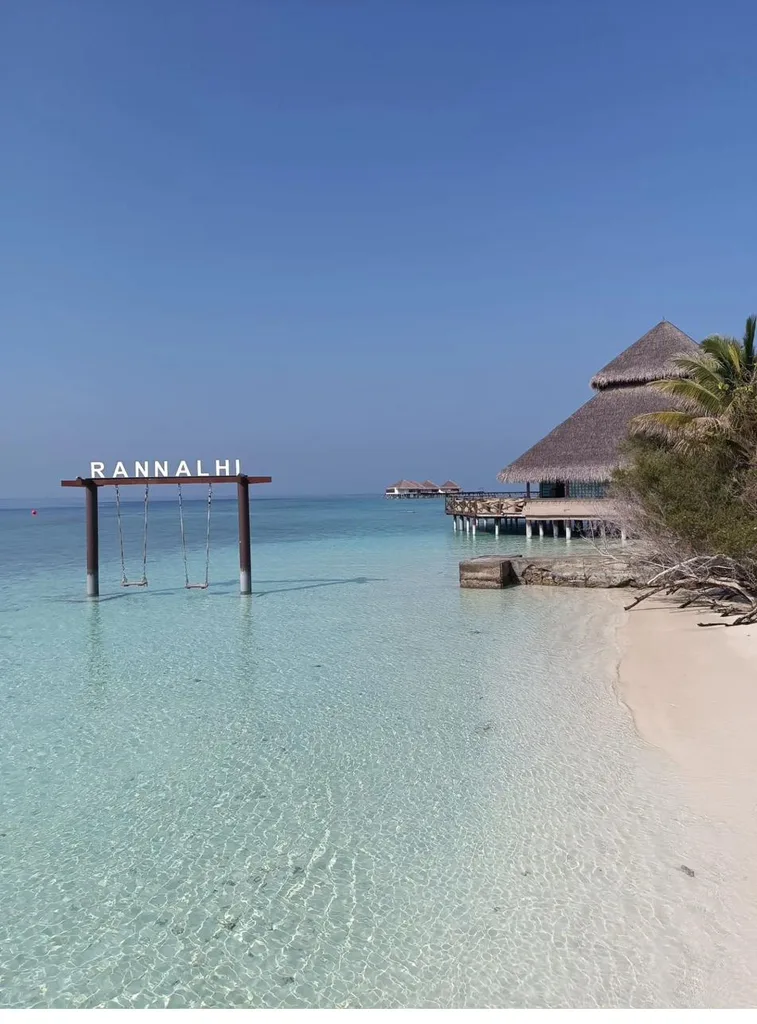
The Maldives has no vertical anything. The high point is about 2.4 metres, there are no hills, no rock and no interior. Every view is flat, and that flatness is either serene or monotonous depending entirely on the person.
It also changes the photographs, which is not a trivial consideration for a trip people are choosing partly on how it will look.
And it changes the light. A mountain produces shadow, weather on the peak, and a sunset with something in front of it. A Maldivian sunset is sea and sky, unobstructed, every evening.
Which is a genuine preference rather than a ranking. Some travellers want the drama and some want the emptiness, and no comparison can decide it for you.
3. Can you leave?
The second difference, and it resolves more favourably than in the Maldives — with a caveat.
Bora Bora has a main island with a town. Vaitape has shops, restaurants, a market, roads and traffic, and it is reachable by boat from the motu resorts.
Which means you can leave, in a way you cannot from a Maldivian resort island. There is somewhere to go, something to buy, and food that is not your hotel’s.
The caveat is that it is still a boat ride, and resorts control the shuttles. It is not the drive-anywhere freedom of Mauritius or Thailand; it is a scheduled crossing to a small town.
And you can hire a car or a scooter on the main island and circle it, which takes about an hour.
The Maldivian equivalent is a paid excursion to an inhabited island with dress rules attached. Our guide to local island visits sets out what that involves, and it is not wandering into a town.
4. What is in the water
Where the Maldives is clearly stronger, and it is the section that should decide it for anybody diving.
The Maldives has more of everything underwater. More coral, more reef fish, more species. Reliable encounters with manta rays, reef sharks and turtles, plus the year-round whale shark aggregation in South Ari, which has no Polynesian equivalent.
Bora Bora’s lagoon is famous for rays and reef sharks, at sites where they are habituated to boats and visitors, and it is a genuinely good snorkelling experience.
But the Pacific reef is less diverse than the Indian Ocean one in this region, and divers who have done both generally say so.
The Maldivian channel diving has no counterpart there — the current-driven big-animal diving our diving guide describes is a specific product of atoll geography and monsoon flow.
And the practical Maldivian caution applies as always: “house reef” covers four different arrangements, one of which is a sandy lagoon with the reef four hundred metres out. The check is in our guide to reading a house reef, and it matters more than the country choice.
5. The flight map, which decides it for most people
The most practical section here, and the one that ends the debate for a large share of readers.
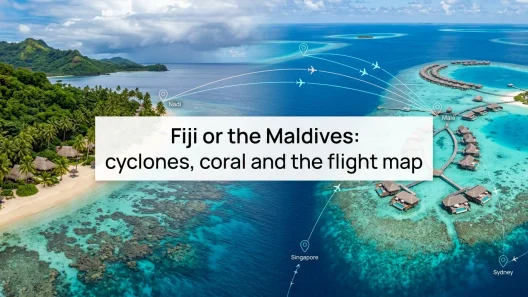
From Europe, the Maldives is straightforward — one connection through the Gulf or Istanbul, and you are there. Bora Bora requires reaching Tahiti first, which from Europe means crossing most of the planet, then a domestic flight of about fifty minutes, then a boat.
From the US West Coast the position reverses. Papeete is a direct flight from Los Angeles; the Maldives from the same starting point is a very long way east with at least one connection.
From Australia, New Zealand and Japan, French Polynesia is comparatively close and the Maldives is not.
Which means this comparison has a different answer depending on where you live, and it is the only one in this set where geography rather than preference is usually decisive.
The practical instruction: price both routes before comparing hotels. The flight difference frequently exceeds the difference in accommodation, and it also determines how much of your holiday is spent in transit.
And note the internal leg. Bora Bora adds a domestic flight, which is a fixed schedule and a further cost — closer to the Maldivian domestic flight pattern than to a taxi transfer.
What “most similar” actually means, and its limits
Worth pinning down, because the similarity is doing a lot of work in this article and it is not total.
The format is shared and the scale is not. The Maldives runs the one-island-one-resort model as a national industry across roughly 1,190 islands and 26 atolls, with over a hundred properties. French Polynesia has a handful of comparable resorts on one lagoon, inside a far larger and more varied territory.
Which changes what “choosing a property” means. In the Maldives it is a research exercise with real variables: density, reef geometry, transfer mode, board basis. Our guides to island size and reading a house reef exist because the choice is consequential.
In a small field the choice is narrower and the variables collapse toward price and availability.
It also changes the failure mode. A Maldivian traveller can pick badly among a hundred options; the other has fewer ways to get it wrong and fewer ways to optimise.
And it changes the research burden. One country rewards two hours with a satellite map. The other rewards checking who has a room, and then booking it.
Neither approach is wrong. They are the appropriate responses to a large market and a small one, and knowing which you are in saves a great deal of unnecessary reading.
6. What it costs
Both expensive, differently structured, and neither is a budget option.
Bora Bora is one of the most expensive beach destinations in the world. A small number of properties, a remote supply chain, French-territory cost levels, and demand that does not soften much.
The Maldives has the wider range. Over a hundred resorts span an accessible tier from about USD 350 a night upward. It also has a separate budget format that Bora Bora does not.
The Maldivian bill compounds. A 10% service charge and 17% goods and services tax reach roughly 28.7% on nearly every resort line, as our guide to money in the Maldives explains.
A week for two, excluding international flights. Maldivian figures from our own budget work; Bora Bora as orientation.
| Maldives | Bora Bora | |
|---|---|---|
| Budget | USD 1,100–1,900 guesthouse island | No equivalent format |
| Mid-range | USD 4,500–8,000 resort | High, with a narrow field |
| Luxury | USD 12,000+ | Comparable or higher |
| Transfer | USD 200–1,640 for two | Domestic flight plus boat |
| Tax on the bill | ~28.7% compounded | Local taxes, usually in the price |
The decisive structural point on price: the Maldives has a cheap version of itself and Bora Bora does not. A guesthouse island runs around USD 60 a night with the same reefs. Pensions on other Society Islands are the nearest Polynesian equivalent.
Which matters if budget is the constraint. Want the overwater villa but not a week of it? The Maldives offers two or three nights inside a longer, cheaper stay. Bora Bora largely does not.
7. The rules you live under
Straightforward, and the difference is larger than the similarity of the two lagoons suggests.
French Polynesia is a French overseas collectivity. Alcohol is sold normally, dress is ordinary, and there is no separation between visitor space and resident space.
The Maldives operates two legal regimes. Alcohol is served on resort islands under licence and is unavailable on every inhabited island; swimwear is for resorts and designated tourist beaches only. Our guides to alcohol and dress codes set out the detail.
Which does not usually affect a resort week in either country, since a Maldivian resort is licensed and behaves like anywhere else.
It affects the day off the island, and any traveller considering a guesthouse island, where the island is dry and the rules are the point rather than a footnote.
And it affects the honeymoon calculation for couples who want a week that includes a town, a bar and somewhere to walk — our honeymoon guide covers the Maldivian case.
8. Season
Similar in shape, different in timing, and worth checking against your dates.
The Maldives runs on the monsoon: December to April is dry, clear and expensive; May to November is wetter, cheaper and better for large animals. The mechanism is in our monsoon guide, the pricing in our guide to high and low season.
French Polynesia is southern hemisphere. Its drier, cooler season runs roughly May to October, and its wetter, warmer one roughly November to April.
Which means the two are broadly out of phase. The European summer is the Maldivian wet season and the Polynesian dry one. That is a real argument for anybody tied to school holidays.
And both are hot year-round. Neither has a cool season in any meaningful sense, which is one reason island size and density matter more than climate when choosing a property.
As always, these are patterns rather than guarantees, and a week of rain in the dry season happens in both.
The lagoon question, which applies to both
A shared caution, and it is the one thing a reader of either destination should internalise.
A calm turquoise lagoon is not the same as a reef. In both countries the water immediately outside a villa is frequently shallow sand — beautiful, warm, and empty of anything to look at.
The reef is somewhere else, usually further out, and reaching it may be a swim, a walk or a boat.
Which is why the satellite check matters more than the country choice. Pale turquoise close to shore is sand; dark blue-green is reef; deep blue is the drop-off. Two minutes on a map, and it applies identically to a motu and to an atoll island.
The Maldivian version of the problem is documented because the country is large enough for the variation to be systematic: four different geometries all marketed with the same phrase.
The lesson generalises. Whichever of these two you book, look at the water colour against the beach before you look at the villa. It is the check that predicts whether you will be in the sea or beside it.
9. Who each one suits
Choose the Maldives if: the water is the point. Diving, snorkelling, big animals, and the widest choice of properties at the widest range of prices in the overwater category.
Choose Bora Bora if: the view is the point. A mountain across a lagoon is a specific image, it is what people picture, and the Maldives cannot produce it.
Divers: the Maldives, and it is not close. Our guide to choosing a resort for diving covers how to pick a base.
Anyone travelling from the Americas or the Pacific: Bora Bora, on the flight map alone.
Anyone travelling from Europe, the Gulf or South Asia: the Maldives, for the same reason — the routes are in our guide to getting there.
Budget-constrained travellers who still want an overwater villa: the Maldives, because a short overwater stretch inside a longer cheaper stay is possible there.
Honeymooners: both, and this is the closest contest in the set alongside the Seychelles. The tiebreaker is usually the flight.
Repeat visitors to one: the other, since they are more alike than anything else in this comparison set and yet the experience differs on the two points above.
And anyone comparing them purely on photographs: be aware that you are comparing a mountain to a horizon, and that both photograph beautifully for different reasons.
10. Can you do both?
Almost nobody should, and the reason is not preference.
They are on opposite sides of the planet. Combining them in one trip means circumnavigating, which is a project rather than a holiday.
Each has a natural partner instead. Bora Bora pairs with the rest of the Society Islands — Moorea, Huahine, Taha’a — reachable by short domestic flights and ferries, which is how most Polynesian itineraries are built.
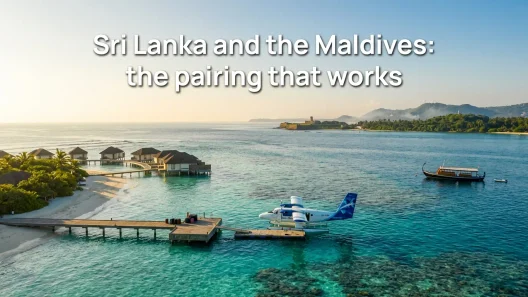
The Maldives pairs with Sri Lanka, a short hop and a completely different trip, and it is the best fortnight available in that part of the world.
Which is a useful reframing. Neither destination is really a one-island trip at its best; both sit inside archipelagos that reward moving. The Maldivian version of that is the split stay our site keeps recommending.
What we know first-hand, and what we do not
We have been to the Maldives — to Maafushi, an inhabited island, with a day visit to one resort. We have not stayed overnight at a Maldivian resort, which is why nothing on this site ranks them.
We have not been to French Polynesia. This comparison is structural: geography, transport, cost mechanics, legal environment and season — facts that are checkable rather than felt.
Which is why this article says nothing about Polynesian food, service, hotels or culture. We are not in a position to, and neither is most of the comparison content that claims otherwise.
The Maldivian figures are ours, from published work on this site. The Bora Bora figures are bands, labelled as orientation.
Three of the ten comparisons in this set were written after visiting both countries. This is not one of them, and the difference is stated on purpose.
Questions travellers ask
Which is better, the Maldives or Bora Bora? They are the two most similar destinations in this comparison set. Bora Bora has a mountain across the lagoon and a town you can reach; the Maldives has better reef life, a far wider range of properties and prices, and a cheap version of itself. Where you live usually decides it.
Which is more expensive? Bora Bora, generally, and it has a much narrower field. The Maldives spans an accessible resort tier and a guesthouse-island format at around USD 60 a night that has no Polynesian equivalent at scale.
Where were overwater villas invented? In French Polynesia, in the 1960s. The Maldives adopted the format later and turned it into a national industry.
Which has better diving and snorkelling? The Maldives, clearly — more coral, more species, and reliable large animals including year-round whale sharks. Bora Bora’s lagoon is known for rays and reef sharks.
Can you leave your resort? In Bora Bora, yes — by boat to the main island, where there is a town with shops and restaurants. On a Maldivian resort island, no.
Which is easier to reach? It depends entirely on where you start. From Europe, the Gulf or South Asia, the Maldives by a wide margin. From the US West Coast, Australia, New Zealand or Japan, French Polynesia.
When should I go? The Maldives is best December to April. French Polynesia is southern hemisphere, with its drier season roughly May to October — so the two are broadly out of phase.
Can I combine them? No sensible itinerary does. They are on opposite sides of the world. Bora Bora pairs with the other Society Islands; the Maldives pairs with Sri Lanka.
What to take away
- These are the two most structurally similar destinations in this comparison set — lagoons, motu resorts, overwater villas, boat transfers.
- The overwater villa was invented in French Polynesia. The Maldives scaled it into a national industry.
- Bora Bora has a mountain across the lagoon; the Maldives has a 2.4-metre high point and an unobstructed horizon. That is the aesthetic choice.
- The Maldives has better reef life and a far wider price range, including a guesthouse format Bora Bora has no equivalent of.
- Where you live usually decides it. Price both flight routes before comparing hotels — the difference frequently exceeds the accommodation gap.
Next step: open a flight search for both, from your own airport, before you look at a single villa. This is the one comparison in the set where the map does most of the deciding. Finding that out first saves a fortnight of researching a destination you were never realistically going to book.