Maldives or Seychelles: The Only Alternative That Is Not Cheaper
Almost every destination compared with the Maldives is a way of spending less. The Seychelles is not. It costs real money too, and that makes it the most interesting comparison in this set, because price cannot decide it for you.
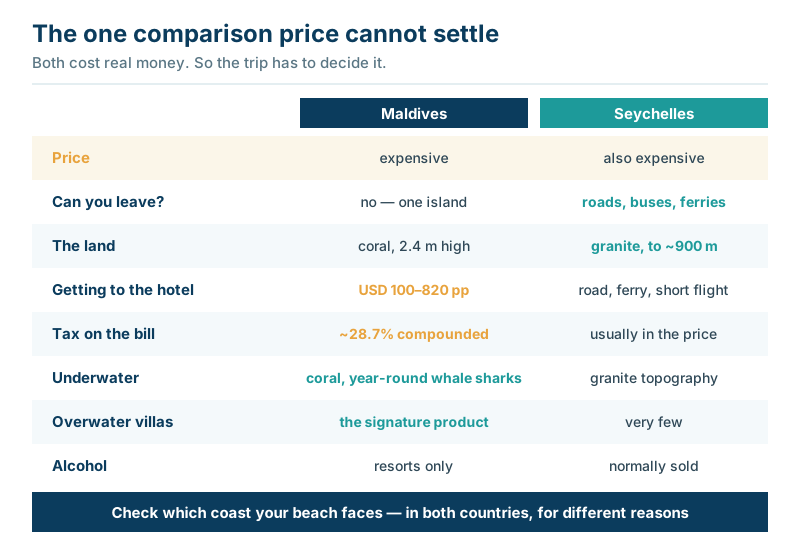
What decides it is the same thing that decides most of these: whether you want to be able to leave. The Seychelles has granite mountains, roads, buses, ferries, a capital city and about a hundred thousand people living on it. The Maldives has an island, a reef and a jetty.
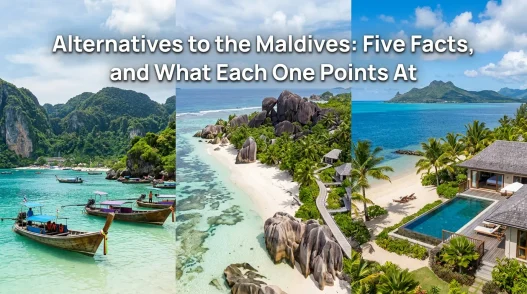
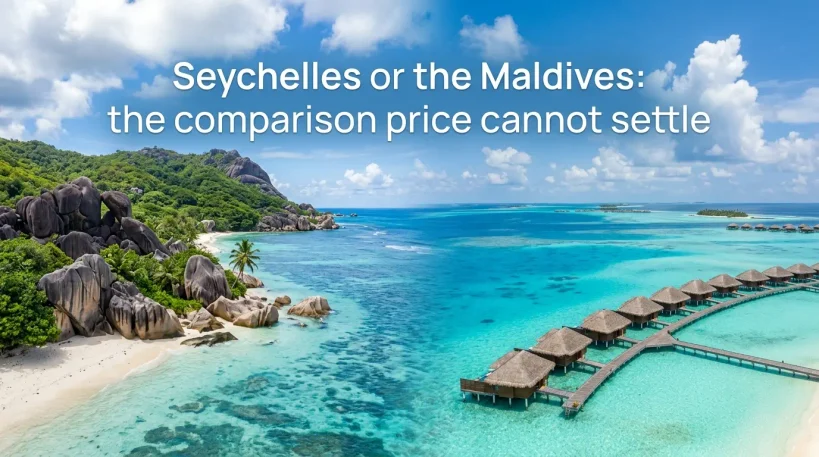
And the beaches genuinely look different — Seychelles beaches are framed by weathered granite boulders, which is not a landscape the Maldives can produce at all.
1. Can you leave?
The dimension that runs through this whole comparison set, and the Seychelles answers it with a qualified yes.
In the Maldives, no. A resort occupies its entire island — no second restaurant, no shop, no road. The alternative is a guesthouse island, a village you can cross in twenty minutes, and our where to stay pillar sets out what that means for a week.
In the Seychelles, yes — on the main islands. Mahé, Praslin and La Digue are populated islands with roads, buses, taxis, restaurants and shops. You can stay in a guesthouse, hire a car, and eat somewhere different each evening.
The qualification matters. The Seychelles also has private-island resorts that work exactly like Maldivian ones: one property, one island, no leaving. If you book one of those, this dimension resolves the same way in both countries.
Which means the Seychelles offers both models and the Maldives, in practice, offers one plus a village. That is a genuine advantage in flexibility and it is easy to miss when comparing resort photographs.
La Digue is the version people remember — a small island where bicycles are the normal way to get about, which is a kind of mobility no Maldivian island can offer.
2. What the land is
Where the two are least alike, and the reason Seychelles photographs are recognisable.
The inner Seychelles islands are granite. Ancient continental rock rather than coral, with mountains rising to around 900 metres on Mahé, forested slopes, and the weathered boulders that frame the famous beaches.
The Maldives has no rock and almost no elevation. The high point is about 2.4 metres. No hills, no rivers, no interior.
Which produces things to do on land. Hiking on Mahé, the Vallée de Mai forest on Praslin, botanical gardens, viewpoints, and a capital small enough to walk across.
And terrestrial wildlife. Giant tortoises, endemic birds and forest. The Maldives has birds, bats and rats, because there is no land for anything else.
The Seychelles also has coral islands, in its outer groups, which are structurally much closer to Maldivian atolls — and much harder and more expensive to reach.
3. What the water is
The comparison people expect to be close, and it is closer than most in this set.
Both have excellent water. Warm, clear, and reef-fringed, with genuine snorkelling from many beaches.
The Maldives has the stronger reef life. More coral, more reef fish, and reliable encounters with manta rays, reef sharks and turtles, plus the year-round whale shark aggregation in South Ari that has no equivalent anywhere. Our guide to reef health records what the 2024 bleaching cost, which applies to both regions.
The Seychelles has granite underwater too. Dive sites built on boulder formations rather than reef walls, which is a genuinely different kind of diving and one many divers prefer for its structure.
Whale sharks pass Mahé seasonally, rather than being resident, which is the practical difference for anyone planning a trip around them.
And the Seychelles has a seaweed season. During the south-east trades, some beaches accumulate seaweed. It varies by coast and by month, and it catches visitors who booked from photographs taken in the other season.
The Maldivian version of that problem is different in kind: not seaweed but geometry, since “house reef” covers four arrangements and one of them is a sandy lagoon with the reef four hundred metres out. Our guide to reading a house reef explains the check.
What the outer islands change
A footnote that is not a footnote, because it is where the two countries converge.
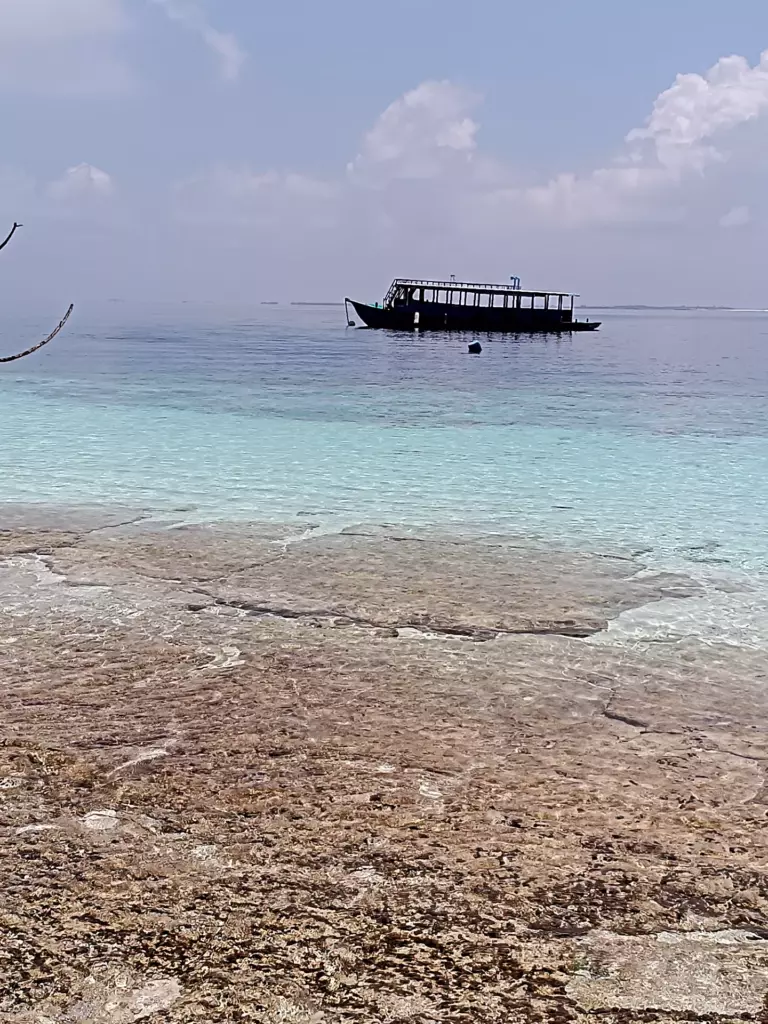
The Seychelles has coralline outer islands — atolls and sand cays far from Mahé, which are structurally much closer to the Maldives than the granite inner islands are.
They are remote and expensive to reach, usually by charter flight, and the properties there operate on the one-island-one-resort model that the Maldives runs nationally.
Which means the Seychelles contains both answers: a granite archipelago you can move around, and atoll isolation at the far end, at a price that reflects the distance.
Aldabra — the giant-tortoise atoll — is a conservation site rather than a holiday destination, and reaching it is an expedition rather than a booking.
The practical consequence for anyone comparing: be specific about which Seychelles you mean. “The Seychelles” as a beach destination usually means Mahé, Praslin and La Digue, and that is the version this article compares.
The Maldives has no equivalent ambiguity. Every resort island works the same way, whichever atoll it is in, which is a limitation and also a reason the country is easy to research — as our guides to island size and choosing an atoll show.
4. Getting there and getting around
Similar at the start, different afterwards.
Both are long-haul from Europe with a connection, typically through the Gulf.
Then the Maldives adds a transfer priced per person. A speedboat at USD 100 to 400 per person return, or a seaplane at USD 400 to 820, charged for children too — the picture is in our transfers guide. Seaplanes fly in daylight only and stop between about 15:30 and 16:00, so a late arrival costs a day.
The Seychelles adds a road transfer on Mahé, and for the other islands a ferry or a short domestic flight. Those cost money and are not free, but they are scheduled public transport with published fares rather than a per-person charter.
And island-hopping is normal there. Mahé, Praslin and La Digue are routinely combined in one trip, on ferries, which is a completely different proposition from moving between Maldivian resorts.
Which is the practical difference: a Seychelles itinerary can contain three islands without a private boat. A Maldivian one contains an island, or an island and a split stay arranged deliberately.
5. What it costs
The section that makes this comparison unusual, because the answer is not “one of them is cheap”.
Both are expensive destinations. The Seychelles has a high cost base, imports heavily, and prices its tourism accordingly. It is not the budget alternative that Thailand or Zanzibar is, and anybody expecting it to be will be surprised.
The Maldivian bill compounds. A 10% service charge and 17% goods and services tax reach roughly 28.7% on almost every resort line. Our guide to money in the Maldives explains it, and our guide to budget and all-inclusive shows what a package leaves out.
The Seychelles has a self-catering sector the Maldives does not. Guesthouses and self-catering apartments on Mahé, Praslin and La Digue, where you can shop and cook, which changes the arithmetic for a family considerably.
The Maldivian equivalent is the guesthouse island, at around USD 60 a night with meals at USD 5 to 13. It is the format our guide to choosing a local island covers, and it lands a week for two at USD 1,100 to 1,900.
A week for two, excluding international flights. Maldivian figures from our own budget work; Seychelles figures as orientation only.
| Maldives | Seychelles | |
|---|---|---|
| Budget | USD 1,100–1,900 guesthouse island | Self-catering, comparable |
| Mid-range | USD 4,500–8,000 resort | High, and competitive with it |
| Luxury | USD 12,000+ | Comparable |
| Transfer | USD 200–1,640 for two | Road, ferry or short flight |
| Eating out | Impossible at a resort | Normal |
| Tax on the bill | ~28.7% compounded | Local taxes, usually in the price |
Which means price rarely decides this one, and that is what makes it the most honest comparison in the set. You are choosing between two expensive holidays on their merits.
The overwater villa question
Worth a section, because it is what a large share of people comparing these two are actually comparing.
The Maldives owns the format. Overwater villas are available at a large share of resorts, at a premium of 40 to 100 per cent over a beach villa — and, as our villa comparison sets out, the water beneath most of them is sand rather than reef.
The Seychelles has very few. Its geography is granite shorelines and deep water close in, which is a poor building proposition compared with a shallow atoll lagoon.
What the Seychelles offers instead is a beach in front of boulders, which photographs at least as well and is a completely different picture.
Which is the honest framing: if the overwater villa is the point of the trip, the Maldives is the answer and this comparison ends. If the point is scenery, the Seychelles has the more distinctive landscape by a wide margin.
And the Maldivian compromise — two or three overwater nights inside a longer beach stay — costs a fraction of a week of it, whichever country the rest of the trip happens in.
6. The rules you live under
Straightforward, and it favours the Seychelles for most travellers.
The Maldives operates two legal regimes. Alcohol is served on resort islands under licence and is unavailable on every inhabited island. Swimwear is confined to resorts and designated tourist beaches, and shoulders and knees are covered elsewhere — our guides to alcohol and dress codes set out the detail.
The Seychelles has none of that. Alcohol is sold normally, dress is a matter of ordinary courtesy, and visitors and residents share the same beaches and towns.
Which changes what a village visit means. In the Maldives, going to an inhabited island is an excursion with rules attached, as our guide to local island visits explains. In the Seychelles it is just where you are.
And it changes the guesthouse proposition. A Maldivian guesthouse island is cheap and dry; a Seychellois guesthouse is on an island where you can buy a beer. For some travellers that single fact settles the whole comparison.
7. Season, and the thing nobody mentions
Both are year-round destinations with meaningful variation, and the Seychelles variation is less well understood.
The Maldives runs on the monsoon: December to April is dry, clear and expensive; May to November is wetter, cheaper and brings the plankton that draws the big animals. The mechanism is in our monsoon guide and the pricing in our guide to high and low season.
The Seychelles has two wind seasons. The north-west monsoon runs roughly November to March — warmer, wetter, calmer seas. The south-east trades run roughly May to September — drier, windier, and rougher on the exposed coasts.
Which coast you are on therefore matters, in a way it does not in the Maldives. A beach that is sheltered in one season is exposed in the other, and this is where the seaweed accumulation shows up.
April and October are the transitions, and they are widely considered the calmest windows.
The practical instruction is the same in both countries: check which side of the island your beach faces and pair it with your travel month. In the Maldives that is about the monsoon side; in the Seychelles it is about the trades and the seaweed.
8. Who each one suits
Choose the Maldives if: the water is the entire point. Big animals, coral, an overwater villa, complete isolation, and a week in which nothing is asked of you and nothing is offered either.
Choose the Seychelles if: you want beaches that look like nowhere else, the ability to move between islands, land to walk on, and somewhere to eat that is not your hotel — at a price that is not much lower.
Divers: the Maldives for pelagics and coral; the Seychelles for granite topography. Our guide to choosing a resort for diving covers how to pick a Maldivian base.
Families: the Seychelles, on balance. Self-catering exists, there is no per-person seaplane, and there is somewhere to go when everybody has had enough of the beach. Our guide to choosing a Maldivian resort for a family covers the other route.
Honeymooners: both, and this is the closest contest in the whole comparison set. The Maldives for seclusion; the Seychelles for scenery and the ability to do something. Our honeymoon guide covers the Maldivian case.
Photographers: the Seychelles, for the granite — though the Maldivian case is underwater rather than on land.
Anyone who wants to be genuinely unreachable: the Maldives, and it is not close.
And anyone who has already done one of them: do the other. They are more different than their marketing suggests, which is the most useful sentence on this page.
9. Can you do both?
Possible, unusual, and worth understanding before an agent suggests it.
They are roughly 2,000 kilometres apart with no convenient direct hop, so combining them means a third long flight or a routing through a Gulf hub.
And they are similar enough in kind — Indian Ocean, warm, beach, reef — that a fortnight split between them is a lot of travelling for two versions of the same climate.
The exception is a specialist diving trip, where the granite sites and the atoll walls genuinely are different products and a diver might want both. Even then, most would rather spend the fortnight in one.
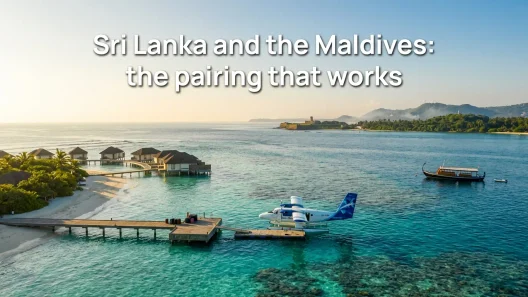
The Maldives’ natural pair is Sri Lanka — a short hop, a completely different trip, and the fortnight that works best of any combination available. The Seychelles pairs more naturally with an East African stop, if anything.
And if you are choosing rather than combining, our comparison hub sets out the five structural facts that decide most of these questions.
What we know first-hand, and what we do not
Stated plainly, and this article’s disclosure is narrower than some others in this set.
We have been to the Maldives — to Maafushi, an inhabited island, with a day visit to one resort. We have not stayed overnight at a Maldivian resort, which is why nothing on this site ranks them.
We have not been to the Seychelles. This comparison is structural: geography, transport, legal environment, cost mechanics and season patterns — things that are checkable rather than felt.
Which is why this article says nothing about Seychellois food, service, hotels or people. We are not in a position to, and neither is most of the comparison content that claims otherwise.
The Maldivian figures are ours, drawn from published work on this site. The Seychelles figures are bands, labelled as orientation, and should be treated as a starting point rather than a quotation.
Three of the ten comparisons in this set were written after visiting both countries — Mauritius, Zanzibar and Thailand. This is not one of them, and the difference is visible on purpose.

Questions travellers ask
Which is better, the Maldives or the Seychelles? Different trips at similar prices. The Maldives is one island, one resort and the strongest reef life in the Indian Ocean. The Seychelles is a granite archipelago with mountains, roads, ferries and towns, where you can move between islands and eat outside your hotel.
Which is cheaper? Neither, meaningfully. Both are expensive, which is what makes this comparison unusual. The Seychelles has self-catering; the Maldives has guesthouse islands at around USD 60 a night, which is the cheapest way into either country.
Which has better snorkelling and diving? The Maldives, for coral, reef fish and reliable large animals including year-round whale sharks. The Seychelles has granite dive topography, which is a different kind of site rather than a worse one.
Can you leave your hotel? On the main Seychelles islands, yes — roads, buses, ferries and restaurants. On a Maldivian resort island, no. Note that the Seychelles also has private-island resorts that work exactly like Maldivian ones.
Is alcohol available in both? In the Seychelles, normally. In the Maldives, only on resort islands and floating bars; every inhabited island is dry.
Which suits families better? The Seychelles, generally — self-catering, no per-person seaplane transfer, and somewhere to go on a wet day.
When should I go to each? The Maldives is best December to April. The Seychelles has a warmer, wetter north-west monsoon roughly November to March and drier, windier south-east trades roughly May to September, with April and October as calm transitions.
Can I visit both in one trip? Rarely worth it. They are about 2,000 kilometres apart with no convenient hop, and they offer similar kinds of water. Sri Lanka pairs far better with the Maldives.
What to take away
- The Seychelles is the one alternative that is not cheaper, which means price cannot decide this comparison and the trip itself has to.
- You can leave on the main Seychelles islands — roads, buses, ferries between Mahé, Praslin and La Digue. You cannot leave a Maldivian resort island.
- The Seychelles is granite: mountains to around 900 metres, forest, boulders on the beaches. The Maldivian high point is about 2.4 metres.
- The Maldives has the stronger reef life, including a year-round whale shark aggregation the Seychelles cannot match.
- Check which coast your beach faces in both countries — for the monsoon side in the Maldives, and for the trades and seaweed in the Seychelles.
Next step: decide whether you want the water or the archipelago. If the answer is that you want to swim, dive and be left alone, the Maldives does that better and the Seychelles will feel busy. If the answer is that you want to look at somewhere extraordinary and be able to drive to another part of it, the Seychelles does that and the Maldives cannot do it at any price.