
Where the Reefs Are Now: Maldivian Coral After the Fourth Bleaching Event
The honest answer to “are the reefs still worth seeing” is yes, with a significant qualification that most travel content skips.
Between 2023 and 2025 the world went through the largest coral bleaching event ever recorded. In the Maldives, sea surface temperatures hit 31.5°C in 2024 and heat stress passed the level at which most coral species die. Surveys published in 2026 found that live hard coral cover in the central atolls dropped by more than 40% on average, with one lagoon reef in Ari Atoll losing 57%.
Then 2025 gave the archipelago a reprieve. What that leaves is a patchwork, and a finding in the research tells you which parts of it to swim over.

What bleaching actually is
Coral is an animal that farms. Inside its tissue live single-celled algae called zooxanthellae, which photosynthesise and hand over most of the sugars they produce. The algae also supply the colour — the coral itself is transparent, and the white underneath is its limestone skeleton.
When water stays too warm for too long, the relationship breaks down. The coral expels the algae, loses its colour and its main food supply, and turns bone white. That is bleaching, and the crucial point is that a bleached coral is stressed, not dead. If the water cools within a few weeks, the algae recolonise and the coral survives, weakened.
If the heat persists, the coral starves. Scientists measure the risk in degree heating weeks, which accumulate the amount and duration of heat above the local summer maximum. Around four is bleaching territory. Above eight, widespread mortality follows. In 2024 the Maldives exceeded nine.
That is why the same event can leave one reef white and recovering while the reef next door becomes rubble.
Four events in twenty-six years
The Maldives has one of the world’s longest continuous reef monitoring records, with annual surveys running since 1998, and it has watched four global events pass through.
| Event | What happened in the Maldives |
|---|---|
| 1998 | The catastrophic one. Coral cover collapsed across the archipelago and took a decade to rebuild. |
| 2010 | A moderate event, with partial mortality and relatively quick recovery. |
| 2016 | Severe. Roughly 60 to 70% of shallow coral above 15 metres died, with branching species hit hardest. |
| 2023–24 | The fourth global event, and the largest ever recorded worldwide. Central Maldivian atolls lost over 40% of live hard coral. |
The fourth event is the one to understand. NOAA confirmed it in April 2024, and by late 2025 bleaching-level heat stress had affected roughly 84% of the world’s reef area across at least 83 countries. The previous record, set during the 2014–17 event, was 68%.
Note the intervals: 1998, 2010, 2016, 2024. Reef recovery from a severe event takes ten to fifteen years for the fast-growing species and considerably longer for structural complexity. The gaps are now shorter than the recovery.
When bleaching happens, and what it means for your dates
Thermal stress in the Maldives is seasonal, and the pattern is consistent enough to plan around — not to avoid the reef, but to understand what you are looking at.
March to May is the risk window. The northeast monsoon ends, winds drop, the sea flattens and surface water heats with nothing to mix it. Every major Maldivian bleaching event has peaked in these months. March, April and May are also, awkwardly, superb months to visit: the calmest water and the clearest visibility of the year.
The southwest monsoon cools things down. From June onward, wind, cloud and mixing pull surface temperatures back. Visibility drops and the sea gets rougher, but the reef gets a break.
El Niño is the amplifier. The 1998 and 2016 catastrophes both coincided with strong El Niño conditions in the Indian Ocean, and 2024 followed the same pattern. If you read that an El Niño is developing, the following northeast monsoon is when Maldivian reefs are at risk.
None of this is a reason to change your booking. Bleaching is not dangerous to swim over and it does not affect anything else about a trip. It is a reason to know what white coral means if you see it in April, and to mention it to your dive centre rather than photographing it as decoration.
The finding that tells you where to swim
Here is the practical payoff, and it comes from long-term monitoring in Ari, South Malé and Vaavu atolls.
Researchers have now formally validated what field reports had suggested for years: an inner and outer reef dichotomy. Recovery on inner lagoonal reefs is stunted compared with the cooler outer slopes. Lagoon water is shallower, warmer, less flushed and slower to shed heat, so it bleaches harder and rebuilds slower. Outer reef slopes, washed by open-ocean water moving through the channels, came through better and are recovering faster.
The most severe single loss recorded in the 2024 event — 57% mortality — was on a lagoon reef.
For a traveller this is directly actionable. If you want to see living coral, get to the outer reef. That means:
- Choosing snorkelling and dive sites on the atoll’s outer rim rather than inside the lagoon
- Booking excursions to channel sites, where current keeps water moving
- Treating the house reef in a shallow, enclosed lagoon as pleasant swimming rather than the best coral you will see
- Asking the dive centre directly which of their sites are outer slope
Divers already benefit from this without knowing why: the classic Maldivian channel dives in Vaavu and across Ari, and the outer slopes of Kaafu in North Malé and South Malé, are outer-water sites, which is part of why they still look good.

What comes back, and what does not
Recovery is not uniform, and the shape of it changes what a reef looks like.
Fast growers return first. Branching and tabular Acropora — the classic staghorn and table corals — grow quickly and recruit readily. They are also the most heat-sensitive, so they die first and return first, which produces boom and bust cycles.
Massive corals endure. Porites and other boulder-forming species survive heat far better and grow at perhaps a centimetre a year. After each event the community shifts further toward these, plus encrusting forms.
Structural complexity is the real loss. The 2024 surveys recorded a marked reduction in it, and that matters more than percentage cover. A reef of table corals is a three-dimensional city with holes for juvenile fish. A reef of boulders and encrusting growth is a suburb. Fish diversity follows structure, not just coral.
Fish recover faster than coral, as long as the structure holds. This is why a damaged reef can still be a good snorkel — the fish are there before the coral is back.
Coralline algae, giant clams and other binders rebuild at their own pace, and their return is one of the markers scientists watch.
The marine life that does not depend on coral
A useful thing to know if you are worried the trip is compromised: several of the Maldives’ headline experiences have nothing to do with coral cover.
Whale sharks feed on plankton and aggregate along the outer rim of South Ari Atoll year-round. Coral condition is irrelevant to them, and our whale shark guide covers the season and the etiquette.
Manta rays gather where currents concentrate plankton, most spectacularly at Hanifaru Bay in Baa Atoll between roughly June and October.
Hammerheads at Rasdhoo and the channel-diving in North Ari are open-water experiences on outer slopes.
Nurse sharks, turtles and reef fish remain abundant on structure that is no longer brightly coloured. Turtles in particular are doing comparatively well, and they eat seagrass rather than coral.
Bioluminescent plankton on the tideline is a phenomenon of the water column entirely. Our guide to bioluminescent beaches explains where and when it shows up.
The reef is the foundation for all of it in the long run. In the short run, a trip built around big animals and outer-slope diving is not much affected by what happened to lagoon Acropora in 2024.
Will you still see a good reef?
Yes, and the honest framing is this: the Maldives has roughly 6,300 square kilometres of reef, close to 5% of the world’s total. Even after a bad event, that is an enormous amount of habitat in a range of conditions.
What you should not expect is the reef of a 2014 brochure photograph. What you can reasonably expect on a decent outer site is live coral in patches, substantial fish life, and areas of rubble and algae in between. On a poor inner-lagoon site you may see mostly dead structure with new recruits scattered across it.
Two cautions about atoll-by-atoll recovery rankings, which circulate widely online. First, conditions vary as much within an atoll as between atolls — the inner-outer difference is larger than most regional differences. Second, the figures in those rankings are usually estimates assembled from resort reports rather than survey data. Use them as a hint, not a basis for booking, and read our atoll decision guide and the complete atolls guide for the factors that are more reliably knowable.
If reef quality is the point of your trip, ask the dive centre at the property you are considering two specific questions: which sites are outer slope, and what they saw during and after 2024. Operators who monitor their own reefs answer immediately.
How to read a reef when you are floating over it
Most visitors cannot tell a recovering reef from a dying one. Four signs to look for.
Bright white coral is bleaching happening now. The animal is alive and stressed. This is the one to report to your dive centre.
Grey-brown coral covered in fine algae is dead, recently. The skeleton is intact but turf algae have colonised it.
Rubble fields are older death, where the structure has collapsed. Look closely for small coloured buttons on the fragments: those are new recruits, and they are the reef trying again.
Colour and shadow is health. A healthy reef has depth, overhangs, fish moving in and out of structure, and colour that varies rather than uniform brown.
Nothing you see on one snorkel represents the country. It represents that reef, that day, at that depth.

Why this is not only an environmental question
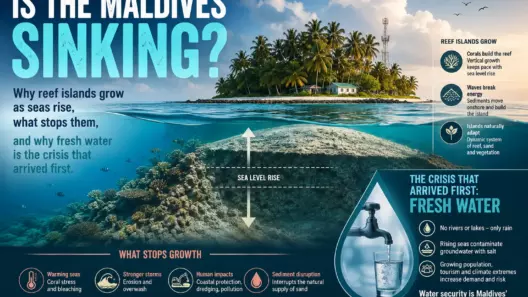
Coral reefs are the reason the Maldives exists as land.
The islands are made of broken coral and shell, deposited by waves onto reef platforms — all 1,190 or so of them. The reef also absorbs wave energy before it reaches the shore — a living reef is a breakwater that repairs itself. When coral dies and the structure erodes, that protection weakens, and the response is concrete: revetments, groynes and seawalls, of the kind now visible on many inhabited islands.
That is the link between reef health and the country’s future, and it is covered in our piece on whether the Maldives is sinking. The short version is that reef islands can build upward if the reef supplying their sand is alive. If it is not, they cannot.
Reefs are also the tourism product. Around 178 resorts and the entire guesthouse sector sell water clarity and marine life, and the fishery that feeds the country depends on reef-associated ecosystems as well as open-ocean tuna, as our food guide sets out.
What a visitor can actually do
Most advice here is small. It is also, unusually, real — reef damage from tourism is local, cumulative and entirely avoidable.
Never stand on coral. This is the big one. A single fin kick or foot placement kills growth that took years. Wear a flotation aid rather than standing to rest, and keep fins away from the reef.
Do not touch anything. Corals, clams, turtles, rays. Sunscreen and skin oils damage coral tissue directly.
Use mineral sunscreen, or cover up. Oxybenzone and octinoxate are implicated in coral stress, many resorts now ask guests to avoid them, and a rash guard is more effective than any lotion.
Do not buy coral or shells. Coral mining is prohibited and taking marine products out of the country is restricted, as our guide to banned items explains.
Choose operators who brief properly. A dive centre that runs a buoyancy check and a no-touch briefing is protecting the site it sells — the same operators who take safety seriously, as our guide to diving risk covers. One that lets snorkellers stand on the reef is not.
Do not feed fish. It alters behaviour and diet, and it concentrates animals in ways that stress the reef.
Skip the reef-walking excursions. If an excursion involves walking on a reef flat at low tide, decline it.
Restoration, and what it can honestly achieve
Many resorts run coral propagation programmes: fragments grown on frames, transplanted onto degraded areas, sometimes offered to guests as an activity for a fee.
These are worth supporting and worth understanding. Restoration works at the scale of hundreds of square metres. Bleaching works at the scale of an ocean basin. A transplanted frame is a garden in the path of a weather system, and the 2024 event killed transplanted coral alongside wild coral in many locations.
What the programmes genuinely do: maintain local structure, keep propagation expertise alive, seed recovery in specific spots, and — not trivially — teach several thousand guests a year what a coral actually is. What they cannot do is offset a marine heatwave.
Judge them on whether the resort also monitors its reef, briefs its guests and manages its own runoff, rather than on the number of frames in the lagoon.
The seagrass argument
One conservation fight visible from your sun lounger.
Seagrass meadows grow in shallow lagoons, stabilise sand, absorb carbon, feed turtles and shelter juvenile fish. They also look, to a guest expecting a swimming pool, like weeds. Resorts have historically raked and removed them to produce a clean sandy lagoon, and a campaign across the Maldivian industry has pushed back, with a number of properties now committing to leave meadows in place.
If you arrive at a resort or a guesthouse island with seagrass in the shallows, that is a property making a choice in favour of the ecosystem. The turtles you came to see are eating it.
The same applies to the drifts of seagrass and algae that wash onto beaches, particularly in the southwest monsoon. Raking them daily removes habitat and sand-binding material. It is one of the honest small tensions between a manicured holiday and a working ecosystem.

What the country is doing
Maldivian marine policy is stronger than its size suggests, and the record is genuinely mixed rather than uniformly good.
Protection that works. Sharks have been protected in Maldivian waters since 2010. Purse-seine fishing is banned, and the tuna fishery is pole and line. Hanifaru Bay in Baa Atoll sits inside a UNESCO Biosphere Reserve with managed access, and Baa Atoll more broadly is among the better-managed regions.
Pressure that does not. Land reclamation and dredging bury reef directly, and the Greater Malé region has over 1,600 hectares under reclamation. Coastal armouring changes sediment movement. Sewage treatment on inhabited islands is improving from a low base. Those are local, immediate impacts on top of a global thermal problem.
Monitoring that matters. The archipelago’s continuous survey record since 1998 is one of the most valuable reef datasets in the Indian Ocean, and citizen-science expeditions add to it annually.
Questions travellers ask
Are the coral reefs in the Maldives dead? No. They were badly damaged in 2024, when central atolls lost over 40% of live hard coral, but the Maldives has around 6,300 square kilometres of reef in widely varying condition. Outer reef slopes are in substantially better shape than inner lagoon reefs.
When was the last coral bleaching in the Maldives? 2024, as part of the fourth global bleaching event — the largest ever recorded. Sea temperatures reached 31.5°C and heat stress passed the mortality threshold. The Maldives avoided a mass bleaching event in 2025.
Where can I still see healthy coral? On outer reef slopes and channel sites, where ocean water keeps temperatures down. Ask your dive centre which of their sites are outer slope. Shallow, enclosed lagoon reefs recovered least.
Is snorkelling still worth it? Yes. Fish life recovers faster than coral and remains excellent, and outer sites hold substantial live coral. Adjust expectations away from brochure photographs taken before 2016.
Does reef-safe sunscreen matter? Oxybenzone and octinoxate are implicated in coral stress and many resorts ask guests to avoid them. A rash guard and shade are more effective than any sunscreen, reef-safe or not.
Can I take coral or shells home? No. Coral mining is prohibited and exporting marine products is restricted. Buying them sustains the trade.
Do coral restoration projects work? At a small scale, yes — they maintain structure and seed local recovery. They cannot offset marine heatwaves, and transplanted coral died alongside wild coral in 2024.
Which atoll has the best coral? Any ranking you read is approximate, and the difference between inner and outer reefs within one atoll usually exceeds the difference between atolls. Choose the site type, not the region.
What to take away
- The 2023–24 event was the largest coral bleaching event ever recorded, affecting about 84% of the world’s reef area. Central Maldivian atolls lost over 40% of live hard coral.
- 2025 brought no mass bleaching, and recovery has begun — unevenly.
- Outer reef slopes recovered better than inner lagoon reefs, and that difference is bigger than the difference between atolls. Swim the outer rim.
- Fish life returns faster than coral, so a damaged reef can still be a superb snorkel.
- The individual actions that matter are simple: never stand on coral, do not touch, cover up instead of relying on sunscreen, and choose operators who brief properly.
Next step: when you enquire at a property, ask the dive centre which of their sites are on the outer reef and what they observed in 2024. The answer will tell you both what the diving is like and whether anyone there is paying attention.