Haa Alifu Atoll and What Bad Timing Costs You – Two Resorts and a Palace
Book Haa Alifu Atoll in September and you will pay roughly half the winter rate for the same villa. You will also, in all likelihood, see no manta rays at all. In this particular atoll the rays turn up almost exclusively in the expensive months. That inversion is the single most useful thing to know about the Maldives’ northernmost atoll, and almost no guide to it says so out loud.
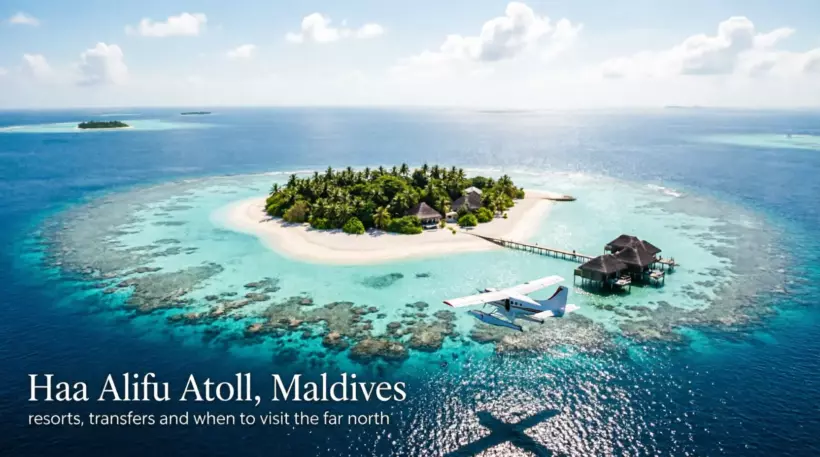
Haa Alifu Atoll sits roughly 300 kilometres north of Malé, closer to India’s Minicoy than to its own capital. It holds two operating resorts, fourteen inhabited islands, and the palace where the Maldivian state’s founding story begins. This guide covers what is actually there, what the journey costs, and when the trip is worth taking.
What Haa Alifu Atoll actually is
Officially it is Thiladhunmathi Uthuruburi — Northern Thiladhunmathi. The administrative unit was created on 21 May 1958. The long Thiladhunmathi atoll was split into northern and southern halves, and the northern half was merged with Ihavandhippolhu, the northernmost natural atoll in the archipelago. Ihavandhippolhu is small by Maldivian standards: about 22 kilometres long, with roughly 25 islands strung along its boundary reef.
Counting islands here is a good early test of any source. The government’s atoll register, maintained by the Ministry of Fisheries and Agriculture, lists 42 islands with 14 inhabited. Wikipedia says 43. Popular travel sites say 45, and at least one recent guide claims 16 inhabited islands. Where a number matters in this article, it comes from the register.
The capital and largest island is Dhidhdhoo. By population and land area, Haa Alifu Atoll ranks third in the country. That surprises visitors who expect the far north to be empty — it is thinly touristed, not thinly populated. To the north, the broad channel known as Maliku Kandu separates the atoll from Minicoy and the rest of India’s Lakshadweep group.
Foreign tourism arrived only in 2005, roughly two decades after it saturated the atolls around Malé. That late start explains most of what follows. You get a handful of very large resorts, an under-built local-island scene, and infrastructure that has been announced far more often than it has been finished.
The season trap: why the cheap months are the wrong months here
Every general Maldives guide teaches the same trade-off. Travel in the southwest monsoon, May to November, and you pay far less — rates commonly run 30 to 60 per cent below peak. Plankton-rich water brings mantas and whale sharks with it. Travel December to April instead and you buy sunshine and calm seas at a premium.
That advice is sound in Baa, Ari and North Malé. It is close to backwards in Haa Alifu Atoll.
The mechanism is the monsoon itself. Wind and current push plankton across an atoll and pile it up on the downwind side, and the filter feeders follow. During the northeast monsoon the rays gather on western edges. During the southwest monsoon they move east.
In the central atolls that rule holds tightly. Further out it degrades. According to ZuBlu’s Maldives seasonality guide, written by Adam Broadbent and updated in March 2025, this atoll is the clearest exception in the north: manta rays are seen here almost exclusively during the northeast monsoon, and all but vanish for the rest of the year.
Stack that against the pricing calendar and the consequence is blunt. The manta window and the peak-rate window are the same window. There is no clever shoulder-season arbitrage to be had here. A traveller who books Haa Alifu Atoll in September on the standard “save money, see more marine life” logic has bought the discount and lost the animals.
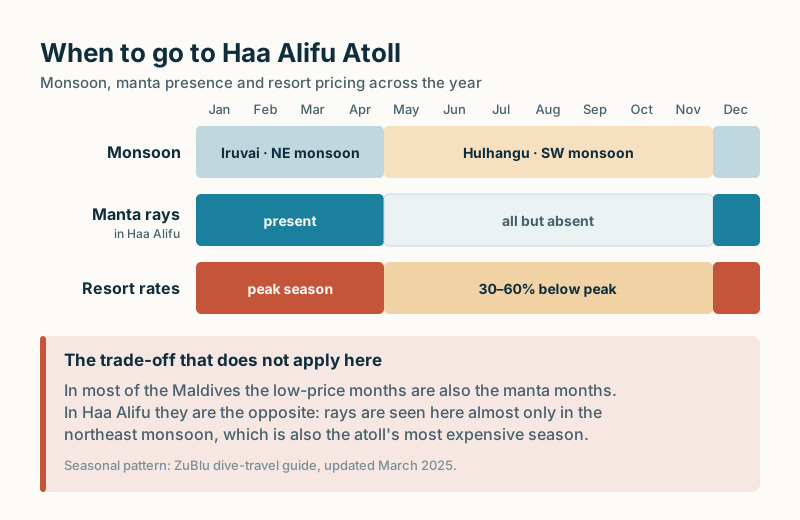
Two practical caveats apply. April and November are transitional months and behave unpredictably in both directions. And the pattern above describes reef mantas at cleaning stations, not the diving in general. Reefs, channel dives and big-game grounds in the north stay worth visiting in the wet season. They simply come without the ray aggregations.
If mantas are the reason for the trip, treat late December to March as the only sensible booking window and budget accordingly. If they are not, the wet season here is genuinely good value. The atoll’s other draw — near-total absence of other boats — costs nothing extra.
Getting there, and the airport that sits in the next atoll
The most common practical error travellers make with Haa Alifu Atoll is assuming its international airport is in it. Hanimaadhoo International Airport (HAQ) sits on Hanimaadhoo island in Haa Dhaalu, the neighbouring atoll to the south. Several well-ranked guides file Hanimaadhoo hotels under Haa Alifu listings. One does so on the same page where its own text correctly places the island in Haa Dhaalu.
The airport actually inside the atoll is Hoarafushi (HRF), which opened in November 2020. It is small: a single terminal, one airline, one route, flights to Malé six days a week. It is also routinely left out of transfer discussions. For one of the two resorts, routing through it cuts the boat leg from about 45 minutes to about 10.
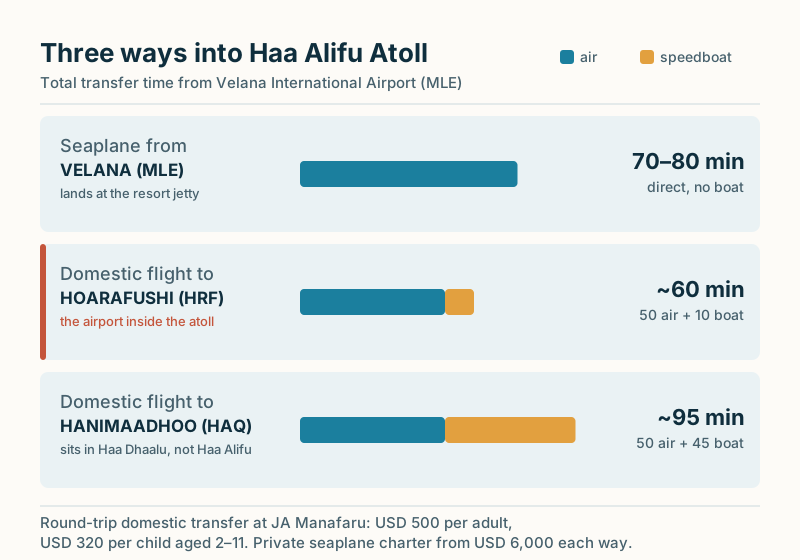
JA Manafaru’s own transfer documentation sets out all three options. A seaplane takes roughly 70 to 80 minutes and lands at the resort. A domestic flight of under 50 minutes to Hoarafushi is followed by a 10-minute speedboat. The same flight to Hanimaadhoo is followed by 40 to 45 minutes on the water.
The round-trip domestic transfer is priced at USD 500 per adult and USD 320 per child aged two to eleven, with infants free. A private seaplane charter for up to twelve passengers starts from around USD 6,000 each way.
Hideaway Beach Resort & Spa, on Dhonakulhi, quotes a seaplane transfer of about 75 minutes. It has also been running a shared charter flight included for stays of seven nights or more. That kind of promotion matters more here than in Kaafu. At these distances the transfer is a real line item, not a rounding error, and a family of four can find the flying costs as much as several nights of the room.
Two scheduling points are worth planning around. Seaplanes do not fly after dark, so a late international arrival usually means an overnight near Velana before you go north. And the domestic connection is a separate flight on a separate operator, which is precisely where delays compound.
For anyone reaching the local islands rather than a resort, a public ferry runs weekly from Malé. It takes something in the order of 16 to 18 hours. It is cheap, and it is a serious commitment.
Two resorts, eight resort islands
Haa Alifu Atoll has two operating resorts, and that number tells you almost everything about its character.
Hideaway Beach Resort & Spa occupies Dhonakulhi, a large crescent-shaped island with roughly 1.4 kilometres of beach on each side and about 103 villas and suites. Its distinguishing feature is structural. The reef it sits on is split by a natural channel, which forms a sheltered harbour used as a marina. That is an unusual arrangement in the Maldives, and it is why the island appears on yacht itineraries as well as hotel ones. The house reef is a double reef, snorkellable directly from shore, and the dive centre holds PADI 5-star Gold status.
JA Manafaru takes a 35-acre island, all villas, each with a private pool. It runs a dine-around all-inclusive model across seven venues, including a subterranean wine cellar. It is the more contained of the two — a single-island estate rather than a small resort town. It is also the property with the Hoarafushi routing advantage described above.
Now the number that frames both. The government’s atoll register codes eight islands in Haa Alifu Atoll as resort islands: Alidhoo, Alidhuffarufinolhu, Dhonakulhi, Gaamathikulhudhoo, Maafinolhu, Manafaru, Medhafushi and Naridhoo. One more, Berinmadhoo, is marked as a proposed resort. Two of those eight are open.
The register’s own summary text still says the atoll has three resorts. That was true when Alidhoo traded as Cinnamon Island Alidhoo and, from August 2010, as J Resorts Alidhoo. It no longer appears in current listings.
Eight designations, two properties. In the central atolls, a designated resort island is a construction schedule. Here it is closer to an intention.
Utheemu and the palace where the country’s founding story starts
Utheemu is a small island of around 900 people and the most historically significant address in the northern Maldives. It is the birthplace of Sultan Mohamed Thakurufaanu, who ended Portuguese rule over the islands.
The compressed version runs like this. The Portuguese occupied the Maldives from 1558 to 1573. Thakurufaanu and his brothers Ali and Hassan withdrew to Minicoy to prepare and built a vessel called the Kalhuohfummi. They ran an eight-year campaign against the occupiers before Thakurufaanu took the throne, which he held for twelve years. The boat itself was built at Baarah, a short distance away — one of the few places where a national myth has a verifiable postal address.
Utheemu Ganduvaru, his childhood home, still stands. It dates to the late fifteenth or early sixteenth century and used an unusual technique for its time: timber posts driven directly into the ground, with coral stone for the wall foundations. Inside the compound is a small stone-and-timber mosque with a teak interior. Its construction date is unknown, though Thakurufaanu is understood to have prayed there as a young man, and his father is buried in the cemetery. There is no entry fee to the island, and most visitors give the site around two hours.
One correction is worth carrying with you. A widely read guide to this atoll describes the old mosque on nearby Kelaa as dating to the seventh century. That cannot be right. The Maldives converted to Islam in a shift conventionally dated to 1153, so no Maldivian mosque predates the twelfth century.
Sources closer to the record place the Kelaa mosque in the reign of Sultan Mohamed Ibn Ali, 1692 to 1701. When a Maldivian heritage date sounds implausibly early, check it against 1153 first.
Kelaa, Uligamu and where you can stay outside the resorts
Kelaa is the atoll’s other history island and, for many visitors, the better place to stay cheaply. Its beaches run exceptionally wide — up to about 100 metres at low tide — and the island opened to budget tourism in 2015.
Its Second World War layer is real. The British built a staging post here that served as the northern counterpart to Gan in the far south, an RAF refuelling station for Allied shipping and aircraft. Dates vary by source, with accounts ranging from 1934 to 1945; Wikipedia’s account has planning beginning around 1941 and construction finished in 1943. Two concrete anchor columns the British sank in the lagoon are still visible, along with remains of the armoury.
Uligamu, at the northern tip, is the most genuinely unusual island here, and it is not a beach story. It is one of the country’s official ports of entry for yachts, alongside Malé and Gan in the south. For boats crossing the Indian Ocean toward the Red Sea, it is frequently the first Maldivian landfall.
Customs and immigration clear vessels here, and an agent is mandatory nationwide. Yachts over 15 metres staying beyond 15 days need a cruising permit. The permit fee for boats under 15 metres was removed in December 2020, and a marina has been under development as of 2025. If you arrive under sail, Haa Alifu Atoll is not a destination you fly to. It is the doorway.
Guesthouses operate on Kelaa, Hoarafushi, Dhidhdhoo and Vashafaru. Aggregator rates commonly start in the region of USD 45 to 80 a night, though a few properties price well above that. The scene is small and improving rather than established. It comes with the standard local-island conditions: modest dress outside designated bikini beaches, no alcohol, and excursions arranged through your guesthouse rather than booked online in advance.
The development gap: a terminal for 1.3 million, one airline
Haa Alifu Atoll has spent a decade being about to change. Understanding that gap will save you from booking on a promise.
Hanimaadhoo’s redevelopment is real and finished. It was funded through an Indian EXIM Bank line of credit at a cost of roughly USD 136 million. The project delivered a runway of about 2.5 kilometres capable of taking A320 and 737 aircraft, a terminal of some 10,380 square metres designed for 1.3 million passengers a year, and what is billed as the first aerobridge outside Malé. President Muizzu inaugurated the new terminal in late 2025, and international services resumed after a year-long pause.
Then look at the schedule. Flight data through the first half of 2026 shows a single airline serving Hanimaadhoo — Maldivian — with domestic routes to Malé, Kulhudhuffushi and Dharavandhoo. There is exactly one international route: Thiruvananthapuram, operating seasonally from May to October. That is a terminal built for 1.3 million passengers a year currently handling something closer to a hundred arrivals a month.
The pattern repeats one atoll north. The iHavan project proposed a transshipment port, free zone and cruise hub for Ihavandhippolhu, which sits beside one of the world’s busiest shipping lanes. It was announced at a Singapore investment forum in 2014.
Boston Consulting Group ran the feasibility study, Saudi Arabia contributed grant funding, and Singapore’s Surbana Jurong was awarded the master plan. Three successive administrations have relaunched it. Nothing has been built.
None of this makes the atoll a bad trip. It does mean that “the north is opening up” has been a true-sounding sentence for twelve years. Plan around the airline schedule that exists, not the terminal built for the one that does not yet.
Who should book Haa Alifu Atoll, and who should not
It suits you if:
- You have been to the Maldives before and are trading convenience for emptiness.
- You dive or snorkel and value reefs that see single-digit boat traffic.
- You want a resort that behaves like a private estate.
- You care about the country’s history, not only its lagoons.
- You are sailing through and need a clearance port.
- You are travelling between late December and March and mantas are on the list.
Look elsewhere if:
- It is your first Maldives trip and you have a week or less. The transfer will eat a disproportionate share of it.
- You are hunting wet-season value and megafauna. This atoll uniquely refuses to sell the two together.
- You have a tight international connection. The domestic leg is a separate operator, and delays compound.
- You want variety in resorts. Two properties is the entire choice.
- You want a developed local-island scene, which Baa and Ari deliver far better.
It fails outright if you are booking on the assumption of direct international flights into the north. They are not there in any meaningful volume, and this is a long way to travel to discover that.
Haa Alifu Atoll FAQ
How many islands does the atoll have? The government’s atoll register lists 42 islands, of which 14 are inhabited. Other sources say 43 or 45; the register is the one to trust.
Which airport serves it? Two do, and neither answer is clean. Hoarafushi (HRF) is inside the atoll but domestic only, with flights to Malé six days a week. Hanimaadhoo (HAQ) is the international airport, but it sits in neighbouring Haa Dhaalu.
How long is the journey from Malé? Roughly 70 to 80 minutes by seaplane direct, about 60 minutes total via Hoarafushi, or about 95 minutes total via Hanimaadhoo. The public ferry from Malé takes 16 to 18 hours.
How many resorts are there? Two: Hideaway Beach Resort & Spa on Dhonakulhi, and JA Manafaru. Eight islands are designated for resort use in the government register.
When is the best time to visit for mantas? Late December to March. Unusually for the Maldives, the manta season here falls inside the dry, high-priced northeast monsoon rather than the cheaper wet season.
Can you stay on a local island? Yes. Guesthouses operate on Kelaa, Hoarafushi, Dhidhdhoo and Vashafaru, typically from around USD 45 to 80 a night, under standard local-island rules on dress and alcohol.
What is there to see besides beaches? Utheemu Ganduvaru, the timber palace of Sultan Mohamed Thakurufaanu; the Second World War British staging post on Kelaa; and Uligamu, the northern yacht clearance port.
The short version
- Haa Alifu Atoll is the Maldives’ northernmost administrative division: 42 islands, 14 inhabited, capital Dhidhdhoo, roughly 300 km north of Malé.
- Its manta season runs in the northeast monsoon and coincides with peak pricing, so the usual wet-season value logic does not apply.
- Its international airport, Hanimaadhoo, is in the next atoll. Hoarafushi is the one inside it, and routing through it can cut the boat leg to about ten minutes.
- Two resorts operate against eight designated resort islands, the clearest single measure of how undeveloped the atoll remains.
- Utheemu holds the palace where the campaign that ended Portuguese rule began, and Uligamu is where boats crossing the Indian Ocean first touch Maldivian soil.
Your next step: fix the month before you shortlist the resort. Decide whether mantas are part of the trip, because that one answer sets both your travel window and roughly half your budget. Then ask each property which airport it will route you through. The Hoarafushi option is rarely offered unprompted, and it is worth the question.
Sources
- Government of Maldives atoll register (Ministry of Fisheries and Agriculture);
- ZuBlu Maldives seasonality guide, Adam Broadbent, updated March 2025;
- JA Manafaru transfer fact sheet; Hideaway Beach Resort & Spa property listings; Maldivian route data and FlightConnections schedules, 2026;
- Corporate Maldives and Maldives Financial Review on the Hanimaadhoo redevelopment;
- Sun Online, Atoll Times and Maldives Independent on the iHavan project;
- Noonsite and Yachting Pages on Uligamu clearance; Wikipedia on Kelaa and Haa Alif Atoll;
- Visit Maldives on Utheemu Ganduvaru.