Meemu Atoll – the Maldives’ quietest atoll: what Meemu really offers in 2026 — and what the guides get wrong
Book Meemu Atoll from the guides currently ranking for its name and you will plan the wrong trip. You will budget $450–550 for a seaplane the atoll no longer strictly requires. You will overnight in Malé for nothing. And you will book one of “the two resorts” while a third — 80 villas, open since January 2023 — quietly sells rooms next door.
Meemu, or Mulaku on the old charts, sits about 130 kilometres south of Malé and holds roughly 33 islands, eight of them inhabited. In May 2025 the atoll got its own airport, and most of the internet has not noticed. This is what is actually there, what it costs, and who should go.
- Ranking the Newest Airports in the Maldives
Mulaku in brief: the facts worth knowing before anything else
Meemu is the code name; Mulaku is the atoll itself. Meemu Atoll, as the administrative division, covers the natural Mulaku Atoll: capital at Muli, 33 islands, eight of them inhabited — Boli Mulah, Dhiggaru, Kolhufushi, Maduvvaree, Muli, Naalaafushi, Raimmandhoo and Veyvah. The code letters were assigned for administrative convenience and stuck because foreigners find them easier to pronounce than the Dhivehi names.
The scale is small enough to be worth stating plainly. Muli, the capital, had 949 residents at the 2022 census and sits 138.8 km south of Malé. Mulah, the largest community, counted 1,426 people; Dhiggaru had 1,099 and Raimmandhoo 171. Around five thousand people live in an atoll roughly 50 kilometres from end to end.
Four numbers frame every decision below:
- Three resorts. Not two, whatever the resort marketing says.
- 45 minutes. Flight time from Malé to Muli Airport, or roughly the same by seaplane.
- June to November. Manta season on the eastern channels.
- Zero. Public ferry routes currently running in the atoll.
Everything else in this guide is detail hanging off those four.
Muli Airport changed the arrival maths in May 2025
For twenty years the only sensible way into Meemu Atoll was a seaplane. Seaplanes have one hard limitation: they do not fly after dark.
Muli Airport, run by the Regional Airports Company, opened to public use on 6 May 2025. It has a 1,200-metre runway and a terminal built for 150 passengers, at a cost the construction minister put at MVR 540 million. He also noted why seaplanes were not the answer: they cannot operate at night. That is the whole point. A night-capable airport turns a late international arrival from a lost day into a connection.
The national carrier, Maldivian, launched the route on 17 May 2025 as a 35-minute flight with one-way fares starting at MVR 1,377, operating weekly on Saturdays. Schedule aggregators listed a single weekly departure at 15:30 as of July 2025, with a 45-minute block time over 142 km. By early 2026 the picture had loosened: Wikipedia’s airport entry, citing the airline’s own destination page in January 2026, lists Malé and Gan as the two commercial destinations served. A Gan connection matters more than it sounds — it makes a Meemu-plus-Addu itinerary possible without backtracking through the capital.
Be honest about the limits. One flight a week is not a transfer network, and no resort here sells the airport as its standard route in. Cinnamon Hakuraa Huraa was still promoting 45-minute seaplane transfers in a 2026 campaign; Medhufushi offers a 35-minute seaplane or a 2.5-hour speedboat.
So the airport is a tool for independent travellers heading to local islands, not yet a resort transfer. It is also a signal. Infrastructure arrives before the crowds do, and Meemu Atoll is now on the wrong side of that curve.
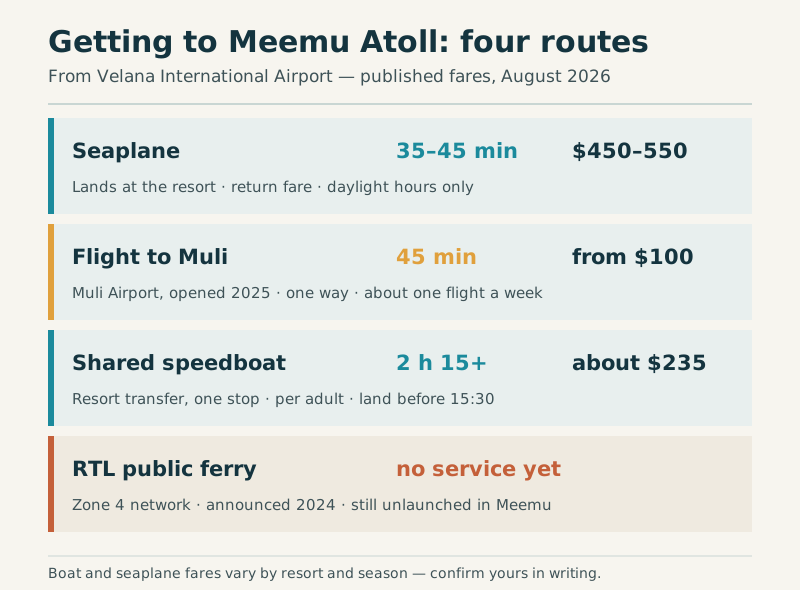
The public ferry is the one line on that graphic worth watching. An agreement to run Raajje Transport Link high-speed ferries between Meemu and Malé atolls was signed in April 2024, and the atoll sits inside RTL Zone 4. When the network reached Laamu on 31 March 2026, taking it to 15 atolls, Maldivian outlets reporting the launch listed Meemu among the atolls still waiting. Budget travellers should plan around private speedboats and the weekly flight, not around a ferry timetable that does not yet exist.
Three resorts, not two: what is actually open in Meemu
The “only two resorts” line has outlived its accuracy by three years, and sources that should know better keep repeating it — including operators’ own pages. AAA Hotels & Resorts, which owns and runs the property, still describes Medhufushi as one of just two resorts in Meemu Atoll. The third opened in January 2023: Madifushi Private Island launched with the tourism minister at the ceremony, offering 80 beach and overwater villas a 35-minute seaplane flight from Velana International.
The confusion runs in the other direction too. One well-optimised 2026 atoll guide lists Al Mahra as a Meemu property; Al Mahra Maldives is a FAM Holding development on Fonagaadhoo island in Laamu Atoll. If you searched for Meemu resorts last week, there is a fair chance you were shown a property in the wrong atoll while the real third resort went unmentioned.
Here is the actual bench, with the character of each:
| Resort | Villas | Transfer | Best for | The catch |
|---|---|---|---|---|
| Cinnamon Hakuraa Huraa | 80 beach and water bungalows | 45-min seaplane or 2 h 15 speedboat | All-inclusive couples, first-timers | Enormous shallow lagoon; snorkelling is a boat ride |
| Medhufushi Island Resort | 112 villas, two lagoon suites | 35–40-min seaplane or 2.5 h speedboat | Value, divers, long stays | Rustic and ageing; no house reef |
| Madifushi Private Island | 80 villas, all with private pools | 35-min seaplane | Honeymoons, families wanting new-build | Newest and priciest; least written about |
Hakuraa Huraa’s own pitch leans on one of the largest shallow lagoons among Maldives resorts and an adults-only island connected to the main island by a walkway. Medhufushi trades on affordability: 112 rustic villas, all-inclusive pricing, facilities that show their age. Madifushi opened with 80 villas each carrying a private pool, and added an all-female villa concept in May 2025. Three properties, three different buyers — which is more choice than most people expect from an atoll this quiet.
The house-reef trap: great marine life, none of it outside your villa
This is the section the ranking guides skip, and it is the one most likely to ruin a booking. A big lagoon and a good house reef are opposite things, and Meemu is where that trade-off bites hardest.
The Werner Lau dive centre that runs Medhufushi’s diving is blunt about it: the resort has no house reef. Its diving happens at sites around the atoll instead — inner sites sheltered from current by the coral formations, outer reefs holding reef sharks, mantas and the occasional whale shark.
Hakuraa Huraa’s selling point has the same consequence. That vast, waist-deep lagoon is lovely to wade and poor to snorkel, and guest accounts describe marine life that looks sparse before it resolves into fish hiding among the stones.
An atoll guide summarising the region puts the general case in one line: house reefs are healthy, but much of the marquee marine life sits at boat-access channel and manta sites. Translate that into practice. If your holiday is “step off the deck, snorkel, repeat”, Meemu Atoll will underdeliver and a house-reef atoll like Baa or South Ari will serve you better. If your holiday is two boat dives a day in channels nobody else is diving, Meemu is close to unbeatable value.
The workaround is a question to ask before you pay: how many snorkelling excursions are included, and how many run per week? Hakuraa Huraa includes complimentary boat trips to snorkelling sites for all guests, which converts a weak lagoon into a functioning marine holiday. A resort that charges per excursion in an atoll with no house reef quietly doubles the price of the thing you came for.
Diving the Mulaku kandus: mantas on a monsoon schedule
The diving reputation of Meemu Atoll rests on channels, not walls. The eastern and western rims are cut by deep kandus whose currents sweep in plankton-rich water, sustaining soft corals and pelagics; the Mulaku Kandu channel in the north-east is studded with submerged pinnacles covered mainly in soft coral. Grey reef sharks, eagle rays and mobulas turn up across the atoll, with whale sharks as an occasional bonus rather than a promise.

The signature is the manta cleaning stations. Muli Corner is a protected site whose cast changes with the monsoon: sharks in the dry north-east season, mantas in the wetter south-west one. Mantas and More, a shallow station, adds tuna, barracuda and Napoleon wrasse to the same dive.
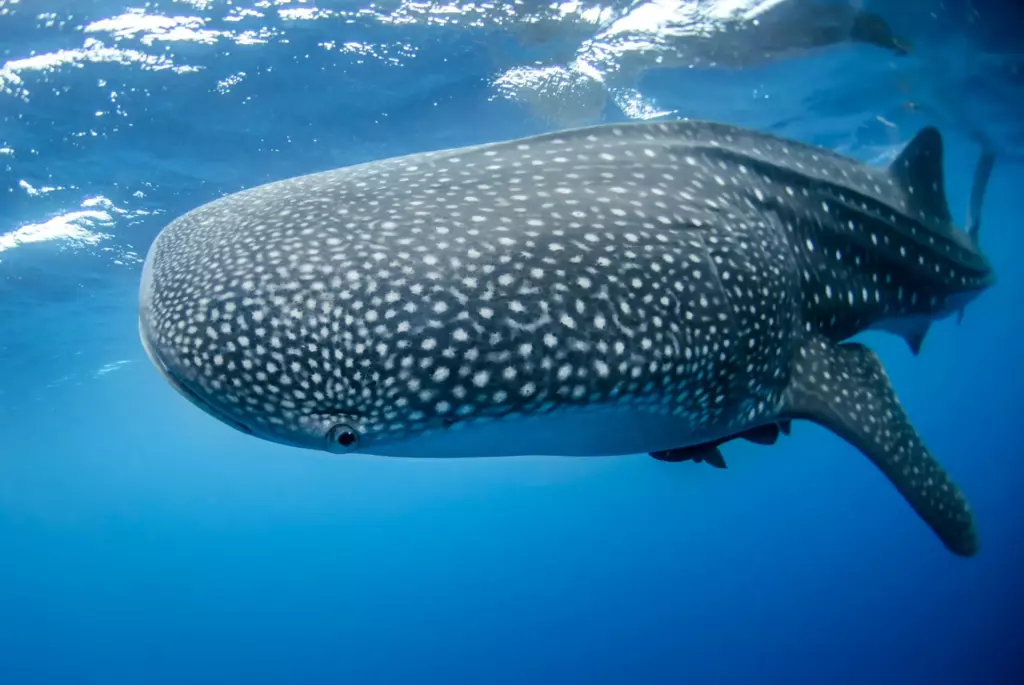
Mulee Kandu offers long drifts alongside schooling snapper and trevally. In the north, Malaku Kandu drops past 100 metres at the outer reef, drawing giant trevally, barracuda and — early in the morning — hammerheads.
Season choice is a genuine trade-off, and dive operators disagree in public about it. One liveaboard operator notes that the best sea and weather conditions run January to April, while divers chasing mantas prefer June to November despite rougher seas and reduced visibility. Manta activity peaks in the south-west monsoon from May to November, at the cost of choppier crossings and occasional cancellations. You are picking between clear water with fewer mantas and full cleaning stations with a chance of a lost excursion day.
What you are not picking between is Meemu and a crowd. Boat traffic across these sites is a fraction of what the famous atolls carry, which is why the channels still fish like channels rather than like aquariums.
Surf off Muli: five breaks, and a naming problem the guides won’t fix
Meemu Atoll is a real surf destination that almost nobody surfs, and its breaks cluster around one reef pass. Surf operator Atoll Travel’s break-by-break guide lists five:
- Veyvah (Playgrounds) — a left on the north side of the channel. Easy take-off into a long wall; the friendliest wave here.
- Mulah Point (Mulhaku) — a right off the tip of Mulah island. Suits intermediates on small days, holds a much bigger swell, and is where local kids learn.
- Mulah Left (Pit Stops) — a challenging left tube over shallow reef, working on bigger swells and higher tides.
- Muli Inside (Formula One, F1) — a fast right off Muli’s northern tip. Needs swell and a south-west wind to barrel; shallow in places.
- Muli Outside (Mushrooms) — the consistent one. A long, tubing right point on the east side of Muli with an easy exit.
Now the problem. Sources contradict each other on the most basic attribute of these waves. Specialist surf-travel operators agree F1 is a right-hander; at least one guesthouse-side review describes F1 as a lightning-fast left better suited to intermediate and advanced surfers. Another guide swaps the labels entirely, treating Muli Inside as “Muli F1” and Muli Outside as Mushrooms while calling Veyvah a left-hander — consistent on Veyvah, muddled on the rest. Book a surf trip on the wrong reading and you arrive goofy-footed for a wave that breaks the other way.
Two practical rules follow. Use the geographic name, not the nickname, when you talk to an operator: “Muli Inside” and “Muli Outside” are unambiguous where “F1” and “Mushrooms” are not. And check the wind before the swell. Prime swell in the central atolls runs March through October, and every Meemu spot faces east, so there is nearly always a left or a right sheltered from the prevailing south-westerly. South-easterly and easterly winds hurt all of them at once.
The counting is not settled either. A surf guesthouse on Muli lists two breaks reachable on foot — F1 and Mushrooms — plus five more within a 15-minute boat ride, and names Boahuraa among them, which the operator guide leaves out. Take the total as five well-documented waves and a couple of local additions. The proposition is the same either way: a paddle-out wave from a $100-a-night room, in an atoll where a weekday line-up may be empty.
Local islands: where the atoll gets affordable
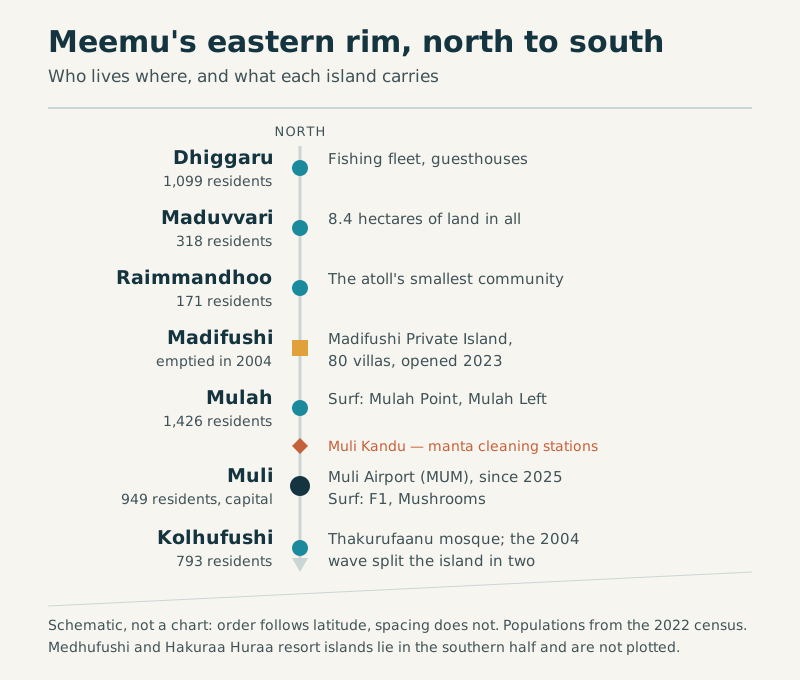
Guesthouse tourism arrived in Meemu Atoll late and stayed small. The bookable cluster sits on Muli, alongside operations on Mulah and Dhiggaru, and it skews heavily towards surfers rather than beach loungers. Muli itself is the practical base: it has the airport, the atoll hospital, the harbour and the two walk-to breaks.
Three things make a local-island stay in Meemu Atoll different from Maafushi or Thulusdhoo. First, you are on inhabited Muslim islands, which means covered swimwear outside designated beaches and no alcohol on sale. Second, the excursion economics change: with no house reef worth the name and the good sites 15–40 minutes out, boat costs dominate a budget trip, so a guesthouse with its own dhoni is worth more than a nicer room. Third, redundancy is thin — one weekly flight, no scheduled ferry, and private speedboat charters as the fallback.
Set against that, the price gap is extreme. Resort rates here run from roughly $150 a night at the value end to five-figure weeks at Madifushi. A surf guesthouse room on Muli costs a fraction of either, and the wave in front of it is the same wave. One 2026 atoll guide notes that guesthouse operators on Mulah and Muli run the same dive circuit as the resort centres, usually with no other group in the water.
One caution on booking: verify what your guesthouse actually includes for transfers. Getting from Muli Airport to another island in the atoll is a private boat arrangement, not a bus, and it is where independent budgets quietly break.
The twenty missing years: why Meemu is this empty
Meemu Atoll is not undeveloped by good fortune. It is undeveloped because the 2004 Indian Ocean tsunami flattened it. Muli ranks among the ten Maldivian islands the wave hit hardest.
Kolhufushi came out of it split in half: the southern half still holds the community, the northern half now grows crops. By mid-January 2005 the island was sheltering 8% of the country’s 13,000 displaced people. Madifushi lost its population outright — every resident resettled on Maamigili in Alif Dhaalu.
That last fact deserves a moment. The national statistics list M. Madifushi as an abandoned island 121.8 km south of Malé, measuring 600 by 260 metres — a footprint matching the 16-hectare island the resort describes. The property that opened in 2023 stands on an island whose community left in 2004 and never came back.
At the opening, the tourism minister called tourism a catalyst for growth in an atoll the tsunami had devastated. Redemption or irony is the reader’s call. Either way, it is why the tourism clock here started twenty years late.
The atoll’s older claim on the national story sits on Kolhufushi. By one account, off the south-eastern reef of Kolhuvaariyaafushi lies the 1573 wreck of the Kalhuohfummi, the vessel of Muhammad Thakurufaanu al-Auzam, the captain who drove out the Portuguese and ruled from 1573 to 1585. A second account holds that the ship wrecked near Kolhufushi’s south coast and its timbers were built into a mosque there, Masjid-ul-Thakurufaan. The versions differ; both put the founding vessel of modern Maldivian independence in this atoll, which is more history than most resort islands can claim.
When to go: three different calendars
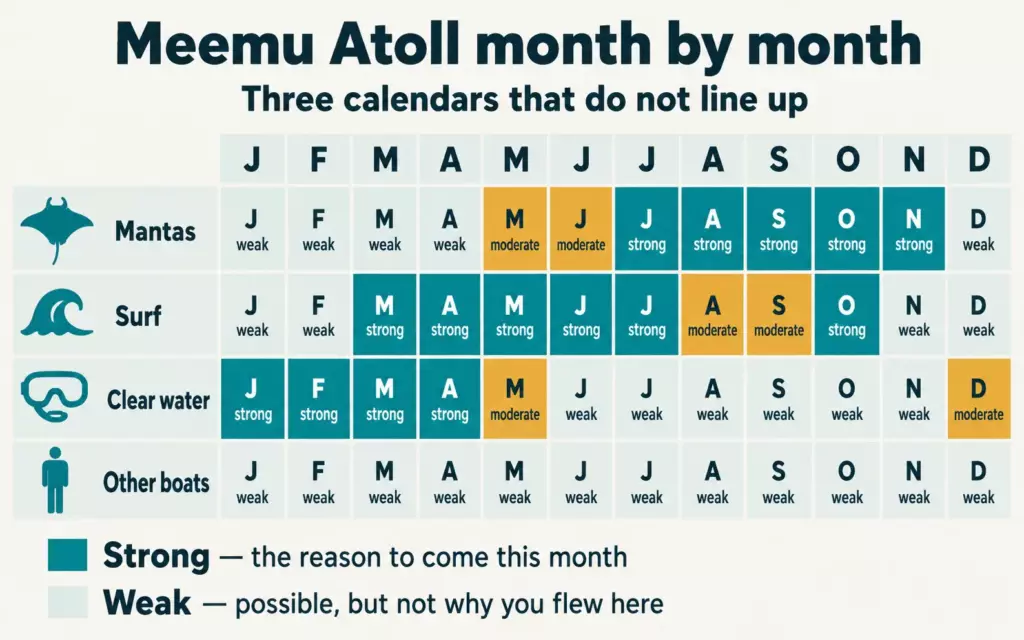
Meemu Atoll runs on three calendars that do not line up, and picking a month means deciding which one you care about.
December to April — the dry north-east monsoon. Best visibility, calmest crossings, and the postcard version of the atoll. Sharks work the channels; mantas are scarcer. This is the right window for a first Maldives trip, for nervous divers, and for anyone booking a seaplane arrival with a tight international connection.
May to November — the south-west monsoon. Plankton-rich currents pull mantas onto the eastern cleaning stations, at the cost of rougher seas and occasional cancelled trips. Rates soften, the atoll gets even quieter, and the mantas are the reason to be here.
March to October — the swell window. Prime swell in the central atolls runs March through October, so a surf trip and a manta trip overlap neatly from May to October. That overlap is the best-value stretch in the Meemu Atoll calendar. It is also exactly when the weather is least reliable.
Who should book Meemu — and who should not
Book Meemu Atoll if you dive and you are tired of queueing at cleaning stations. Or if you surf at an intermediate level and want an empty right-hander. Or if you want an all-inclusive week at a below-average Maldives price and will happily take a boat to see fish. The Gan connection also makes a Meemu-plus-Addu trip work.
Book elsewhere if your priority is stepping off a deck onto a reef — Baa, South Ari and Vaavu all beat Meemu at that game. Look elsewhere too if you need a short transfer after a late arrival, want dining variety across several restaurants, or would be ruined by one cancelled excursion day. A five-night trip in August carries real weather risk.
It will not work at all if you are building an independent island-hopping itinerary on public transport. Until RTL ferries reach Zone 4’s northern end, moving around Meemu Atoll means chartering boats at resort-adjacent prices, which defeats the purpose of a budget trip.
Meemu FAQ: quick answers before you book
How do you get to Meemu Atoll? Three working options. A 35–45-minute seaplane direct to your resort island, roughly $450–550 return. A Maldivian flight to Muli Airport, about 45 minutes, from around $100 one way but currently only about weekly. Or a resort speedboat, 2 h 15 or more, arriving before 15:30. There is no scheduled public ferry yet.
How many resorts are in Meemu Atoll? Three resorts operate in Meemu Atoll: Cinnamon Hakuraa Huraa, Medhufushi Island Resort and Madifushi Private Island. Many guides and even some operator pages still say two, a claim that stopped being true in January 2023.
When is manta season in Meemu Atoll? Roughly June to November, when the south-west monsoon pushes plankton through the atoll’s eastern kandus and mantas gather at the cleaning stations. Expect rougher water and lower visibility in exchange.
Is Meemu Atoll good for snorkelling? Good in the water, weak at the villa. The best sites are boat-access channels and thilas; the house reefs are limited and one resort has none at all. Check how many boat trips your rate includes before booking.
Can you surf in Meemu Atoll? Yes — five breaks: Veyvah, Mulah Point, Mulah Left, Muli Inside (F1) and Muli Outside (Mushrooms), best from March to October, with two breaks walkable from Muli. Use the geographic names when booking: sources disagree on which way F1 breaks.
Is Meemu Atoll worth it? For divers, surfers and value-seekers who accept boat-based marine life, Meemu Atoll delivers. For house-reef snorkellers and travellers who need flexible logistics, no.
The short version
- Meemu Atoll has had its own airport since May 2025 — one weekly Maldivian flight to Muli from about $100, plus a Gan connection — and the guides ranking for the atoll have not updated.
- Three resorts operate here, not two: Hakuraa Huraa, Medhufushi and Madifushi Private Island, which opened in January 2023.
- The marine life of Meemu Atoll is genuine and the crowds are not: manta cleaning stations from June to November, uncrowded channel dives year-round.
- House reefs are the weak point. Budget for boat excursions, or book an atoll built around a house reef instead.
- The public ferry promised for Zone 4 still had not launched as of March 2026, so independent itineraries need private boats.
Next step: decide your calendar before your resort. Pick manta season, dry season or swell season first, then choose the island. In an atoll this small, the month you fly shapes the trip more than the villa you book.