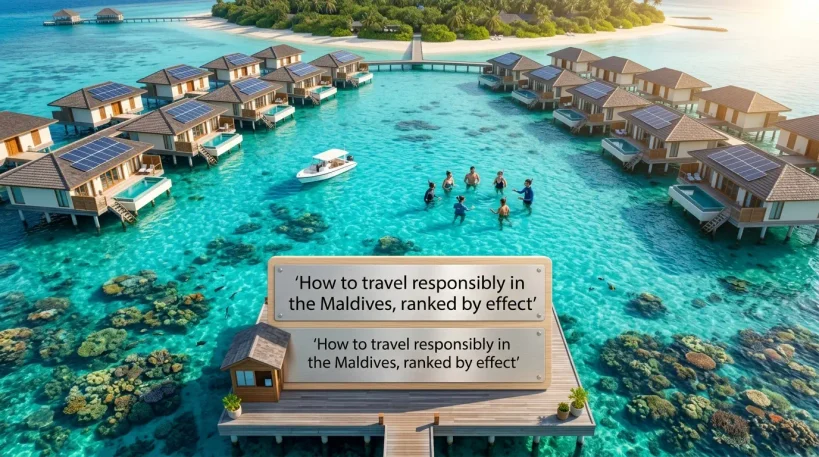
Responsible Travel in the Maldives: Most of It Is Not Touching Things
Responsible travel writing tends toward a list of virtues, and virtues are hard to check. This guide to responsible travel in the Maldives is about specific choices in one country — most of them free, several about restraint rather than action, and one worth more than all the others combined.
That one is where you sleep. A week on an inhabited island puts money directly into a small local economy; a week at a resort puts it into a self-contained operation that imports almost everything. Both are legitimate. Only one of them is a transfer of income to the place you are visiting.
And the honest framing before anything else: the largest environmental cost of your trip is the flight, and no amount of responsible travel offsets it. What follows is about the part you can control once you have decided to come.
Who this actually affects
Worth naming, because “responsible” is an abstraction until you say whose interests are involved.
The reef, which supports the fish, the fishery and the islands themselves — coral debris is what the beaches are made of, and a dead reef stops producing sand.
The people who live here. Roughly half a million Maldivians across about 190 inhabited islands, of whom a large share work in tourism and most of whom a resort guest will never meet.
The animals, which are wild, unmanaged and habituated to boats in some places by sheer volume of visitors.
And future visitors, including you. A reef that is dived carefully is still there in five years, and a village whose residents have had good experiences with tourists is a better place to arrive.
None of that requires a moral argument. These are the parties affected by ordinary decisions a visitor makes anyway, and knowing who they are makes responsible travel easier rather than heavier.
Which is the tone this article is trying to hold: practical rather than pious, and specific rather than aspirational.
The reef, which is most of it
Three reef rules, and the first is the one people break without noticing.
Do not stand on coral. One foot destroys growth that took years, and it is by far the commonest damage visitors do — not from malice but from resting, adjusting a mask, or steadying for a photograph. There is nowhere on a reef it is acceptable to stand.
Do not touch anything. Coral is a living animal with a protective mucus layer; a hand removes it and opens the way to infection.
Do not chase. A fish that moves away from you is telling you something, and following it costs the animal energy it needs.
Fins are the underestimated hazard. Most contact damage comes from feet the swimmer cannot see, which is why our snorkelling guide argues for looking behind you in shallow water.
And the sunscreen question is real and smaller than it is presented. Mineral filters are the reasonable choice and “reef-safe” is not a regulated claim. The larger pressure on this reef by a wide margin is water temperature, as our guide to reef health sets out.
Which is why a rash guard beats a better sunscreen. The most reef-friendly sun protection is the kind you do not apply.
The animals, and what the rules actually are
Specific rules, because vague responsible-travel advice produces confident mistakes.
Turtles must surface to breathe. Hovering above one prevents it. Stay beside and below the animal’s eye line, never above it, and give it a clear path up — the etiquette is in our guide to snorkelling with turtles.
Mantas are approached by staying still. They are curious and will come to you; swimming at one ends the encounter. At cleaning stations there are position rules, and the guide will explain them — our manta guide sets them out.
Whale sharks are not to be touched, blocked or ridden, and boats are meant to keep distance and approach from behind rather than across the animal’s path. The South Ari code is in our whale shark guide.
Nothing is to be fed. Not fish, not rays, not sharks. Feeding changes behaviour permanently and creates dependence and aggression.
And no touching, at any point, of anything. It is the single rule that covers every animal in this country and it requires no judgement to apply.
What to do if an operator breaks these rules: say so, and do not book with them again. Guest pressure is the most effective responsible travel mechanism there is. Guests asking is the mechanism that changes operator behaviour, and it works better than any code of conduct.
Two photographs we held back
Worth explaining, because it says something about how this site handles responsible travel.
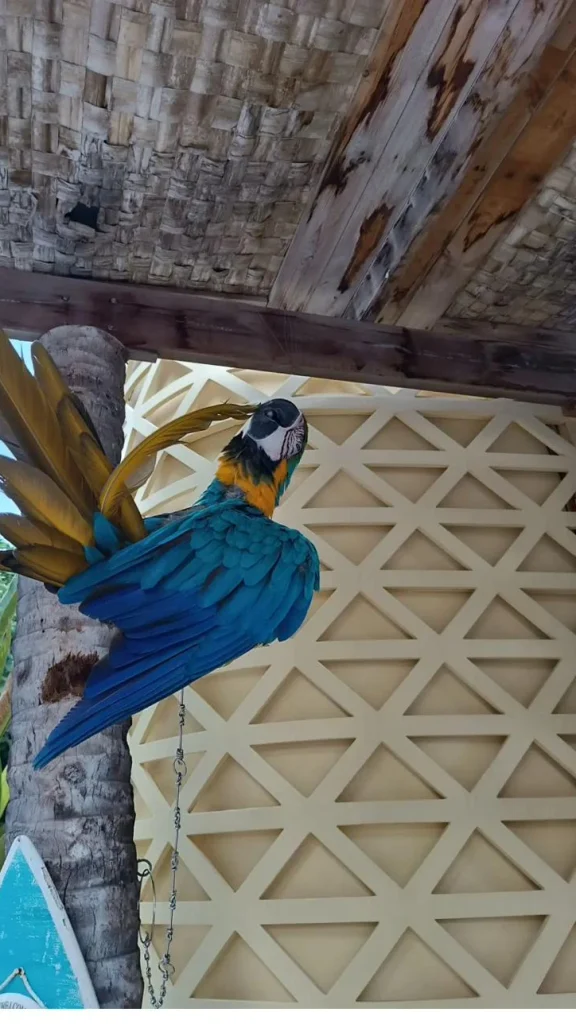
We photographed a tethered parrot on an inhabited island, and we have not published the frame in any of the seventeen articles it could have illustrated.
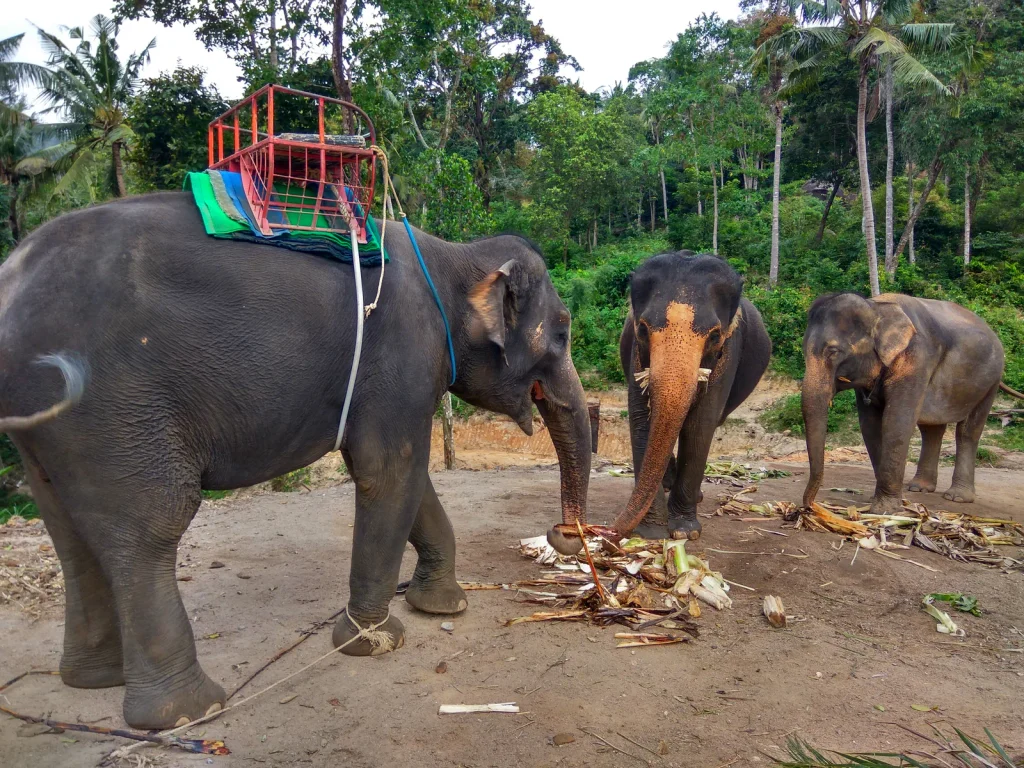
We photographed elephants at a tourist camp on Ko Pha Ngan, in Thailand, and did not use it in our Thailand comparison, where it would have been incidental colour in an article about destinations.
The reason is the same for both. Publishing an image of a chained or tethered animal as decoration normalises it. Publishing it where the treatment of animals is the subject does not.
Neither photograph identifies a business. The Maldivian frame is cropped for that reason: a partial sign was visible in the original and has been removed. The point is not one guesthouse or one camp, but a pattern across the region that visitors fund by turning up.
Tethered birds appear at guesthouses and cafés in small numbers, kept as attractions. There is no legitimate version of this: a parrot on a short chain is not an enrichment activity and photographing yourself with it is what pays for the next one.
Captive elephant tourism is a larger and better-documented version of the same economics, and it sits on many itineraries that include a Maldives stopover in Southeast Asia. The animal in our frame wears a chain on its rear leg.
What to do about both is identical and free: do not pay for it, do not photograph it for social media, and say why when asked. Demand is the entire mechanism.
Where the money goes
The section that matters most and appears in almost no responsible travel article.
A resort island is a self-contained operation. It imports food, fuel, water technology, furnishings and frequently much of its senior staff, and the guest spends inside a closed system.
An inhabited island is an economy. The guesthouse is family-owned, the café is somebody’s business, the boat belongs to the man driving it. Money spent on lunch stays on the island, and the format is in our guesthouse guide.
Which makes the accommodation decision the largest single lever a visitor has, and it is a decision most people make on aesthetics — the four formats are compared in our where to stay pillar.
This is not an argument against resorts. They employ Maldivians and pay a service charge distributed to staff. The industry funds a large share of the national economy, as our guide to what the country runs on sets out.
It is an argument for knowing what you are choosing, and for considering a split stay, which puts several nights of spending into a village and several into a resort.
And if you stay at a resort, the tip and the service charge are different things. Our guide to money in the Maldives explains how the 10% is distributed and what an additional tip actually does.
Responsible diving, specifically
A short section for the group with the most reef contact and the most control.
Buoyancy is the whole thing. Most reef damage by divers is a fin or a knee, and it happens to people who are not neutrally buoyant. If it has been more than a year, book a refresher before the first dive.
Secure everything. A dangling gauge or octopus is a rake.
Do not collect anything, including dead shells, which house other animals.
Ask the centre about their group sizes. Four divers per guide is a manageable group; eight is a procession that cannot be watched — the questions to ask are in our guide to choosing a resort for divers.
And on a liveaboard, the same rules apply three or four times a day, which is where fatigue and carelessness meet.
Park fees at protected sites go toward management of those sites, and they are one of the few direct payments a visitor makes to conservation here — the diving picture is in our diving guide.
Plastic and water
A real environmental problem with a genuinely easy answer.
The country imports almost everything and has limited waste infrastructure. A visitor’s plastic does not leave with them.
Resorts desalinate their own water, and most provide filtered drinking water in glass bottles — several have abandoned single-use plastic entirely.
On an inhabited island the position is more mixed, and a refillable bottle plus a filter or purification tablets removes most of the problem.
Ask before assuming. A property that has removed plastic will tell you, and one that has not will still refill a bottle.
And Thilafushi exists. The industrial island that handles Malé’s waste is a real place with real consequences, and it is worth knowing about rather than being shown.
What actually helps: carrying a bottle, refusing straws and single-use items, and taking home anything with a battery in it.
One question worth asking your property
A single email, sent before booking, that does more than any checklist.
“What do you do with your waste, and where does your water come from?” Properties that have thought about it answer specifically — a desalination plant, a glass bottling line, a waste separation arrangement. Properties that have not send a paragraph about caring for the environment.
The quality of the answer is the answer. This is the same technique our guide to reading a house reef recommends for a different question, and it works for the same reason: specificity is hard to fake.
Ask a second question if you dive: whether the centre runs reef clean-ups or monitoring, and whether guests can join. Some do, and it is one of the few ways a visitor contributes labour rather than money.
And ask a guesthouse the same thing. Small operators frequently have better answers than large ones, because the waste is visibly theirs.
What not to do is grade them. One email is a signal to the property that guests ask, which is itself worth sending — and this site does not audit or rank anybody on the basis of a reply.
Respect, which costs nothing
Five things, all free, all noticed — and all part of what responsible travel means here.
Dress modestly on inhabited islands. Shoulders and knees covered outside the designated tourist beach, including on the walk to it. It is a legal and social norm rather than a suggestion — the rules are in our guide to dress codes.
Ask before photographing people, particularly children, and accept a no without negotiating.
Understand that every inhabited island is dry. Bringing alcohol ashore is both illegal and a serious discourtesy — the arrangement is in our guide to alcohol rules.
Behave differently during Ramadan if you are on an inhabited island — no eating, drinking or smoking in public during daylight hours.
And learn two words. Shukuriyaa is thank you, and it is noticed every time — a few more are in our guide to Dhivehi phrases.
None of that is difficult, and the reason it appears in a responsible travel article is that a visitor who gets it wrong makes the next visitor’s welcome slightly worse.
Excursions, and what to ask an operator
Four questions for an excursion operator, and the answers tell you what you need to know.
“What is the policy on touching?” The right answer is that nobody touches anything. A hesitant answer is an answer.
“How many people are on the boat?” Crowding at a manta cleaning station or a whale shark sighting is the main pressure at both — the seasonal picture is in our guide to manta season and Hanifaru.
“Do you feed anything?” The right answer is no.
“What happens if we do not find the animal?” An operator that guarantees a sighting is an operator that will chase one.
Prices differ enormously by format — USD 25 to 60 from a guesthouse island against USD 90 to 300 from a resort, on the figures in our excursion guide — and the cheaper boats are frequently better behaved because the guides live on the island.
What responsible travel does not mean here
Worth clearing away, because several assumptions are wrong in this specific country.
It does not mean avoiding resorts. They are the industry, they employ Maldivians, and boycotting them helps nobody. The argument in this article is about knowing what a resort week is, not about refusing to have one.
It does not mean paying more. The most responsible accommodation format in the country is also the cheapest one, which is unusual and worth saying — a guesthouse island at around USD 60 a night is both.
It does not mean a shorter trip. Staying longer per flight is better than flying more often, so a fortnight beats two weeks split across two years.
And it does not mean sustainability certifications, which vary enormously in rigour and which this site is not equipped to assess. A property’s practices are better established by asking two questions than by reading a page on its website.
What responsible travel does mean here is a small number of concrete choices, most of them made before you arrive, and a set of rules in the water that take thirty seconds to learn.
What actually helps, ranked
Honest ordering by impact, because several popular gestures do very little.
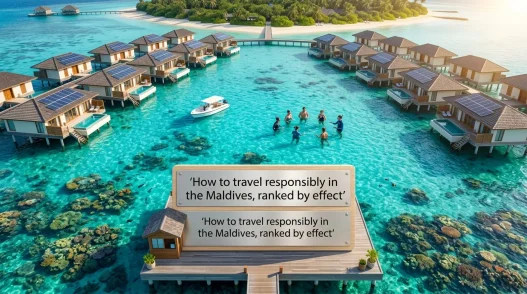
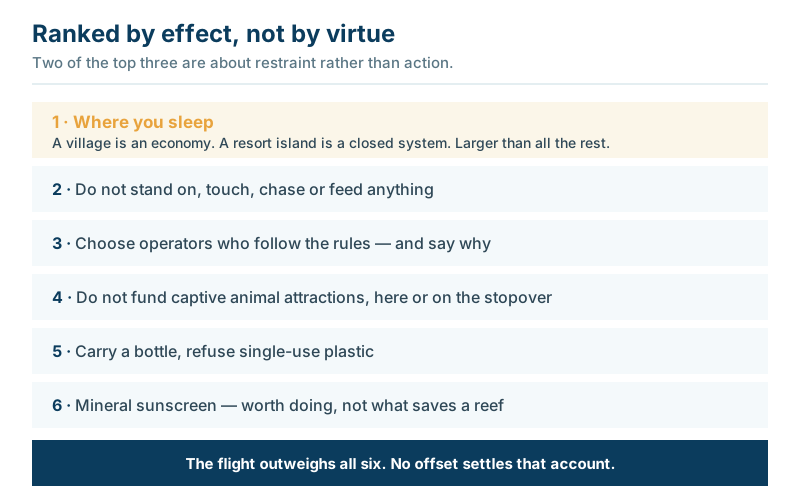
1. Where you sleep, for the reasons above. Larger than everything below it combined.
2. Not touching the reef, which costs nothing and prevents damage that takes years to undo.
3. Choosing operators who follow the rules, and telling them why when you do not.
4. Not funding captive animal attractions, in the Maldives or on the stopover.
5. Carrying a bottle and refusing single-use plastic.
6. Mineral sunscreen, which is worth doing and is not the thing that saves a reef.
And what does very little: buying a carbon offset for a long-haul flight and considering the matter closed, or choosing a property because its website has a sustainability page.
The limits of this article
Stated plainly, because responsible travel writing is prone to overclaiming.
The flight dominates. A long-haul return flight outweighs everything on the list above, and no amount of bottle-carrying changes that arithmetic. The honest options are to fly less often and stay longer, or to accept the cost knowingly.
Staying longer is genuinely better than two short trips, and it happens to be the better holiday — the length arithmetic is in our itineraries guide and the cost case in our budget guide.
We cannot audit properties. We have not stayed at a Maldivian resort overnight and we do not rank them. This article names none and makes no claim about any property’s practices.
And the reef is under pressure this article cannot address. The 2024 bleaching was a temperature event. A visitor’s behaviour is worth getting right and is not the variable that decides what the reef looks like in ten years.
Which is the honest summary of responsible travel here: most of what a visitor controls is small, all of it is free, and one decision — where you sleep — is genuinely significant.
Questions travellers ask
What is the most important thing I can do? Choose where you sleep deliberately. A week on an inhabited island transfers income directly to a local economy; a week at a resort spends inside a self-contained operation. A split stay does both.
Is reef-safe sunscreen worth it? Mineral filters are the reasonable choice, though “reef-safe” is not a regulated claim and water temperature is a far larger pressure on this reef. A long-sleeved rash guard removes most of the need for sunscreen at all.
Can I touch a turtle or a manta? No. Nothing in this country should be touched, fed, chased or blocked. With turtles the specific rule is never to hover above one, because it must surface to breathe.
Are there animal attractions to avoid? Yes. Tethered birds appear at some guesthouses and cafés, and captive elephant tourism is common on Southeast Asian stopovers. Do not pay for either, and do not photograph them for social media.
What about plastic? The country imports almost everything and has limited waste infrastructure. Carry a refillable bottle, refuse single-use items, and take anything with a battery home with you.
How should I dress on a local island? Shoulders and knees covered outside the designated tourist beach, including on the walk there. Every inhabited island is also dry, and alcohol must not be brought ashore.
Do tips reach the staff? The 10% service charge is distributed to staff under a defined mechanism, and an additional tip is separate. The detail is in our guide to money in the Maldives.
Does any of this offset the flight? No, and this article does not claim otherwise. The flight is the largest environmental cost of the trip. Flying less often and staying longer is the only meaningful response.
What to take away
- Where you sleep is the largest responsible travel lever you have. An inhabited island transfers income to a local economy; a resort spends inside a closed system.
- Never stand on coral, touch anything, chase anything or feed anything. Most contact damage comes from fins the swimmer cannot see.
- Do not fund tethered birds in the Maldives or captive elephants on the stopover. Demand is the entire mechanism.
- Carry a refillable bottle. The country imports almost everything and your plastic does not leave with you.
- The flight outweighs all of it. Fly less often, stay longer, and do not pretend an offset settles the account.
Next step: pick the one responsible travel decision on this page that is still open for your trip. If the accommodation is not yet booked, that is the one worth thinking about. If it is, the reef rules cost nothing and take thirty seconds to learn — and the operator questions take one email.