
Diving in the Maldives: Current, Channels and the Price Nobody Quotes
Diving in the Maldives is not what the brochure photograph suggests. The real product is current: dropping into a channel where an atoll breathes, hooking onto rock while grey reef sharks stack up in the flow, and drifting out over blue water when the tide turns.
It is also more expensive than anyone budgets for. A price quoted at USD 110 becomes closer to USD 180 once equipment, taxes, park fees and nitrox are added. The same site, from an island forty minutes away, costs USD 55.
This guide covers what it is, what level it needs, what it costs and where to base yourself. For when, our season calendar answers with one rule.

What the diving actually is
Four characteristics define it, and none of them appears in a resort brochure.
Current is the point of it. Atolls are rings of reef cut by channels, and every tide pushes an ocean’s worth of water through those gaps. The animals gather where the water moves. A briefing here is usually built around the direction the current is running, not around a fixed route.
You will be hooked on. A reef hook — a short line and a hook you place on dead rock or rubble — lets you hang in the flow and watch rather than swim against it. It is standard equipment here and unfamiliar to anyone from calm-water destinations.
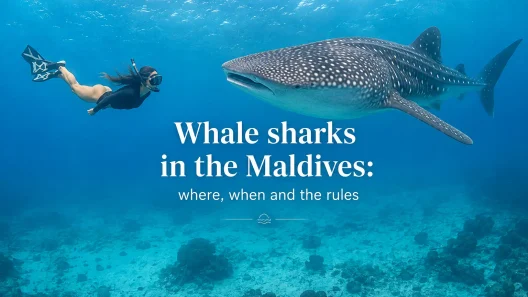
Big animals, at close range. Grey reef sharks, eagle rays, napoleon wrasse, schooling jacks, whitetips, mantas and, in the right places, whale sharks and tiger sharks. This is a pelagic destination that happens to have reefs.
Visibility is exceptional, seasonally. Twenty-five to forty metres in the dry season, fifteen to twenty-five in the wet, which is still better than most of the world.
What it is not: a gentle destination for a first-ever descent. Gentle sites exist, and the signature ones are not among them.
The four kinds of site
Maldivian site names describe the site, and four words cover almost everything.
Kandu — a channel. The main event. Current, sharks at the mouth, and an exit into blue water. Advanced territory. Fotteyo Kandu, Miyaru Kandu, Embudhoo Express.
Thila — a submerged pinnacle that does not break the surface. Sheltered from the worst of the flow, covered in soft coral, and the best compromise between spectacle and difficulty. Maaya Thila, Kandooma Thila, Fushifaru Thila.
Giri — a coral pinnacle rising close to the surface. Shallow, gentle, and often snorkellable too.
Faru and falhu — the outer reef and the shallow reef flat. Walls and drifts along the atoll rim.
Add miyaru for shark and madivaru for manta and the morning briefing becomes half-readable before it starts. Our guide to Dhivehi place names has the full decoder, and it is more useful to a diver than any phrasebook.
What you will see
Reliably, almost everywhere: grey reef sharks, whitetip reef sharks, schooling fusiliers and snapper, moray eels, napoleon wrasse, turtles, eagle rays.
Seasonally and locationally: manta rays at cleaning stations and feeding aggregations, whale sharks in the South Ari protected area, hammerheads at dawn off Rasdhoo, tiger sharks at Fuvahmulah.
After dark: nurse sharks in numbers, hunting jacks, sleeping turtles, and the macro life that hides during daylight.
Increasingly patchy: hard coral cover, which lost more than 40% in the central atolls during the 2024 bleaching event. Fish life recovers faster than coral, so a damaged reef is still worth the trip — the full picture is in our guide to coral reef health.
Do you need to be certified?
No, for a first experience. Yes, for everything worth doing.
Discover Scuba Diving requires no certification: a pool or shallow-water briefing, then one guided descent to around 12 metres with an instructor. Around USD 150 for a pool session and USD 180 for an open-water experience at a luxury resort, considerably less on a local island.
Open Water is the entry certification, four days, and qualifies you to 18 metres. Advanced Open Water takes two days more and opens the sites this country is famous for, because most operators require it for the stronger channels.
Here is the money advice, and it is the most useful thing in this article: get certified before you come. A PADI Open Water course costs USD 550 to 900 in the Maldives against USD 200 to 400 at home. The referral option is better still — complete theory and confined-water sessions at your local dive school, arrive, and do only the four open-water checkout dives. That saves one to two full days of your holiday and roughly USD 100 to 150.
Spending four days of a seven-day trip in a training bay at Maldivian prices, while the channels run without you, is the single most avoidable mistake here.
What you can dive at each level
| Level | What opens up | Typical requirement |
|---|---|---|
| No certification | Discover Scuba, house reef with instructor, to about 12 m | Swim, medical declaration |
| Open Water | House reefs, giris, sheltered thilas, to 18 m | 4 days, or 2 with a referral |
| Advanced Open Water | Channels, deeper thilas, drift dives, to 30 m | Usually required for the signature sites |
| Advanced plus 30–50 logged dives | The strong channels at spring tide | Operator discretion |
| Nitrox certified | Longer bottom times across three dives a day | Half a day, and worth it here |
Most operators also want you to have been in the water within the last twelve months, or they will ask for a check on the house reef first. That is not an upsell; it is how a guide decides whether to put you in a channel.
The quoted price, and the real price
This is where budgets break. Every figure below is per dive, in dollars, at 2026 rates.
The quoted price, per tank:
| Where | Quoted price |
|---|---|
| Local island guesthouse operator | USD 40–70 |
| Mid-range resort | USD 70–110 |
| Luxury resort | USD 110–200 |
What gets added:
- Equipment. BCD and regulator around USD 15 per dive, or USD 8–15 per individual item. Many quoted prices include only tank, weights, mask, fins and an SMB — the Park Hyatt price list is explicit about exactly that split.
- Taxes. A 10% service charge and 17% TGST, applied in sequence, which compounds to roughly 28.7% above the menu price rather than 27%. The mechanism is in our guide to money in the Maldives.
- Marine park fees. USD 6–15 per person per trip. South Ari’s protected area charges around USD 10 per diver. Hanifaru Bay charges a separate conservation permit of about USD 20 to 30, and it is a snorkelling permit rather than a dive.
- Nitrox. USD 5–10 per fill, or USD 80–150 for a week of unlimited.
- The equipment handling fee. Some resorts and liveaboards charge USD 5–10 a day to store and handle gear you brought yourself. Local island centres generally do not.
Worked example. A USD 110 luxury-resort tank, with rented BCD and regulator at USD 15, a park fee of USD 10 and nitrox at USD 8, is USD 143 before tax. Add the compounding 28.7% and it is roughly USD 184.
The same site, booked from a guesthouse island centre at USD 55 with the same extras, lands near USD 100.

What a week actually costs
Three honest budgets, for twelve tanks across seven days, excluding international flights.
Guesthouse island, budget. Diving USD 500–800 all-in, guesthouse from USD 60 a night, meals USD 16–20 a day, speedboat transfers USD 50–60 each way. Total in the region of USD 1,500–2,000 per person. Divers report doing exactly this on islands like Dhigurah and Rasdhoo.
Mid-range resort. Diving USD 1,200–1,800 all-in, accommodation and board dominating everything else. Total USD 4,000–6,000 per person.
Luxury resort. Diving USD 2,000–3,000 all-in. Total USD 8,000 upward, and the diving is a rounding error against the villa.
Liveaboard. From about USD 150 per day including cabin, all meals and three to four dives, before tax, nitrox and park fees. For a diver rather than a holidaymaker this is the best value in the country. It is also the only way to reach the central atolls, as our season calendar explains.
The pattern is consistent: the water is the same and the accommodation is the variable. Two people can surface from the same site on the same morning, a factor of four apart on the week.
Bring your own gear, or rent?
The economics are clear once you see the per-dive numbers.
Always bring: mask, and a dive computer if you own one. A mask that fits is worth more than any other single piece of equipment, and computers are the item rental centres are least likely to have in your preferred configuration.
Worth bringing for twelve tanks or more: BCD and regulator. At USD 15 each, twelve is USD 180 in rental — more than the baggage excess on a seaplane, which allows 20 kg checked and charges about USD 5 a kilo beyond it.
Leave at home: wetsuit, unless you are in the water four times a day. Water sits at 26 to 30°C year-round and a 3 mm shorty rented locally is enough for most people.
Check before you pack: whether your resort or liveaboard charges an equipment handling fee for gear you brought. Paying USD 10 a day to store your own regulator changes the arithmetic entirely.
Nitrox certification is worth having before you arrive if you plan three dives a day. The course takes half a day and the benefit here — longer bottom times at 18 to 20 metres — is real.
Where to base yourself
Three models, and the choice matters more than the resort brand.
A resort dive centre. Convenient, well equipped, and working whatever sits within an hour of the island. Excellent when the island is beside good sites and limiting when it is not. Ask which sites are on the daily rotation before booking the property, not after.
A guesthouse island centre. Same sites, a third to a half of the price, and a shorter walk to the boat. Islands like Maafushi, Dhigurah, Rasdhoo, Fulidhoo and Thulusdhoo have serious operations. The compromise is in the accommodation, not the water.
A liveaboard. The boat follows the conditions. If the current turns, the itinerary changes, which is worth a great deal in the transition months of April and November. It is also the only realistic access to the central atolls, and it removes every transfer decision from the trip.
For the geography behind all three, our atoll decision guide and the complete atolls guide set out what is within reach of what.
Two things worth knowing before you book the resort
The house reef decides more of your week than the villa does. A property with a genuine drop-off within swimming distance gives you unlimited free entries, a night session from the beach and somewhere to go when the boat is cancelled. A property in a wide shallow lagoon gives you a swimming pool with fish in it. Ask for a description of the entry and the drop-off, in metres, before you book — an adjective is not an answer.
Ask what happens when the wind turns. Every centre has sites for the prevailing conditions and sites for the other direction. One that names both is telling you it can still run a good week in the transition months of April and November, when the current reverses and nobody can forecast it a day ahead.
Those two questions, asked before booking rather than at check-in, do more for the quality of a diving week than any comparison of villa categories.
Atoll by atoll, briefly
The short version. The seasonal detail is in the diving season calendar, which explains why each of these works when it works.
North Malé and South Malé. The accessible option, reachable by speedboat, with channel diving at Lankan, Dhigu Thila and Embudhoo. Busy, and good.
Ari Atoll. The year-round all-rounder. Maaya Thila in North Ari is among the best night dives in the Indian Ocean; South Ari holds the whale shark protected area.
Vaavu. Channel country, and the atoll most divers name when pressed. Fotteyo, Miyaru Kandu, and Alimatha’s nurse sharks.
Baa. Hanifaru in the wet season, reached through Dharavandhoo.
Rasdhoo. Hammerheads at dawn, in the blue, in the dry season.
Lhaviyani. Fushifaru Thila and a longer manta window than the general rule predicts.
Fuvahmulah. Tiger sharks, year-round, reached by domestic flight. An exception to every rule in this article, including the monsoon rotation.
The far south — Huvadhu and Addu. Bigger channels, stronger current, almost nobody there.
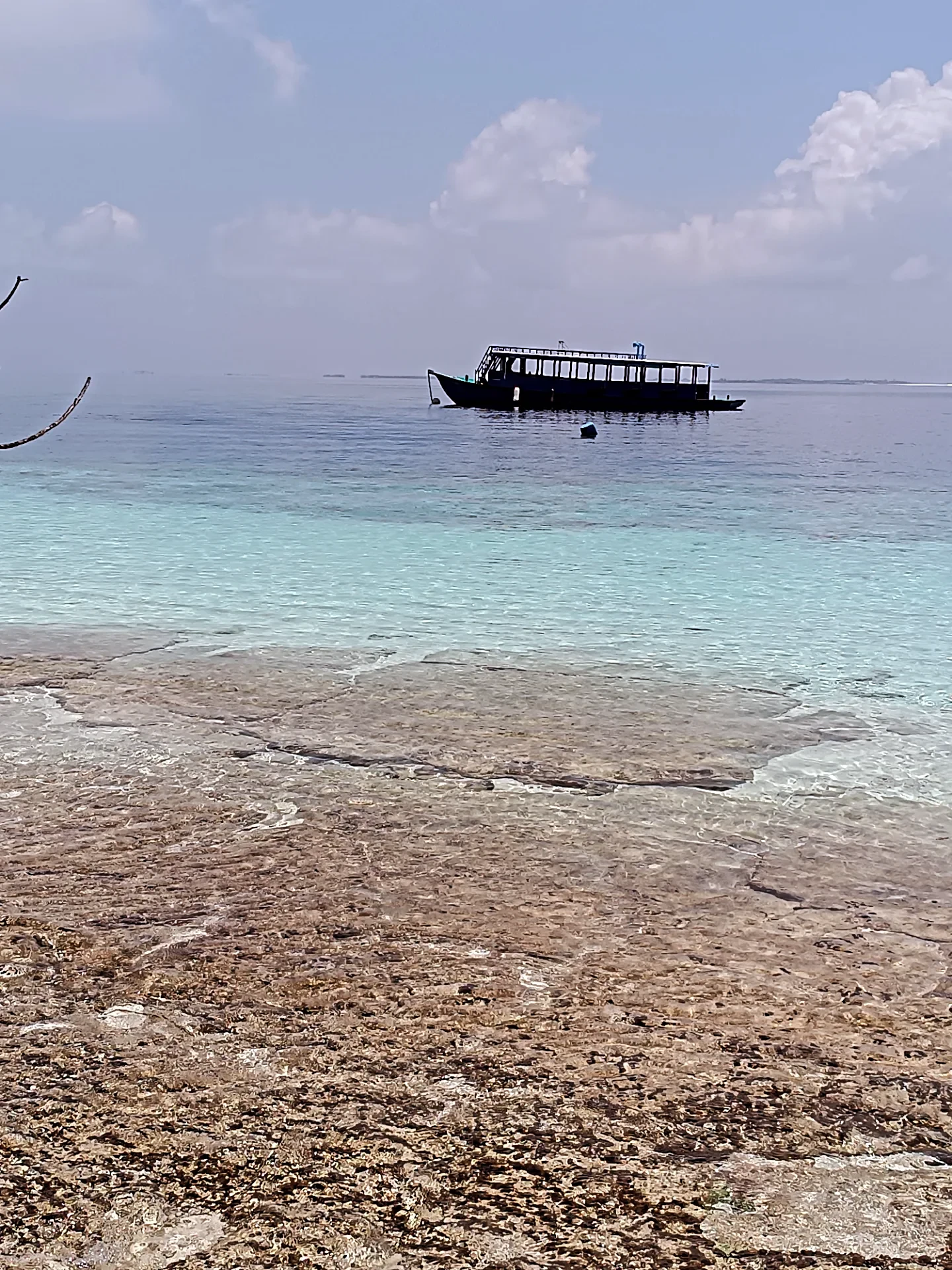
What a dive day looks like
Predictable, and worth knowing so the timings do not surprise you.
07:00. Briefing at the centre. Site chosen that morning, on the current, not the day before.
07:30. Load the dhoni. Tanks are already aboard; you carry your own bag from the drying room.
08:00. Twenty to sixty minutes to the site, depending on the island.
08:40. Backward roll or negative entry, straight down before the current takes you. Forty to fifty minutes below.
09:40. Surface interval on the boat. Water, fruit, and the guide deciding whether the second site still works.
10:30. Second tank.
12:30. Back on the island.
Afternoon. A single tank around 15:00 at many centres, and a night session on scheduled evenings.
Resorts run this on resort time, an hour ahead of the country, while the boat, the tide and the flight home all run on Malé time — a discrepancy explained in our guide to the time zone and a recurring cause of missed briefings.
Current, hooks and the technique nobody teaches you at home
Three skills that separate a good hour underwater from an exhausting one.
Negative entry. You roll in with no air in the BCD and descend immediately. Hanging on the surface in a channel means being carried off the site before you start.
Reef hooking. Place the hook on dead rock or rubble — never on coral — take up the slack, add a little air, and hang. The current does the work and you watch the show. Ask for a demonstration on land if you have not used one.
Reading the flow rather than fighting it. Stay low, use the reef as shelter, move laterally in the lee of structure. Anyone who swims into current burns air in ten minutes and surfaces early.
Air consumption is the limiter here, more than depth. A relaxed diver in a channel gets forty-five minutes; a tense one gets twenty-five.
Currents are strongest around the full and new moon, and the mechanism is in the season calendar.
Safety, and the four chambers
Not a section to skim.
There are four hyperbaric chambers in the country, all at resorts rather than hospitals: Bandos in Kaafu, Kuramathi in the Rasdhoo and Ari area, Kuredu in Lhaviyani and Kandima in Dhaalu. There is none south of Dhaalu Atoll, which matters if you are diving Huvadhu, Fuvahmulah or Addu. Our guide to safety and medical care covers the whole picture.
Chamber treatment costs USD 5,000 to 15,000 and is not covered by many standard travel policies. Dedicated dive insurance is not optional here. Read the depth limit in the wording, because policies capping at 30 metres exclude a good deal of Maldivian diving.
No-fly time applies to the seaplane, not just the flight home. Your last dive has to sit far enough before the transfer, which for a seaplane resort means planning the final dive day around the boat rather than the aircraft.
Carry a computer and an SMB. Both are standard requirements, and a surface marker in a channel exit is not optional.
Hydrate. Warm water, three dives a day and a beer at sunset is the classic recipe for a bad afternoon.
Night diving
Worth a paragraph of its own because it is the most under-booked dive in the country.
Maaya Thila in North Ari is the famous one: whitetips hunting in the torch beams, and the reef entirely different in character from its daytime self.
Alimatha in Vaavu draws nurse sharks in numbers that surprise people.
House reef night sessions are available at most resorts and cost less than a boat trip.
Cost is broadly the same as a daytime tank, sometimes with a torch rental added. If you have never been in at night, a house reef is the right place to start rather than a thila with current.
Choosing a dive centre
Six questions, and the answers tell you more than the certification logo on the door.
Which sites do you dive regularly, and which are on the eastern rim? A centre that answers instantly understands the monsoon rotation.
What is the guide-to-diver ratio, and do you split by experience? Four experienced divers with one guide is a different dive from twelve mixed-ability ones.
Is nitrox available, and at what price?
What is included in the quoted price? Ask specifically about BCD, regulator, computer, park fees and tax. This one question resolves most of the budget problem in this article.
What is the house reef like? Ask for a description of the entry and the drop-off, not an adjective.
What happens if I am not comfortable? Any answer other than “we bring you up” is the wrong answer.
Certification agency — PADI, SSI, others — matters far less than the ratio, the boat and the guide.
Etiquette, and why it matters here
The reef is under measurable pressure, and diver behaviour is the part visitors control.
Never touch, never stand, never chase. A fin kick kills growth that took years, and the 2024 bleaching event removed a great deal of what remains.
Hook onto dead rock, never living coral.
Do not feed anything, and decline operators who do.
Keep your distance from mantas and whale sharks. Approach rules exist, and they exist because unmanaged access damaged the sites they protect.
Choose operators who brief properly. A no-touch briefing and a buoyancy check are the signals of a centre protecting the sites it sells.
Questions divers ask
Is the Maldives good for beginners? For learning, yes — warm, clear water and gentle house reefs. For the diving the country is famous for, no: the channel sites need an Advanced certification and comfort in current.
How much does diving in the Maldives cost? A fun dive is quoted at USD 40–70 on a local island, USD 70–110 at a mid-range resort and USD 110–200 at a luxury one. Add equipment at about USD 15, park fees of USD 6–15, nitrox at USD 5–10 and taxes compounding to about 28.7%.
Should I get certified before I travel? Yes. An Open Water course costs USD 200–400 at home against USD 550–900 in the Maldives, and takes four days of a seven-day holiday. A referral, doing theory at home and checkout dives here, saves both.
Do I need dive insurance? Effectively yes. There are only four hyperbaric chambers in the country, treatment costs USD 5,000–15,000, and many standard travel policies exclude chamber costs or cap diving at 30 metres.
Where are the decompression chambers? Bandos in Kaafu, Kuramathi in the Rasdhoo and Ari area, Kuredu in Lhaviyani and Kandima in Dhaalu. There is none south of Dhaalu Atoll.
Is it cheaper to dive from a local island? Substantially. The same sites cost a third to a half of resort prices. A week from a guesthouse island runs USD 1,500–2,000 all-in, against USD 4,000–6,000 at a mid-range resort.
What is a reef hook and do I need one? A short line with a hook, placed on dead rock, that lets you hang in current instead of swimming against it. It is standard on Maldivian channel dives, and centres provide them.
How many dives can I do in a day? Two morning boat dives plus an afternoon dive is the standard maximum at most centres, with a night dive on scheduled evenings. Nitrox makes three comfortable.
What to take away
- Maldivian diving is current diving: channels, reef hooks and pelagics, not shallow coral gardens.
- The quoted price is not the price. Equipment, park fees, nitrox and 28.7% compounding tax turn a USD 110 dive into roughly USD 180.
- The same sites cost a third as much from a guesthouse island, and a liveaboard from about USD 150 a day is the best value in the country.
- Certify at home. An Open Water course costs half as much and does not consume four days of the trip.
- Four hyperbaric chambers, none south of Dhaalu, and dive insurance that covers chamber treatment to your actual depth.
Next step: before you book anything, ask one dive centre what their quoted price excludes. The answer tells you what the week really costs, and it is the question almost nobody asks until the bill arrives at checkout.