
Five Words, and a Key to the Whole Map: Dhivehi for Travellers
You do not need any Dhivehi to travel in the Maldives. English is the working language of tourism, it is the medium of instruction in schools, and every resort and guesthouse will handle you in it without difficulty.
Five words will still change the temperature of every interaction you have on an inhabited island. And a dozen place-name endings turn the map from a wall of unfamiliar syllables into something you can read. That is the genuinely useful thing this language gives a visitor.
This guide covers what Dhivehi is, the script that runs right to left, the phrases worth learning, and how to decode island and dive site names.

What Dhivehi actually is
Dhivehi — sometimes written Divehi, and called Maldivian in English — is an Indo-Aryan language spoken by roughly 380,000 people. It is the sole official language of the Maldives and one of the smallest national languages in the world.
Its closest relative is Sinhala, spoken in Sri Lanka, from which it separated many centuries ago. That relationship makes Dhivehi a distant cousin of Hindi, Bengali and Nepali, and a very distant one of English through the shared Indo-European root.
The vocabulary carries the country’s trading history in layers: Arabic from religion and law, Sinhala from the linguistic ancestry, Hindi and Urdu from commerce, Persian, Portuguese from the sixteenth-century occupation, and now a steady flow of English.
It is also spoken outside the country. The Mahl dialect on Minicoy island, part of India’s Lakshadweep territory, is a variety of Dhivehi with a separate political history.
The script that runs the other way
Thaana is one of the more unusual writing systems in the world, and it is worth two minutes of attention even if you never learn a word.
It is written right to left. Signs, menus and newspapers all run in that direction, which is the first thing a visitor notices on a street in Malé.
Its letters came from numerals. The first nine consonants are derived from Arabic numerals and the next nine from indigenous Indic numerals — a construction found in no other script. The remaining letters were adapted for loanwords.
Vowels are diacritics. Marks above and below the consonants, called fili, work in a way familiar to anyone who has seen Arabic vocalisation.
It replaced older scripts. Dhives Akuru and the earlier Eveyla Akuru ran left to right and were used for centuries before Thaana came into general use, plausibly around the sixteenth century and possibly as a code during a period of foreign occupation.
You will not learn to read it on a week’s holiday. You will notice that street signs, official notices and the sides of ferries carry both Thaana and Latin script, and that the Latin transliteration of place names is inconsistent — the same island appears as Maafushi, Mafushi and Māfushi depending on who printed the sign.
Where English works, and where it thins out
Realistic expectations, by setting.
Resort islands. Fluent English throughout, plus staff who often speak Russian, Mandarin, German or Italian depending on the market the property serves. Language is a non-issue.
Guesthouse islands. English at reception, in restaurants, at excursion desks and among younger residents. Thinner in small shops, with older people, and among the boat crews.
Malé. Widely spoken, particularly in business and government — see our guide to the capital for what a day there is like.
Outer islands with little tourism. Patchier, and this is where a few words earn their keep — in the Nilandhe atolls or anywhere off the guesthouse circuit.
The pattern is generational and occupational rather than geographical. English has been the medium of instruction in Maldivian schools for decades, so anyone under about fifty who went through the system will have it. The exception is the vocabulary of daily island life, which nobody learned in English because nobody needed to.
The words that actually get used
Not a phrasebook dump. These are the ones that come up, in the order you will need them.
| Dhivehi | Rough pronunciation | Meaning |
|---|---|---|
| Assalaamu alaikum | as-sa-LAAM-u a-LAY-kum | Hello (the standard greeting) |
| Kihineh? | ki-HI-neh | How are you? |
| Baraabaru | ba-RAA-ba-ru | Fine, good |
| Shukuriyaa | shu-ku-ri-YAA | Thank you |
| Aan / Noon | aan / noon | Yes / no |
| Maafu kurey | MAA-fu ku-rey | Sorry, excuse me |
| Kobaa…? | ko-BAA | Where is…? |
| Kihaa vareh? | ki-HAA va-reh | How much? |
| Rangalhu | RAN-ga-lhu | Good, fine, OK |
| Vaki nujehey | va-ki nu-JE-hey | No problem |
| Fen | fen | Water |
| Mas | mas | Fish |
| Insha Allah | in-sha-al-LAH | God willing — used constantly about future plans |
Assalaamu alaikum is the one to learn first. It is Arabic rather than Dhivehi, it is universal, and it is the greeting that signals you have bothered.
Shukuriyaa is the second. Thank you in the local language is disproportionately effective in a country where visitors almost never say it.
Everything else is optional. Nobody expects a tourist to speak Dhivehi, and attempting long sentences generally produces a polite switch back to English rather than a conversation.
Sounds that catch English speakers out
Four spelling conventions explain most of the confusion in transliterated Dhivehi.
dh is a soft d, close to the “th” in “this” — so dhoni, the traditional boat, is closer to “thoni” than “donny”.
lh is an l pronounced with the tongue further back. It appears in rangalhu and in island names like Lhaviyani.
gn is a single sound like the ny in “canyon”, not two letters.
th is an unaspirated t, not the English th — Thaana starts closer to a plain t.
Stress is generally light and even, and the language has no tones. Vowel length matters: doubled vowels in transliteration are held longer, which is why Maafushi has a long first syllable.
None of this needs mastering. It does explain why the same island name is spelled three different ways on three different signs.

Numbers, days and the words on a schedule
Two small sets that come up in practice more than any polite phrase does.
Counting. One to ten runs ekeh, dheyh, thineh, hathareh, faheh, hayeh, hatheh, asheh, nuvayeh, dhihayeh. You will hear them at a market stall or a ferry counter far more often than you will need to say them, and recognising dhihayeh when someone quotes ten rufiyaa is more useful than producing it yourself. Prices themselves are covered in our guide to money.
Friday. Hukuru is Friday, and it is the day the working week structures itself around. Prayers pause islands around midday, cafés close for an hour or two and the public ferry network largely stops. It is the single most consequential word on a Maldivian calendar for a traveller.
Ramadan appears as Ramazan in Maldivian usage, and roadha is the fast itself. Our guide to Ramadan covers what changes, and Eid al-Fitr covers the celebration at its end.
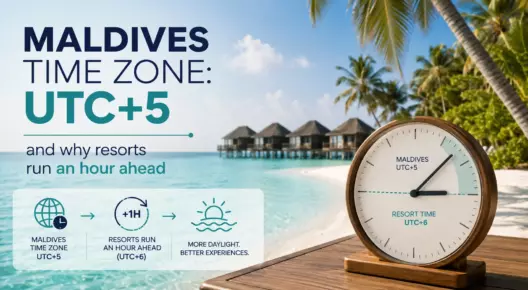
Time. Schedules are quoted in Malé time, but many resorts run their clocks an hour ahead — an arrangement explained in our guide to the Maldives time zone, and one that catches out more visitors than any language barrier ever will.
Reading the map: the part that actually helps
This is the most useful section of this article, and no phrasebook includes it.
Maldivian place names are descriptive compounds. Once you know the endings, the name of an island or a dive site tells you what it is — which is why dive guides and boat captains use them as shorthand.
Island and land endings
- -fushi — island. Maafushi, Thulusdhoo’s neighbours, hundreds of others
- -dhoo — island, an older and equally common ending. Hulhudhoo, Kudahuvadhoo
- -raa / -ru — island, mostly in the north
- -villingili / -villingilli — a common name in itself, appearing in several atolls
Water and reef endings — the ones that matter to divers
- -finolhu — a sandbank or sandy islet with little vegetation
- -giri — a coral pinnacle rising toward the surface, and one of the most common dive-site endings in the country
- -thila — a submerged reef or seamount that does not reach the surface
- -kandu — a channel between islands or reefs, where the current runs and the big animals gather
- -falhu — a reef flat or lagoon reef
- -faru — a reef, often the outer rim
Descriptive prefixes and words
- maa- — big. Maafushi is, literally, the big island
- kuda- — small
- hulhu- — of the east; dhekunu south, uthuru north, medhu middle
- rasdhoo / ras- — royal, or capital, from rasgefaanu, the king
Put those together and a dive briefing stops being noise. Miyaru Kandu is the shark channel. Hulhumalé is east Malé. Kudarah Thila is the small submerged pinnacle. Fushifaru Kandu is the channel by the island reef.
For the wider geography those names sit inside, our complete atolls guide maps the administrative system, and the diving guides to Vaavu, Ari and Rasdhoo are full of exactly these endings.
Where you will actually hear it
A few places where the language stops being background and becomes noticeable.
The ferry. Announcements, tickets and the crew’s working chatter are all in Dhivehi. On the public boats described in our transfers guide, you are the only person in the conversation who needs English.
Island shops and cafés. On Maafushi and every other guesthouse island, the trade behind the counter runs in Dhivehi and switches for you.
The mosque. The call to prayer is Arabic; the sermon is Dhivehi. Both are audible across a small island five times a day, which is one of the things that most clearly separates a guesthouse island from a resort.
Signage. Thaana on official notices, ferry timetables and shopfronts, usually alongside Latin script. Immigration and customs signage at Velana is bilingual throughout, so nothing about arrival requires it.
Nowhere on a resort island. Staff speak Dhivehi to each other and English to you, and a guest can pass a week without hearing a full sentence of the national language.
Dialects, and why the south sounds different
Standard Dhivehi is the dialect of Malé, and it is what you will hear in tourism, media and government throughout Kaafu and the central atolls.
The southern atolls speak differently enough to cause genuine difficulty. Addu bas in the far south, Mulaku bas on Fuvahmulah and the dialect of the Huvadhu atolls diverge in pronunciation, vocabulary and grammar. Speakers of the Malé dialect do not automatically understand them.
This is a live cultural matter rather than a curiosity. Southern dialects carry regional identity, they are not written in standard media, and the southern islands have a distinct history within the country.
For a visitor the practical implication is small and worth knowing: the handful of phrases you learn are the Malé versions, and in Addu or Fuvahmulah they will be understood but will not be quite what a local would say.

Words you already know
A short list, because the borrowing runs both ways and it is a nice thing to notice.
Atoll is the one English took. It comes from the Dhivehi atholhu, which entered English through nineteenth-century surveying and is now the standard scientific term for a coral ring worldwide. A country of 1,190 or so islands gave the language the word for the structure they sit on.
Dhoni is the traditional Maldivian boat, and the word is used unchanged in English throughout the tourism industry — you will see it on excursion boards and in our transfers guide.
Rufiyaa, the currency, is cognate with the Indian rupee and the Persian rupiya, as our guide to money explains.
Mas huni, garudhiya, hedhikaa and roshi are the food words a visitor actually uses, covered in the food guide.
Going the other way, modern Dhivehi has absorbed a great deal of English for technology, administration and tourism — a conversation about wifi, a booking or a transfer will be intelligible in outline to an English speaker who catches the nouns.
Language, religion and register
Some context, because the greeting you learn first is a religious one.
The Maldives has been Muslim since the twelfth century, and Arabic sits inside Dhivehi wherever religion, law or formality does — a history covered in our piece on how the Maldives embraced Islam.
Assalaamu alaikum is an Arabic greeting used universally. Non-Muslim visitors say it freely and it is received warmly; the reply is wa alaikum assalaam.
Insha Allah — God willing — attaches to statements about the future, including boat departures and weather. It is not evasion. It is the ordinary way of speaking about things not yet settled, and travellers who read it as vagueness have misunderstood the register.
Alhamdulillah — praise God — answers “how are you” as often as baraabaru does.
Politeness in Dhivehi is carried by verb forms rather than by please and thank you, which is why direct translations of English requests can sound blunt in Dhivehi and Dhivehi speakers can sound abrupt in English. Neither is rudeness.
What conversation is actually like
Language is only half of talking to people, and the other half is worth a paragraph.
Expect to be asked where you are from. It is the standard opening on an inhabited island, it is friendly rather than transactional, and the answer often produces a follow-up about a relative working abroad.
Expect questions about family. Marriage and children come up early in conversation in a way that reads as intrusive to some visitors and is simply normal here.
Photography needs asking. Of people, and particularly of women and children. The etiquette sits alongside the dress rules covered in our guide to what to wear where, and a gesture at the camera with a raised eyebrow does the job in any language.
Money talk is direct. Prices are negotiated plainly on guesthouse islands, and the conversation about what an excursion costs is not considered impolite. Whether to add anything afterwards is covered in our guide to tipping.
Silence is comfortable. Boat crews and guides are not filling gaps, and a quiet forty minutes on the water is not awkwardness. Travellers from talkative cultures sometimes read it as coldness, and it is the opposite — nobody is performing for you.
How a language this small survives
Worth a paragraph, because the answer is not obvious.
Dhivehi has roughly 380,000 speakers and no diaspora of scale. Languages that size usually lose ground to a regional giant, and this one has instead remained the sole official language of a functioning state, used in government, media, courts and schooling.
Three things hold it up. It is the language of a sovereign country, not a minority within someone else’s. It has a script of its own, which anchors a written culture. And the religious and legal vocabulary sits in Arabic rather than in English, so the prestige register was never occupied by the coloniser’s language.
The pressures are real all the same. English dominates tourism, technology and higher education, digital resources for Dhivehi are thin, and machine translation handles it poorly. Younger speakers in Malé mix English into everyday speech in a way older speakers on outer islands do not.
For a visitor this is context rather than instruction. But it is the reason two words of Dhivehi land the way they do: in a country where the working language of your entire holiday is English, using theirs is a small acknowledgement that it exists.
What not to do
Four things, briefly.
Do not assume English on an outer island. It is usually there and occasionally is not, particularly with older residents — worth knowing if you need help rather than conversation, as our safety guide notes about emergencies.
Do not use Google Translate for Dhivehi and expect much. The language has limited digital resources and small training corpora, and output is frequently wrong in ways you cannot detect.
Do not perform. Two words said well beat eight said badly, and long attempts usually produce a switch back to English out of politeness.
Do not treat Thaana as decoration. Getting a phrase tattooed or printed from an internet source, in a script most designers cannot read, produces exactly the results you would expect.
Questions travellers ask
What language do they speak in the Maldives? Dhivehi, an Indo-Aryan language related to Sinhala, spoken by around 380,000 people. English is widely spoken in tourism, government and business, and is the medium of instruction in schools.
Do I need to speak Dhivehi to visit? No. English covers everything a visitor needs at resorts, guesthouses and excursion desks. A greeting and a thank-you in Dhivehi are appreciated but never required.
How do you say thank you in Dhivehi? Shukuriyaa, pronounced roughly shu-ku-ri-YAA. The standard greeting is assalaamu alaikum, which is Arabic and used universally.
What script is Dhivehi written in? Thaana, written right to left, with letters derived from Arabic and Indic numerals and vowels marked as diacritics. It replaced older left-to-right scripts, probably around the sixteenth century.
Is Dhivehi related to Arabic? No. It is Indo-Aryan and most closely related to Sinhala, though it borrows heavily from Arabic in religious and formal vocabulary, and the Thaana script draws on Arabic numerals and vocalisation conventions.
What does “fushi” mean in Maldivian island names? Island. Other common endings include -dhoo for island, -finolhu for a sandbank, -giri for a coral pinnacle, -thila for a submerged reef and -kandu for a channel.
Are there dialects? Yes. The Malé dialect is the standard, and the southern dialects of Addu, Fuvahmulah and the Huvadhu atolls differ enough that speakers of standard Dhivehi may not understand them.
Where else is Dhivehi spoken? Only in the Maldives, plus the Mahl dialect on Minicoy island in India’s Lakshadweep territory.
What to take away
- English covers everything a visitor needs. Dhivehi is a courtesy rather than a requirement.
- Learn two things: assalaamu alaikum to greet and shukuriyaa to thank. That covers almost every occasion where it matters.
- Thaana runs right to left and its letters were built from numerals, which makes it unique among world scripts.
- The place-name endings are the genuinely useful vocabulary: -fushi island, -finolhu sandbank, -giri pinnacle, -thila submerged reef, -kandu channel.
- Southern dialects differ substantially from the Malé standard, and English is thinner among older residents on outer islands.
Next step: learn the two greetings on the flight, and read the endings list once before your first dive briefing. The greetings change how the week feels; the endings change how much of it you understand.