
Power in the Maldives: Six Socket Types, and One Adapter That Covers Them
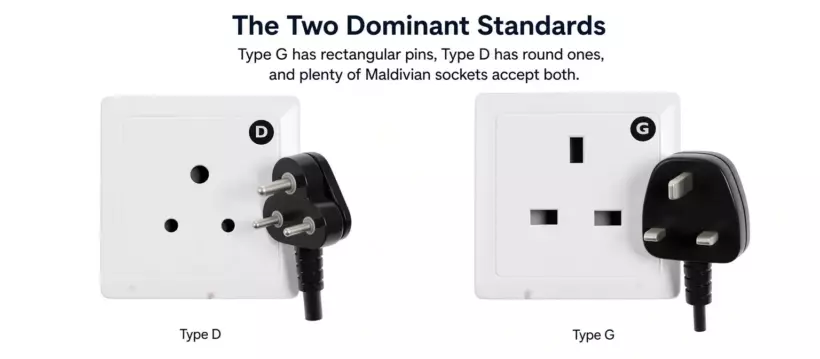
The Maldives runs on 230 volts at 50 hertz, and the sockets on the wall are usually Type G — the British three-pin — or Type D, the older round-pin standard from South Asia.
You will also meet Type C, and occasionally J, K and L. Six standards in a country of 380,000 people, which is why so many hotel rooms here have universal sockets that swallow anything you put in them.
The practical answer takes one line: bring a universal travel adapter and check that your devices say 100–240V. The rest explains what you will find where, what needs a converter, and what packing lists miss.

The official answer
Voltage: 230V. Frequency: 50Hz. Identical to the UK, Europe, most of Asia and Africa. If you are travelling from any of those, your appliances work without a converter.
Primary plug types: G and D. Type G is the British three-pin plug with rectangular prongs. Type D is the older three-round-pin standard used across India, Nepal and parts of Africa.
Also present as plug types: C, J, K and L. Type C is the two-pin Europlug, and J, K and L are the Swiss, Danish and Italian standards. These turn up in individual properties rather than nationwide.
No official national standard exists. That is the unusual part, and it is worth a section of its own.
Why one small country has six standards
The mix of plug types is not random. It is a record of who supplied the building materials.
The Maldives has no domestic manufacturing of electrical fittings, so every socket in the country was imported. British fittings arrived through Commonwealth trade links and the strong Sri Lankan and Indian supply chains that serve the archipelago, which is why Type G and Type D dominate. When European hotel groups built and fitted out resorts, they bought what their own contractors knew — hence the Swiss, Danish and Italian outlets that appear in isolated properties.
There was never a moment when the state imposed one standard, and by the time the industry was large enough for it to matter, thousands of rooms were already wired.
Resorts solved this the pragmatic way. Universal multi-standard sockets, which accept several plug shapes in one moulding, are now standard in mid-range and luxury properties. That is why most guests report never needing an adapter and a minority report needing one urgently — both are describing real experiences, in different buildings.
What you will actually find, by property type
This is the table worth reading, because “the Maldives uses Type G” is true and not useful.
| Where you are staying | Plug types and sockets you will find |
|---|---|
| Luxury resort, built or refurbished in the last decade | Universal multi-standard sockets, bedside USB-A and USB-C, plenty of outlets |
| Established resort, 1990s or 2000s build | Mostly Type G, some universal sockets, fewer outlets than you want |
| Older resort, not recently refurbished | Type G and Type D mixed, occasional European fittings, no USB |
| Guesthouse on an inhabited island | Type G and Type D, sometimes both in the same room, rarely USB |
| Budget guesthouse or older building | Type D only in places, with multi-way extension leads doing the work |
| Malé apartment or city hotel | Type G predominantly, Type D in older buildings |
| Liveaboard or safari vessel | Type G in cabins, 12V and USB in common areas, limited outlets |
The pattern is age rather than price. A twenty-year-old resort at the top of the market may have older fittings than a new guesthouse.
The practical consequence: a universal adapter is not optional insurance on a guesthouse island, and it is genuinely unnecessary at many new resorts. If you are doing both in one trip, as our resort and inhabited island comparison discusses, pack for the guesthouse.

Do you need a voltage converter?
Almost certainly not, and the check takes ten seconds.
Read the label on the power brick. If it says 100–240V, the device handles Maldivian electricity and needs only a plug adapter. Every modern phone charger, laptop power supply, camera battery charger, tablet charger and electric toothbrush falls into this category.
If it says 110–120V only, do not plug it in. At 230V it will fail, sometimes spectacularly. The devices that catch people out are all heating elements:
- Hair dryers and straighteners bought in North America or Japan
- Travel kettles
- Curling irons
- Older electric shavers
The simplest fix is to leave them at home. Every resort villa provides a hairdryer, and most guesthouses do too. A converter capable of running a 1,600-watt hairdryer is a heavy, expensive object that exists to solve a problem your accommodation has already solved.
Frequency is not an issue. The Maldives runs at 50Hz, and the handful of devices sensitive to frequency rather than voltage are not things tourists carry.
Travellers from the UK, Ireland, Europe, Australia, New Zealand, India, Singapore and most of Africa need no converter at all — only, at most, a plug adapter.
What to actually pack
Four items, in order of usefulness.
A universal travel adapter with USB ports. One good one covers every socket in the country and reduces the number of devices needing a wall outlet. Models with USB-C power delivery will charge a laptop and a phone simultaneously.
A short multi-way extension lead. The single most useful thing in this article. Villa and guesthouse rooms frequently have two accessible sockets, and a party of two with phones, a laptop, a camera, a watch, a dive computer and a power bank needs more than two. One adapter plus a four-way lead converts one Maldivian socket into four of your home ones.
A power bank. Useful on excursion boats where charging does not exist, and essential if you are relying on your phone for maps, bookings and your IMUGA QR code. Our guide to mobile data makes the same argument from the connectivity side.
A short USB-C cable or two. Newer resorts have bedside USB ports, and using them frees the wall sockets entirely.
What not to bring: a voltage converter, a travel iron (usually prohibited and always unnecessary), and an extension lead with built-in surge protection, which some airlines and properties treat with suspicion.
The five-minute test before you leave home
Do this once and the whole subject is closed.
Count your plugs. Phone, partner’s phone, laptop, camera, watch, headphones, e-reader, dive computer, power bank. A couple on a week’s holiday routinely travels with eight to ten devices and two accessible wall sockets waiting for them.
Check every power brick for the voltage line. Anything reading 100–240V is fine. Anything reading 110–120V stays at home.
Plug your own plugs into the adapter before packing it, every plug shape you are bringing. Universal adapters vary in build quality, and a loose fit discovered in a villa at midnight is not the moment.
Test the extension lead with the adapter. Some multi-way leads have oversized plugs that will not seat properly in a travel adapter, which defeats the entire arrangement.
Charge the power bank. Airlines will not let you charge it in flight on many routes, and it is no use to you flat.
The sockets in your room, and where they are not
A specific complaint worth pre-empting.
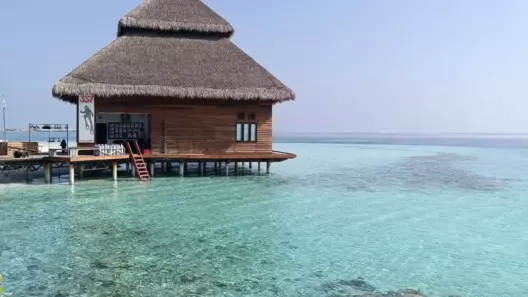
Overwater villas and beach bungalows are designed around a view rather than a workstation. Sockets cluster at the desk and behind the television, and bedside outlets are a feature of newer builds rather than a guarantee. Bathroom sockets, where they exist, are often shaver-only and low-current.
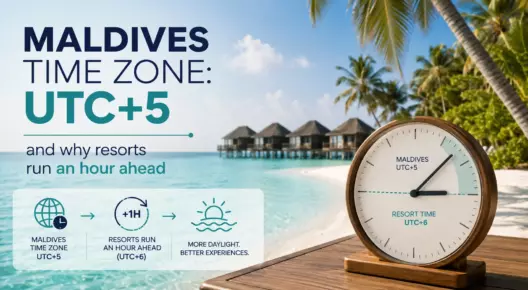
Two practical consequences. Charging overnight beside the bed may not be possible in an older villa, which matters if your phone is also your alarm clock — and, as our guide to the time zone explains, your phone is on Malé time while the room clock is usually an hour ahead.
Outdoor and terrace sockets are rare. If you plan to charge something on a deck, plan on a cable through a door.
Charging on boats, dives and excursions
The gap in every packing list.
Excursion dhonis have no passenger sockets. A half-day sandbank trip, a snorkelling run or a fishing evening is entirely off-grid for your devices — the boats themselves are described in our transfers guide.
Dive boats sometimes have 12V. Cigarette-lighter sockets appear on some larger vessels, and a 12V USB adapter is worth carrying if you dive daily. Dive computers, torch batteries and camera housings all need charging, and dive centres will usually charge equipment for you overnight.
Liveaboards have cabin sockets but frequently limited capacity, and generators may be shut down at night on some vessels. Divers working through Vaavu or the Ari channels for a week should ask about overnight charging before booking.
Long boat days need a power bank. The whale shark runs out of South Ari and manta days at Hanifaru Bay are full-day trips with cameras running.
Salt water and electronics. Rinse anything that got spray on it, and do not charge a device that is still damp. Corrosion in a USB-C port is the commonest device failure on a Maldives trip and it is entirely preventable.
Cameras, drones and dive gear
The people with a real power problem are not the ones with a phone.
Camera batteries. A full day of shooting on a boat drains one or two, and a charger occupies a wall socket for hours. Two spare batteries are lighter than the anxiety, and they remove the socket contention entirely.
Underwater housings and strobes. These charge slowly and need a dry, ventilated spot. Dive centres will usually charge equipment overnight in their own facility, which is safer than a humid villa bathroom.
Dive computers. Modern ones charge by USB and take a socket for an hour. If you are diving daily through Vaavu or off Rasdhoo, build it into the evening routine.
Night photography. Bioluminescence and star shots mean long exposures, and long exposures mean a drained battery by midnight.
Drones. Multiple large batteries, a slow charger and a permission requirement. Establish the resort’s policy before you pack, not after.
Nothing here is unusual for a photographer. It is unusual for the number of wall sockets a Maldivian villa provides, which is the point.
How reliable is the power?
Better than the geography suggests, with a clear split.
Resorts are effectively uninterrupted. Each island generates its own electricity, usually with diesel generators and increasingly with substantial solar arrays and battery storage. Redundancy is built in because the alternative is a resort without air conditioning.
Inhabited islands have outages. Powercuts happen, particularly during heavy weather in the southwest monsoon — June through September — and on smaller islands where a single generator serves everyone. They are usually short. Guesthouses on established islands like Maafushi generally have backup.
Surges are the real risk to your devices. Island grids with generators are less stable than national ones, and a surge on restoration after an outage can take out a charger. Unplugging during a storm is not paranoia.
Air conditioning is the load that matters. If power is limited, that is what the property protects, and it is the correct priority — particularly in the hot, still months before the monsoon breaks, covered in our March guide.
What a guesthouse room actually looks like
Concretely, because the resort answer does not transfer.
Rooms on inhabited islands are practical rather than designed. Expect two sockets, sometimes one, often positioned behind the bed or beside the door rather than where you would want them. The plug shapes may differ between the two, with a Type G beside a Type D in the same room.
Many guesthouses keep a shared box of adapters at reception. They are lent freely and they run out during full weeks, so bringing your own is the difference between charging tonight and charging tomorrow.
Ask the host on arrival. On a small island in Kaafu or wherever your chosen atoll takes you, the person at the desk knows exactly which socket in the room is reliable, which one is loose, and whether the generator cuts out at any point in the night.
Air conditioning shares the circuit. In older buildings, running a hairdryer while the air conditioning is on occasionally trips something. This is a building-age issue rather than a national one, and the fix is to not do both at once.
None of this is a hardship. It is the difference between a property built for guests and a property built for a family that later took guests, which is the same distinction our Maafushi guide draws throughout.
What the airlines and customs care about
Three rules that intersect with the electronics in your bag.
Power banks go in the cabin, never in checked luggage. This is an international aviation rule rather than a Maldivian one, and it is enforced. Capacity limits apply above 100 watt-hours, and airlines increasingly restrict in-flight use and charging.
Vapes and e-cigarettes are prohibited outright. The Maldives operates a total ban on vaping devices and e-liquids, and they are confiscated at the border — as our guide to banned items and customs rules sets out. This is the electronics rule most likely to catch a traveller, and it applies to devices in hand luggage.
Drones need permission. Restricted, and resorts have their own policies on top of the national rules — one of several things worth checking before you fly, alongside the entry formalities.
Nothing else in an ordinary traveller’s bag attracts attention. Laptops, cameras, dive computers, chargers and adapters all pass through Velana International Airport without comment.

If you forget one
Not a crisis, and the options run in order of convenience.
Ask reception. Most resorts keep adapters to lend, usually against a deposit and usually in limited numbers. Guesthouses often have a box of them behind the desk.
The airport. Shops at Velana sell universal adapters at airport prices, and the counters are open through the arrivals window.
Malé. Electrical shops in the capital sell adapters cheaply, and if you are spending a transit night there anyway — see our guide to Malé and to a late arrival — it is a five-minute errand.
Island shops. Guesthouse islands have small hardware and general stores stocking basic adapters. Pay in rufiyaa, as our guide to money explains, since these are not card establishments.
What you will not find easily is a voltage converter. If your device genuinely needs one, buy it before you travel or plan to do without.
Solar, and where the electricity comes from
Worth a paragraph, because it is changing quickly and it connects to everything else on this site.
Historically every island in the Maldives burned imported diesel for electricity — an expensive arrangement for a country with no fossil fuel of its own and a heavy dependence on shipping. Resorts, running air conditioning and desalination around the clock, are large consumers.
Solar has moved fast. Panel arrays on roofs and over car parks, floating solar on lagoons, and battery storage are now common at resorts and increasingly deployed on inhabited islands. The economics are straightforward: sunshine is the one resource the country has in surplus, and diesel has to arrive by boat.
The connection to the rest of the country’s situation is direct. A nation whose land depends on reef health and whose future is bound up with sea level has an unusually concrete interest in the emissions of its own power supply — and the desalination plants that produce drinking water on almost every island run on that same electricity.
None of which affects the socket on your wall. It does explain why the resort with the largest solar roof will tell you about it at check-in.
Questions travellers ask
What plug type does the Maldives use? Primarily Type G, the British three-pin, and Type D, the older three-round-pin South Asian standard. Types C, J, K and L also appear in individual properties, which is why many Maldivian sockets are universal multi-standard fittings.
What voltage is the Maldives? 230 volts at 50 hertz, the same as the UK, Europe and most of Asia and Africa.
Do I need an adapter for the Maldives? If you are coming from the UK, Ireland, Singapore, Malaysia or the Gulf with Type G plugs, often not. From anywhere else, yes. A universal adapter covers every case and costs very little.
Do I need a voltage converter? Only for single-voltage 110–120V appliances, which in practice means hair dryers, straighteners and travel kettles from North America or Japan. Check the label: anything marked 100–240V needs only a plug adapter.
Are there USB ports in the rooms? In recently built or refurbished resorts, usually including USB-C. In older resorts and most guesthouses, no. Bring an adapter with USB built in.
Is the power reliable? On resort islands, effectively yes — each island generates its own supply with redundancy. On inhabited islands, short outages happen, particularly in bad weather.
Can I bring a power bank? Yes, in your cabin baggage only. It must never go in checked luggage, and capacity limits apply above 100 watt-hours.
Can I bring a vape? No. Vaping devices and e-liquids are banned outright in the Maldives and are confiscated at the border.
What to take away
- 230V, 50Hz, with plug types G and D dominant and four other standards in circulation. One universal adapter covers all of them.
- Check every power brick for “100–240V”. If it says that, you need no converter. If it says 110–120V, leave it at home.
- Sockets track building age, not room price. Pack for the oldest property on your itinerary.
- A four-way extension lead is the most useful thing you can bring, because villas have fewer accessible sockets than you have devices.
- Power banks in the cabin only, and vapes not at all — they are confiscated at the border.
Next step: turn over the charger for whatever you are reading this on and find the voltage line. If it says 100–240V, you need nothing but an adapter. That thirty-second check is the entire preparation for this subject, and it is the one people skip.