Every Maldives travel guide tells you the same thing: overwater villas, turquoise water, pristine beaches. What most of them skip is the one piece of information that actually changes where you should book — the fact that South Ari Atoll contains the only permanent, year-round whale shark aggregation site on Earth.
This isn’t a seasonal window. There is no “best month to go if you want whale sharks.” They are here in January. They are here in August. Researchers from the Maldives Whale Shark Research Programme have logged over 7,500 documented encounters at this single site over 14 years of continuous study. Nowhere else on the planet offers that kind of certainty.
This guide explains why South Ari Atoll (officially called Alifu Dhaalu Atoll) works differently from every other Maldives destination, how to reach it, which resorts and guesthouses actually put you closest to the action, and what you can expect whether you dive or just snorkel.
Why South Ari Is the Whale Shark Capital of the Maldives
Most whale shark destinations are seasonal. The aggregations at Ningaloo Reef in Australia peak March through July. Holbox in Mexico runs May through September. Oslob in the Philippines is the only year-round alternative, and that site is ethically controversial because it relies on hand-feeding — not wild foraging behavior.
South Ari Atoll is different. The South Ari Marine Protected Area (SAMPA) covers 42 km² of reef along the atoll’s western and southern edges and was designated in 2009 specifically because of its global importance as a whale shark aggregation zone. It remains the largest marine protected area in the Maldives.
What draws the sharks here permanently is a combination of plankton-rich upwellings from the deep Indian Ocean, the atoll’s sheltered lagoon geometry, and water temperatures that stay consistently warm year-round. MWSRP research indicates the animals using the area are predominantly juvenile male whale sharks, using the atoll as what scientists describe as a secondary nursery — a feeding and thermoregulation zone they inhabit until they reach sexual maturity around age 30.
The Maldives banned all shark fishing across its entire 90,000 km² Exclusive Economic Zone in 2010, making it one of the first national shark sanctuaries in the world. That legal protection, combined with SAMPA’s specific management rules for in-water encounters (no touching, no flash photography, a minimum three-metre distance), means the sharks here behave naturally — unhurried and unbothered by snorkelers swimming alongside them.
Encounter rates at reputable operators exceed 80–85% year-round, and on nine out of ten excursions at well-positioned resorts, guests come back having seen at least one animal. Multiple sightings in a single morning are common.
How to Get There: Seaplane, Domestic Flight, or Speedboat
South Ari Atoll lies roughly 110 kilometres southwest of Malé, which means it requires a secondary transfer after you land at Velana International Airport. You have three practical options.
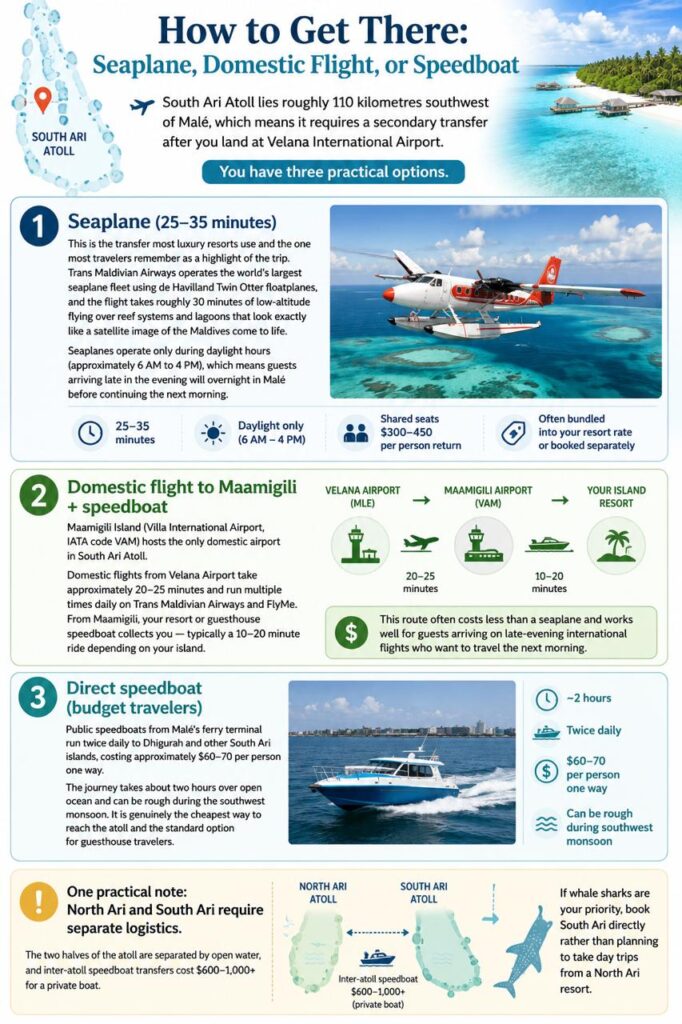
Seaplane (25–35 minutes): This is the transfer most luxury resorts use and the one most travelers remember as a highlight of the trip. Trans Maldivian Airways operates the world’s largest seaplane fleet using de Havilland Twin Otter floatplanes, and the flight takes roughly 30 minutes of low-altitude flying over reef systems and lagoons that look exactly like a satellite image of the Maldives come to life. Seaplanes operate only during daylight hours (approximately 6 AM to 4 PM), which means guests arriving late in the evening will overnight in Malé before continuing the next morning. Shared seaplane seats typically run $300–450 per person return, bundled into your resort rate or booked separately.
Domestic flight to Maamigili + speedboat: Maamigili Island (Villa International Airport, IATA code VAM) hosts the only domestic airport in South Ari Atoll. Domestic flights from Velana Airport take approximately 20–25 minutes and run multiple times daily on Trans Maldivian Airways and FlyMe. From Maamigili, your resort or guesthouse speedboat collects you — typically a 10–20 minute ride depending on your island. This route often costs less than a seaplane and works well for guests arriving on late-evening international flights who want to travel the next morning.
Direct speedboat (budget travelers): Public speedboats from Malé’s ferry terminal run twice daily to Dhigurah and other South Ari islands, costing approximately $60–70 per person one way. The journey takes about two hours over open ocean and can be rough during the southwest monsoon. It is genuinely the cheapest way to reach the atoll and the standard option for guesthouse travelers.
One practical note: North Ari and South Ari require separate logistics. The two halves of the atoll are separated by open water, and inter-atoll speedboat transfers cost $600–1,000+ for a private boat. If whale sharks are your priority, book South Ari directly rather than planning to take day trips from a North Ari resort.
Best Resorts in South Ari Atoll by Budget
South Ari doesn’t get enough credit for its range of accommodation. Most coverage fixates on Baa Atoll mega-resorts or properties near Malé. Here’s what’s actually worth considering in Alifu Dhaalu, across different price points.
Intimate Boutique: V Villas Maldives at Mirihi
Formerly known as Mirihi Island Resort and recently relaunched under the V Villas identity, Mirihi sits on a tiny private island in the southern part of the atoll, a short boat ride from SAMPA. It’s the resort that keeps coming up in conversations among serious divers and returning Maldives travelers as their favorite — not because of any single feature, but because of the overall caliber of the experience: outstanding house reef snorkeling directly off the jetty, a dive school with genuine expertise in the local sites, and a staff-to-guest ratio that makes service feel effortless.
The resort runs dedicated Whale Shark Seeker cruises to the SAMPA zone, with guests regularly reporting multiple sightings per trip. The villas are semi-detached rather than fully private, there is no in-room television by design, and the atmosphere is intentionally low-key — no pool, no nightlife, serious focus on the ocean. Best suited to couples and solo divers who want proximity to the water over resort amenities.
Mid-Range All-Inclusive: Lily Beach Resort & Spa
Lily Beach is positioned directly inside the protected area on Huvahandhoo Island and consistently ranks among the best all-inclusive resorts in the Maldives, not just for marine encounters but for total value. The Platinum Plan — the resort’s single accommodation option — covers meals, alcoholic beverages (including Champagne), a set number of excursions, and non-motorized water sports. Entry prices start around $760 per night.
The whale shark program here has one of the highest documented success rates in South Ari, around 80%, and the resort’s Prodivers operation is experienced and well-equipped. Lily Beach is also notably family-friendly — the Turtle Kids’ Club runs daily for ages 3–12 at no extra cost. If you want an all-in price that removes daily bill anxiety and gives you reliable whale shark access with a comfortable base, this is the most frequently recommended South Ari option in that mid-luxury tier.
Ultra-Luxury: Conrad Maldives Rangali Island
Conrad Maldives Rangali Island spans two connected islands in South Ari Atoll — Rangalifinolhu (the family island) and Rangali Island (adults-only) — linked by a 500-metre wooden jetty. The seaplane transfer from Malé takes approximately 30 minutes, landing directly at the Conrad jetty between the two islands.
This is the most internationally recognizable luxury brand currently operating in South Ari Atoll, and prices reflect it — expect $1,200 to $3,000+ per night depending on villa category and season. The resort is known for its Ithaa Undersea Restaurant, the first all-glass undersea restaurant in the world, where you dine surrounded by coral reef. Whale shark excursions run from the resort’s own dive center with dedicated boats to the SAMPA zone. The house reef at Conrad is frequently noted as less impressive than Mirihi’s for casual snorkeling — the appeal here is more about the overall resort experience than the reef immediately at your feet.
Comparing Constance Properties: Moofushi (South Ari) vs Halaveli (North Ari)
This is a point worth clarifying, because Constance Halaveli is located in North Ari Atoll — not South Ari. It reaches guests via a 90-minute speedboat or 25-minute seaplane from Malé, and while it offers excellent reef diving and occasional whale shark sightings, the SAMPA zone is not accessible on a day trip from North Ari at a reasonable cost.
If the Constance brand is important to you and whale sharks are a priority, the property to book is Constance Moofushi — the group’s South Ari resort, located on the atoll’s western rim near established manta ray cleaning stations and within reasonable boat range of the whale shark zone. Moofushi consistently receives strong reviews for diving quality and service, at a price point slightly below Halaveli. The trade-off: Halaveli is widely regarded as the more polished resort experience of the two.
Top Dive Sites: Where Exactly to Find Whale Sharks
Whale shark encounters in South Ari are almost always conducted as snorkel excursions rather than scuba dives — and this is intentional. The sharks feed near the surface on plankton, which means snorkeling puts you in the water alongside them at their natural depth. Scuba divers produce exhaled bubbles that can disturb the animals and push them deeper. Most reputable operators in the atoll have moved toward snorkel-only whale shark protocols.
That said, for divers who want to maximize their chances of an in-water encounter while also diving, these are the key sites:
Maamigili Beyru is the anchor site within SAMPA — a broad protected reef zone directly west of Maamigili Island where sightings occur with higher frequency than almost anywhere else on the planet. The site encompasses the outer reef slope at 15–30 metres, though whale shark interactions typically happen at 5–15 metres or shallower when the animals come up to feed.
Bodufinolhu Thila, Dhidhdhoo Beyru Faru, and Whale Shark Point are three additional named sites within SAMPA’s boundaries that deliver regular encounters. Whale Shark Point extends roughly 10 km along the atoll’s southern tip near Maamigili and Fenfushi Islands — boats cruise this stretch scanning the surface, then alert snorkelers to enter when a dorsal fin is spotted.
Seasonal movement matters for positioning. During the northeast monsoon (December to April), whale sharks concentrate on the western side of the atoll, in the area between Maamigili and Rangali Islands. During the southwest monsoon (May to November), they shift to the eastern side, between Maamigili and Dhigurah. All South Ari resorts can reach both sides, but the journey time varies — factor this in when choosing which island to stay on if you’re visiting during a specific season.
For pure reef diving beyond whale sharks, Kudarah Thila (12–28 metres, overhangs and caves with reef sharks and stingrays) and the Machchafushi Wreck — carpeted in coral growth and home to dense fish populations — are South Ari’s most talked-about sites outside the protected area.
Snorkeling Without Diving: What’s Possible
South Ari Atoll is one of the few destinations in the Maldives where non-divers miss almost nothing that matters most.
Whale shark excursions are snorkel-only, as noted above. You join a boat for two to four hours, typically leaving early morning (between 6 and 8 AM, when sharks are most surface-active), cruise along the reef until the spotter boat or guide identifies a dorsal fin, then enter the water quietly and swim alongside the animal. The standard rules apply: maintain a three-metre distance, no touching, no flash photography. Children aged eight and above can usually participate, and most operators require only basic swimming comfort rather than snorkeling experience — gear is provided and briefings happen on the boat.
Pricing from local islands (Dhigurah, Maamigili) runs approximately $40–70 per person for a half-day excursion. Resort-based excursions from properties like Conrad or Lily Beach typically cost $150–300 per person and often include equipment, guides, and refreshments.
Beyond whale shark trips, South Ari offers good house reef snorkeling directly off the beach or jetty at resorts like Mirihi and Lily Beach. Reef manta rays visit cleaning stations at sites like Rangali Madivaru — a cleaning station where mantas hover while cleaner wrasse attend to them — and these encounters can also be done as snorkel trips. Green and hawksbill turtles are common sightings without ever leaving the house reef.
For non-divers planning a week in South Ari, a realistic schedule would include two or three dedicated whale shark excursions (to account for weather or position days), daily house reef snorkeling sessions, and one or two manta ray trips. The itinerary fills easily.
South Ari vs North Ari: Which Part of the Atoll Is Better?
This is the most common question travelers ask when planning a Maldives trip around marine wildlife, and the answer depends entirely on what you want to see.
Choose South Ari (Alifu Dhaalu) if: Whale sharks are your primary goal, or if you want the flexibility of whale shark access regardless of when you travel. South Ari is also better for beginner and intermediate divers — the dive sites are generally shallower and have less extreme currents than North Ari. The domestic airport at Maamigili gives budget travelers a significantly cheaper transfer option. Local island infrastructure (guesthouses, dive operators, ferry connections) is more developed here than in most of the southern atolls.
Choose North Ari if: You’re an advanced diver interested in sites like Maaya Thila (one of the Maldives’ most celebrated night dive locations, famous for white-tip reef sharks hunting under lights) or the wreck sites at Fesdu and Halaveli. North Ari is also faster to reach from Malé — around 90 minutes by speedboat versus two or more hours to South Ari islands — which matters for a shorter stay. Resorts like W Maldives and Constance Halaveli in North Ari are excellent properties with strong house reefs, but they cannot reliably put you in the water with whale sharks. Dedicated whale shark day trips from North Ari involve long boat transfers and inconsistent results — multiple forum regulars on Maldives travel boards report making the trip from North Ari and coming back empty-handed.
The one scenario where North Ari competes directly: manta ray encounters. North Ari has its own cleaning stations and channel sites where manta rays visit regularly, and for divers who want mantas over whale sharks, the atoll is a legitimate alternative. For anyone with whale sharks on their bucket list, South Ari isn’t a preference — it’s the answer.
Best Time to Visit South Ari Atoll
The headline answer is that whale sharks are present year-round in Alifu Dhaalu, and no month delivers zero encounters. But within that, conditions vary.
November to April (Northeast Monsoon): The dry season brings calmer seas, clearer water, and visibility frequently exceeding 20 metres — the best conditions for photography. Whale sharks concentrate on the western side of the atoll during this period. January, February, and March represent the peak window for conditions: settled weather, excellent visibility, and strong whale shark sighting rates. Accommodation prices are at their highest, particularly December through March.
May to October (Southwest Monsoon): Seas can be rougher and visibility reduced compared to the dry season, though the atoll’s protected inner lagoon buffers much of the swell. Whale sharks shift to the eastern side of the atoll. Manta ray encounters become more frequent and reliable on the eastern reef sites. This is also when Baa Atoll’s Hanifaru Bay — a separate destination 100+ km north — produces its famous aggregations of hundreds of mantas, but that is a different trip entirely.
For manta rays within South Ari specifically, the western cleaning stations (including Rangali Madivaru near Conrad) are most active December to May. Eastern manta sites are better May to November. The pattern loosely mirrors whale shark movement.
Practical verdict: November through April offers the most reliable combination of calm seas, high visibility, and strong whale shark activity. If your dates are flexible, February is the peak of peak season. If you’re traveling in July or August, you’ll still see whale sharks — adjust your expectations for occasional rougher sea days and plan at least two or three excursion slots.
Local Islands: Dhigurah for Budget Travelers
Dhigurah is the local island that most budget-conscious travelers should know about, and it receives far less coverage than it deserves in mainstream travel guides.
The island’s name translates as “Long Island” in Dhivehi, and the description is apt — Dhigurah stretches nearly four kilometres in length while remaining narrow enough that you can see both ocean sides from a single path through the interior. Two-thirds of the island stays covered in natural jungle. The southern sandbank extends into open water at low tide, creating one of the most photographed natural beaches in the atoll. In 2017, Dhigurah’s beaches were named among the 50 World’s Best Beaches.
Its location is what makes it exceptional for travelers on a budget. Dhigurah sits at the eastern end of SAMPA, which means the whale shark zone is effectively on the island’s doorstep. Local operators here report encounter success rates exceeding 85% year-round, matching what the luxury resorts quote for their much more expensive excursions. Guesthouse rates run from approximately $77 to $150 per night for a private room with air conditioning and WiFi, and whale shark snorkel trips cost $40–60 per person — versus the $150–300 charged at resort islands.
The Maldives Whale Shark Research Programme has used Dhigurah as a base for its field surveys, which means the guides operating here often have more direct scientific familiarity with the whale sharks in the area than guides at most resorts.
Getting to Dhigurah is straightforward: direct speedboats from Malé run twice daily at approximately 8 AM and 2 PM, taking around two hours and costing $60–70 per person. The alternative is a 20–25 minute domestic flight from Velana Airport to Maamigili, then a 20-minute speedboat east to Dhigurah — faster but more expensive. From Maamigili, FlyMe and Trans Maldivian Airways both offer multiple daily departures.
Practical reality check: Dhigurah is a Muslim-majority local island, which means alcohol is not served on the island itself (only at the resort-style guesthouses that have specific licenses), and dress standards apply in the inhabited village areas. Bikini beach — the designated swimming beach — is at the island’s northern tip and is openly accessible to tourists. The trade-off for the price difference is tangible: you eat at local restaurants rather than resort dining venues, share the experience with other travelers at the guesthouse, and have less buffer if the boat schedule doesn’t align with your plans. For anyone who has already done a Maldives luxury resort trip and wants to return for the marine life without paying resort prices, Dhigurah is probably the highest-value option in the entire country.
Final Verdict: Is South Ari Right for You?
South Ari Atoll works best for travelers who have whale sharks on their list as a genuine priority, not just a vague hope. The combination of SAMPA’s year-round resident population, easy snorkel access (no dive certification required), multiple accommodation tiers from $77/night guesthouses to $3,000/night overwater villas, and a domestic airport that keeps transfers manageable makes Alifu Dhaalu uniquely flexible.
If you want the Maldives primarily for pure resort luxury and a beautiful lagoon, and whale sharks are a bonus rather than the point, North Ari properties like W Maldives or Constance Halaveli offer a shorter transfer and a slightly different style of diving. If a seasonal manta ray aggregation matters more than guaranteed whale shark encounters, Baa Atoll is worth the comparison. But if you want to be reasonably certain that at some point during your week in the water, a 7-to-10-metre whale shark will cruise past within arm’s reach — South Ari is, without qualification, the right atoll.