
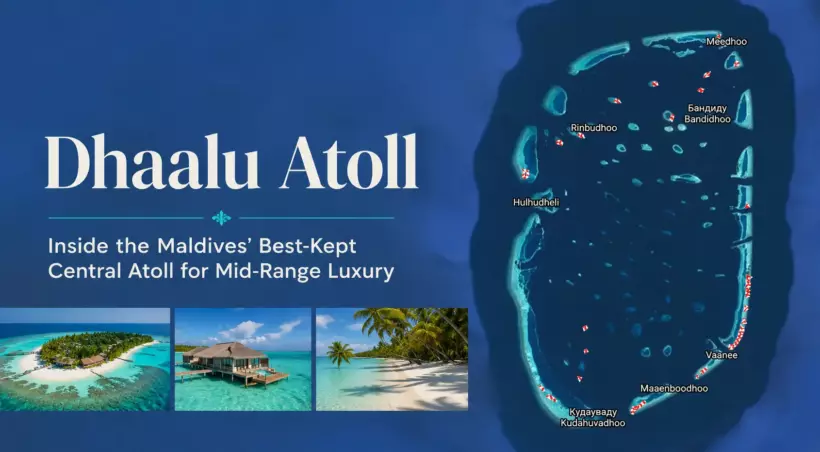
Ask most travelers to name a Maldives atoll and you’ll hear Malé, Ari, or Baa. Dhaalu Atoll rarely makes that list, and that’s exactly why it’s worth a closer look. Sitting roughly 150 to 180 km southwest of Malé, in the central-to-southern stretch of the archipelago, Dhaalu Atoll punches above its weight for travelers who want real five-star quality without an ultra-luxury bill. It holds barely a dozen resorts, led by Niyama Private Islands and Sun Siyam Iru Veli, plus one of the most talked-about underwater dining rooms on the planet and coral reefs that still see relatively little dive traffic. This guide covers what Dhaalu Atoll actually is, how to get there, what its two flagship resorts do differently, and whether it earns its “value-for-money luxury” reputation.
What Is Dhaalu Atoll? Geography and Location
Dhaalu Atoll is the administrative name for what geographers call South Nilandhe Atoll (Nilandhe Atholhu Dhekunuburi in Dhivehi), one of 26 atolls that make up the Maldives. Its capital is Kudahuvadhoo, and the atoll stretches about 23 km from east to west and 38 km from north to south, containing 56 islands in total, only seven of which are inhabited by local Maldivian communities.
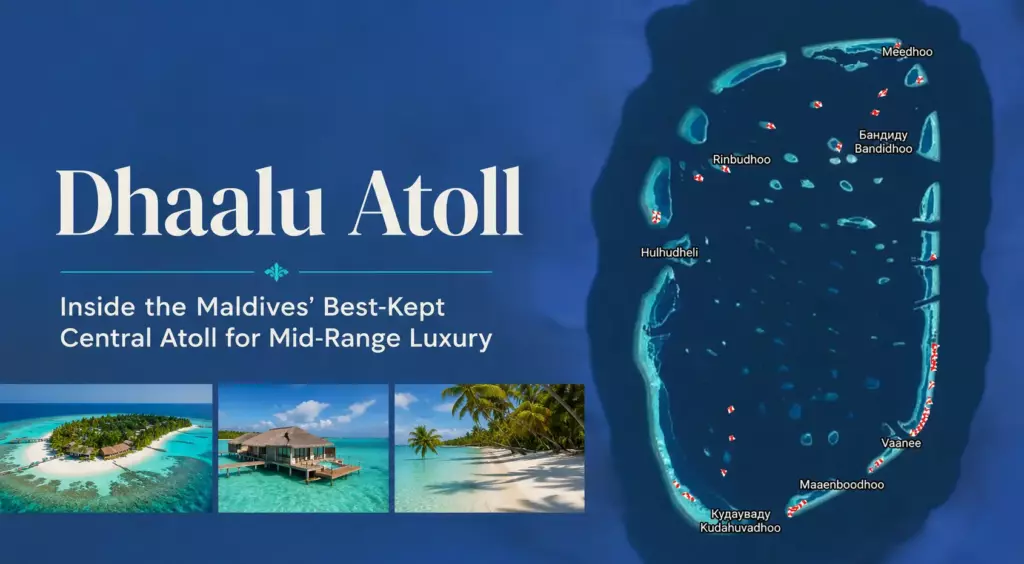
The “South” in South Nilandhe Atoll refers to its position relative to Faafu Atoll, or North Nilandhe, its immediate neighbor across a natural channel to the north. In absolute terms, though, Dhaalu sits close to the midpoint of the country’s north-south spread, which is why dive operators and travel platforms often group it with the Maldives’ central atolls rather than the far south. That distinction matters practically: Dhaalu is close enough to Malé for a same-day connection, yet far enough from the capital’s main flight paths to stay noticeably quieter than Malé, Ari, or Baa atolls.
Because nearly all of Dhaalu’s inhabited islands are small fishing and jewelry-making communities rather than tourist hubs, the local-island beaches here are fairly modest. Almost all visitor activity happens on private resort islands, which makes Dhaalu feel closer to a resort-only atoll than a backpacker-friendly one.
Getting to Dhaalu Atoll: Seaplane, Domestic Flight, and Its Own Airport
Dhaalu Atoll has a genuine advantage that many Maldives atolls lack: its own airport. Dhaalu Airport (IATA code DDD) opened on Kudahuvadhoo island in 2017, built on reclaimed land with a runway long enough for ATR-72 and Dash-8 aircraft. It currently runs scheduled Manta Air flights to Malé and to Bangalore, India. That single piece of infrastructure gives travelers two realistic ways to reach the atoll’s resorts.
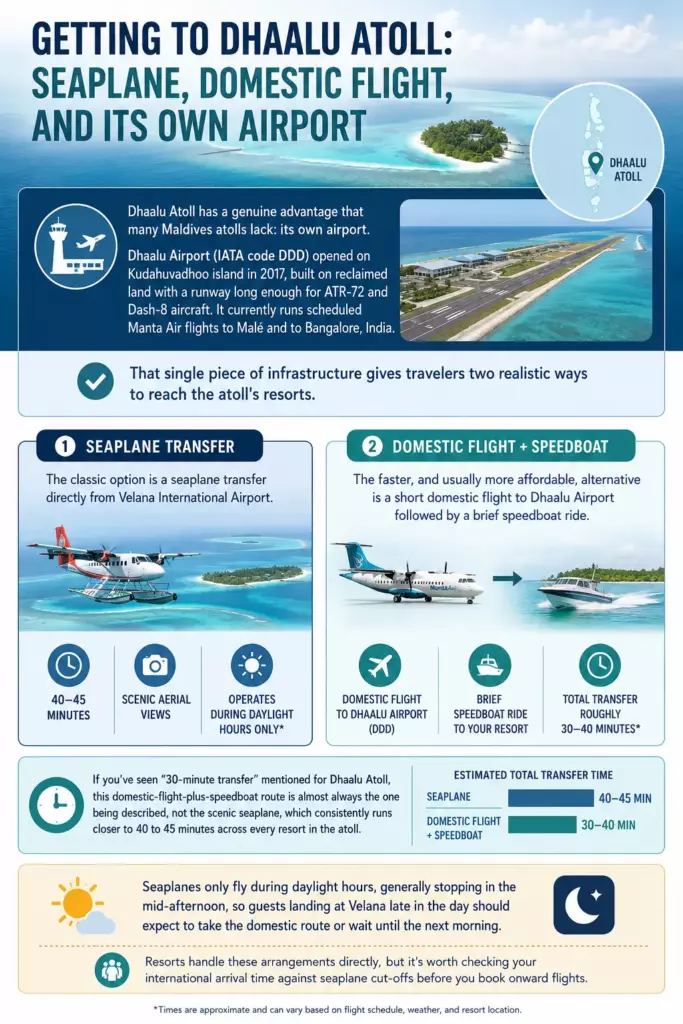
The classic option is a seaplane transfer directly from Velana International Airport, which typically takes 40 to 45 minutes and delivers the aerial views the Maldives is known for. The faster, and usually more affordable, alternative is a short domestic flight to Dhaalu Airport followed by a brief speedboat ride, a combination that can bring the total transfer down to roughly 30 to 40 minutes depending on the resort and flight schedule. If you’ve seen “30-minute transfer” mentioned for Dhaalu Atoll, this domestic-flight-plus-speedboat route is almost always the one being described, not the scenic seaplane, which consistently runs closer to 40 to 45 minutes across every resort in the atoll.
Seaplanes only fly during daylight hours, generally stopping in the mid-afternoon, so guests landing at Velana late in the day should expect to take the domestic route or wait until the next morning. Resorts handle these arrangements directly, but it’s worth checking your international arrival time against seaplane cut-offs before you book onward flights.
Niyama Private Islands: Dhaalu’s Headline Resort, and Home to Subsix
Niyama Private Islands Maldives is Dhaalu Atoll’s best-known name, and it earns that reputation with a genuinely unusual layout. The resort spans two connected islands, branded Play and Chill, splitting 134 beach and overwater villas between a livelier social side and a quieter, more adult-leaning side. It’s part of the Minor Hotels portfolio, and its two-island concept remains one of the few in the Maldives that lets a couple mix nightlife one day with total seclusion the next without ever changing resorts.
The real headline act, though, is Subsix. Opened in 2012 as the world’s first underwater nightclub, it sits six metres below the surface about 500 metres offshore, reached by a short boat ride and a dramatic staircase descent. By day it operates as a restaurant with floor-to-ceiling glass walls looking straight into the reef, where reef sharks, rays, and reef fish drift past during meals. On weekend evenings it converts into a small nightclub with resident and guest DJs, capped at around 40 guests, for an experience that feels closer to diving than dining. Specialist Maldives reviewers consistently flag Subsix’s lunch pricing, around USD 250 per person, as one of the more affordable underwater dining experiences in the country, which fits neatly with Dhaalu’s overall value positioning.
Beyond Subsix, Niyama runs nine restaurants and bars in total. Nest serves Asian cuisine in a treetop setting, Tribal brings South American and African flavors to a beachfront dining room, and Edge sits on an all-glass platform out over the lagoon. That’s a wider spread than most single-island Maldives resorts can offer, which is part of why families and larger groups gravitate here rather than to smaller boutique properties.
One practical detail worth knowing before you book: Niyama’s own beach lagoon is soft-sand and comparatively shallow, with relatively little coral directly offshore. That’s ideal if you want an easy, current-free swim straight from your villa, but if house-reef snorkeling is a priority, you’ll want to join a boat excursion or head toward Subsix’s reef rather than expect it right off the sand.
Sun Siyam Iru Veli: Boutique, All-Inclusive, and Built for Couples
Sun Siyam Iru Veli sits on its own island, Aluvifushi, within Dhaalu Atoll, and takes a more intimate approach than Niyama. Every one of its 125 beach and overwater suites comes with a private plunge pool, and the resort forms part of Sun Siyam’s upper-tier Prive Collection. Where Niyama leans into activity and dual-island variety, Iru Veli leans into stillness: six restaurants and bars, a spa built partly over the lagoon, and a layout designed for couples and honeymooners who want privacy without needing an entire private island to themselves.
The resort’s Premium All-Inclusive plan is a major part of its value case. It typically bundles dine-around access across the property’s restaurants, a spa or diving credit, motorized water-sports credit, and a handful of guided excursions such as snorkeling trips and sunset dolphin cruises. For travelers who’d rather fix their holiday budget upfront than watch it climb with every cocktail and excursion, that all-inclusive structure does much of the value-for-money work on its own.
Its restaurants lean into variety too. Aqua Orange handles the main buffet-style dining with live cooking stations, Grouper Grill focuses on beachside grilled meat and seafood, and Fresh Water keeps the poolside bar running with pizzas, pasta, and all-day snacks. Combined with the Premium All-Inclusive plan, guests rarely need to think twice about where to eat next.
Guest reviews consistently single out the resort’s dolphin sightings, house reef, and staff attentiveness, and it currently ranks among the top handful of Dhaalu Atoll’s dozen-plus resorts on major review platforms. Think of it as a smaller, quieter counterpart to Niyama rather than a competitor trying to out-scale it.
Niyama vs. Sun Siyam Iru Veli: Which One Fits You?
| Niyama Private Islands | Sun Siyam Iru Veli | |
|---|---|---|
| Layout | Two islands (Play + Chill), 134 villas | One island, 125 suites |
| Best for | Couples, families, groups wanting variety | Couples and honeymooners wanting quiet |
| Signature feature | Subsix underwater restaurant and nightclub | Private plunge pool in every suite |
| Meal plans | B&B through full all-inclusive | Premium All-Inclusive is the signature plan |
| Vibe | Livelier, more activity-driven | Boutique, intimate, understated |
Neither resort is a budget choice. Both are five-star properties in one of the world’s most expensive destinations. But neither approaches the price ceiling of the Maldives’ true ultra-luxury resorts, and that gap is where Dhaalu Atoll earns its value-for-money reputation.
A Third Option: Kandima Maldives for a Lower Entry Point
If even Niyama’s and Sun Siyam Iru Veli’s pricing feels like a stretch, Dhaalu Atoll has a third well-known name worth knowing about. Kandima Maldives sits on one of the atoll’s largest islands and trades some of the other two’s intimacy for scale: around 270 studios and villas, one of the longest pools in the Maldives, and a kids’ club considered among the country’s biggest. Its studio rooms bring the Maldives within reach for travelers who might otherwise be priced out of the atoll entirely, while its villas still deliver a private pool and ocean views at a lower cost than Niyama’s comparable categories.
Kandima isn’t one of this guide’s two must-know resorts, but it’s the clearest evidence that Dhaalu Atoll’s value range runs wider than just its two headline properties, and it’s worth a look if budget matters as much as brand.
Diving and Snorkeling: Dhaalu Atoll’s Coral Reefs
Dhaalu Atoll’s diving follows the classic Maldivian channel format: nutrient-rich currents flow between the atoll’s inner lagoon and the open ocean through a series of kandus, or channels, pulling in pelagic species and feeding the coral that lines the drop-offs. Around five channels sit on the atoll’s western edge and roughly ten on the eastern side, giving dive centers a wide spread of sites to rotate through depending on conditions.
Named highlights include Fushi Kandu, generally cited as the atoll’s most celebrated site for its sea-fan-covered pinnacles, eagle rays, sharks, and turtles. Manta Point is a cleaning station that draws mantas in on outgoing currents. Vaanee Corner and Vaanee Express bring stronger currents and are better suited to advanced divers. Manta ray season in Dhaalu Atoll generally runs from May to November, overlapping with the Maldives’ southwest monsoon, while turtle sightings happen more sporadically year-round.
What consistently sets Dhaalu apart in diver feedback isn’t any single site but the lack of crowds. Compared with the heavily dived channels of Ari or North Malé Atoll, Dhaalu’s reefs see meaningfully less boat traffic, largely because resort infrastructure arrived here later and most divers are guests of the atoll’s small resort count rather than day-trippers from elsewhere. Like the rest of the Maldives, the dry season from roughly November through April brings calmer seas and the best underwater visibility, while the May-to-November monsoon trades some of that clarity for the manta season described above. Neither window is a wrong time to visit; it mostly comes down to whether you’re prioritizing calm, sunny days or marine-life encounters. For snorkelers rather than certified divers, the same rule from the Niyama section applies atoll-wide: some house reefs are excellent right off the sand, while others need a short boat ride, so it’s worth checking a specific resort’s reef access before you book.
Is Dhaalu Atoll Good Value? Who It’s Actually For
This is the question that matters most, and the honest answer is: it depends what you’re comparing it to. Nightly rates at Dhaalu’s resorts commonly range from a few hundred dollars for entry-level rooms at family-oriented properties up to the low thousands for premium suites and villas, and that’s before transfers, which aren’t always bundled into the room rate. By comparison, the Maldives’ true ultra-luxury brands, names like Soneva, One&Only, or Joali, routinely start where Dhaalu’s resorts top out, and often run several times higher for their signature villas. Specialist reviewers consistently rate Niyama’s pricing as competitive for a genuine five-star property, and Sun Siyam Iru Veli’s all-inclusive structure caps holiday costs in a way that à la carte ultra-luxury resorts rarely allow.
Dhaalu Atoll makes sense if you:
- Want a real five-star Maldives resort experience without paying for the top-tier privacy premium
- Are traveling as a couple, honeymooning, or bringing a family that wants activities alongside relaxation
- Care about diving or snorkeling somewhere less crowded than Malé or Ari Atoll
- Would rather have one standout, talked-about experience, like an underwater meal or a private-pool suite, than an entire resort built around exclusivity
It’s probably not the right fit if you:
- Are traveling on a strict backpacker budget; Dhaalu’s local islands have limited guesthouse infrastructure and unremarkable beaches, so there’s little to fall back on outside the resorts
- Want vibrant coral directly off your villa with zero boat rides involved; check specific resorts carefully, since this varies even within the atoll
- Are chasing the absolute top tier of Maldivian ultra-luxury and privacy; Dhaalu’s resorts are excellent, but they sit a clear notch below brands built entirely around billionaire-level seclusion
The Bottom Line on Dhaalu Atoll
Dhaalu Atoll won’t show up on many “best Maldives atoll” lists, and that’s part of its appeal. It offers an own-airport shortcut most atolls don’t have, two very different but equally strong flagship resorts in Niyama and Sun Siyam Iru Veli, one of the most distinctive dining experiences in the Maldives at Subsix, and coral reefs that haven’t yet been loved to death by dive tourism. For mid-range and upper-mid travelers who want quality over exclusivity, it’s one of the more honest value propositions left in the Maldives.
Dhaalu Atoll: Frequently Asked Questions
Is Dhaalu Atoll worth visiting? Yes, particularly for travelers who want five-star Maldives quality without ultra-luxury pricing. It suits couples, honeymooners, and families more than budget backpackers, since almost all tourist infrastructure sits on resort islands rather than local ones.
How do you get to Dhaalu Atoll from Malé? Either a 40- to 45-minute seaplane transfer from Velana International Airport, or a domestic flight to Dhaalu Airport (DDD) followed by a short speedboat ride, which together can take as little as 30 to 40 minutes and is often the more affordable option.
Is Niyama or Sun Siyam Iru Veli better? Niyama suits travelers who want variety, activity, and its signature underwater restaurant Subsix. Sun Siyam Iru Veli suits couples wanting a quieter, more intimate all-inclusive stay with a private pool in every suite. Neither is objectively better; they’re built for different paces of holiday.
What’s the best time to dive in Dhaalu Atoll? Manta ray season generally runs from May to November, while November through April brings calmer seas and clearer water. Dhaalu’s channel dive sites also see notably less crowding than Malé or Ari Atoll year-round, which matters more to many divers than the season itself.
Is Dhaalu Atoll good for families? Yes. Niyama has a dedicated kids’ club and family villa options, and nearby Kandima Maldives, also in Dhaalu Atoll, is built specifically around family activities and one of the country’s largest kids’ clubs if you want an even more family-first base.