
Laamu Atoll, Maldives: The Eco-Adventure Atoll That Asks More of You Than Any Other
Laamu Atoll is the Maldives destination people describe in superlatives and then quietly book elsewhere. The surf is real. The conservation science is real — arguably the most serious resort-based marine research programme in the country. But Laamu Atoll sits roughly 260 km south of Malé, and getting there costs either a full travel day or about $1,200 per adult in transfer fees alone. That distance is the entire story. It is why the reefs are uncrowded, why one atoll has 82 islands and only a handful of tourist properties, and why Laamu is the wrong answer for most people who type “best Maldives atoll” into a search bar.
This guide is written for the traveller deciding whether the commitment is worth it — with the numbers, the trade-offs, and the things brochures leave out.
The short answer: is Laamu Atoll a top Maldives destination?
Yes, for a specific traveller. No, for the default one.
Laamu Atoll is worth the journey if you:
- surf at intermediate level or above, and want empty lineups
- dive or snorkel seriously, and care more about what’s on the reef than what’s on the beach
- find working marine biology genuinely interesting, not just a nice line in a brochure
- want to see inhabited Maldivian islands, not just a resort island
- can absorb a long transfer without resenting it
Book a different atoll if you:
- have five nights or fewer (you’ll lose one to travel each way)
- want the glassy, empty, postcard-blue lagoon — Laamu’s flagship resort deliberately protects seagrass in its lagoon
- are travelling on a tight budget at the luxury end (transfers alone run $1,200+ per adult round trip)
- want nightlife, shopping, or a wide choice of resorts to compare
- are visiting the Maldives for the first time and simply want the classic experience
Laamu isn’t a better Maldives. It’s a narrower one.
What makes Laamu Atoll different from every other Maldives atoll
Laamu — historically Haddhunmathi — is an administrative atoll of 82 islands with a population of around 19,500, of which roughly a dozen islands are inhabited. Its capital is Fonadhoo.

A geography note worth getting right: Laamu is routinely marketed as “the southern Maldives,” and that’s loose. Laamu forms the southern boundary of the central Maldives. Beyond it lies the Huvadhu Kandu, the widest inter-atoll channel in the country, and only past that channel do the true southern atolls begin. Kadhdhoo sits roughly halfway between Malé and Addu. The distinction matters practically: Laamu catches the swell and the emptiness of the south without being as far as Huvadhu or Addu.
The genuinely unusual feature is the road. Gan, in Laamu, is the longest island in the Maldives, and it is joined to Maandhoo, Kadhdhoo and Fonadhoo by an 18-kilometre causeway system known locally as the Link Road. In a country where almost every journey is a boat journey, Laamu lets you rent a bicycle or a scooter and ride between four islands — past a tuna cannery, a hospital, a mosque, a beach, another beach. There is no equivalent experience in North Malé or Baa.
That single piece of infrastructure is why Laamu supports guesthouse tourism at all. It’s also why Laamu feels like a place where people live, rather than a place staged for arrivals.
Getting to Laamu Atoll: the domestic flight to Kadhdhoo and the seaplane that replaced it
There are now two access routes, and most published guides still describe only the old one.
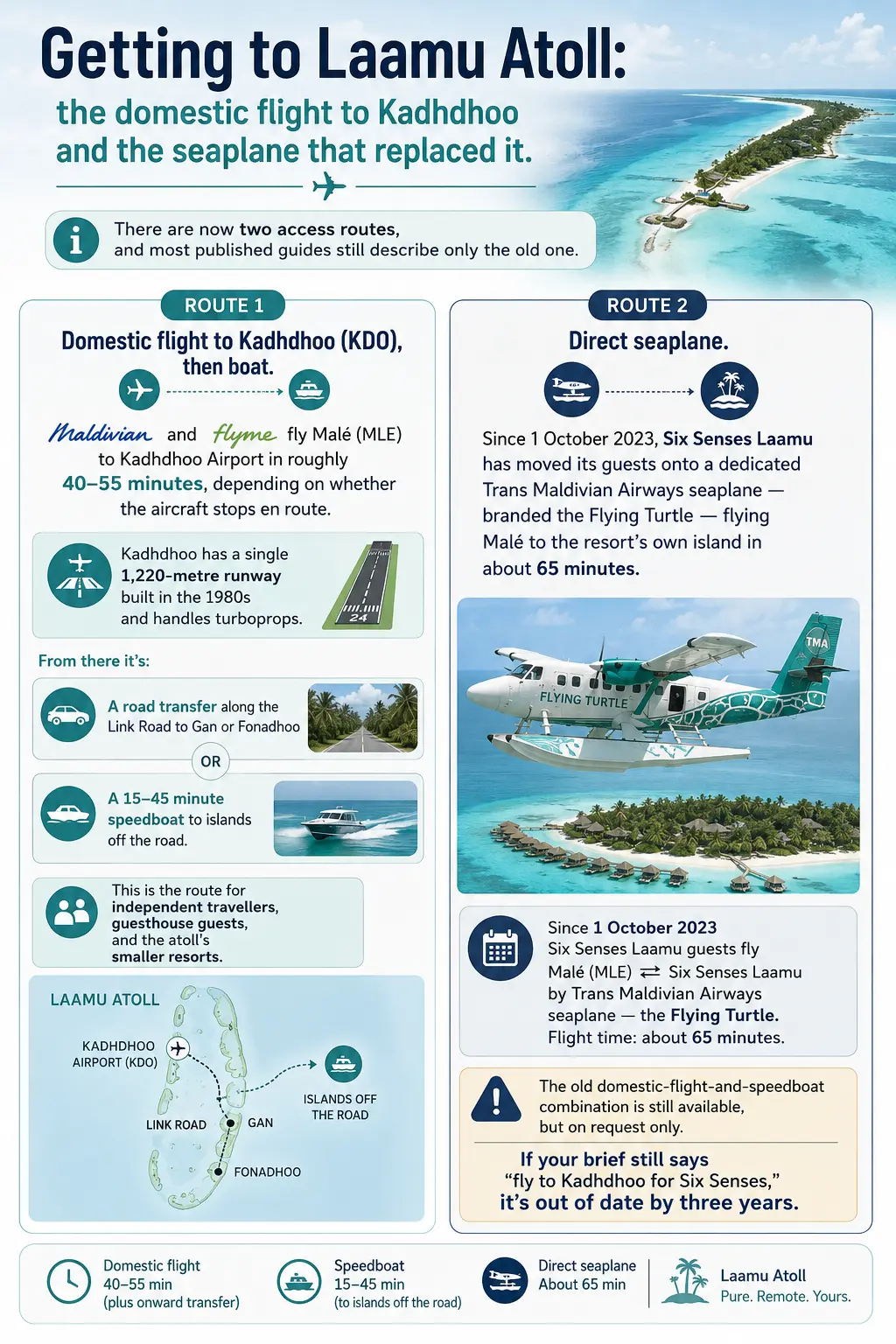
Route 1 — domestic flight to Kadhdhoo (KDO), then boat. Maldivian and Flyme fly Malé (MLE) to Kadhdhoo Airport in roughly 40–55 minutes, depending on whether the aircraft stops en route. Kadhdhoo has a single 1,220-metre runway built in the 1980s and handles turboprops. From there it’s a road transfer along the Link Road to Gan or Fonadhoo, or a 15–45 minute speedboat to islands off the road. This is the route for independent travellers, guesthouse guests, and the atoll’s smaller resorts.
Route 2 — direct seaplane. Since 1 October 2023, Six Senses Laamu has moved its guests onto a dedicated Trans Maldivian Airways seaplane — branded the Flying Turtle — flying Malé to the resort’s own island in about 65 minutes. The old domestic-flight-and-speedboat combination is still available, but on request only. If your brief still says “fly to Kadhdhoo for Six Senses,” it’s out of date by three years.
| Domestic flight + boat | Direct seaplane | |
|---|---|---|
| Time from Malé | ~40–55 min flight + 15–45 min transfer | ~65 min, no connection |
| Who uses it | Guesthouses, Rahaa, Reveries, independent surfers | Six Senses Laamu guests |
| Rough cost | Domestic sector typically a few hundred USD round trip | ~$1,209 per adult round trip, ~$706–709 per child 2–11 |
| Operating hours | Scheduled daytime flights | Daylight only |
| Baggage | Standard domestic allowance | 20 kg checked, 5 kg hand |
The scheduling trap nobody warns you about
Maldivian seaplanes are restricted to daylight operation by the civil aviation authority. In practice, to be guaranteed a same-day onward transfer, you need to land at Malé by around 15:00, and your outbound international flight needs to depart after roughly 09:30. Miss that window and you overnight in Malé or Hulhumalé at your own cost — on both ends, potentially.
Most long-haul routings from Europe arrive in Malé in the evening. Check your arrival time before you check villa rates. Seaplane wait times at the terminal can also run to several hours in peak season, which is why the resort maintains its own airport lounge.
This is the single most common way a Laamu trip goes wrong, and it happens at the booking stage, not on the day.
Six Senses Laamu and the coral restoration work behind the “eco-luxury” label
“Eco-luxury” is the most abused phrase in Maldives marketing. Laamu is one of the few places where it survives scrutiny, and the reason is structural rather than decorative: the science isn’t a guest activity bolted onto a resort, it’s a permanent research operation the resort happens to host.
Six Senses Laamu opened in 2011 on Olhuveli Island and hired its first marine biologist in 2012. The Manta Trust joined in 2014, Blue Marine Foundation in 2016, the Olive Ridley Project in 2018. That year the partnership was formalised as the Maldives Underwater Initiative (MUI). In 2023 the resort opened SHELL — the Sea Hub for Environmental Learning in Laamu — a purpose-built research centre with labs, exhibition galleries and an amphitheatre, which guests can walk into.
The resort’s own published 2024 figures give a sense of scale:
- 2,862,000 coral larvae released onto reefs
- 335,024 m² of seagrass meadow protected
- 1,350 hours of scientific surveys
- 14,061 megafauna sightings logged on dives and snorkels
- 1,268 individual sea turtles identified across the atoll
- 703 manta ray sightings
- 1,597 turtle hatchlings reaching the sea from resort beaches
The coral work responds directly to the 2024 global bleaching event. MUI rears larvae in onsite tanks timed to the lunar spawning cycle, and combines larval restoration with micro-fragmentation and cloning of vulnerable species. Its sister organisation, Maldives Resilient Reefs, developed what has been described as the country’s first resort-based sustainable fishing programme. Long-running seagrass surveys have turned up two species not previously documented in the Maldives.
When TIME named Six Senses Laamu to its World’s Greatest Places 2026 list, the argument it made was not about the scale of the science but about access to it: guests can tour the labs, dive with working biologists, take PADI’s Manta Ray Dive Specialty course, and contribute species monitoring data. That’s the actual differentiator. Plenty of resorts have a marine biologist. Very few let you spend a week alongside a research team.
The seagrass paradox: why Laamu’s best conservation story ruins the postcard
Here is the trade-off nobody puts in a brochure, and it’s the most useful thing in this guide.
Across the Maldives, resorts rake, dredge and remove seagrass from their lagoons because guests expect an unbroken sheet of turquoise. In a survey of 49 resorts, MUI found that around half of those with seagrass were actively removing it — and those were only the ones prepared to admit it.
Six Senses Laamu went the other way. It pledged in 2017 to protect its meadows, and in 2019 launched the #ProtectMaldivesSeagrass campaign with Blue Marine Foundation, which drew commitments from more than 30 resorts and formal backing from the Ministry of Tourism. The ecological case is strong: seagrass is a nursery for juvenile fish, it buffers wave energy and slows beach erosion, it stores carbon, and it is the primary food source for green turtles. A 2018 MUI survey found that the average Six Senses Laamu guest saw at least 11 individual turtles, sharks or rays in the seagrass around their own villa within a four-day stay. Sightings of turtles, sharks and rays roughly doubled after protection began.
And it means the lagoon does not look like the postcard. Experienced Maldives travellers on forums flag this consistently: the water between the resort’s jetties, and in front of some beach villas, has dark seagrass rather than clean white sand. Guests hoping for a pristine, empty lagoon have been disappointed. Guests who wanted to watch a green turtle graze twenty metres from their deck got exactly that.
Neither reaction is wrong. But this is precisely where Laamu filters its visitors: the thing that makes it ecologically exceptional is the thing that makes it photographically ordinary. If your mental image of the Maldives is a drone shot of empty blue, you will be quietly annoyed for a week and won’t be able to say why. Know it before you book, not after.
Surfing Laamu Atoll: Yin Yang and the breaks around it
Laamu is one of the least crowded quality surf zones in the Maldives — fewer resorts, fewer charter boats, and a long way from the Malé-atoll circus of Cokes, Chickens and Jailbreaks.
Yin Yang (also written Ying Yang) is the headline wave, sitting at the mouth of a wide channel on the atoll’s southern edge, a short boat ride from Six Senses Laamu. Note a correction worth making, because it’s misreported often: Yin Yang is predominantly a right-hander, not a left. It opens with a barrelling outside section, walls and bowls through the corner, then the inside section picks up speed and power along a shallow reef ledge — that inside is where the barrels and the reef risk both live. Some guides describe a shorter left at the same spot. It is an intermediate-to-advanced wave; the outside can be surfed by improving intermediates on smaller days, the inside cannot.
| Break | Direction | Level | Access |
|---|---|---|---|
| Yin Yang | Right (long, barrelling inside) | Intermediate–advanced | Boat |
| Machines | Right, fast and mechanical | Advanced (channel currents) | ~30 min boat |
| Antiques / Reef Top | Long-walling left | Intermediate | Boat |
| Petrols | Left-hand wedge, short and punchy | Intermediate–advanced | Boat |
| Jetty C / house reef lefts | Left | Intermediate | Paddle from resort |
| Lagoon in front of the surf shack | Small, forgiving | Beginner | Walk / paddle |
Season. The Maldives surf season runs roughly April to October; in Laamu the reliable window is around May to September, driven by the southwest monsoon. Outside it, expect flat spells. Six Senses runs a Tropicsurf base and organises daily boat trips through the season; guesthouses on Gan and the eastern islands run cheaper surf-camp style operations year-round.
The trade-off is blunt: the best surf months are the wettest and least calm months. You cannot have peak swell and glassy December visibility in the same trip.
Buddhist ruins at Isdhoo: what’s actually left of Laamu’s pre-Islamic past
Before the Maldives converted to Islam in 1153 CE, Haddhunmathi was a centre of Maldivian Buddhism. Isdhoo, at the atoll’s northeastern tip, held one of the largest stupas ever found in the archipelago, and Buddha images have been recovered from the island.
Manage your expectations carefully here. The British archaeologist H.C.P. Bell excavated Laamu’s Buddhist sites in the 1920s; a Buddha head he recorded has since disappeared, and the sites have been repeatedly damaged in the century since. The well-preserved stupa Bell documented at Kuruhinna on Gan is now essentially a heap of stone and gravel. The Maldives Heritage Survey, which resurveyed Isdhoo in 2018, describes the mound there as an earthen havitha averaging about 7.5 metres in diameter, its surface scattered with coral rubble, some finely worked coral stone blocks with ornamental detail, cowrie shells, and traces of a wall at the base.
In other words: this is archaeology, not a monument. You are looking at a low overgrown mound and reading the significance into it. If that appeals, it’s one of the most atmospheric things in the country. If you’re expecting Borobudur, don’t go.
The genuinely important object is a document. The Isdhoo Loamaafaanu — a royal edict inscribed on copper plates, dated 1194 CE, four decades after conversion — is the oldest surviving Maldivian government record. It deals with land grants, taxation and the administration of a mosque established at a desecrated monastery site. It is, in effect, the paperwork of a country changing religion, and it comes from this island.
The island’s Old Mosque, built in 1701 under Sultan Ali VII, carries its own quiet evidence: it faces due west rather than northwest towards Mecca, which is generally read as a sign it was built on the footprint of an earlier temple.
Practical note: Isdhoo is an inhabited island of around 900 people, not on the Link Road, reached by boat. Dress modestly, ask before photographing people, and treat it as someone’s village — because it is.
The Star Wars Rogue One filming location: what you can and can’t visit
Laamu played the planet Scarif in Rogue One: A Star Wars Story (2016). The beach battle — the stormtroopers wading through shallow water, the sequence that produced the film’s poster imagery — was shot here. Production used Baresdhoo (Berasdhoo), Kudafushi, Kudarah and Gan, with Gan housing the crew. Interiors were shot at Pinewood and Elstree in England.
What that means for a visitor is less than the internet implies. Three of the four locations are uninhabited islands, reachable only by chartered boat, with nothing left on site — no set, no marker, no plaque. The production removed everything, as it was required to.
So: a fun half-day excursion your resort or guesthouse can arrange, best framed as “an empty desert island that happens to be famous.” A reason to be pleased you came. Not a reason to come.
Diving and marine life in Laamu Atoll
The atoll’s signature dive is Hithadhoo Corner, about a 10–15 minute boat ride from Six Senses Laamu, where coral blocks at around 20 metres form a cleaning station for reef manta rays. Laamu’s mantas are notable for being present year-round rather than seasonally, and the resident Manta Trust team has catalogued around 150 individuals — using, among other tools, the first underwater contactless ultrasound scanner developed for checking pregnant mantas.
Alongside this, the atoll holds a network of voluntary marine protected areas declared with Laamu Atoll Council, covering the turtle nesting beach, mangroves and seagrass of the uninhabited island of Gaadhoo, the channel between Gaadhoo and Olhuveli, the mangrove of Hithadhoo, and additional channels, wetlands and an island elsewhere in the atoll. It’s a connected system — reef, mangrove, seagrass — rather than isolated protected patches, which is unusual in the Maldives.
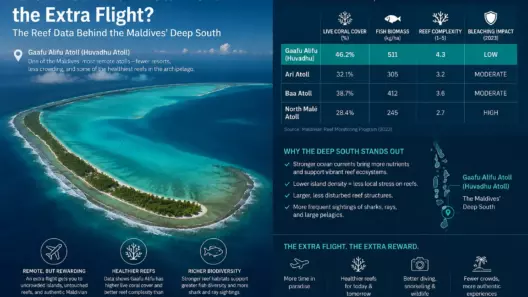
On coral condition, honestly. The 2024 bleaching event was the most extensive on record globally, and the Maldives recorded sea surface temperatures around 31.5 °C. Research published in Coral Reefs found a pronounced north–south gradient: live hard coral cover in the central atolls fell by more than 40% on average, while reefs in the far-southern Huvadhu Atoll showed no detectable mortality and in places gained cover. That study did not survey Laamu directly — Laamu sits between the two surveyed zones — so treat the gradient as a reason for cautious optimism rather than a guarantee. What is documented is that MUI ran its first major post-bleaching coral planting dives in Laamu in mid-2025, combining fragment and larval methods.
If you want a diving destination where you can watch a reef being actively rebuilt and ask the people doing it what’s working, there are very few better options anywhere.
Where to stay in Laamu Atoll: resorts, guesthouses and what each costs
Another correction worth making: you will read constantly that Six Senses is “the only resort in Laamu.” That was true for years and isn’t any more. It is the only five-star resort in the atoll.
| Property | Island | Level | Rough nightly rate |
|---|---|---|---|
| Six Senses Laamu | Olhuveli | 5★ eco-luxury | Rarely below $1,000, often $1,400+ |
| Rahaa Resort | Kudafares | 4★, saltwater lake, all-inclusive | Mid-range |
| Reveries Maldives | Gan (Link Road) | 4★ dive-focused | Mid-range |
| The Maverick Surf and Dive | Mundoo | 3.5★ boutique, surf/dive | Lower mid-range |
| Guesthouses | Gan, Fonadhoo, Hithadhoo, Maamendhoo, Mundoo | Local island | ~$40–110 |
The guesthouse route deserves more attention than it gets. Laamu’s inhabited islands have not been reshaped by mass tourism the way Maafushi or Dhiffushi have. You get local restaurants, a working harbour, dhonis unloading the day’s catch, and — thanks to the Link Road — the ability to actually move around. Alcohol is not served on inhabited islands, and you’ll be on a locally-used beach unless the guesthouse has a designated tourist beach; both are normal, and both should be confirmed before booking.
The full cost of the luxury option, assembled: two adults, seven nights at Six Senses in a beach villa, plus $1,209 per person round-trip seaplane, plus the Maldives green tax at $12 per person per night, plus service charge and GST. Do that arithmetic before comparing headline rates with a Baa Atoll property forty minutes from Malé.
Who Laamu Atoll is right for — and who should book elsewhere
Come to Laamu if:
- you are staying seven nights or more
- surfing or diving is the point of the trip, not a side activity
- you’d rather spend an afternoon in a research lab than by a pool
- you want to combine a resort stay with local islands, ruins and a bike ride across a causeway
- you understand that seagrass in the lagoon is a feature, not a defect
Don’t come to Laamu if:
- you have a short trip, or an evening arrival into Malé you can’t change
- the visual perfection of the lagoon is what you’re paying for
- you want choice — one atoll, a handful of properties, and no ability to switch if it doesn’t suit
- you’re comparing purely on price per night (the transfer changes the arithmetic entirely)
- you need reliable flat-calm water year-round for young children or nervous swimmers
The most common Laamu regret is not “it wasn’t beautiful.” It’s “we lost two days getting here and back, and we’d only booked five.”
Best time to visit Laamu Atoll
- December–April — dry season. Calmest seas, best underwater visibility, most reliable weather. Best for divers, snorkellers, families. Surf is unreliable.
- May–September — surf season. The southwest monsoon delivers consistent swell to Yin Yang and Machines. More rain, more wind, more chop. Best for surfers.
- April and October — shoulder. The genuine compromise months: some swell, still decent conditions, lower rates. April in particular tends to suit improving intermediates who don’t want the season’s biggest days.
There is no month that is optimal for both surfing and glass-flat visibility. Decide which one you’re actually travelling for, and book that.
Laamu Atoll FAQ
How long does it take to get to Laamu Atoll from Malé? About 40–55 minutes by domestic flight to Kadhdhoo plus a 15–45 minute onward transfer, or roughly 65 minutes by direct seaplane to Six Senses Laamu. Add terminal waiting time, which can be substantial.
Is Yin Yang a left or a right? Predominantly a long right-hander at the mouth of a channel on Laamu’s southern edge. It suits intermediate to advanced surfers; the inside section is fast, hollow and shallow.
Can you visit the Star Wars filming location in Laamu? Yes, by boat charter — Baresdhoo, Kudafushi and Kudarah are uninhabited islands. But nothing from the production remains on site. It’s a pleasant excursion, not a destination.
Is Six Senses Laamu the only resort in Laamu Atoll? No. It’s the only five-star property. Rahaa Resort, Reveries Maldives and The Maverick also operate in the atoll, alongside guesthouses on several inhabited islands.
Why does the water at Six Senses Laamu look darker than other Maldives resorts? Protected seagrass meadows. The resort has conserved over 335,000 m² of seagrass since 2017 rather than removing it, which draws turtles, rays and sharks close to the villas — at the cost of the classic uniform-turquoise lagoon.
Is Laamu Atoll good for a first Maldives trip? Usually not. First-time visitors generally want proximity, choice and the postcard lagoon. Laamu offers none of those. It’s an excellent second or third Maldives trip.
The verdict
Laamu Atoll is not a top Maldives destination in the general sense, and the atoll is better for it. It’s a top destination for surfers who want empty reef breaks, for divers who want year-round mantas and a front-row seat on active coral restoration, and for travellers who find a 12th-century copper plate and a seagrass survey more interesting than a swim-up bar.
Everything Laamu offers is downstream of one fact: it’s far away, and it stays that way because most people won’t make the trip. That’s the deal on offer. Take it deliberately, with seven nights and a daytime arrival into Malé, and it’s one of the most rewarding weeks in the Indian Ocean. Take it casually, and you’ll spend a lot of money to be mildly disappointed in paradise.