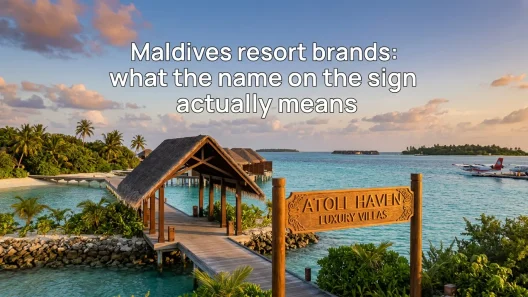
Resort Brands in the Maldives: The Name on the Sign Is a Contract
A branded resort in the Maldives is frequently not owned by the brand. It is owned by somebody else — often a Maldivian company, sometimes an investment vehicle — and operated under a management agreement that runs for a fixed term. Which means the name on the arrival jetty is a contract…
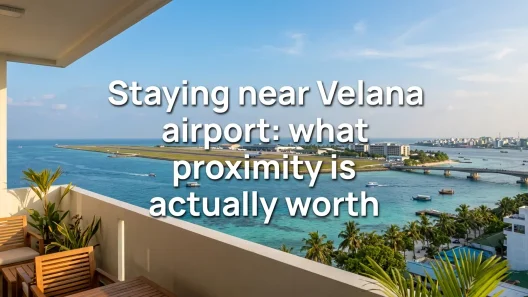
Maldives Resorts Near the Airport: On a Short Trip, the Transfer Is a Quarter of It
A ninety-minute boat each way costs three hours. Add the wait at the terminal, the counter, the luggage and the crossing itself, and a distant resort takes most of the arrival day and most of the departure day. On a two-week trip that is a rounding error. On a four-night trip it is a quarter…
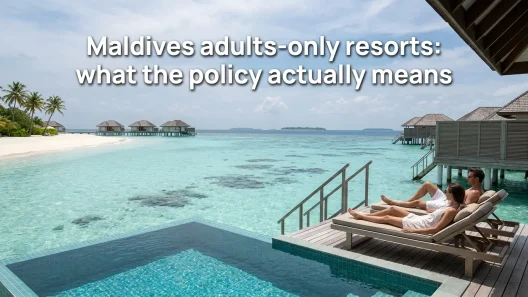
Adults-Only in the Maldives: Quiet Is Density, Not a Policy
Adults-only sounds like a single thing. It is at least three, with age thresholds ranging from twelve to eighteen depending on the property, and some islands apply the rule in parts rather than in whole. More usefully: if what you want is quiet, an age policy is a poor proxy for it. A dense…
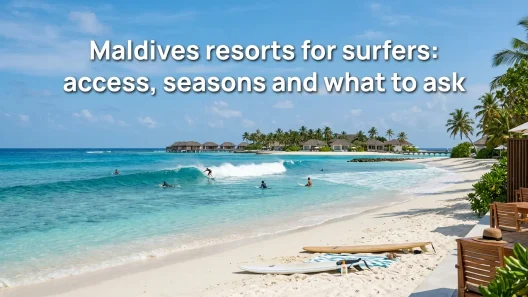
Choosing a Maldives Resort for Surfing: Where You Sleep Decides What You Surf
In every other category on this site, the property is a place to stay and the water belongs to everybody. Surfing is the exception. Two of the best-known waves here sit in front of resorts that control access to them, and the only way to surf either is to be a guest. Several more are…
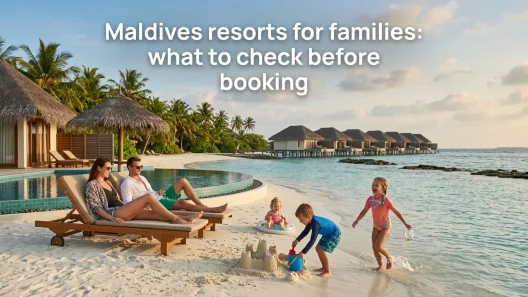
Choosing a Maldives Resort for a Family: The Lagoon Matters More Than the Kids’ Club
Every family-focused review of Maldivian resorts leads with the kids’ club. That is a room with staff in it, and most properties have a decent one. What actually decides a family week is the water at the end of the beach. Whether a five-year-old can stand up in it, whether the entry is…

Choosing a Maldives Resort for Diving: Ask the Dive Centre, Not Reservations
The reservations desk will tell you the resort has a five-star dive centre. Every resort has a five-star dive centre. What decides a diving week is not the centre’s certification but its geography and its operation. How many sites sit within thirty minutes, how many boats run, how many…

Luxury Resorts in the Maldives: Space First, Villa Last
A resort island in the Maldives costs anywhere from USD 350 a night to USD 10,000. The reef is the same reef, the fish are the same fish, and the light at seven in the morning is identical at both ends. So the useful question is not whether the top of the market is worth it, which depends on…

Budget Resorts in the Maldives: All-Inclusive Excludes More Than It Includes
“All-inclusive” is the most misleading phrase in Maldivian pricing, and not because properties lie. It means something different here than in the Caribbean, and nobody explains the difference before you book. On an island where the resort is the only restaurant and the only bar,…

The Hotel That Moves: Liveaboards in the Maldives
Every resort in this country has the same structural weakness: when the wind turns, the island cannot follow it. A liveaboard can. If the current reverses or the swell builds on one side of an atoll, the boat sails overnight to the sheltered side and the week continues. That single…

Resort Island Size in the Maldives: Count the Villas, Measure the Island
Two resorts at the same price, in the same atoll, with the same house reef, can feel completely different. The reason is usually density. One is 400 metres long with 60 villas. The other is 1,200 metres long with 60 villas. The first is a property where you know the staff by day three and…

Choosing a Resort by Its House Reef: Read the Colour of the Water
Every resort in the Maldives says it has a house reef. The phrase is never defined and covers four completely different situations, one of which is a sandy lagoon with the water you came for four hundred metres away. Nobody will tell you which one you are booking. But you can find out in…

Choosing a Local Island in the Maldives: Not a Ranking
There is no best local island, and anyone who publishes a numbered list of them is ranking communities against each other on criteria they have not stated. What there is: about a dozen inhabited islands with enough tourism infrastructure to stay on comfortably, each with a different reason…
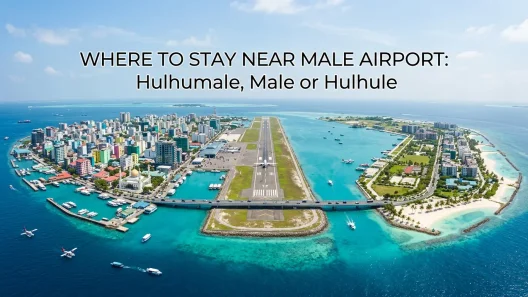
Hotels in Malé and Hulhumalé: The Night Nobody Books
Roughly half of visitors to the Maldives end up spending a night near the airport, and almost none of them planned to. The reason is arithmetic. Seaplanes fly in daylight only and stop between about 15:30 and 16:00, and immigration takes 75 to 90 minutes at peak. Land after roughly 14:00 and…

Guesthouses in the Maldives: A Room in a Village
Until 2009 you could not do this. Tourists stayed on uninhabited resort islands and Maldivians lived elsewhere, and the separation was deliberate policy. Then guesthouses on inhabited islands were legalised and a second Maldives opened. Rooms from about USD 60 a night, meals at USD 5 to 13,…

Overwater Villa or Beach Villa: The Water Underneath Is Probably Sand
The overwater villa is the photograph that sells the Maldives, and it costs 40 to 100 per cent more than the beach villa forty metres away. What almost nobody checks before paying that premium is what the water underneath actually contains. At most resorts it is sand. The jetty runs out over…

Where to Stay in the Maldives: You Are Choosing an Island, Not a Hotel
Everywhere else, if the hotel disappoints you, you walk out and eat somewhere else. Here you cannot. A Maldivian resort occupies its entire island, and the property you booked is the only restaurant, the only bar and the only company for the length of your stay. That is the fact that should…

What Maafushi Maldives Is Really Like: Bikini Beach, Honest Prices and the Rules Nobody Warns You About
Type “Maafushi Maldives resort” into a search box and the results will happily sell you one. There is no resort on Maafushi. The island is a working Maldivian town of roughly 4,500 people, with a mosque, a school, a harbour, a prison and around fifty guesthouses stacked along…