Choosing a Maldives Resort for Surfing: Where You Sleep Decides What You Surf
In every other category on this site, the property is a place to stay and the water belongs to everybody. Surfing is the exception.
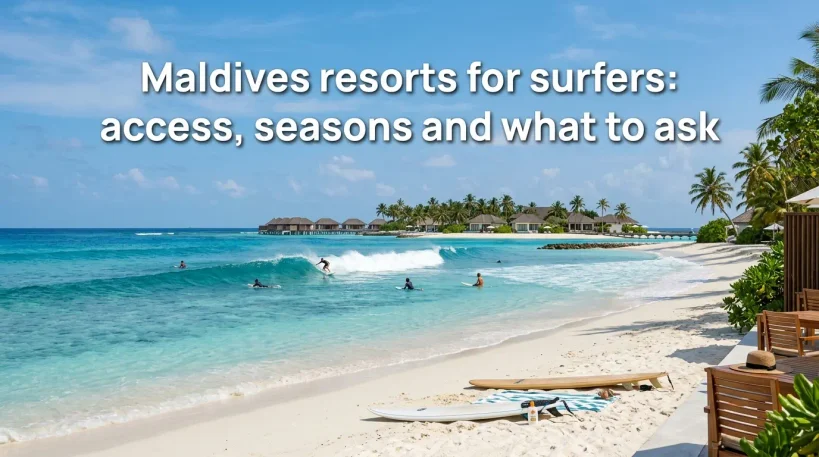
Two of the best-known waves here sit in front of resorts that control access to them, and the only way to surf either is to be a guest. Several more are reachable only by boat. The wave you get is decided at the booking stage, not at the beach.
This guide covers which properties give access to what, what to ask before booking, and why a guesthouse island frequently beats a resort for anyone who just wants to surf a lot.
The access problem, stated plainly
Most Maldivian waves are public. Anybody with a boat can surf them, and boats are available from resorts, guesthouse islands and charters.
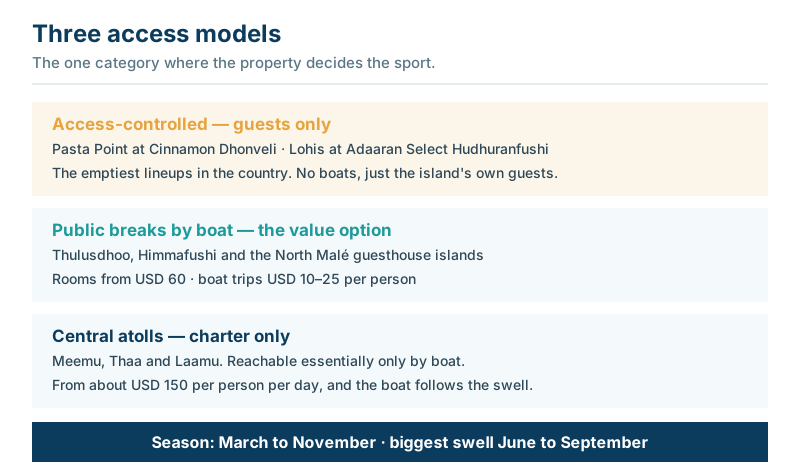
Two are not. Pasta Point and Lohis are access-controlled by the resorts they sit in front of — Cinnamon Dhonveli and Adaaran Select Hudhuranfushi respectively. Guests surf them; non-guests do not.
This site names those two properties, against its general rule of naming nobody, because the arrangement is structural rather than commercial. It is a fact about access rather than a judgement about quality, and it does not date the way a recommendation would.
What that produces is the emptiest lineups in the country. A wave with a fixed number of surfers on it, all of them staying on the same island, is a different sport from a wave with six boats parked on it.
Whether it is worth the room rate depends on how much an uncrowded wave is worth to you, which is a personal calculation this article cannot make.
One correction while we are here: Pasta Point is a left. A remarkable number of published guides call it a right, and our surfing guide sets out the full break-by-break picture.
The three regions
Access works differently in each, and the region decides the trip before the property does.
North Malé Atoll. The most accessible surf in the country: a cluster of reef breaks within a short boat ride of each other, served by resorts, by guesthouse islands and by day boats from the capital area. This is where most first Maldivian surf trips happen, and where the two access-controlled waves are.
The central atolls. Meemu, Thaa and Laamu — consistent, uncrowded and reachable essentially only by boat. A surf charter is the realistic way to surf them, and it is the strongest argument for the boat format anywhere in this country.
The southern atolls. Huvadhu, Addu and the far south, reached by domestic flight, with the emptiest waves and the smallest number of properties. Our domestic airlines guide covers getting there.
Which to choose. North Malé for a first trip or a short one. The central atolls by boat for the most waves per day. The south for emptiness, at the cost of a travel day each way.
The regional detail
Where the waves actually are, by area rather than by property.
North Malé carries the best-known names — Cokes, Chickens, Jailbreaks, Sultans, Honkys, Pasta Point and Lohis — within a compact area reachable from Kaafu properties and from the guesthouse islands. Our surfing guide sets out each break’s direction, level and access.
South Malé has fewer named breaks and correspondingly fewer boats — the regional guide covers what is there.
The central atolls are boat country, and the reason a charter is the format that unlocks them.
The southern atolls work best in the shoulder months and carry almost nobody, at the cost of a domestic flight each way.
And what does not vary by region: the bottom is reef everywhere, the season is the southwest monsoon everywhere, and the crowds follow access rather than quality. A mediocre wave with easy access is busier than a good one without it — which is the whole logic of this article in one sentence.
The guesthouse island alternative
The option that beats a resort on most measures, and it is not close.
Thulusdhoo sits beside Cokes and Chickens, two of the best-known waves in North Malé, with a guesthouse scene, board hire and boats to the surrounding breaks at USD 10 to 25 per person.
Himmafushi gives access to Jailbreaks and is quieter.
What you get: rooms from about USD 60, meals at USD 5 to 13, and boat trips at a fraction of resort excursion prices — the comparison is in our guesthouse guide and our excursion price guide.
What you give up: the two access-controlled waves, alcohol, and the resort infrastructure.
Which means the honest recommendation for most surfers is a guesthouse island, unless the specific wave you want is one of the two — in which case the resort is the only route and the room rate is the ticket price.
The bikini beach rule applies on inhabited islands, as our guide to dress codes explains, and boardshorts are fine everywhere while everything else is beach-only.
What to ask a property
Seven questions, and they are different from the ones a diver asks.
1. Which breaks are within thirty minutes by boat? Names, not “several excellent waves nearby”.
2. How many boat trips a day, and at what cost? Two a day included is a surf resort. One a day chargeable is a resort with a boat.
3. Is the boat schedule tide-led or clock-led? Reef breaks work on specific tides, and a boat that leaves at nine regardless is a boat that misses half the sessions.
4. Is there a surf guide, and do they read the forecast? A guide who calls the day based on swell and wind is worth more than any facility.
5. Board storage, and is there ding repair on the island? A cracked board on day two with no repair is a week over.
6. Board hire — what is the quiver, and what condition is it in? Bringing boards is expensive; hiring bad ones is worse.
7. What is the wave in front of the property, and who can surf it? The access question, asked directly.
And one more: what happens on flat days? Every surf trip has them, and the answer tells you whether the property has anything else.
The season, briefly
Surf here runs on the southwest monsoon and the swell it generates in the southern Indian Ocean.
March to November is the season, with the biggest and most consistent swell from June to September.
April, May and October are the shoulders: smaller, cleaner, and better for anyone who does not want overhead reef waves.
December to February is the flat season for most breaks. Some southern spots still work.
And the wind matters as much as the swell. The full month-by-month picture is in our surf season calendar, and the mechanism behind both is in the monsoon guide.
Book the season, then the property. A perfect resort in February is a resort with a pool.
What a surf day looks like
Set out because the rhythm is unlike any other trip in this country.
The tide decides everything. A break that works two hours either side of high water works at six one morning and at ten the next, and the schedule moves through the week.
Dawn patrol is real here, and the first boat frequently leaves before breakfast. Properties that serve an early breakfast or a packed one are the ones that understand their guests.
Two sessions a day is normal in season, with the middle of the day too hot and frequently too windy — the wind pattern is in our rainy day guide, which explains why wind rather than rain cancels things here.
The gap between them is four or five hours. A good house reef, a hammock and something to read matter more here than on any other kind of trip.
Evenings are early. Two sessions on reef waves at the equator is a full day, and the island is asleep by ten.
And flat days happen. Even in July there are mornings with nothing, which is the argument for a base that has something else — a reef to snorkel, a village to walk, or a boat that can go looking somewhere further.
Who should be here
The honest assessment, because the Maldives is not a beginner destination.
Every wave breaks over reef. There is no sand-bottomed beach break anywhere in the country. A fall means reef, and reef cuts infect quickly in warm water.
The majority of breaks suit intermediate and better. Confident on overhead waves, comfortable duck-diving, and able to get out of trouble without a lifeguard — because there are none anywhere in the Maldives, as our safety guide sets out.
There are gentler waves, particularly in the shoulder months, and there are surf schools. A complete beginner is better served learning somewhere with a sand bottom and coming here later.
Booties are worth bringing. Opinions differ, and the reef entries at several breaks make the argument for you — the reef in question is described in our reef health guide.
A helmet is not unusual at the shallower spots, and nobody will think anything of it.
And bring a first aid kit with antiseptic. Coral cuts are the injury of a Maldivian surf trip, they need cleaning the same day, and medical facilities on a small island are limited — see our comparison of the two island types.
Crowds, and what access buys
The variable that decides how a session feels, and it is the whole argument for the resort option.
A public wave in season carries boats. Six boats on a break is thirty surfers, and the good sets go to whoever paddles hardest.
An access-controlled wave carries the island. However many guests the property has who surf — frequently a dozen — and no boats.
Which is what you are buying, and it is a real product rather than a marketing claim.
The guesthouse islands are somewhere in between: more crowded than a private wave, considerably less crowded than a boat-served break in July, and a fraction of the price.
And the central atolls by charter are the emptiest of all, because access requires a boat and a week.
The non-surfing partner
The same problem as the diving article, with one difference.
Surf days are tide-led, not clock-led, which means the schedule moves through the week and nobody can plan around it.
Which is harder on a partner than a diving trip, where the boat leaves at seven every morning.
What helps: a property with a good house reef for snorkelling, a spa, and enough on the island to fill a shifting timetable — our activities overview covers what a week can hold.
A guesthouse island helps more than a resort here, because there is a village, other people and things happening that are not organised around the tide.
And the honest structure: surf the good tides, not every tide. A partner who gets three afternoons is a partner who enjoys the trip.
What it costs
| Typical | |
|---|---|
| Guesthouse island room | From USD 60 a night |
| Boat trip to a break, guesthouse island | USD 10–25 per person |
| Surf resort, room | From USD 350 a night, higher at the access-controlled properties |
| Resort boat trips | Frequently included at surf-focused properties, otherwise USD 40–100 |
| Board hire | USD 20–35 a day |
| Surf charter | From about USD 150 per person per day, all in |
| Board carriage on flights | Airline-dependent, and check before booking |
Resort prices carry the 28.7% in service charge and tax, as our guide to money in the Maldives explains. Guesthouse island prices largely do not.
The value comparison: a week on a guesthouse island with daily boat trips costs a fraction of a week at a surf resort, and delivers more sessions in most conditions.
What the resort premium buys is the uncrowded wave and the certainty of it. That is the whole trade.
Boards, and getting them there
The logistics that catch people out.
Board bags are charged by most airlines on the international leg, at rates that vary enormously. Check before booking the flight, not after.
Seaplanes are the constraint. The baggage allowance is 20 kg checked plus 5 kg cabin, boards are carried at the operator’s discretion and at extra cost, and space is genuinely limited — the rules are in our guide to seaplane baggage.
Which is another argument for speedboat-served properties and guesthouse islands, where boards travel without a conversation.
Hire is viable at the established bases — Thulusdhoo and its neighbours among them — at USD 20 to 35 a day.
Bring your own leash and fins even if you hire a board. They weigh nothing and rental sets are tired.
And ding repair. Ask whether the island has it. On a guesthouse island somebody usually does; on a small resort, frequently nobody.
A charter instead
The format that solves the access problem differently.
A surf charter is a liveaboard with boards instead of tanks, running the central atoll breaks that no property can reach.
The flexibility argument is stronger for surfing than for diving. Swell direction and wind both move, and a boat follows them; a resort surfs what is in front of it.
Costs from about USD 150 per person per day including cabin, meals and the boat.
Who it suits: intermediate and better, groups who can charter a whole vessel, and anyone who wants the maximum number of empty waves in a week.
Who it does not: non-surfing partners, anyone prone to seasickness, and beginners.
And the same no-fly caution does not apply — surfers have no decompression interval, which makes the last day of a surf charter a surfing day rather than a dry one.
Booking, and when
Surf trips book differently from every other kind of Maldives trip.
The access-controlled properties fill for the peak swell window — June to September — a long way ahead, because a fixed number of surfers can be on the island at once and repeat guests rebook before leaving.
Six to twelve months for those, and shorter for everything else.
Guesthouse islands book weeks rather than months ahead, outside the December to April tourist peak — which is conveniently the flat season anyway, on the pattern in our high and low season guide.
Charters book furthest of all, and the good boats for the peak months go a year out.
Check the transfer before paying. A speedboat property lets you arrive at any hour; a seaplane one commits you to a daylight window and a conversation about boards — and a late arrival means a night in Hulhumalé, as our guide to missed connections explains.
And a note on flat weeks. Nobody refunds swell. A surf trip is a bet on a forecast that does not exist yet — an argument for a longer trip, and for a base with something else to do, whether that is diving or a village.
One more thing about the two waves
Worth closing on, because it is the decision this article exists to inform.
An access-controlled wave is a genuine product and it is also a narrow one. You are buying a specific break, in a specific place, in whatever condition the swell delivers that week.
If it is flat, you have paid a premium for exclusivity you cannot use. The property is still a good one, and not the one you would have chosen otherwise.
Whereas a boat-served base gives you options. If the wave in front is not working, the boat goes somewhere else — which is the same argument our liveaboard guide makes about following the weather.
Which produces the honest summary: book the access-controlled property if that specific wave is the trip, and accept the risk. Book a boat-served base — resort or guesthouse island — if surfing a lot matters more than surfing one thing.
Most people, most of the time, want the second one.
Questions travellers ask
Which Maldives resorts have their own surf break? Two waves are access-controlled by the resorts in front of them: Pasta Point at Cinnamon Dhonveli and Lohis at Adaaran Select Hudhuranfushi. Guests surf them and non-guests do not, which produces the emptiest lineups in the country.
Do I need to stay at a resort to surf in the Maldives? No. Most waves are public and reachable by boat from guesthouse islands such as Thulusdhoo and Himmafushi, at a fraction of resort prices. Only the two access-controlled waves require a specific property.
When is the surf season? March to November, with the biggest and most consistent swell from June to September. April, May and October are smaller and cleaner. December to February is flat for most breaks.
Is the Maldives good for beginners? Not especially. Every wave breaks over reef, there is no sand bottom anywhere, and most breaks suit intermediate and above. Learn somewhere with a sand bottom and come here afterwards.
How much does a surf trip cost? A guesthouse island runs from USD 60 a night with boat trips at USD 10 to 25. A surf resort starts around USD 350 a night plus the 28.7% service charge and tax. A charter runs from about USD 150 per person per day all in.
Can I bring my own boards? Yes, with two cautions: airlines charge for board bags at varying rates, and seaplanes carry them at the operator’s discretion within a 20 kg checked allowance. Speedboat-served properties avoid the problem.
What should I ask a surf resort? Which breaks are within thirty minutes, by name. How many boat trips a day and at what cost, whether the schedule is tide-led or clock-led, and whether there is ding repair on the island.
Resort or charter? A resort for the access-controlled waves and a partner-friendly week. A charter for the central atolls, the most empty waves, and the ability to follow the swell.
What to take away
- Surfing is the one category where the property decides the sport. Two waves — Pasta Point and Lohis — are surfable only by guests of the resorts in front of them.
- For everyone else, a guesthouse island beats a resort: rooms from USD 60, boat trips at USD 10 to 25, and more sessions per dollar than any property.
- Ask whether the boat schedule is tide-led or clock-led. A boat that leaves at nine regardless misses half the sessions.
- Every wave breaks over reef and there is no sand bottom anywhere in the country. This is not a beginner destination.
- Book the season first — March to November, biggest June to September. A perfect surf resort in February is a resort with a pool.
Next step: decide whether an uncrowded wave is worth a resort room rate. If it is, the two access-controlled properties are the entire shortlist. If it is not, book Thulusdhoo, take a boat every morning, and spend the difference on a longer trip.