

What a Maldives Seaplane Transfer Really Costs — and Why You Cannot Book One Yourself
Vakkaru Maldives charges $950 per adult for a return seaplane transfer. The same published terms state that the resort is not responsible for any cancellation or delay, and that the charge is non-refundable. Both sentences sit on the same page, and the gap between them is the part almost nobody explains before you pay.
A Maldives seaplane transfer is not a flight you have booked. It is capacity your resort has chartered, resold to you, and priced at whatever the property decides. You hold no ticket, no booking reference, and none of the passenger rights that come with a scheduled airline. This guide covers what a seaplane transfer costs across the market in 2026, which of the three operators will actually fly you, how the booking sequence and its deadlines work, and what happens to your money when the weather closes in.
What Your Seaplane Transfer Fee Actually Buys — and What It Does Not
Every seaplane transfer in the Maldives runs on a charter arrangement between an operator and a resort. The resort books the seats, the resort sets your price, and the resort bills you. The operator’s customer is the hotel, not the guest.
That structure explains almost every frustration travellers report. You cannot compare fares, because no fare is published for your route. You cannot switch operators, because your resort’s contract already decided that. You cannot rebook yourself onto a later departure, because you were never issued a ticket to change.
It also explains the liability position, which is where the real cost of misunderstanding shows up. Amilla Maldives states plainly in its terms that departure timings are set externally and that the resort is not responsible for delays or cancellations to seaplane transfers. Vakkaru’s terms go further: seaplane charges are non-refundable, and cancelling on the day of arrival or failing to show incurs a 100% fee on the one-way charge.
Read those two positions together and the picture is clear. If the aircraft does not fly, the resort will help — and most do, genuinely — but the money is gone and the delay is yours to absorb.

The practical consequence is that your protection has to come from somewhere else. A comprehensive travel insurance policy, a same-airline booking on the international leg, and a deliberate buffer on departure day do more for you than any conversation with the operator will.
Three Operators Fly These Routes, Not Two
Most guides name two seaplane transfer operators, Trans Maldivian Airways and Manta Air, and stop there. There is a third, and it matters because its rules are different.
Trans Maldivian Airways: the incumbent
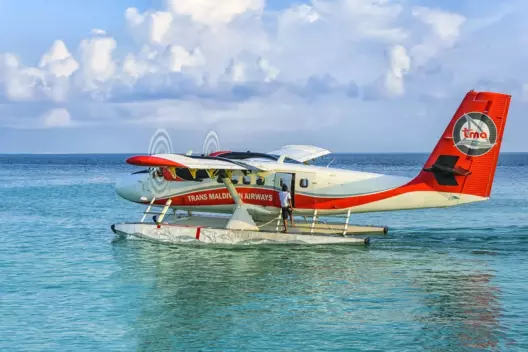
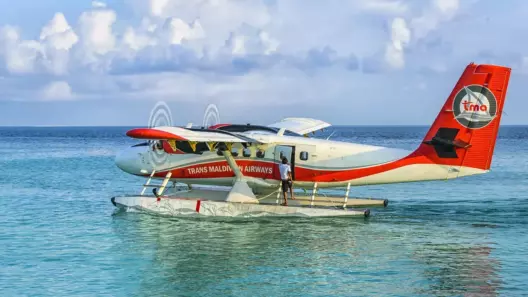
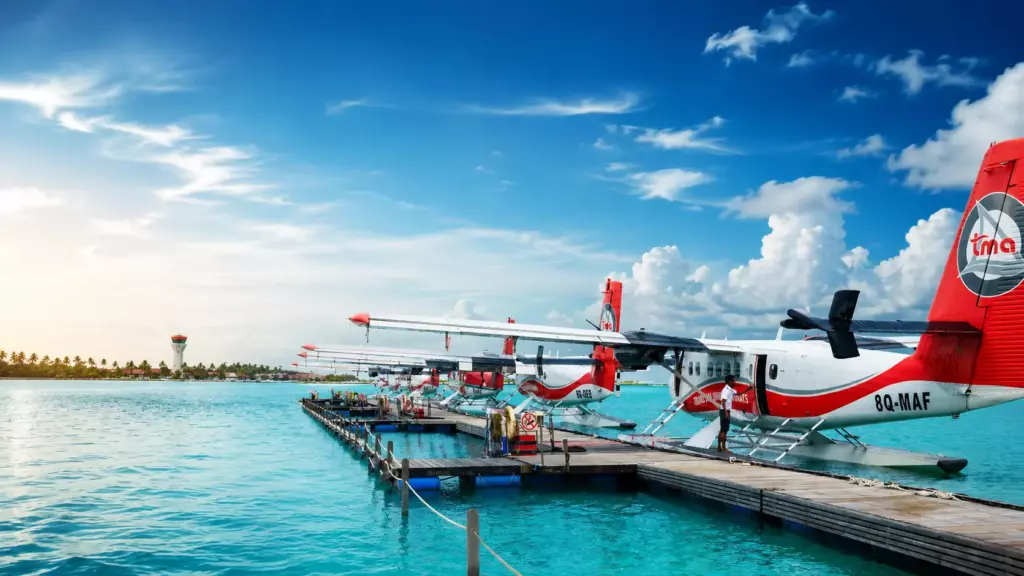
Trans Maldivian Airways is the largest seaplane operator in the world by fleet and by passengers carried. The airline took delivery of its 66th de Havilland Canada DHC-6 Twin Otter in January 2026 and connects more than 80 resorts across 16 atolls, running over 400 flights on a typical day. Thirteen aircraft carry resort liveries and two are configured for VIP use.
Its history is older than the industry it serves. The company began in 1989 as Hummingbird Island Helicopters, added its first seaplane in 1997, completed the switch to a float-only fleet by 1999, and took the Trans Maldivian name in 2000. In 2013 it merged with rival Maldivian Air Taxi under Blackstone ownership.
The ownership chain since then is worth knowing, because it shapes pricing. Bain Capital led a consortium that bought the airline in December 2017 in a deal reported at over $500 million. After the pandemic grounded most of the fleet, Carlyle Group took majority control in July 2021 through a restructuring of roughly $300 million of debt, alongside King Street Capital Management and Davidson Kempner. A business carrying that kind of leverage, holding near-monopoly access to most resort lagoons, has little reason to discount.
Manta Air: the scheduled challenger
Manta Air ferried its first two Twin Otters 16,000 km from Calgary in October 2019 and began seaplane operations that November. Its distinguishing move was publishing seaplane timetables, so a guest could know a departure time in advance rather than waiting for a call the night before.
One correction is due here. A claim repeated across travel sites credits Manta Air with the world’s first scheduled seaplane service. That is not accurate. Harbour Air in British Columbia introduced scheduled seaplane service in 1984, roughly thirty-five years earlier, and today runs up to 300 scheduled departures a day. Manta Air’s achievement was real but national: it was the first operator to bring published schedules to the Maldives.
Maldivian: the state carrier nobody mentions
Maldivian, operated by Island Aviation Services, has flown seaplanes since 2014 and lists eleven DHC-6-300 floatplanes in its fleet. It sells scheduled seaplane seats across Raa, Baa, Noonu, North Ari, Vaavu and Meemu, and offers discounted resident fares.
Its baggage rule is the reason it belongs in this article. Maldivian allows 15 kg per seat-occupying passenger, inclusive of carry-on. Trans Maldivian and Manta Air both publish 20 kg checked plus 5 kg cabin. Anyone who packs to the widely quoted 25 kg figure and then flies Maldivian is 10 kg over before they reach the scale.
The airline has also signed a letter of intent with De Havilland Canada for two Twin Otter Classic 300-G aircraft, which would make it the first operator of that variant in the country.

Seaplane Transfer Costs in 2026 and What Really Sets the Price
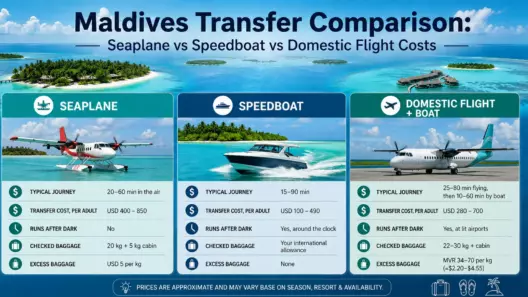
Across the market, a shared return seaplane transfer runs roughly $300 to $820 per adult. That band is wider at the bottom than most guides admit — several publish $450 as the floor, which quietly writes off the cheaper short hops to closer resorts.
Named 2026 examples give the band some shape. W Maldives quotes around $720 per adult return. Conrad Maldives Rangali Island charges about $700 per adult, with a 30% low-season reduction between April and September. The St. Regis Maldives Vommuli sits near $745. Vakkaru charges $950 for adults and $475 for children. At the top, Raffles Maldives Meradhoo has been quoted at $1,450 per adult, rising to $1,980 over the festive period.
Price tracks the room rate, not the distance
Here is the counterintuitive part. In normal aviation, a longer flight costs more. In the Maldives, the seaplane transfer price tracks the nightly rate of the resort far more closely than it tracks flying time.
Dividing published return fares by typical round-trip flight minutes makes the pattern visible:
| Resort (atoll) | Typical one-way flight | Return fare per adult | Cost per minute flown |
|---|---|---|---|
| Conrad Rangali (South Ari) | ~25 min | ~$700 | ~$14 |
| W Maldives (North Ari) | ~25 min | ~$720 | ~$14 |
| St. Regis Vommuli (Dhaalu) | ~40 min | ~$745 | ~$9 |
| Vakkaru (Baa) | ~30 min | ~$950 | ~$16 |
Flight times are indicative operator ranges, not published timetables; fares are the resorts’ quoted 2026 rates and move with season.
The furthest resort in that group is the cheapest per minute. The nearest-but-one is the most expensive. Distance is not doing the work — brand positioning is.
The practical takeaway is blunt: when two resorts in the same atoll quote seaplane transfer prices $200 apart, the gap is a pricing decision, not a fuel bill. It is a legitimate factor when you compare two properties you otherwise like equally.
Children, infants and the seasonal loading
Child pricing is more consistent than adult pricing. Children aged roughly 2 to 11 typically pay 30–50% less than the adult fare, and infants under two travel free on a parent’s lap. Vakkaru’s $475 child rate against a $950 adult rate is a clean 50% example.
Two loadings catch people out. Peak-season premiums apply through the northeast monsoon months, and festive-period rates over Christmas and New Year can approach double the standard fare. If your travel dates fall in the last week of December, ask for the seaplane transfer quote for those exact dates rather than the published annual rate.
Watch the word “included”
Some resorts genuinely bundle the seaplane transfer, and a handful of 2026 promotions give a complimentary return seat on stays of four nights or more. Others describe the transfer as “arranged” or “organised”, which means only that they will book it and add it to your folio.
Ask one question in writing: is the return seaplane transfer for every travelling guest included in the rate I am quoted, with no separate charge on departure? An answer that avoids the word “included” is an answer.

Booking Sequence, Deadlines and the Penalty for Missing Them
Because you are not the airline’s customer, booking a seaplane transfer means supplying information on time and approving a charge. The sequence is the same almost everywhere.
- Reserve the resort. The property’s operator contract is now fixed. If a specific operator matters to you, this is the only moment it can be influenced.
- Send your international flight details. Full passenger names as printed in passports, flight numbers, and arrival and departure times.
- Meet the deadline. Most resorts want this 48 to 120 hours before arrival. Vakkaru specifies no later than 96 hours. Missing it does not cancel your holiday, but it moves you to the back of the loading queue.
- Receive the seaplane transfer confirmation. Usually 24 to 48 hours out. With Trans Maldivian’s on-demand loading model, your actual departure time is often confirmed only the evening before.
- Pay. Some resorts prepay with the room, others post the charge to your folio at checkout.
The penalty clause deserves attention. Cancelling a seaplane transfer on the day of arrival, or simply not turning up, attracts a 100% charge on the one-way fare under Vakkaru’s published terms — with an exception carved out for airline changes outside the guest’s control. If your international flight is delayed and you decide to abandon the seaplane transfer, tell the resort before your original arrival time, not after.
The Daylight Window That Decides Your Arrival Day
Seaplanes operate under visual flight rules and do not fly after dark. Departures run from roughly 06:00 to somewhere between 16:00 and 16:30, and the practical cutoff for a same-day seaplane transfer is an international landing at Velana International Airport by 14:00.
On the way home the arithmetic reverses. Resorts generally require international departures to be scheduled after 09:00 so the morning seaplane can get you back with time to check in. Vakkaru states this explicitly; most seaplane properties apply a similar rule.
Our full transfers guide covers the overnight-in-Malé scenario in detail, so this section stays short deliberately. The one point worth adding here concerns the return leg, which is consistently under-planned. A seaplane that lands you at Velana at 11:00 for a 22:00 flight leaves eleven hours to fill, and most international check-in desks open only three hours before departure. Book a day room or a lounge, or accept a long afternoon in the terminal.
When Weather Grounds the Fleet: Your Money and Your Connection
One widely repeated claim needs correcting. Several guides state that seaplanes are grounded immediately whenever it rains. That is wrong. Visual flight rules set minimum visibility and cloud-clearance requirements, not a ban on precipitation, and Maldives floatplanes fly through rain routinely. What stops them is visibility collapsing, cloud sitting too low, or sea state making a lagoon landing unsafe.
Genuine mass disruption is uncommon but real. When it happens it tends to close both seaplane and speedboat operations at once, because the same wind and swell drive both decisions.
Two consequences follow, and they are the reason this section exists.
Your seaplane transfer fee does not come back. The resort’s terms say non-refundable, and in practice the seat is re-flown the next morning rather than refunded. Budget for an unplanned night near the airport in the same way you budget for the seaplane transfer itself.
Your international connection is your problem. Travellers have reported seaplane delays cascading into missed long-haul departures, and because the two journeys sit on separate tickets there is no protected connection. Rebooking means paying the change fee and any fare difference. Tell your airline before the departure time rather than after — a no-show is treated far more harshly than a change.
Three habits reduce the exposure. Take a policy that covers travel delay and missed departure rather than assuming the resort carries the risk. Leave a full day between your resort checkout and a non-refundable long-haul flight if the itinerary allows. And if your resort offers a domestic-flight alternative, ask whether it replaces the seaplane when floatplanes stop flying — fixed-wing services run at night and cope with weather that grounds a Twin Otter.

Baggage Allowances Differ by Operator — Including One That Catches Everyone
Weight matters more on a fifteen-seat floatplane than on a wide-body, and every seaplane transfer enforces the limit at the scale.
| Operator | Checked | Cabin | Total per adult |
|---|---|---|---|
| Trans Maldivian Airways | 20 kg | 5 kg | 25 kg |
| Manta Air | 20 kg | 5 kg | 25 kg |
| Maldivian | — | — | 15 kg inclusive |
Excess runs at roughly $5 per kilogram, usually settled at the terminal. A single bag is generally capped near 32 kg regardless of your total allowance. Infants under two get no separate baggage allowance.
Two practical points close this out. Hardshell suitcases fit the float hold badly, and when the geometry does not work your case travels on a later aircraft — normally the same day, occasionally the next morning. Soft duffels load reliably. Keep medication, documents and one change of clothes in your cabin bag on every seaplane transfer, without exception.
Inside Noovilu: The Wait, the Lounges and the Rule Nobody Warns You About
All three operators fly from the Noovilu Seaplane Terminal, inaugurated in October 2022 as a $55 million project. It spans 28,000 square metres across four storeys, with a floating dock able to hold more than 55 aircraft and over 40 lounges — most of them branded to individual resorts. Nationally, the seaplane fleet handles in the region of 600 flights a day.
The seaplane transfer wait averages around two hours and ranges from under one to about four. On Trans Maldivian’s on-demand model the aircraft loads once enough guests bound for your resort have cleared immigration, so a mid-morning landing can still mean an afternoon departure. Manta Air’s published schedules narrow that uncertainty, which is a genuine reason some travellers prefer its resorts.
Now the detail that surprises people at the worst moment: no alcohol is served anywhere in the seaplane terminal, including the most exclusive resort lounges. The Maldives prohibits alcohol on inhabited islands, and Hulhulé is one. If a celebratory glass on arrival is part of the plan, it starts at the resort jetty, not at Noovilu.
Your resort booking assigns the lounge. You do not choose it, and the property arranges premium lounge access rather than selling it at the door.
Which Atolls Need a Floatplane, and Where a Domestic Flight Beats One
A seaplane transfer serves the middle band of the archipelago — roughly 80 to 250 km from Malé. Closer than that, a speedboat is faster and cheaper. Further out, fixed-wing aircraft take over.
| Atoll | Usual mode | Typical seaplane time |
|---|---|---|
| North Malé / South Malé | Speedboat | 10–15 min where offered |
| North Ari / South Ari | Seaplane or speedboat | 20–30 min |
| Baa | Seaplane or domestic | 30–35 min |
| Vaavu / Meemu / Faafu | Seaplane or speedboat | 25–40 min |
| Dhaalu | Seaplane or domestic | ~40 min |
| Lhaviyani / Raa / Noonu | Seaplane or domestic | 45–60 min |
| Shaviyani / Haa Alifu / Haa Dhaalu | Domestic + speedboat | 60–70 min if flown |
| Thaa / Laamu | Domestic + speedboat | Rarely offered |
| Gaafu Alifu / Gaafu Dhaalu / Addu / Fuvahmulah | Domestic + speedboat | Not practical |
Where both options exist, the trade is straightforward. The seaplane is faster door to door and lands at your resort. The domestic flight runs after dark, handles marginal weather better, and lets a late international arrival reach the resort the same night. Our guides to Hanimaadhoo, Dharavandhoo and Maafaru cover the fixed-wing side in more depth.
Who Should Fly It, Who Should Skip It, and When It Does Not Work
It suits you if your international flight lands before 14:00, your resort sits in the middle band of atolls, and you want the aerial view of the reefs that no other transfer delivers. It also suits families with small children better than a long speedboat crossing, because the flight is short and smooth.
Think twice if you are tall, claustrophobic, or travelling with someone who is. The Twin Otter cabin has a low ceiling, fifteen tightly spaced seats, no toilet, and no air conditioning in flight — fans only, and it gets warm on the water before takeoff. Anyone above about 1.8 m will find a 60-minute sector long.
The seaplane transfer will not work at all if your arrival is after dark, your resort sits in the far north or far south, or your outbound international flight leaves before 09:00. In those cases the choice is made for you.
One more group deserves a mention: travellers on tight, non-refundable long-haul itineraries. If missing your flight home would be financially serious, a resort reachable 24/7 by speedboat removes the single largest timing risk in a Maldives trip.
What to Check Before You Approve the Seaplane Transfer Invoice
Five things decide whether this goes smoothly:
- The seaplane transfer is a resort product, not an airline ticket. No fare comparison, no rebooking rights, no refund if weather intervenes.
- Budget $300–$820 per adult return, with named properties running to $950 and beyond, and festive dates loading on top.
- Price follows resort positioning, not flying time. A $200 gap between neighbouring resorts is a commercial decision worth weighing.
- Three operators fly these routes, and Maldivian’s 15 kg inclusive allowance is 10 kg tighter than the figure most guides quote.
- Land by 14:00, depart after 09:00, and protect the return leg with insurance rather than optimism.
Your next step is a single email to your resort before you pay the balance. Ask for the exact return seaplane transfer cost for your travel dates, the operator, the child rate, the baggage allowance in kilograms, and whether a domestic-flight alternative exists if seaplanes are grounded. Five answers, one message — and the largest unbudgeted line in a Maldives holiday stops being a surprise.
Frequently Asked Questions
How much is a seaplane transfer in the Maldives? Expect roughly $300 to $820 per adult for a shared return seaplane transfer in 2026. Named examples include Conrad Rangali at about $700, W Maldives at about $720, and Vakkaru at $950. Ultra-luxury properties such as Raffles Meradhoo have quoted $1,450, rising to about $1,980 over the festive period. Children aged 2–11 usually pay 30–50% less and infants under two travel free.
Can I book a Maldives seaplane transfer myself? Not for a resort seaplane transfer. Seats are chartered by the resort under contract with the operator, and the resort reserves and bills them. Maldivian, the state carrier, does sell some scheduled seaplane seats directly, but resort transfers are still arranged through the property.
Which airlines operate seaplanes in the Maldives? Three operators run seaplane transfers. Trans Maldivian Airways took delivery of its 66th Twin Otter in January 2026 and serves over 80 resorts across 16 atolls; Manta Air, flying seaplanes since November 2019 and publishing scheduled timetables; and Maldivian, the national carrier, which has operated floatplanes since 2014.
What is the baggage allowance on a Maldives seaplane transfer? Trans Maldivian Airways and Manta Air both allow 20 kg checked plus 5 kg cabin per adult. Maldivian allows 15 kg per seat-occupying passenger, inclusive of carry-on. Excess is about $5 per kilogram and a single bag is capped near 32 kg. Soft bags load more reliably than hardshell cases.
What time do Maldives seaplanes stop flying? They operate in daylight only, roughly 06:00 to between 16:00 and 16:30. For a same-day seaplane transfer your international flight should land at Velana by 14:00. On departure day, international flights are generally required to leave after 09:00.
How long is the wait at the seaplane terminal? Around two hours on average, ranging from under one to about four. Trans Maldivian loads aircraft once enough guests for your resort have cleared immigration, so the wait varies. Manta Air’s published schedules make departure times more predictable.
What happens if my seaplane transfer is cancelled because of weather? The resort will normally rebook the seaplane transfer on the next available flight and help arrange a night in Malé, but the seaplane transfer charge is non-refundable under most published terms and the overnight cost is yours. Because the seaplane and your international flight are on separate tickets, a missed long-haul connection is also your responsibility — travel insurance covering delay and missed departure is the practical protection.
Is a seaplane or a domestic flight better? Where both exist, the seaplane transfer is faster and lands at your resort, but flies in daylight only. A domestic flight plus speedboat takes longer and adds a connection, yet operates after dark and copes better with marginal weather. Late arrivals and tight return connections favour the domestic option.
Do seaplanes fly in the rain? Yes. Visual flight rules set minimum visibility and cloud-clearance limits rather than banning precipitation, and Maldives floatplanes fly through rain routinely. Operations stop when visibility drops too far, cloud sits too low, or sea conditions make a lagoon landing unsafe.
Can I choose my seat for the best views? No. Twin Otter seating is assigned by the crew for weight and balance, not by passenger preference. Advice to sit on a particular side is unreliable because it depends on the routing, and most of the fifteen seats have window access anyway.
Sources for This Article
- Trans Maldivian Airways — fleet, network and corporate history: 66th aircraft announcement, January 2026; About TMA; Noovilu Seaplane Terminal lounges
- Manta Air — seaplane fleet arrival and launch: Manta Air newsroom
- Maldivian (Island Aviation Services) — seaplane scheduled services, baggage allowance and check-in rules: Maldivian Seaplane
- Reuters / Carlyle Group — ownership change and debt restructuring, July 2021: Carlyle takes over Trans Maldivian Airways from Bain Capital
- Bain Capital — 2017 acquisition announcement: Bain Capital-led consortium acquires Trans Maldivian Airways
- ch-aviation — restructuring detail and subsequent sale reports: Trans Maldivian gets new owners
- Vakkaru Maldives — published transfer rates, 96-hour deadline, liability and cancellation terms: Terms and Conditions
- Amilla Maldives — transfer liability and infant policy: Terms & Conditions
- Maldives Airports Company / Velana International Airport — Noovilu Seaplane Terminal specification, lounges and operating practice: Seaplane transfers; Seaplane terminal lounges
- ACI Asia-Pacific — official inauguration of the Noovilu Seaplane Terminal, October 2022: Code F runway and Noovilu opening
- Harbour Air — scheduled seaplane service from 1984, used to check the “world’s first” claim: Into the Archives: The Harbour Air Story
- Maaldif — TMA fleet expansion and Maldivian’s Twin Otter Classic 300-G letter of intent: TMA 66th aircraft; Maldivian Twin Otter Classic 300-G
- Resort-published 2026 transfer tariffs for Conrad Maldives Rangali Island, W Maldives, The St. Regis Maldives Vommuli and Raffles Maldives Meradhoo, cross-checked against Maldives specialist agencies
Prices, allowances and schedules were verified in August 2026. Transfer tariffs change by season and by property; confirm your own figures in writing with your resort before travel. Corrections are welcome via our corrections policy.