Health Before You Go: No Vaccinations Required Is Not Nothing to Do
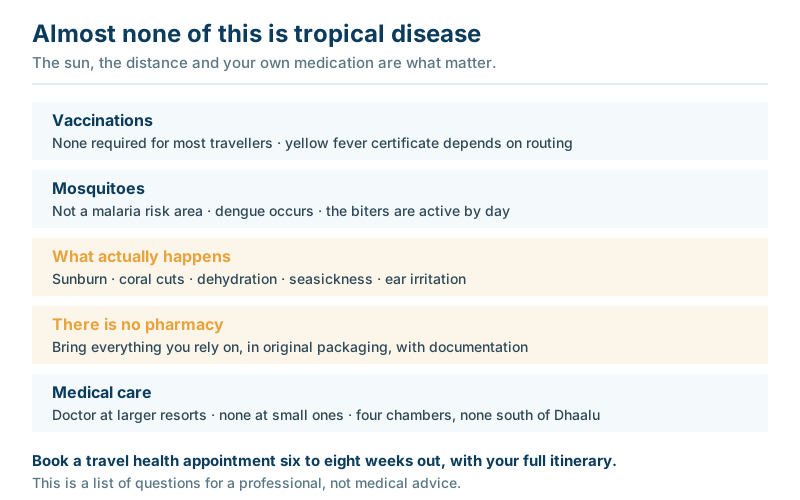
For most travellers there are no compulsory vaccinations for entry to the Maldives. That surprises people, and it produces the wrong conclusion: that there is no health preparation to make.
There is, and almost none of it is about tropical disease. It is about the sun, the water, the distance to a doctor, and the medication you will not be able to buy once you are on an island with no pharmacy.
This article is not medical advice. We are not clinicians and individual circumstances differ enormously. The only reliable sources are a travel health professional, your own doctor, and current official guidance from your country’s health authority. What follows is a list of things to raise with them, and a description of what the country is actually like.
Required, recommended and neither
Three different categories that get confused constantly.
Required for entry is a very short list. For most travellers arriving from most places there is nothing.
The one common exception is a yellow fever certificate, which may be required of travellers arriving from or transiting countries where yellow fever is present. Whether it applies to you depends on your itinerary rather than your nationality, and it is worth confirming against official guidance before booking a routing through Africa or South America.
Recommended is a different category, and it is a conversation with a travel clinic rather than a rule. Routine immunisations being up to date is the usual starting point, and clinics commonly discuss hepatitis A, typhoid and tetanus for travel in the wider region.
Neither required nor commonly recommended is where most of the anxiety sits, and where the honest answer is that a Maldives resort week is a low-exposure trip by any standard.
Which produces the practical instruction: book a travel health appointment six to eight weeks before departure if you want vaccinations discussed, because some schedules take time. Take your full itinerary rather than just the destination, since a stopover changes the picture.
Malaria and mosquito-borne illness
Worth separating, because these two are frequently conflated.
The Maldives is generally not regarded as a malaria risk area, and prophylaxis is not routinely recommended for it. Confirm this against your own country’s current guidance rather than against an article, because designations do change.
Mosquito-borne illness is a different matter. Dengue occurs in the region and is present in the Maldives, and it is transmitted by daytime-biting mosquitoes rather than the nocturnal kind.
Which changes the advice from evening to all-day. Repellent, long sleeves at dusk, and awareness that a densely vegetated island has more mosquitoes than a bare one — a point our guide to island size makes about mature planting.
Guesthouse islands and resorts differ in how much they manage it, and a village island in the wet season is the higher-exposure setting of the two.
And there is no vaccine question to resolve for most travellers. It is a bite-avoidance question, which is why repellent belongs on the packing list alongside the sun items.
What actually affects visitors
The health issues that matter here, and they are unglamorous.
Sunburn, which is the commonest injury of a Maldives trip by a wide margin, and which our snorkelling guide flags for the same reason. The equatorial sun burns in under twenty minutes at midday and snorkelling exposes your back for hours — the fix is a long-sleeved rash guard rather than more sunscreen.
Coral cuts, which infect quickly in warm water. Clean them the same day, wear reef shoes at entries that are not sand, and do not stand on the reef in the first place — the etiquette is in our guide to reading a house reef.
Dehydration, because people drink less than they should in this heat and alcohol does not help.
Seasickness, on every excursion and worst on an anchored boat at night — take something before boarding rather than after, as our guide to night fishing notes.
Ear problems, from repeated immersion over a week of snorkelling, which is an underrated nuisance and easily prevented by drying ears properly.
And stomach upsets, which are no more likely here than anywhere and worth carrying something for regardless.
Five of those six are preventable with items that weigh nothing.
Why a Maldives trip is a low-exposure trip
Worth stating, because the anxiety around tropical destinations frequently exceeds the risk.
A resort island is a controlled environment. Desalinated water, a kitchen feeding the same guests for a week, no traffic, no crowds and no urban exposure of any kind.
The population you are among is small. A hundred or two hundred guests and staff, on an island of a few hundred metres.
There is no wildlife hazard on land, because there is almost no land — the shared consequence of the geology our comparison of the Maldives and Lakshadweep describes.
And the activities are water-based, which shifts the risk profile toward sun, immersion and boats rather than toward anything infectious.
A guesthouse island is a village, which is a slightly different exposure — more mosquitoes, ordinary food, ordinary water supply — and still a low-risk setting by any regional standard.
Which is the honest framing. The health preparation for this destination is mostly about the sun, your own medication and the distance to a doctor, and much less about disease than the words “tropical island” suggest.
Heat, and the thing nobody plans for
Its own section, because it is the underlying cause of several items above.
It is hot year-round, at 26 to 32°C, with high humidity and no cool season — the pattern is in our monsoon guide.
Which means the middle of the day is not usable for most people. The rhythm that works is water from seven until ten, shade from eleven until three, and water again from four.
Everybody works this out by day three and nobody plans for it on day one — the point our guide to choosing a resort for a family makes about structuring a day.
Shade is not guaranteed. Some islands have mature planting and umbrellas; some have neither, and it is visible from a satellite image before you book.
And the two items that make the middle of the day survivable are a brimmed hat and a rash guard, which is why they sit near the top of the packing list.
The medication question, which matters most
The section to act on, because a resort island has no pharmacy.
Bring everything you rely on, in original labelled packaging, in quantities covering the trip plus a delay.
There is no chemist on a resort island. The shop stocks a handful of items at a large markup, and a guesthouse island has whatever the island has.
Some medications require documentation. Countries vary in what they restrict, and the Maldives is no exception — carrying a doctor’s letter or a copy of the prescription for anything unusual, controlled or injectable is sensible practice and occasionally necessary. Check current official guidance for your specific medication before travelling, because lists change and getting this wrong at customs is a serious problem rather than an inconvenience.
Split supplies between bags if you are checking one, in case it does not arrive with you — and remember that a delayed bag on a seaplane island may take another day to catch up.
And declare what needs declaring. Customs here is real, as our guide to restricted items sets out, and medication is not the category to be casual about.
The small kit worth carrying
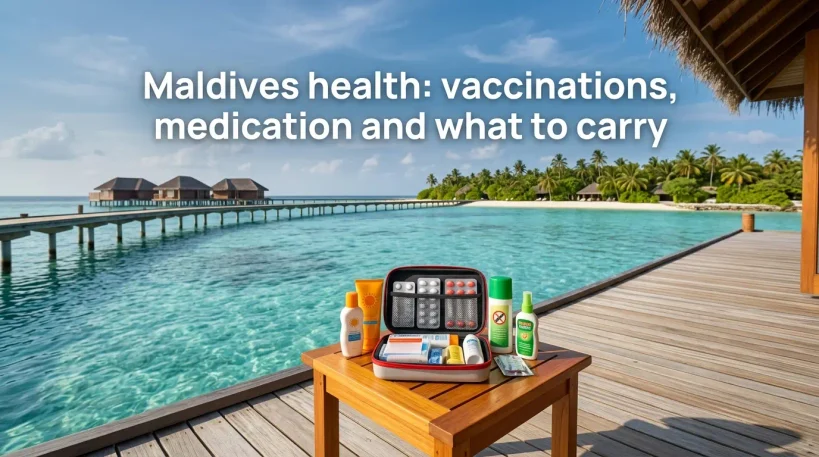
Six items, and together this small medical kit covers most of what goes wrong.
Antiseptic, for coral.
Plasters and a small dressing.
Painkillers, of the kind you normally use.
Rehydration sachets.
An antihistamine, for bites and for reactions.
Something for motion sickness, taken before boarding.
Add anything you personally need, and remember that a resort island cannot supply substitutes — the full list is in our packing list.
Water and food
Briefly, because the picture is better than people expect.
Resorts desalinate their own water and provide drinking water, though some charge for bottled water outside an all-inclusive package.
On an inhabited island, bottled or filtered water is the norm for visitors.
Ice and salads follow the same logic as the water they were made with, which at a resort is not a concern.
Food safety at resorts is generally high, as it must be for an operation feeding the same guests for a week with no hospital nearby.
And local island cafés are ordinary and inexpensive, with the same sensible precautions you would apply anywhere — our food guide covers what to eat.
One genuine caution: drinking enough. In this heat the failure mode is not contamination but volume, and it creeps up on people who are in the water all day and do not feel thirsty.
What medical care exists, and where
The medical picture is structural, and it is about distance rather than quality.
Larger resorts have a doctor or a nurse on the island. Smaller ones have neither.
Inhabited islands have health centres of varying capability, and the larger ones have more.
Serious cases go to Malé, a transfer away — the same boat or aircraft that brought you, on the same daylight constraints if it is a seaplane.
There are four hyperbaric chambers in the country, all at resorts, and none south of Dhaalu Atoll — which matters to divers and is set out in our safety guide.
Ask what your property has before booking if anybody in the party has a condition that might need attention. It is a reasonable question and properties answer it.
And the number that matters on an insurance schedule is evacuation, not the headline medical figure — the clauses are in our guide to travel insurance.
Fitness to dive
A specific pre-travel medical task for a specific group.
Dive centres use a standard medical questionnaire, and certain answers require a physician’s sign-off before you can dive.
Which is a pre-travel task, not an arrival one. Discovering on day one that you need a doctor’s clearance is discovering it too late.
Conditions commonly requiring clearance include respiratory, cardiac and ear or sinus problems, and the questionnaire is publicly available from the major training agencies — worth reading before you travel rather than at the desk.
Recent surgery, pregnancy and some medications are also on the list, and the answer is a conversation with your own doctor rather than with a dive centre.
And if it has been more than a year since your last dive, book a refresher. Every centre offers one and it is the correct response rather than a sales tactic — the questions to ask are in our guide to choosing a resort for divers.
Health on a liveaboard, which is different again
Brief, and worth its own note because the constraints change.
You are further from help. A boat on a southern itinerary can be a long way from the nearest chamber — four in the country, all at resorts, none south of Dhaalu.
Ask about oxygen and crew training before booking, which is one of the safety questions in our liveaboard guide.
Seasickness is a week-long question rather than a day one. Take something before boarding, and book a lower-deck midships cabin if you are prone to it.
Three or four dives a day is tiring, and fatigue rather than illness is what most guests report by day five.
And bring a warm layer. Repeated immersion cools you cumulatively, and the last dive of the day is the cold one.
Diving insurance matters most in this format, and some operators require proof of it — the clauses are in our guide to travel insurance.
Pregnancy
Short, because the honest answer is that this is a conversation with your own doctor.
Airlines have their own rules on flying at different stages, and they vary.
Diving is generally not recommended in pregnancy, and dive centres will ask.
Some spa treatments and certain activities are restricted, and properties will tell you which.
The relevant Maldives-specific factors are the distance from a hospital, the heat, and the fact that a transfer is a boat or a small aircraft rather than a car.
Which is not a reason not to go, and is a reason to have the conversation before booking rather than after. Read the insurance terms on pregnancy too, since they frequently carry conditions — and consider a property near the airport, which shortens every journey.
Travelling with children
The additions worth planning for children’s health, and they are mostly about sun and supply.
Sun protection above everything. Rash guards for children are the single most useful item, because twenty minutes of midday sun burns and reapplying sunscreen is a fight.
Bring their medication and their brands. Substitutes will not be there, and neither will the reassurance of a familiar label — our guide to choosing a resort for a family sets out the rest.
Ask whether the property has a doctor, and what the nearest facility is. It is a function of property size.
Hydration, because children drink less than they need in this heat.
And reef shoes, because a cut foot on day two ruins a week of swimming for a child faster than for an adult.
What to do, and when
Six weeks of health preparation, most of which takes an hour.
Six to eight weeks out. Book a travel health appointment if you want vaccinations discussed, and take your full itinerary — the shape of which is in our itineraries guide — rather than just the destination.
At the same time. Check whether any of your medication needs documentation, and request a letter or a copy of the prescription if so.
Six weeks out. Buy insurance if you have not — cancellation cover runs from purchase, and the timing is in our booking timeline.
Four weeks out. If you dive, read the medical questionnaire and arrange clearance if any answer requires it.
Two weeks out. Assemble the small kit and check that prescriptions cover the trip plus a delay.
Three days out. Submit the IMUGA declaration, which is required within 96 hours of travel.
And on the day. Split medication between bags, and keep the insurance emergency number offline.
What this is not
Stated plainly, because health information deserves the same care as insurance.
We are not clinicians and this is not advice. Every item above is something to raise with a professional rather than a conclusion to act on.
Individual circumstances differ enormously — age, existing conditions, medication, pregnancy, the activities planned and the specific itinerary.
Official guidance changes, including on malaria designations and on entry requirements, and it is published by health authorities rather than by travel sites.
Where this site has first-hand knowledge it says so. On health it has none, and the value here is knowing which questions to ask and what the country is physically like.
The one thing worth repeating: there is no pharmacy where you are going, and that single fact governs more of this article than any vaccination question.
Questions travellers ask
What vaccinations do I need for the Maldives? For most travellers, none are required for entry. A yellow fever certificate may be required if you are arriving from or transiting a country where it is present. Routine immunisations being up to date is the usual starting point, and a travel clinic can advise on what else is worth discussing.
Is there malaria in the Maldives? It is generally not regarded as a malaria risk area and prophylaxis is not routinely recommended. Confirm against your own country’s current official guidance, since designations change.
Are there mosquitoes? Yes, and dengue occurs in the region. The relevant mosquitoes bite during the day, so repellent is an all-day measure rather than an evening one. Densely vegetated islands have more than bare ones.
Is there a doctor on the island? At larger resorts, usually. At smaller ones, frequently not, and serious cases are transferred to Malé. Ask the property directly if anybody in the party has a condition that might need attention.
Can I buy medication there? Not on a resort island — there is no pharmacy, and the shop stocks very little. Bring everything you rely on in original packaging, with documentation for anything unusual or controlled.
Is the water safe to drink? Resorts desalinate and provide drinking water. On inhabited islands, visitors normally drink bottled or filtered water. The more common problem in this heat is not drinking enough.
What actually makes people ill on a Maldives trip? Sunburn above everything, then coral cuts, dehydration, seasickness and ear irritation from repeated immersion. Five of those are preventable with items that weigh almost nothing.
Do I need a medical check before diving? Dive centres use a standard questionnaire and some answers require a physician’s sign-off. Read it before you travel, because arranging clearance on arrival is arranging it too late.
What to take away
- No vaccinations are required for most travellers, though a yellow fever certificate may apply depending on your routing. Routine immunisations and a travel clinic conversation are the sensible baseline.
- The Maldives is generally not a malaria risk area, but dengue occurs and the mosquitoes bite by day — repellent is an all-day measure.
- What actually affects visitors is sunburn, coral cuts, dehydration and seasickness. A rash guard, reef shoes, antiseptic and motion sickness tablets cover most of it.
- There is no pharmacy on a resort island. Bring everything you rely on, in original packaging, with documentation for anything unusual.
- If you dive, read the medical questionnaire before travelling. Clearance arranged on arrival is arranged too late.
Next step: make one appointment and pack one small bag. The appointment is with a travel health professional six to eight weeks out, with your full itinerary in hand rather than just the country. The bag is antiseptic, plasters, painkillers, rehydration sachets, an antihistamine and something for motion sickness — which weighs almost nothing, costs very little, and covers most of what actually goes wrong on a Maldives trip.