Maldives or Lakshadweep: Same Geology, Different Country
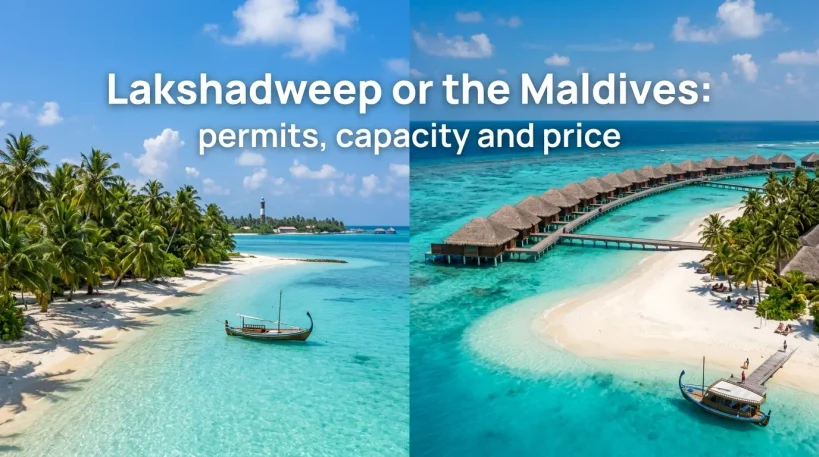
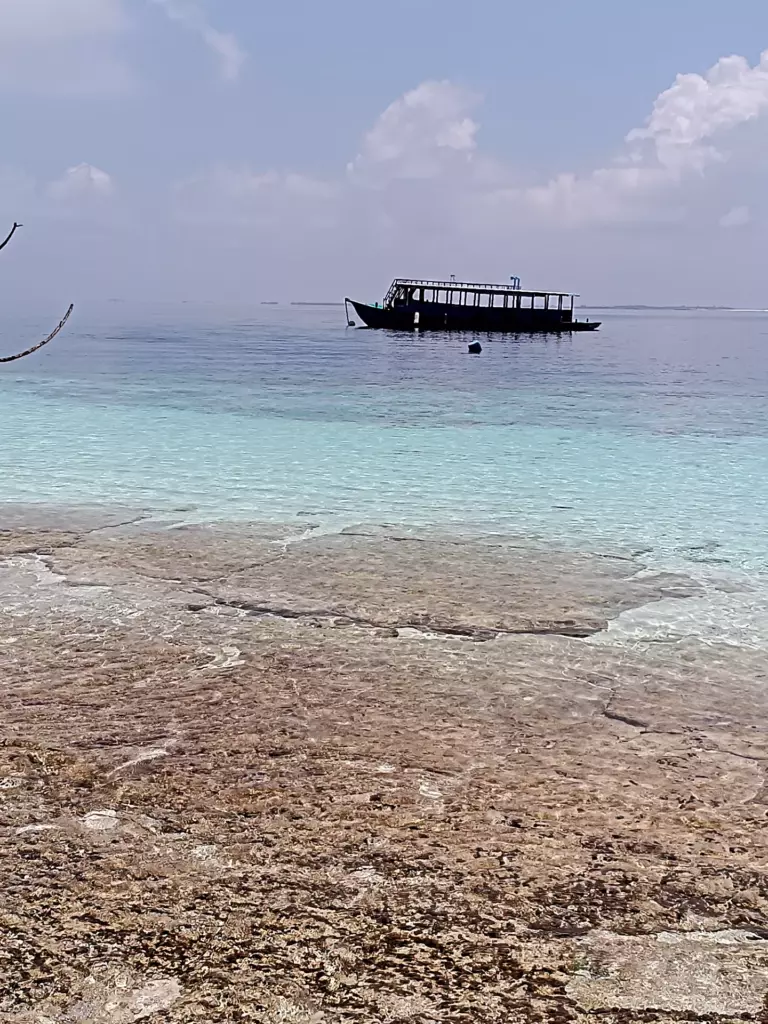
Lakshadweep and the Maldives sit on the same submarine ridge. The atolls are formed the same way, the lagoons look the same, the reefs are related, and the islands are equally low and equally small.
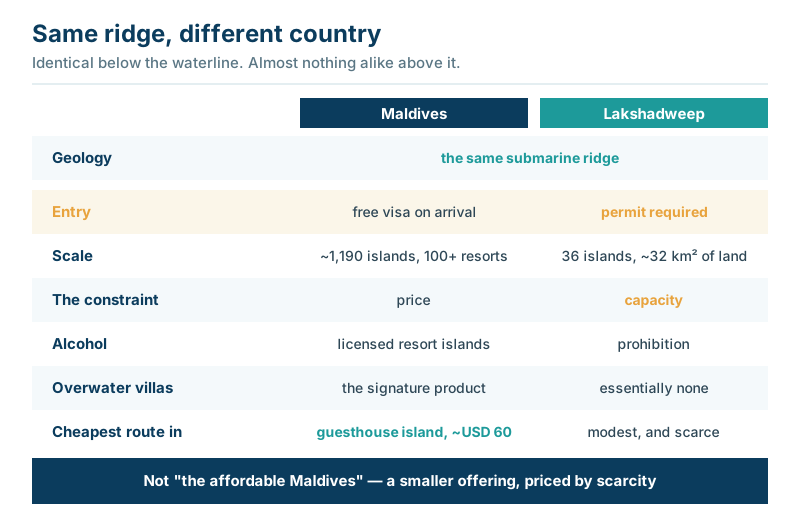
Everything above the waterline is different. The Maldives has roughly 1,190 islands, over a hundred resorts and a tourism industry that carries the national economy. Lakshadweep has 36 islands, around ten of them inhabited, a total land area of about 32 square kilometres, and a handful of places to stay.
And you cannot simply book a flight. Lakshadweep requires a permit for non-residents, including Indian citizens, which is the structural fact that defines the whole comparison.
A note on why this page exists. Interest in the comparison rose sharply in 2024 and has stayed high. This article takes no position on any of that; it sets out what the two places are, structurally, and who each suits.
1. The geology is genuinely the same
Worth establishing first, because it is the only claim of similarity that survives scrutiny.
Both are coral atolls on the same submarine ridge, which runs south from the Indian subcontinent through Lakshadweep and on into the Maldives and beyond.
Which means the water looks alike. Lagoons inside reef rings, sand cays, shallow turquoise water and a drop-off outside — the same landscape our guide to reading a house reef teaches you to read.
The islands are equally low. Neither has hills, rivers or interiors. Both face the same long-term questions about sea level, covered in our guide to whether the Maldives is sinking.
The reefs are related and support similar life — reef fish, turtles, rays and sharks.
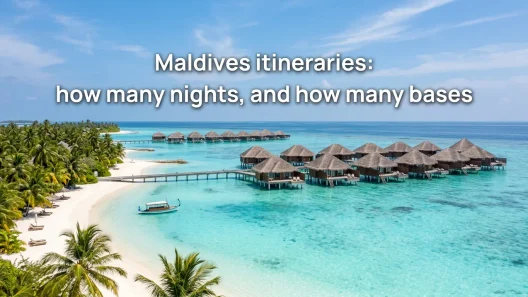
So a photograph from one could be from the other, and frequently is. This is the one comparison in this set where the marketing images are genuinely interchangeable.
Everything else diverges, and the rest of this article is that divergence.
Worth drawing out, because it is the one place where knowledge of one destination transfers cleanly to the other.
The satellite check works identically. Pale turquoise close to shore is shallow sand; dark blue-green is reef; deep uniform blue is the drop-off. The method in our guide to reading a house reef applies to any atoll island on this ridge.
The tide behaves similarly. Both have a modest tidal range, unlike the East African coast, where the sea withdraws hundreds of metres — the contrast our Zanzibar comparison sets out.
Coral bleaching affects both, because they share a body of water and a temperature regime. The 2024 event and its consequences are covered in our guide to reef health, and the ecological questions are not confined to one side of a border.
Reef etiquette transfers too. Do not stand on it, do not touch anything, and use reef-safe sunscreen — the rules in our snorkelling guide apply on both.
And the vulnerability is shared. Low coral islands with no elevation face the same physical constraints, and neither administration has the option of moving inland.
2. The permit
The defining structural difference, and the one most people discover late.
Non-residents need a permit to visit Lakshadweep, including Indian citizens travelling from the mainland. It is applied for in advance, tied to specific islands and dates, and it is a genuine administrative step rather than a formality.
The Maldives has nothing comparable. A free visa is granted on arrival to almost all nationalities, with no application and no approval to wait for. Our guide to the visa on arrival sets out the process; the only paperwork is the IMUGA declaration, submitted within 96 hours of travel.
Which changes how a trip is planned. A Maldives trip can be booked on a whim and flown to next week. A Lakshadweep trip is arranged in a sequence, with the permit as a dependency.
And it changes who goes. Permit systems reduce visitor numbers by design, which is the point of them — the islands are ecologically fragile and the administration limits pressure deliberately.
The practical instruction: check the current permit process and requirements before booking anything, because the arrangements have changed over time and are the first thing to verify.
3. Capacity, which is the real constraint
The reason Lakshadweep cannot become a second Maldives quickly, whatever anybody intends.
Air access is limited. Agatti has an airstrip served by a small number of flights from the Indian mainland, on small aircraft, with correspondingly limited seats.
Sea access exists — passenger ships from Kochi — and it is slow.
Accommodation is tiny by comparison. A handful of properties across a few islands, including government-run accommodation and a small number of private options, against more than a hundred Maldivian resorts.
Which produces the central practical difference: the Maldives can absorb visitors and Lakshadweep cannot, at present. Availability is the binding constraint rather than price.
And it explains the pricing. Scarce beds and scarce seats do not produce cheap holidays, whatever the underlying cost base — which is why “the affordable Maldives” is a misleading description of the place.
Building capacity takes years, and doing it on 32 square kilometres of fragile coral island raises exactly the environmental questions the permit system exists to manage.
4. Alcohol, and how the two countries differ
A sharper difference than most people expect, and it runs the opposite way to the assumption.
The Maldives separates tourism from the population. Alcohol is served on resort islands under licence, and every inhabited island is dry — the arrangement our guide to alcohol rules explains.
Lakshadweep is a predominantly Muslim territory with prohibition across the inhabited islands, and the historical exception was a single uninhabited resort island rather than a licensed resort sector.
Which means the Maldivian model — a dry country with licensed enclaves — does not exist there in the same form.
Anyone assuming a resort bar should check the current position for the specific island before booking, since arrangements have been discussed and revised.
The same applies to dress. Both are conservative Muslim societies where modest clothing is expected on inhabited islands, and the Maldivian version is set out in our guide to dress codes.
The difference is the enclave. In the Maldives you can book a resort island and live by resort rules for a week. In Lakshadweep that structure is largely absent.
5. What there is to do
Similar activities, very different infrastructure.
Diving and snorkelling are the point in both, and Lakshadweep’s reefs are far less visited — uncrowded sites are its genuine advantage over a Maldivian atoll near Malé.
Dive centres exist on the tourist islands, at a scale appropriate to the number of visitors rather than to a national industry.
The Maldives has more of everything organised. Manta rays at known cleaning stations, the year-round whale shark aggregation in South Ari, liveaboards, and a dive operation on essentially every island.
Water sports and lagoon activities exist in both, at very different densities of provision — the Maldivian range is in our guide to water sports.
And neither has anything on land, because neither has land in any meaningful quantity. That is the shared consequence of the shared geology.
Which produces the honest summary: Lakshadweep offers quieter water and less choice; the Maldives offers more choice and more boats on the same site.
6. Getting there
Different starting points, and this is where the two audiences diverge.
Lakshadweep is reached from India — flights to Agatti from the mainland, or a passenger ship from Kochi. For a traveller already in India it is a domestic journey.
For anybody outside India it is not. Reaching Lakshadweep from Europe means flying to India first, then a domestic connection, then an inter-island transfer — three legs, with a permit attached.
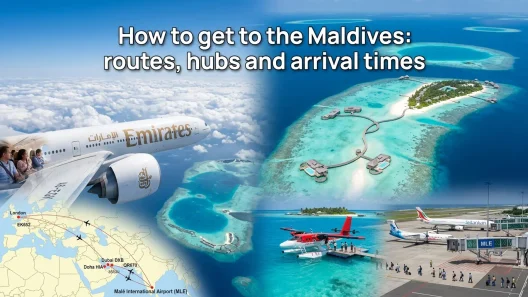
The Maldives is reached directly from a wide range of markets, with connections through the Gulf, Istanbul, Colombo and Southeast Asia, into a single international airport — the routes are in our guide to getting to the Maldives.
Then the Maldivian transfer is priced per person. A speedboat at USD 100 to 400 return, or a seaplane at USD 400 to 820. Seaplanes fly in daylight only and stop between about 15:30 and 16:00, as our transfers guide sets out.
Lakshadweep’s inter-island movement is by boat or helicopter and is subject to the same capacity limits as everything else.
Which produces a clean rule of thumb. For an Indian traveller, Lakshadweep is close and the Maldives is a short international flight. For everybody else, the Maldives is straightforward and Lakshadweep is a project.
7. What it costs
Less obvious than the assumption, and worth setting out carefully.
Lakshadweep is not simply cheap. The cost base is lower than a Maldivian resort’s, but scarce flights and beds keep prices up. The accommodation on offer is modest rather than luxurious.
The Maldivian bill compounds. A 10% service charge and 17% tax reach roughly 28.7% on nearly every resort line, as our guide to money explains.
And the Maldives has a cheap version of itself that most comparisons ignore: a guesthouse island at around USD 60 a night with meals at USD 5 to 13, on the same reefs the resorts use.
A week for two, excluding international flights. Maldivian figures from our own budget work; Lakshadweep as orientation only.
| Maldives | Lakshadweep | |
|---|---|---|
| Budget | USD 1,100–1,900 guesthouse island | Government accommodation, modest |
| Mid-range | USD 4,500–8,000 resort | Limited options |
| Luxury | USD 12,000+ | Essentially absent |
| Transfer to the hotel | USD 200–1,640 for two | Boat or helicopter, capacity-limited |
| Availability | Wide | The binding constraint |
| Tax on the bill | ~28.7% compounded | Indian taxes |
Which is the point to take away on price. The Maldivian guesthouse island is the cheapest way to experience this geology at present, and it is available now, without a permit, with a free visa on arrival.
8. Who each one suits
Choose Lakshadweep if: you are travelling from India, you want uncrowded reefs, and you are content with modest accommodation and a permit process.
Choose the Maldives if: you want choice, availability, an established dive industry, and the ability to book a trip without an approval step.
Divers: both are genuine. Lakshadweep for quiet sites, the Maldives for pelagics, variety and infrastructure — our guide to choosing a resort for diving covers the Maldivian side.
Travellers who want an overwater villa: the Maldives, since the format barely exists there — and our villa comparison explains what it actually buys.
Travellers who drink: the Maldives, on a resort island, for the reasons above.
Families: the Maldives has far more capacity and facilities, and our guide to choosing a resort for a family sets out what to check.
Anybody in a hurry: the Maldives, where our trip planner sets out the whole sequence. Permits and limited flights make Lakshadweep a planned trip rather than a booked one.
And anybody who wants to see this geology before it has a tourism industry: Lakshadweep, honestly, with the corresponding trade-offs.
9. The comparison people are actually making
Worth addressing directly, because the framing is usually wrong.
“Lakshadweep instead of the Maldives” implies substitution, and the two are not substitutable at present for most travellers. One has capacity and the other does not.
“The affordable Maldives” is the second misleading phrase. Lakshadweep is not a discounted version of a Maldivian resort holiday; it is a different and much smaller offering, at prices set by scarcity.
The accurate version is narrower: Lakshadweep offers the same geology with fewer visitors, less infrastructure and an access process, and it suits a specific traveller very well.
And the Maldivian answer to “cheaper” is internal, not geographic. The guesthouse islands are the country’s own budget format, and they compete with anything in the region — as our guide to choosing a local island sets out.
Which is the honest reframing. If the question is “how do I see this kind of water without paying resort prices”, the answer is a Maldivian inhabited island — Maafushi and its neighbours, available immediately. If the question is “where can I see it with almost nobody there”, the answer is Lakshadweep, with the process that implies.
A note on how fast this changes
Unusual for this site to say, and necessary here.
Lakshadweep’s tourism arrangements are actively developing. Access, accommodation, permits and policy have all been subject to change and public discussion, and any specific figure or process quoted anywhere — including here — should be checked against a current official source before it is relied on.
This article therefore deliberately avoids specifics it cannot stand behind: no flight frequencies, no property names, no permit fee, no bed counts.
What it gives instead are the structural facts that will remain true whatever the detail does: the shared geology, the permit requirement, the capacity constraint, the alcohol position, and the fact that the Maldives has a cheap format available immediately.
The Maldivian side of this article is stable by comparison, because that industry has been running on the same model since 1972 and its numbers are documented across this site.
And the practical instruction is the same one this whole set repeats: verify anything that could have changed, and treat any comparison — including ours — as a starting point rather than a booking document.
10. Season
Similar systems, similar answers.
Both sit in the same monsoon regime, broadly, and both are affected by the southwest monsoon from roughly May to September.
The Maldivian pattern is dry from December to April with the best visibility and the highest prices, and wetter from May to November — the mechanism is in our monsoon guide and the pricing in our guide to high and low season.
Lakshadweep’s season is comparable, with the monsoon months bringing rough seas and reduced access — and where access is already limited, weather closes the door harder.
Which is an underrated point. In the Maldives a rough day cancels an excursion. In a capacity-constrained destination it can cancel the flight that gets you there.
Build more buffer for Lakshadweep, particularly around the shoulder months.
What we know first-hand, and what we do not
We have been to the Maldives — to Maafushi, an inhabited island, with a day visit to one resort. We have not stayed overnight at a Maldivian resort, which is why nothing on this site ranks them.
We have not been to Lakshadweep. This comparison is structural: geology, access, capacity, legal environment and cost mechanics — facts that are checkable rather than felt.
Which is why this article says nothing about Lakshadweepi food, hospitality or the quality of individual properties. We are not in a position to.
And it is why the permit and capacity details carry a warning to verify them. They are administrative arrangements that have changed and may change again, and this is the comparison in the set where the most time-sensitive information sits.
The Maldivian figures are ours, from published work on this site. The Lakshadweep figures are bands, labelled as orientation.
Three of the ten comparisons in this set were written after visiting both countries — Mauritius, Zanzibar and Thailand. This is not one of them.
Questions travellers ask
Is Lakshadweep the same as the Maldives? Geologically, close to it — the same submarine ridge, the same atoll formation, similar lagoons and reefs. Above the waterline they are entirely different: the Maldives has over a hundred resorts and Lakshadweep has a handful of properties, a permit system and very limited flights.
Do I need a permit for Lakshadweep? Yes. Non-residents require one, including Indian citizens, applied for in advance and tied to specific islands and dates. The Maldives grants a free visa on arrival to almost all nationalities.
Is Lakshadweep cheaper than the Maldives? Not straightforwardly. The cost base is lower but scarce flights and beds keep prices up. The cheapest way into this kind of water is a Maldivian guesthouse island at around USD 60 a night, available without a permit.
Can you drink alcohol in Lakshadweep? It is a predominantly Muslim territory with prohibition on the inhabited islands, and the Maldivian model of licensed resort islands does not exist there in the same form. Check the current position for your specific island before booking.
Which has better diving? Both are genuine. Lakshadweep offers far less visited reefs; the Maldives offers pelagics, a year-round whale shark aggregation, liveaboards and an established industry.
Which is easier to reach? From India, Lakshadweep. From anywhere else, the Maldives by a wide margin — Lakshadweep means flying to India, connecting domestically, and holding a permit.
Are there overwater villas in Lakshadweep? Essentially not. The format is a Maldivian and Polynesian product; Lakshadweep’s accommodation is land-based and much more modest.
Will Lakshadweep become the next Maldives? Not quickly. Air access, bed capacity and 32 square kilometres of fragile land are the constraints, and the permit system exists partly to manage exactly that pressure.
What to take away
- The geology is genuinely shared — the same submarine ridge, the same atolls, the same water. Photographs from the two are interchangeable.
- Everything above the waterline is not. A permit is required for Lakshadweep, including for Indian citizens, and it is the first thing to arrange.
- Capacity, not price, is the binding constraint. A handful of properties and limited flights against more than a hundred Maldivian resorts.
- Lakshadweep is not “the affordable Maldives”. The cheapest route to this kind of water is a Maldivian guesthouse island at around USD 60 a night, available now and without a permit.
- Check the permit process, the alcohol position and the flight availability before booking anything. They are the most time-sensitive facts in this comparison.
Next step: work out which question you are actually asking. If it is “how do I see this water cheaply”, the answer is an inhabited island in the Maldives, bookable this week and with no approval to wait for. If it is “where can I see it with almost nobody else there”, the answer is Lakshadweep — and the permit is the first thing to sort out rather than the last, because everything else in that trip depends on it.