
What a Maldives Trip Costs: The Room Rate Is About Half of It
Somebody quotes you USD 450 a night for a Maldives resort. Seven nights is USD 3,150, and that feels like the number.
It is not the real cost. Add the transfer for both of you, the service charge and tax compounding on almost every line, the green tax, the dives, the excursions and the drinks, and the same week costs closer to USD 6,000 before you have flown anywhere.
This guide sets out what a Maldives trip actually costs, line by line, across four very different ways of doing it — and which five decisions move the budget most.
The lines people forget
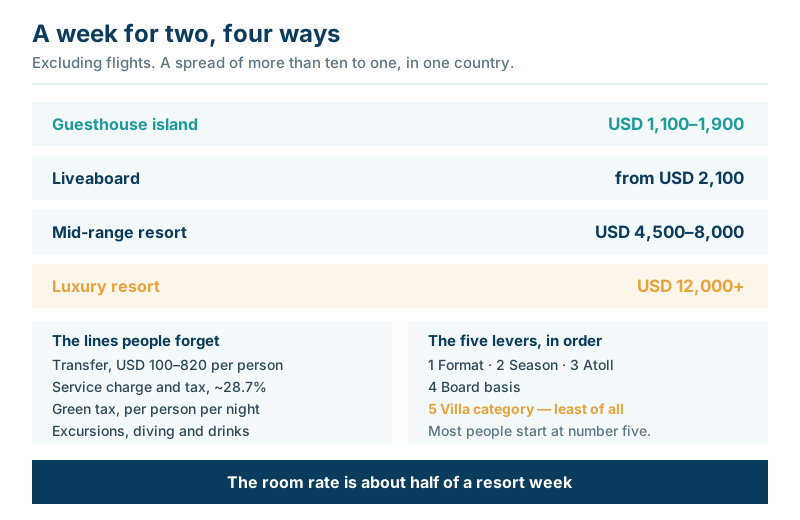
Five of them, and together they are frequently half the trip.
The transfer, priced per person. A speedboat at USD 100 to 400 per person return, or a seaplane at USD 400 to 820 — charged for children too, and covered in our transfers guide. For a family of four that is between USD 400 and USD 3,280.
The 28.7%. A 10% service charge, then 17% goods and services tax on top of it, compounding on almost every resort line — the mechanism is in our guide to money in the Maldives.
Green tax, charged per person per night, separately from the above — and it applies on guesthouse islands too, at a lower rate.
The excursions and the diving, which are excluded from every board basis including all-inclusive — the exclusion list is in our guide to budget and all-inclusive.
And the drinks, at USD 18 to 25 for a cocktail after tax — one reason the luxury tier bills differ so far from their room rates.
None of these costs appears on the page you booked from, and together they are why a quoted rate and a final bill diverge so widely.
Four ways to spend a week
Two people, seven nights in the Maldives, excluding international flights. Bands rather than quotes, and each is itemised below.
| Cost for two, one week | |
|---|---|
| Guesthouse island | USD 1,100–1,900 |
| Liveaboard | from about USD 2,100 |
| Mid-range resort | USD 4,500–8,000 |
| Luxury resort | USD 12,000+ |
A spread of more than ten to one within one country, which is why “is the Maldives expensive” has no useful answer until you say which Maldives you mean.
The guesthouse island week, itemised
The cheapest genuinely good week in the country, and the one most comparisons never mention.
| Line | Two people, seven nights |
|---|---|
| Room, from USD 60 a night | USD 420 |
| Meals, USD 5–13 a head | USD 300–450 |
| Speedboat transfer, both ways | USD 100–200 |
| Three excursions | USD 200–350 |
| Green tax and incidentals | Modest |
| Total | USD 1,100–1,900 |
No alcohol, because inhabited islands are dry — our guide to alcohol rules explains the arrangement, and it is a real part of why the total is what it is.
Same reefs, same excursion sites. A sandbank trip from a guesthouse island runs USD 35 to 50 per person against USD 150 to 300 from a resort, on the figures in our excursion price guide.
The 28.7% largely does not apply, because you are not buying from a resort.
What you give up is the villa, the seclusion and the bar. What you keep is the water — the trade our guide to choosing a local island sets out.

The liveaboard week, itemised
The best value in the country for anyone whose trip is about diving, and the clearest example of price following format.
| Line | Two people, seven nights |
|---|---|
| Berths, from USD 150 per person per day | USD 2,100 |
| Park fees, USD 6–15 per protected site | USD 100–200 |
| Nitrox, if used | USD 160–300 |
| Equipment rental | USD 200 upward |
| Drinks and gratuity | Variable, and expected |
| Total | from USD 2,600–3,000 |
Twelve to eighteen dives are included in that price, against six to ten at a resort at USD 110 to 200 each — the arithmetic is in our liveaboard guide.
Budget 20 to 35 per cent above the headline fare for the extras, which is the gap that catches people.
And no transfer cost beyond reaching the boat, which is usually in Malé.
The mid-range resort week, itemised
The trip most people mean when they say “the Maldives”.
| Line | Two people, seven nights |
|---|---|
| Beach villa, USD 350–600 a night | USD 2,450–4,200 |
| Half board or all-inclusive supplement | USD 700–2,100 |
| Service charge and tax at 28.7% | USD 900–1,800 |
| Speedboat transfer, both ways | USD 200–800 |
| Three excursions or dives | USD 500–1,000 |
| Green tax | Per person per night |
| Total | USD 4,500–8,000 |
The tax line is the cost people miss, and at this tier it is frequently larger than the transfer.
The board decision matters more than the villa. All-inclusive costs USD 80 to 150 per person per day, and the break-even is roughly lunch plus four to six drinks each — our guide to budget and all-inclusive does the arithmetic.
A seaplane island adds USD 600 to 1,640 for two, which is a tier’s worth of money for a transfer.
And a close house reef removes the excursion line entirely, which is worth USD 400 to 800 across a week — the check is in our guide to reading a house reef.
The luxury week, itemised
Where the arithmetic changes shape rather than scale, and where the gap between price and bill is widest.
| Line | Two people, seven nights |
|---|---|
| Villa, USD 1,000–2,000+ a night | USD 7,000–14,000+ |
| Food and drink, frequently à la carte | USD 1,500–3,000 |
| Service charge and tax at 28.7% | USD 2,400–4,800 |
| Seaplane transfer, both ways | USD 800–1,640 |
| Spa, diving, excursions | USD 1,000 upward |
| Total | USD 12,000+ |
The counterintuitive part: breakfast-only is common at the top, with everything else à la carte at prices set by a property with no competition on the island. The gap between the room rate and the final bill widens as you go up, not down — our guide to what the luxury tier buys explains why.
The tax on a large number is a large number. At this tier the 28.7% alone exceeds an entire guesthouse week.
And the transfer is usually a seaplane, because the most spacious islands are furthest out.
The transfer, as a budget category
It deserves treating as a line rather than a detail, because for some trips it is the second largest one.
It is charged per person, including children at most properties from about two years old.
A family of four on a seaplane island pays four fares of USD 400 to 820 — between USD 1,600 and USD 3,280, before anybody has eaten anything.
The same family on a speedboat island pays USD 400 to 1,600.
The difference costs a tier of accommodation, and it is decided by which atoll you choose rather than by which property — the point our guide to staying near the airport makes at length.
And on a short trip it is worse than the money suggests, because a distant transfer also takes six to ten hours out of a 96-hour holiday.
Which produces the single most useful budget instruction on this page: choose the atoll before the property, and price the transfer for everybody travelling before you compare room rates.
How the 28.7% actually behaves
Worth showing rather than stating, because the compounding surprises people.
It is not 27%. A 10% service charge is added first, then 17% goods and services tax is applied to the sum — which produces roughly 28.7%, not 27%.
A USD 100 dinner bills at about USD 128.70. A USD 250 spa treatment bills at about USD 322. A USD 110 dive, with equipment and a park fee, reaches close to USD 184.
It applies to almost every resort line: the room, the board supplement, food, drinks, the spa, diving, excursions and laundry.
Green tax sits outside it, charged per person per night as a separate item.
And it barely touches a guesthouse island, which is a large part of why that format costs what it does.
The practical consequence for a budget: take your resort cost estimate and add roughly a third to everything except the transfer. If the result is uncomfortable, the property is above your budget rather than at the edge of it.
Flights, and where they sit
Excluded from every Maldives figure above, and frequently the largest single line.
Long-haul from Europe runs a wide range depending on season, carrier and how far ahead you book — and Christmas and New Year are the peak of it.
From the Gulf, India and Sri Lanka it is a short flight and a modest fare.
Book flights first for peak season, six to twelve months ahead, as our booking timeline sets out. The routes are in our guide to getting there, and the sequence in our trip planner.
And price the whole journey, not the ticket. A cheaper long-haul fare arriving at 15:00 can cost you a night near the airport and a lost day, on the arithmetic in our guide to missed connections.
Where the money actually goes
Rough shares of a resort week, excluding flights, to show what is worth optimising.
| Share of a mid-range resort week | |
|---|---|
| Room and board | About half |
| Service charge and tax | Around a fifth |
| Transfer | A tenth to a quarter |
| Excursions, diving, drinks | The remainder |
Which tells you where effort pays. Shopping for a cheaper room price at the same property moves the budget very little. Changing atoll, changing board basis or changing format moves a great deal.
And it explains a common frustration. Travellers who negotiate hard on the room price and then accept a seaplane island and all-inclusive have optimised the smallest lever and ignored two larger ones.
What the money is actually buying
Worth a section, because a budget article that only counts is half an article.
In the Maldives you are paying for isolation and logistics. Every resort is a self-contained operation on an island with no economy. Food, fuel, staff and water are all imported, and you arrive by a boat or aircraft that exists to bring you.
That structure has a floor. It is why there are no genuinely cheap resorts here. The alternatives in our comparison hub are mostly cheaper because they have economies you can buy from.
And it is why the guesthouse islands are so different. There the economy exists: a café, a shop, a boat owner, a dive centre, all competing, none of them importing your dinner specially.
What you are not paying for is better water. The reef, the fish and the excursions are the same at every price point. That is the argument our where to stay pillar makes, and the reason the format lever is the largest one.
Which reframes the whole budget question. The Maldives is not expensive because the holiday is better at the top. It is expensive because a private island with no economy costs a great deal to run, and you can opt out of that structure without opting out of the country.
The five levers, in order
Ranked by how much each moves a Maldives total.
1. The format. Guesthouse island against resort is a factor of three or four. Nothing else comes close, and our where to stay pillar compares all four options.
2. The season. Low season against Christmas is a large multiple on the same room — the comparison is in our guide to high and low season.
3. The atoll, through the transfer. Speedboat against seaplane is USD 300 to 420 per person return.
4. The board basis, calculated rather than assumed.
5. The villa category, which is where most people start and which moves the total least of the five.
And one that is free: a close house reef, which removes the excursion budget. Two minutes on a satellite map, worth USD 400 to 800 across a week.
Two weeks, and the split stay
The arithmetic changes with length, and it changes in a useful direction.
A second week at a Maldives resort costs the same as the first, minus one transfer. The price does not fall with length.
A split stay does get cheaper. Four nights on a guesthouse island and five at a resort costs materially less than nine resort nights, and it contains more of the country — the pattern our comparison of resort and inhabited islands recommends.
The extra cost is one internal transfer, and on nearby islands that is a modest speedboat fare rather than another seaplane.
And a fortnight is where the guesthouse format stops being a compromise. Two weeks in a village at USD 60 a night is an affordable holiday; two weeks at a resort is a serious cost for most people.
The other long-trip answer is a liveaboard week attached to a land week, which experienced divers converge on — the boat first, because of the no-fly interval before flying home.
Solo, and with children
Two arithmetic variations worth stating.
Solo travel costs disproportionately more at a resort, because rooms are priced per villa and the single supplement is real — a point our guide to island size and density touches on from the other direction. A guesthouse island narrows the gap considerably, and a liveaboard narrows it further since berths are sold per person.
Children are charged for the transfer from about two years old, which is the line families most often miss.
Board supplements for children run around half the adult rate for older children and are frequently free for under-sixes, which shifts the all-inclusive calculation — our guide to choosing a resort for a family sets out the rest.
Kids’ clubs are usually free at family properties; babysitting is not, and the spa certainly is not.
And a family of four should price the transfer before anything else, because it is the line most likely to decide which atoll is affordable.
What people underestimate
The five Maldives costs that surprise people most often.
The transfer, every time, and especially for families.
The tax, because a third on top of everything is not intuitive.
Drinks, at USD 18 to 25 a cocktail after tax, which is how a modest budget becomes an immodest bill.
Diving, at USD 110 to 200 a dive plus equipment plus park fees plus tax — our guide to choosing a resort for diving prices it properly.
And the last day. A seaplane departure means leaving the island in the morning, which can mean a night near the airport that nobody budgeted for — the options are in our guide to hotels in Malé and Hulhumalé.
How to build your own estimate
Five minutes and a spreadsheet, and it is more reliable than any published Maldives average.
One column per property. Room rate times nights. Board supplement times nights times people. Add 28.7% to both. Green tax times people times nights. Transfer times people times two. Then your realistic dives, excursions and drinks.
Divide by nights and compare.
Do it for two properties in different atolls, and the exercise routinely reverses a shortlist — a USD 320 room on a seaplane island loses to a USD 450 room forty minutes away by boat.
Add flights separately, because they vary by where you live and obscure the comparison if mixed in.
And add a contingency of ten per cent, because something will cost more than you budgeted and it is usually the drinks.
Questions travellers ask
How much does a week in the Maldives cost? For two people, excluding flights: USD 1,100 to 1,900 on a guesthouse island and from about USD 2,100 on a liveaboard. A mid-range resort runs USD 4,500 to 8,000, and a luxury one USD 12,000 upward.
What is the cheapest way to visit the Maldives? A guesthouse island on an inhabited island — from about USD 60 a night with meals at USD 5 to 13, using the same reefs and the same excursion sites as the resorts. There is no alcohol.
What do people forget to budget for? The transfer, which is charged per person including children; the service charge and tax compounding to about 28.7%; green tax; and the excursions and diving, which no board basis includes.
How much is the transfer? USD 100 to 400 per person return by speedboat, or USD 400 to 820 by seaplane. For a family of four that is between USD 400 and USD 3,280.
Is all-inclusive cheaper? Only if you drink. The supplement runs USD 80 to 150 per person per day, and the break-even is roughly lunch plus four to six drinks each. Light drinkers usually do better on half board.
How much are excursions? USD 25 to 60 per person from a guesthouse island, USD 90 to 300 from a resort depending on the trip. Diving runs USD 110 to 200 per dive at a resort, plus equipment, park fees and tax.
What moves the total most? The format, then the season, then the atoll through the transfer, then the board basis. The villa category — where most people start — moves it least.
How do I estimate my own trip? Put each property in a spreadsheet column: room, board, 28.7% on both, green tax, transfers for everyone, then realistic dives and drinks. Divide by nights. Add flights separately and a ten per cent contingency.
What to take away
- The room rate is roughly half a resort week. The transfer, the 28.7%, green tax, excursions and drinks are the other half.
- Four formats, a spread of more than ten to one: guesthouse island from USD 1,100, liveaboard from USD 2,100, mid-range resort USD 4,500 to 8,000, luxury USD 12,000 upward.
- The transfer is a budget category, not a detail. Per person, including children, and set by the atoll rather than the property.
- The 28.7% compounds — service charge first, then tax on the sum. Add a third to every resort line except the transfer.
- The five levers in order: format, season, atoll, board basis, villa. Most people start at the fifth.
Next step: take the property you are considering and add up every line in this article, including the transfer for everybody travelling. If the total surprises you, that is the useful outcome — it is far better to discover it now than at checkout, and the same exercise on a property one atoll closer frequently produces a week you can actually afford.