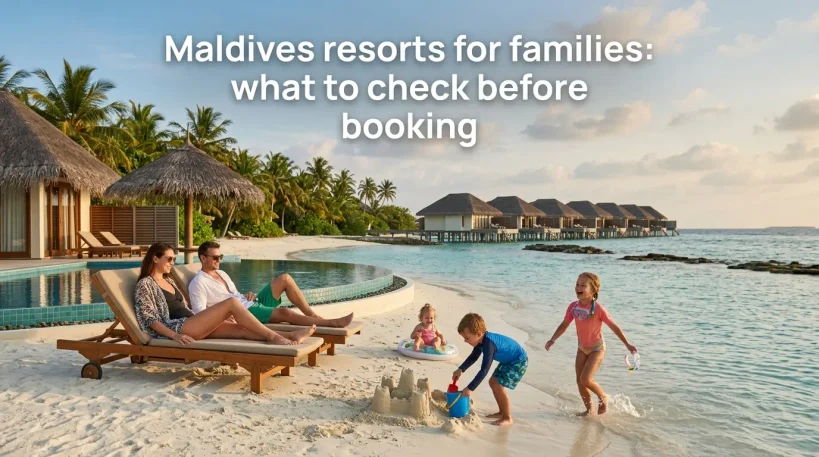
Choosing a Maldives Resort for a Family: The Lagoon Matters More Than the Kids’ Club
Every family-focused review of Maldivian resorts leads with the kids’ club. That is a room with staff in it, and most properties have a decent one.
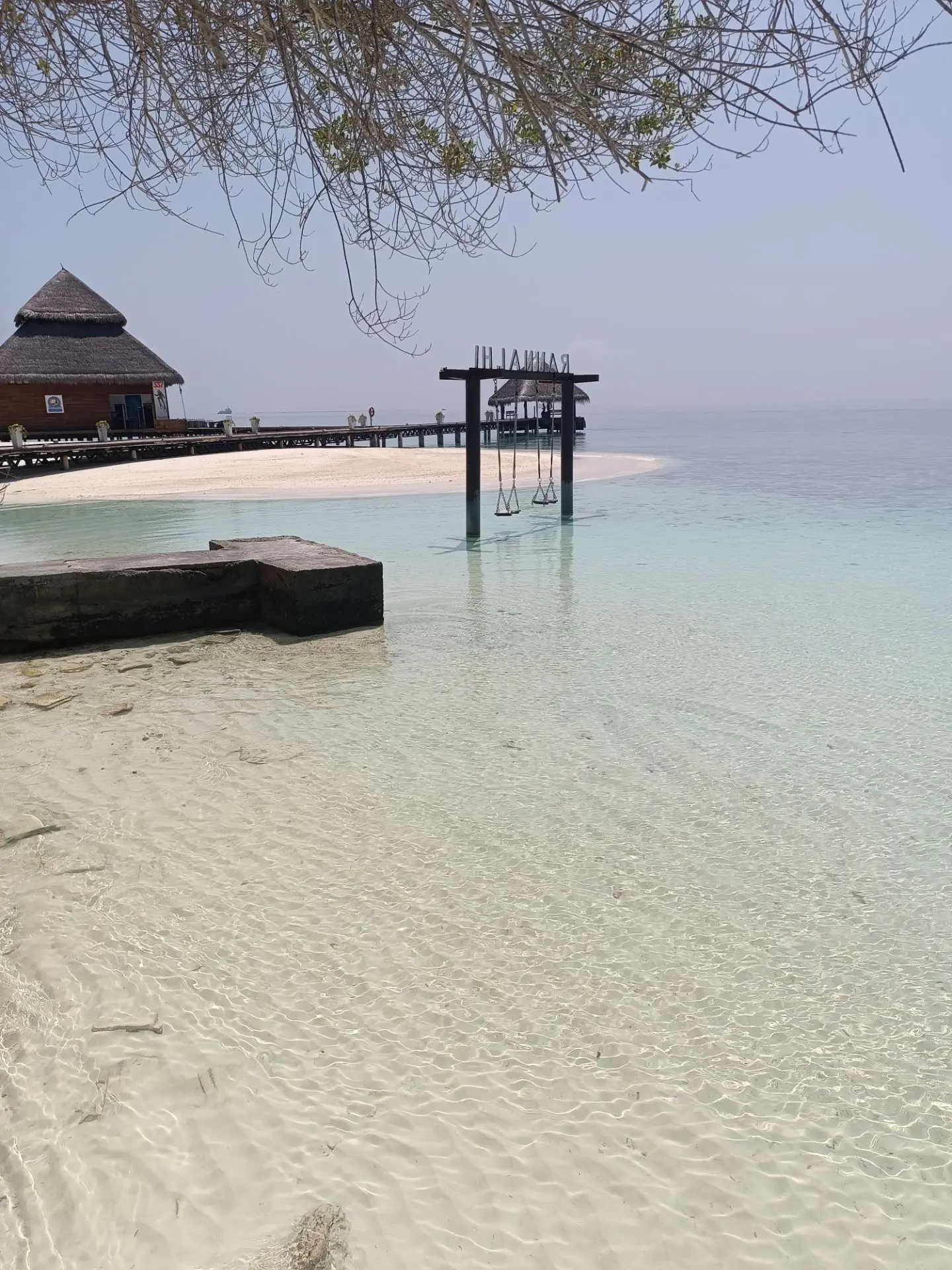
What actually decides a family week is the water at the end of the beach. Whether a five-year-old can stand up in it, whether the entry is sand or rubble, and how far the shallow part extends.
And here is the part nobody says: the house reef that makes a resort brilliant for snorkellers makes it worse for small children. A drop-off twenty metres from the beach is what divers pay for and what parents of a four-year-old should avoid.
The inversion nobody mentions
Worth stating carefully, because it contradicts the advice on the rest of this site.
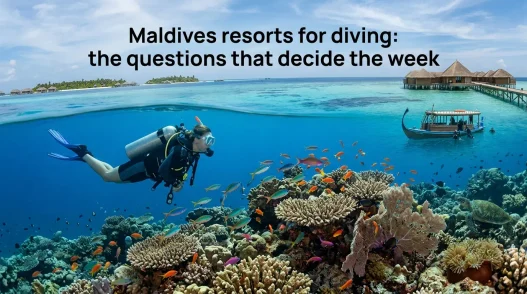
Our guide to reading a house reef argues that a close drop-off is the thing to look for, and it is — for snorkellers and divers.
For small children it is the opposite. What you want is a wide, shallow, sandy lagoon: warm water at knee height for fifty metres, no coral underfoot, no current, and a gradual edge rather than an abrupt one.
Which means the properties this site is generally lukewarm about — the lagoon islands, with the reef four hundred metres out — are frequently the best ones in the country for this.
How to check it, on the same satellite image. Pale turquoise close to the beach is shallow sand, and for a family that is the feature rather than the flaw. Look for a broad pale band on at least one side.
The compromise property has both: a shallow lagoon on one side and a reef edge on the other. These exist, they are not rare, and they suit a mixed group — one parent snorkelling, one with a toddler.
Ask directly: how far out can a child stand, and is the bottom sand or coral rubble?
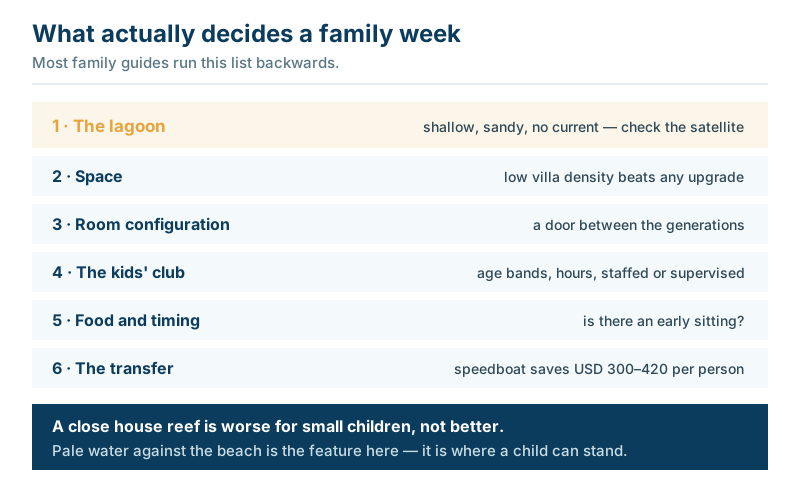
What actually matters, in order
1. The lagoon, as above.
2. Space. They need room, and low villa density delivers it in a way no upgrade does. Our guide to island size sets out how to measure density from a map — and a dense island with a family in the next villa is a different week from a spacious one.
3. Room configuration. Where everybody sleeps, and whether the parents get an hour after bedtime — see below.
4. The kids’ club, which matters, and fourth.
5. Food and timing. Whether they can eat at six, whether there is anything they will actually eat, and whether the buffet is a queue.
6. The transfer. The most underestimated variable in a family trip, and covered in its own section.
What matters less than the brochures suggest: the water slide, the number of pools, and the amount of scheduled activity.
The kids’ club, properly assessed
Four questions, and the answers vary far more than the descriptions.
What are the age bands, and where is the cut-off? Four to twelve is the common range. Under-fours are frequently excluded, or admitted only with a parent, which is not childcare.
Are the hours continuous? Nine to five with a lunch closure is a different offer from nine to five.
Is it staffed or supervised? A ratio and trained staff, or a room with a television and somebody watching it.
Is there a babysitting service, and at what cost? Usually available, usually chargeable at USD 15 to 30 an hour, and usually needing a day’s notice.
Two more worth asking: what languages do the staff speak, and is there an evening session so parents can eat dinner alone?
And one honest caution: these work for children who like them. Some do not, and a week built around the assumption goes wrong on day two.
Room configuration
The decision that determines whether the adults get an evening.
A single villa with a sofa bed means everybody in one room, and lights out at eight for all of you.
A family villa or a two-bedroom puts a door between the generations, which is the single largest quality-of-life difference available. Frequently better value than two separate rooms.
Connecting villas achieve the same thing and need asking for by name — booking platforms show them inconsistently.
Overwater villas are the wrong choice with young ones. Open decks, ladders into deep water, glass floors, and no beach outside the door. Some properties will not sell them to you at all, and our villa comparison explains why.
A beach villa with a private pool is the upgrade that earns its money: contained shallow water at two in the afternoon, which is exactly when the lagoon is least usable.
And check the layout, not the square metreage. One large open space is worse than a smaller villa with a partition.
By age
The same island suits different families differently.
Under two. The lagoon, shade and a routine. Cots are standard, high chairs are standard, and the transfer is the hard part. Most of the week happens within fifty metres of the villa.
Two to five. The best age for a Maldivian lagoon: shallow warm water, sand, and no traffic anywhere on the island. Kids’ clubs frequently exclude this band, so plan for the parents being the entertainment.
Six to eleven. The sweet spot. Kids’ clubs, snorkelling in shallow water, sandbank trips, dolphin cruises, night fishing and enough independence to let the adults read for an hour.
Twelve and over. Diving from twelve at most centres, water sports, and the same activities as adults — at which point the property choice looks more like a diving decision than a family one.
Mixed ages are the hardest, and the answer is space: a larger island with more to do beats a smaller one with a better kids’ club.
The transfer, which is the hard part
Underestimated by everybody, and it shapes the whole trip.
Seaplanes are loud. Not dangerously, but a small aircraft with an open cabin is uncomfortable for young ears — bring ear defenders, which nobody tells you and which transform the flight.
Seaplanes fly in daylight only, stopping between about 15:30 and 16:00. An international arrival after roughly 14:00 misses the last one, which means a night near the airport with exhausted children — the arithmetic is in our guide to missed connections, and the accommodation options are in our guide to hotels in Malé and Hulhumalé.
Speedboats are noisy and bouncy and take thirty to ninety minutes, and they run at any hour — which for a family is worth more than the comfort difference.
Transfers are charged per person, including children at most properties from about two years old. Four people on a seaplane island pay four fares of USD 400 to 820.
Which makes a speedboat island the default recommendation here, on cost, on timing flexibility and on the misery avoided. Our transfers guide covers the modes.
And build a buffer on departure. A cancelled transfer with children and a fixed international flight is the worst version of a Maldives problem.
What a family day actually looks like
Worth setting out, because the rhythm is dictated by the sun rather than by the resort.
Six thirty. Somebody is awake. On a Maldivian island this is fine — the light is beautiful, the beach is empty and the water is flat.
Seven to ten. The best hours of the day and the ones the whole week should be built around. Lagoon, sand, snorkelling in shallow water.
Ten to eleven. Breakfast, or a second one.
Eleven to three. Indoors, shaded or in a pool. This is not optional at the equator with children, and the properties that handle it well are the ones with shade, a pool and somewhere air-conditioned that is not your villa.
Three to six. Back in the water, and this is when the kids’ club, the excursions and anything organised happen.
Six. Early dinner if the property offers it, which is the single most useful facility on this list.
Seven thirty. Small children are asleep, and the parents get an evening if — and only if — there is a door between the rooms.
What this means for booking: shade, a pool, an early sitting and a two-room villa. Four features, all checkable in advance, and together they matter more than everything else in this article except the lagoon.
Sun and heat, which is the actual risk
Not sharks, not the water, and not the food.
The equatorial sun burns a child in under twenty minutes at midday, and the water reflects. A rash guard is worth more than any amount of sunscreen because it does not wash off or get missed.
Structure the day around it. Water from seven until ten, indoors or shaded from eleven until three, water again from four. This is what everybody on the island does by day three and what nobody plans for on day one.
Shade on the beach is not guaranteed. Some properties have umbrellas and mature palms; some have neither. Look at the vegetation on the satellite image, as our guide to island size describes.
Hydration. Children drink less than they should in this heat, and bottled water may be charged outside an all-inclusive package.
Reef shoes all round, because the entry is not always sand and coral cuts infect quickly in warm water.
And the sea itself. There are no lifeguards anywhere in the country, at any property, as our safety guide sets out. Supervision is entirely yours.
Medical, and what to bring
Short, and worth thinking about before rather than after.
Larger resorts have a doctor or a nurse on the island, and it is one function of island size. Smaller properties have neither, and the nearest facility is a boat ride away.
Ask which, specifically, before booking with young children.
Serious cases go to Malé, which is a transfer away — the same transfer that brought you.
Bring what you rely on. Children’s paracetamol, rehydration sachets, plasters, antiseptic, an antihistamine, and anything prescribed. Resort shops stock little and charge accordingly.
Insect repellent for dusk, more useful on a densely planted island than on a bare one.
And check the insurance covers them for the activities they will actually do, including any water sports — several policies exclude the motorised ones.
Food, which decides more than it should
The daily variable that parents notice most.
Buffets suit children well — visible food, no waiting, and they can eat what they recognise, which is not always true of Maldivian cooking.
Ask about children’s meal times. An early sitting at six is what families want and not every property offers it.
Ask what is on the children’s menu, because “children’s menu” can mean pasta and chips for seven days.
All-inclusive frequently pays off here, because soft drinks, ice creams and snacks accumulate invisibly on half board. The arithmetic and the child supplement rates are in our guide to budget and all-inclusive.
Milk, formula and baby food should be brought rather than assumed. Resorts will heat and store things; they will not necessarily stock what you use.
And the buffet at eight is not a family dinner. It is the reason the early sitting matters.
When to go with children
The seasonal question has a different answer for families than for anyone else.
School holidays are peak season, which is unfortunate and unavoidable. December to April coincides with the dry season, the highest prices and the fullest islands — the comparison is in our high and low season guide.
The shoulder months — late April, May, October, November — are substantially cheaper and the weather is workable. If your children are not yet at school, this is the largest single saving available.
The wet season is not a washout. Rain arrives in squalls and passes, and what actually gets cancelled is boat trips, not beach days — the distinction our rainy day guide draws. With young children who spend the week in the lagoon anyway, the wet season is a better trade than it looks.
Heat is constant at 26 to 32°C year-round, so there is no cooler month to aim for. The monsoon guide covers what does vary.
And one date to check: Ramadan changes nothing at a resort and a great deal on an inhabited island, which matters only if you are doing a split stay.
Adults-only islands, and why it matters
A whole category is closed to you, and it is worth knowing the shape of it.
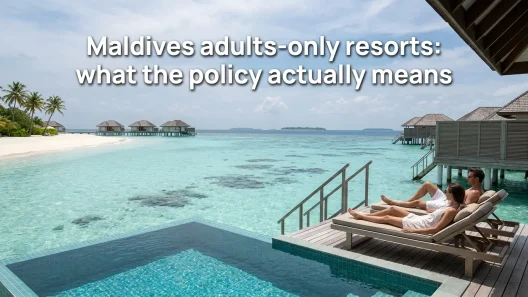
Adults-only properties exclude children entirely, usually under sixteen or eighteen — the detail is in our guide to adults-only resorts.
Which removes a meaningful slice of the market, particularly at the upper tiers where quiet is the product.
Some properties are adults-only in parts: an adults-only pool, restaurant or wing on an otherwise family island. Worth asking about, because it is where the compromise lives.
And the reverse is also true. A property that markets itself to families will have families on it, which is what you want with children and precisely what to avoid without them.
A guesthouse island with children
The alternative worth considering, and it works better than people expect.
Other children. A village has a school, a football pitch and a population, and Maldivian islands are safe in a way that surprises visiting parents.
The cost difference is enormous. A week for two adults and two children on a guesthouse island is a fraction of the resort equivalent.
What you give up: the kids’ club, the pool, the lagoon-with-a-lifeguard illusion, and any alcohol.
What you need to check: the bikini beach, since that is the only place children can swim in swimwear, and its quality varies enormously — our guide to choosing a local island covers it.
Best for ages six and up, where other children and a beach are enough. Under-fives are better served by a resort’s shallow lagoon and shade.
And the split stay — a few nights on an inhabited island, a few at a resort — works well with older children and gives them two countries rather than one, as our comparison of the island types describes.
What it costs
Child rates on the room vary: many properties allow one or two children free in an existing villa, and family villas are priced as a category rather than per person.
Board supplements for children run roughly 50 per cent of the adult rate for older children and free for under-sixes, which shifts the all-inclusive calculation.
The transfer is per person, from about two years old.
The kids’ club is usually free at family properties, and babysitting is not.
And the 28.7% applies to everything chargeable, as our guide to money in the Maldives explains.
The comparison worth doing: total trip cost divided by nights, including four transfers rather than two. It reverses shortlists, and the method is in our guide to budget and all-inclusive.
The questions to ask
Eight, by email, before booking.
1. How far out can a child stand in the lagoon, and is the bottom sand or rubble?
2. What are the club’s age bands and hours, and is it staffed or supervised?
3. Do you have family villas or connecting rooms, and what is the layout?
4. Is there an early dinner sitting?
5. Is there a doctor or nurse on the island?
6. What does the transfer cost for two adults and two under-tens, each way?
7. Are cots, high chairs and a bottle steriliser available?
8. And is any part of the property adults-only?
A property that answers all eight quickly is a property that has families regularly, which is itself the answer to the question you were asking.
Questions travellers ask
What should I look for in a Maldives resort for a family? The lagoon first — a wide, shallow, sandy area where children can stand — then space, then room configuration, then the kids’ club. Most guides run that list backwards.
Is a good house reef better for families? Not for small children. A drop-off twenty metres from the beach is what snorkellers want and the opposite of what a five-year-old needs. Look for a broad shallow lagoon, ideally on a property that also has a reef edge elsewhere.
Are overwater villas suitable for children? Generally not for young ones. Open decks, ladders into deep water and glass floors are a poor combination, and some properties will not sell them to families at all.
What age is best for the Maldives? Two to five for the lagoon, six to eleven for the full range of activities and kids’ clubs, twelve and over for diving. Under two works but the transfer is the hard part.
Seaplane or speedboat with children? Speedboat, in most cases. It runs at any hour, costs USD 300 to 420 less per person, and avoids the daylight-only deadline. Bring ear defenders if you do take a seaplane.
Is all-inclusive worth it for families? Frequently, because children’s soft drinks, snacks and ice creams accumulate invisibly. Child supplements run around half the adult rate and are often free for under-sixes.
Are there doctors on resort islands? At larger properties, usually. At smaller ones, frequently not, with serious cases transferred to Malé. Ask specifically before booking with young children.
Can we stay on a guesthouse island with children? Yes, and it works well from about six — other children, a football pitch and a fraction of the cost. Check the bikini beach, which is the only place children can swim in swimwear.
What to take away
- The lagoon decides a family week, not the kids’ club. Look for a wide shallow sandy area where a child can stand, and check it on a satellite image.
- A close house reef is worse for small children, not better. The properties this site is usually lukewarm about are frequently the best family islands.
- Book a family villa, a two-bedroom or connecting rooms. A door between the children and the parents is the largest quality-of-life difference available.
- Take a speedboat island. It costs USD 300 to 420 less per person, runs at any hour, and avoids the daylight deadline with tired children.
- Sun is the real risk, and there are no lifeguards anywhere in the country. Rash guards, reef shoes, and the water between seven and ten.
Next step: open the satellite image of your shortlist and look for a broad pale band against at least one beach. Then send the eight questions. A property that answers all of them within a day has families on it every week — which tells you more than any photograph of a kids’ club.