
Snorkelling in the Maldives: The House Reef Decides Your Whole Week
Snorkelling is the free activity that decides whether a Maldives holiday works. Everything else is bought; this you do from the beach, twice a day, for nothing.
Which is why the most consequential thing about your island is something almost nobody checks before booking: whether the reef is a two-minute swim away or four hundred metres of empty lagoon. Two properties in the same atoll, at the same price, differ completely on this.
This guide covers how to tell before you book, what you will actually see, when to go in, and the technique that separates a good hour in the water from a cold, tired forty minutes.

What “house reef” actually means
The phrase appears in every resort description and covers four completely different situations.
A close drop-off. The snorkelling edge sits ten to fifty metres from the beach, and the wall falls away from two metres to twenty. You walk in, swim briefly and you are at the good part. This is the arrangement that makes a property.
A reef flat with a distant edge. Shallow coral rubble for a hundred metres or more, then the drop-off. Swimmable, tide-dependent, and at low water you may not be able to cross it without touching.
A wide sandy lagoon. Beautiful, warm, turquoise, and largely empty. The reef is a four-hundred-metre swim away or a boat ride. Many of the most photographed islands in the country are exactly this.
A channel edge. The island sits beside a kandu, which means current, big animals and genuine hazard. Superb for confident swimmers on the right tide, unsuitable otherwise.
The words “house reef” tell a snorkeller none of this. It appears in the description either way, and the difference is the whole snorkelling experience.
How to check before you book
Three ways to establish what the snorkelling will be like, in ascending order of reliability.
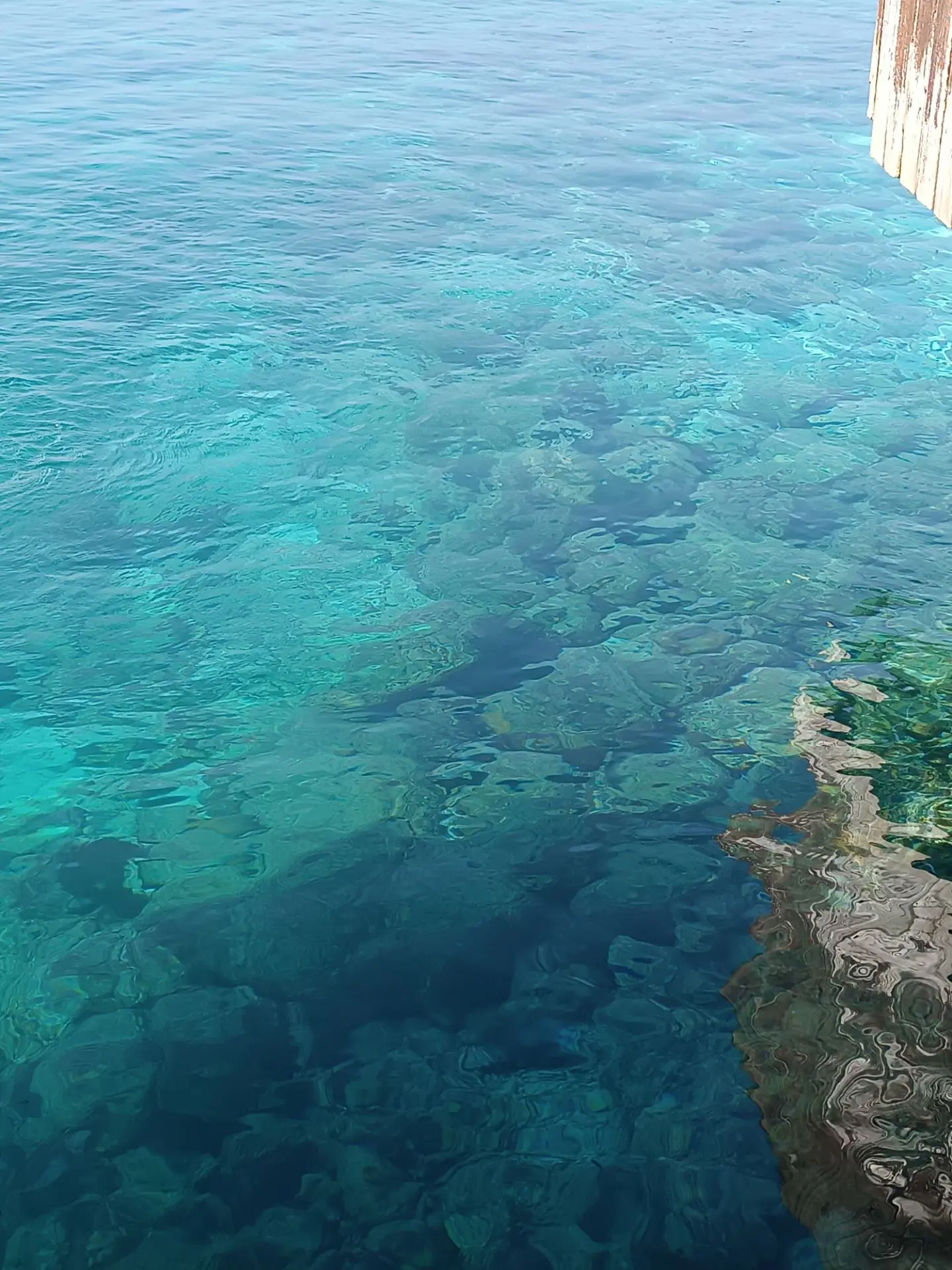
Read the satellite image. Open the island in any satellite map view and read the colours. Pale turquoise is shallow sand. Dark blue-green is reef. Deep blue is the drop-off. If a dark ring hugs the shoreline, the reef is close. If a broad pale halo surrounds the island before any darker colour appears, you have a long lagoon swim. This takes thirty seconds and is the single most useful pre-booking check in this article.
Ask a specific question. Not “is there a house reef” — the answer is always yes. Ask: “How many metres from the beach is the drop-off, and where is the entry point?” A property with a good reef answers immediately and precisely. A property with a lagoon answers vaguely or talks about boat trips.
Read snorkelling-specific reviews. Search reviews for the words “lagoon”, “far”, “walk out” and “boat”. The complaints are more informative than the praise.
One structural note: this varies by atoll geography rather than by price. A modest guesthouse on an island with a close drop-off out-snorkels a luxury resort in a wide lagoon, every day of the week — an argument our resort and inhabited island comparison makes about other things too.
What you will actually see
By zone, because the reef is layered and most people only visit the top of it.
The reef flat, one to three metres. Where most snorkelling happens. Parrotfish grazing, wrasse, damselfish, blue-green chromis in clouds, juvenile everything. The nursery. Easy, warm and busy.
The reef edge, three to eight metres. The best snorkelling in the country, and the zone worth swimming out to. Butterflyfish, angelfish, sweetlips, moray eels in holes, coral formations that read as architecture. Turtles cruise this zone, and our turtle snorkelling guide covers where they concentrate.
The wall, eight metres and down. Where you look rather than go. Schooling fusiliers, jacks, occasionally a reef shark passing below, and on a good day an eagle ray. You do not need to descend to see any of it — visibility does the work.
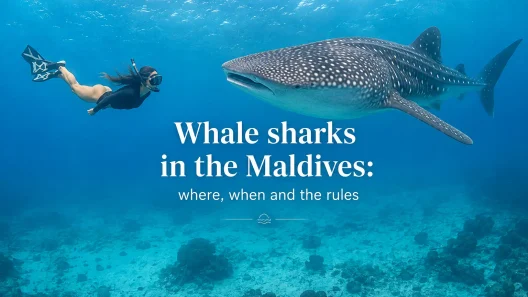
The blue. Off the wall, over nothing. Where the large animals move: mantas at cleaning stations, whale sharks in the South Ari protected area, and pelagic schools.
What you will not see much of: untouched hard coral. The 2024 bleaching event removed more than 40% of live coral in the central atolls, and the honest picture is in our guide to reef health. Fish life recovers faster than coral, so the snorkelling remains excellent — it simply looks different from a 2014 photograph.
Blacktip reef sharks, and the fear conversation
Worth addressing directly, because it stops people getting in.
You will see blacktip reef sharks in the shallows, frequently and close to shore. They are typically under a metre and a half, they are eating small fish, and they are not interested in you. Baby blacktips patrol the lagoon edge of most islands at dusk.
You may also see whitetip reef sharks resting under coral heads, and nurse sharks on excursions.
Attacks on snorkellers in the Maldives are essentially unheard of. The genuine hazards in the water are current, sun and stonefish — all covered in our safety guide, none of them shaped like a shark.

When to get in
For snorkelling, time of day and tide matter more than the month.
Early morning, from about seven. Flat water, low wind, best light, fewest people and the most active fish. If you snorkel once a day, do it now.
Late afternoon, from about half past four. The second-best window. Predators become active and the light returns.
Avoid eleven to three. Vertical sun, flat light, maximum burn risk and the least interesting fish behaviour.
High tide over a reef flat. More water above the coral means you can cross without contact. On a shallow flat, low tide can make the swim impossible without standing — which you must not do.
Slack water at a drop-off. The hour around the turn of the tide is the calmest. A running tide at a reef edge moves you faster than you expect.
Rain does not matter to a snorkeller. Overcast reduces colour slightly. Wind matters far more, because chop makes breathing through a snorkel unpleasant and cuts surface visibility to nothing.
For the seasonal picture — which months bring which animals, and which side of the atoll — our diving season calendar applies to snorkellers exactly as it does to divers.
House reef or boat trip
Both, and they answer different snorkelling questions.
The house reef costs nothing, has no schedule, and can be swum twice a day for a week. Familiarity is its advantage: by day four you know where the turtle sleeps and which coral head the moray lives under.
A guided boat trip costs USD 30 to 60 per person and takes you to reef structures a swimmer cannot reach — thilas, giris, channel edges, and sites chosen for that day’s current. Half-day trips typically include two stops.
Sandbank and picnic trips include a snorkelling stop as part of the package, covered in our sandbank guide.
The specialist trips — whale sharks, mantas at Hanifaru, night snorkelling — have their own guides on this site and their own etiquette.
The pattern that works for most people: the house reef every day, and two guided trips across a week. Our excursion price reference covers what the rest of the list costs.
Where the snorkelling is good
Snorkelling quality follows island type rather than brand, because properties change and geography does not.
Guesthouse islands with close reefs. Maafushi and its neighbours across South Malé, plus islands in North Ari such as Ukulhas and Dhigurah, and Rasdhoo. Cheap, and the water is identical to the resort next door.
South Ari for whale sharks, year-round, from both resorts and guesthouse islands.
Baa Atoll for Hanifaru Bay between roughly June and November, which is snorkel-only by regulation and the best marine spectacle in the country.
Vaavu and the channel atolls for confident swimmers who want current and big animals.
Kaafu, meaning North Malé and South Malé, for accessibility — the shortest transfers and the widest choice of property.
Which region suits your trip overall is the question our atoll decision guide and the complete atolls guide exist to answer.
Equipment: what to bring and what to rent
Bring your own mask. The single highest-return item any snorkeller packs. A rented mask that leaks turns a week of snorkelling into a week of stopping every four minutes to clear it. A mask that fits costs little and packs small — press it to your face without the strap and inhale through your nose; if it holds, it fits.
Bring a rash guard. Long-sleeved, UV-rated. It is more effective than any sunscreen over three hours, it protects against reef scrapes, and it removes the biggest single injury risk in the country. Our guide to what the sun actually does here covers the rest.
Rent fins. Bulky, heavy in a seaplane baggage allowance, and universally available. Short fins are easier than long ones for surface swimming.
Take a float or a noodle if you are not a strong swimmer. Snorkelling with one is normal here. Every operator has them, nobody thinks less of you, and it removes the fatigue problem entirely.
Consider a snorkelling vest. Inflatable, low-profile, and it lets a nervous swimmer relax enough to actually look down.
Reef-safe sunscreen, on the parts a rash guard does not cover. Oxybenzone and octinoxate are implicated in coral stress and many resorts ask guests to avoid them.
Skip the full-face mask for anything beyond a lagoon paddle. They limit exhalation, they make duck-diving impossible and they are not recommended by most operators.
Technique that makes the difference
Five snorkelling habits, none difficult, all of them the difference between an hour in the water and twenty minutes.
Breathe slowly and deeply. Panic starts with fast shallow breathing through a tube. Slow it down deliberately in the first minute and everything else follows.
Let the fins do the work. Arms at your sides. Slow, long kicks from the hip, not fast ones from the knee. Arm swimming exhausts people in ten minutes.
Stay horizontal and relaxed. A snorkeller who hangs vertically is working against their own buoyancy the whole time.
Clear the snorkel with one sharp exhale, then breathe gently. Do not gasp; the tube still holds water at the top.
Spit in the mask, rub it, rinse it. The oldest trick in the sport, and it works better than every product sold to replace it.
If you duck-dive, equalise on the way down and never hold your breath on the way up. Do not duck-dive alone.
The genuine hazards
Three genuine snorkelling hazards, and none of them has teeth.
Current is the real one. Water at a reef edge or channel mouth moves faster than it looks from the beach, and the trip back is always harder than the trip out. Ask before you swim — resort staff and guesthouse owners know their own channel and the answer changes through the day. Never snorkel alone near a channel, and if you find yourself drifting, swim across the current rather than against it.
Sun is the most common injury on the whole list. A back exposed for three hours at the equator burns severely, and the water hides it completely.
Contact injuries. Stonefish in shallow rubble, urchins around jetty pilings, fire coral, and coral cuts that infect fast in warm water. Reef shoes for entry, and hands to yourself.
There are no lifeguards. Anywhere. On any beach in the country, resort or otherwise. The responder is whoever is nearest, and rescue services are not comparable to those at home.
Several tourists drown in Maldivian waters every year, and the overwhelming pattern is a snorkeller alone near a channel who tired on the way back. It is entirely preventable and it is the reason this section exists.
Nervous swimmers, non-swimmers and children
The group most often written off, and least fairly.
Nervous swimmers. A vest, a float and a shallow lagoon on a calm morning. Fifteen minutes with your face in the water in waist-deep sand is enough to discover that the equipment works, and most people go further the next day.
Non-swimmers. Snorkelling is genuinely possible with a buoyancy vest and a guide, and many resorts offer exactly this. It is not the same experience and it is not nothing.
Children. From about six with a float and an adult within arm’s reach. Junior masks fit; adult masks on a small face leak constantly and ruin it.
The one snorkelling rule for everybody: enter and exit at the same designated point. Currents run parallel to shore, and the most common minor incident is a swimmer who surfaces two hundred metres down the beach from where they went in.
Glass-bottom boats exist for those who genuinely will not get in, and are covered in our activities overview.
Reef etiquette, and why it is not optional here
The reef is under measurable pressure, and snorkeller behaviour is the part visitors control.
Never stand on coral. Not to rest, not to adjust a mask, not for a photograph. A single foot placement kills growth that took years, and this is by far the most common damage tourists do.
Do not touch anything. Coral, clams, turtles, rays. Skin oils and sunscreen damage tissue directly.
Keep fins up. A kick over a shallow flat breaks more coral than a hand ever would. If the water is too shallow to fin without contact, the water is too shallow.
Do not chase. A turtle that is being followed stops feeding and surfaces early. Hold position and let it come past, which it frequently will.
Do not feed fish, however normal the practice looks.
Take nothing. Shells, coral fragments and sand are all covered by export restrictions, as our guide to banned items explains.
None of this reduces the experience. Every good encounter happens because the animal decided to stay.
What it costs
| Item | Typical cost |
|---|---|
| House reef snorkelling at a resort | Free, equipment included |
| Equipment rental, guesthouse island | USD 5–10 per day |
| Guided half-day boat trip | USD 30–60 per person |
| Whale shark day trip | USD 70–120 per person |
| Hanifaru Bay permit | USD 20–30 per person |
| Hanifaru guided excursion from Dharavandhoo | about USD 60 per person, permit included |
| Marine park fees, other sites | USD 6–15 per person |
| Night snorkelling session | USD 40–70 per person |
Resort prices attract a 10% service charge and 17% TGST, which compound to roughly 28.7% — the mechanism is in our guide to money in the Maldives.
The free option remains the best value in the country, which is the argument for choosing the island by its reef.
The five snorkelling experiences worth planning around
Ranked by what people describe afterwards rather than by what costs most.
1. Hanifaru Bay, in season. Snorkelling only, by regulation, and the largest manta feeding aggregation on earth. June to November, peaking July to September, permit-controlled and guided. Nothing else in the country compares.
2. Whale sharks in South Ari. A full day on a boat and several entries into open water, snorkelling beside an animal the size of a bus. Year-round.
3. Your own house reef, on the fourth morning. Unglamorous and consistently what people miss afterwards. By day four you are not looking for things; you are noticing what changed.
4. A channel-edge snorkel at slack water, with a guide who knows the tide. The closest a snorkeller gets to what divers see, and it needs the right conditions and the right supervision.
5. Night snorkelling. Lights over the water, plankton drawn in, and whatever arrives to feed. Covered in our night snorkelling guide.
What is missing from this list is any resort’s paid lagoon experience. Snorkelling in a sandy lagoon is swimming, and swimming is free.
Snorkelling with a camera
Briefly, because the full treatment has its own guide.
A phone in a waterproof case works for shallow, bright, close subjects. Beyond about three metres the colour disappears and everything turns blue.
Get close. Water absorbs light and colour with distance, so a fish at half a metre photographs better than a reef at three.
Shoot upward or level, never down, and shoot in the morning when the sun is at an angle rather than overhead.
Do not chase a shot. Every rule in the etiquette section overrides every photograph.
Our guide to underwater photography covers gear, settings and sites properly.
The week that works
A snorkelling pattern, from people who get it right.
Day one: the house reef, in the shallow zone, in the morning. Learn the entry, the exit and the layout.
Day two: the same reef at the drop-off, and again at five in the afternoon. It is a different reef at a different hour.
Day three: a guided boat trip to a thila or a channel edge, where a guide reads the current for you.
Mid-week: the specialist trip, whichever the season supports — whale sharks, mantas, or the night session.
The rest: the house reef, twice a day, until you know it. That familiarity is what people describe afterwards, rather than the excursions.
Two or three paid trips across a week is the right number, as our activities overview argues. The rest of it is free and it is better.
Questions travellers ask
Is snorkelling free in the Maldives? At most resorts, yes — equipment is provided and the house reef is swum from the beach. On guesthouse islands, expect USD 5 to 10 a day for rental. Guided boat trips cost USD 30 to 60.
What is a house reef and does every island have one? Every island has reef somewhere. The question is distance: some drop-offs are ten metres from the beach, others are a four-hundred-metre swim across a sandy lagoon. Check the satellite image before booking — dark colour close to shore means close reef.
Do you need to be a strong swimmer? No. A buoyancy vest or float makes snorkelling accessible to weak swimmers and even non-swimmers with a guide. Current, not swimming ability, is the thing to respect.
When is the best time of day to snorkel? Early morning, from about seven — flat water, best light, most active fish. Late afternoon is the second window. Avoid the vertical sun between eleven and three.
Are there sharks, and are they dangerous? Blacktip reef sharks are common in the shallows and are not a threat. Attacks on snorkellers in the Maldives are essentially unheard of. The real hazards are current, sun and stonefish.
Can children snorkel? From about six, with a float, a properly fitting junior mask and an adult within arm’s reach. Adult masks leak on small faces and ruin the experience.
Has the coral recovered from the bleaching? Partially. Central atolls lost over 40% of live hard coral in 2024. Fish life recovers faster than coral, so the snorkelling is still excellent, but the reef looks different from older photographs.
What should I bring from home? A mask that fits and a long-sleeved rash guard. Rent fins locally. Both items cost little, pack small and transform a week of snorkelling.
What to take away
- The house reef decides the week, and “house reef” in a description can mean a ten-metre swim or a four-hundred-metre one. Read the satellite image before you book.
- The reef edge at three to eight metres is the best snorkelling in the country, and you reach it from the beach on the right island.
- Morning, from seven, on a high tide over a flat or slack water at a drop-off. Wind matters more than rain.
- Bring a mask that fits and a rash guard. Rent everything else.
- Current is the genuine hazard, not sharks. Ask before you swim, never snorkel alone near a channel, and never stand on coral.
Next step: open the satellite view of the island you are considering and look at the colour around it. Thirty seconds now decides whether you spend the week swimming to the reef or living on it.