


Swimming with Manta Rays in the Maldives: Six Thousand Residents
The Maldives holds the largest documented reef manta population on earth. More than 6,000 individuals have been catalogued by the spot patterns on their bellies, and they are residents rather than migrants, moving between atolls as the monsoon moves the plankton.
That produces two different encounters. At a cleaning station a manta hovers above a coral head while small fish work over it, and you watch for as long as it stays. At a feeding aggregation dozens of animals roll through a plankton soup shallow enough to snorkel.
This guide covers where each happens, the rules at Hanifaru Bay, and what it actually costs — considerably less than most guides suggest.

Two encounters, not one
Cleaning stations. Coral outcrops where cleaner wrasse remove parasites from visiting mantas. The animals queue, hover and rotate slowly, sometimes for an hour. Divable and snorkellable, calm, and the better encounter for photography and for anyone who wants time to look.
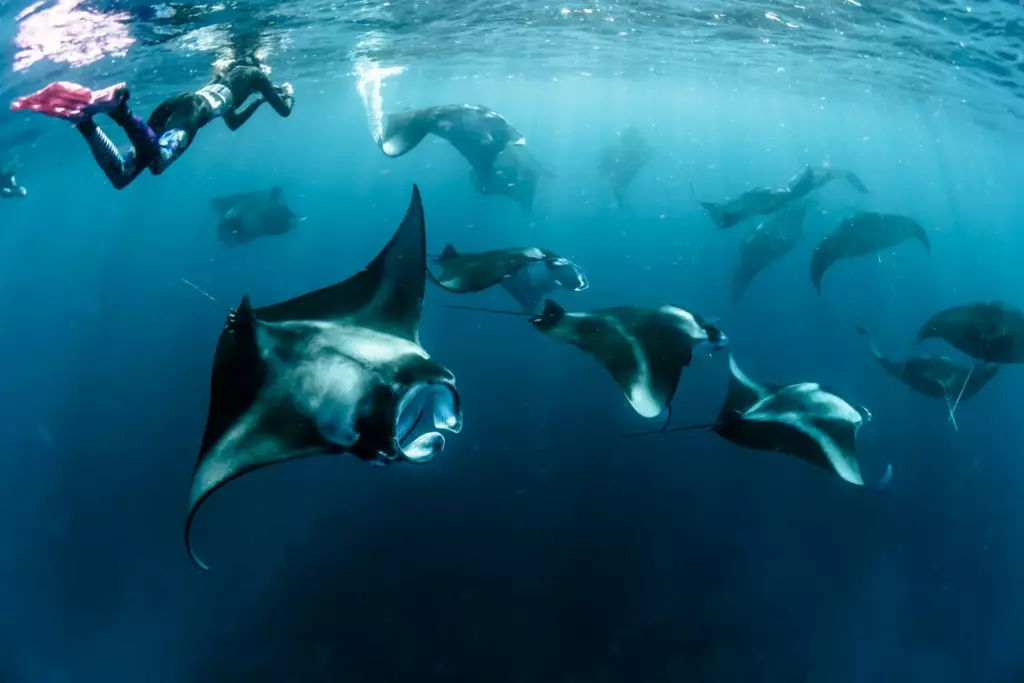
Feeding aggregations. Where currents concentrate plankton into a dense soup, mantas gather to feed by swimming open-mouthed through it, sometimes chain-feeding nose to tail or spiralling in a slow cyclone. Chaotic, brief and overwhelming.
The monsoon decides which you get and where. Plankton is pushed to the downwind side of an atoll, so the feeding happens on the eastern sides during the southwest monsoon and the western sides during the northeast one. Cleaning stations follow the clear water on the opposite side. The mechanism is the same one that governs the whole marine calendar, and our diving season calendar explains it in full.
Hanifaru Bay: the aggregation
A small, dead-end bay off Hanifaru island in Baa Atoll, and the most concentrated manta feeding event documented anywhere.
How it works. Current pushes plankton into the bay, the bay’s shape traps it, and mantas arrive to exploit the concentration. When the density is high enough they feed in formations — chains, and the slow rotating “cyclone” that produces the photographs.
Numbers vary enormously. A typical day is five to twenty animals. A good day is fifty to a hundred. Exceptional days during peak conditions have produced more than two hundred mantas feeding simultaneously, and juvenile whale sharks frequently join them.
The season is the southwest monsoon, roughly May or June to November, peaking August to October, and the biggest events cluster around the new and full moons when tidal flow is strongest.
Protection came in 2009. Hanifaru was declared a Marine Protected Area on World Oceans Day, 8 June 2009, after tourism at the site became unsustainable. In 2011 the whole of Baa Atoll became a UNESCO Biosphere Reserve, with Hanifaru as one of its core zones — the atoll is covered in our Baa guide.
The rules at Hanifaru
Strict, enforced by rangers on site, and the reason the site still works.
Snorkelling only. Scuba diving has been prohibited in the bay since the management plan came in. Mantas feed at or near the surface, so this costs you nothing.
A licensed guide is mandatory. Guides hold a Hanifaru Bay guide licence from the Biosphere Reserve, and each may lead a limited number of snorkellers — commonly cited as a maximum of ten.
Forty-five minutes. One session per visitor per day, managed in windows so the bay is never crowded.
A daily cap. Around eighty visitors per day and a small number of boats, with a limit on how many are in the water at once. Published figures for the simultaneous limit vary between twenty and forty-five, and the rangers apply whatever the current management plan specifies.
Hours are 09:00 to 17:00, with plankton concentration usually best between about 11:00 and 15:00.
No touching, no chasing, no blocking. Approach from the side, never head-on, and never across an animal’s path.
No flash photography, and no motorised devices — no scooters or underwater propulsion in the bay.
Boats drop you outside. Vessels wait in a designated zone and you swim in.
What it actually costs
Here the published figures need correcting, because several guides quote a number an order of magnitude too high.
The permit is USD 20 to 30. It is a token bought at the Hanifaru Visitor Centre on Dharavandhoo island, or purchased in advance by your resort or liveaboard and sold on to you. Proceeds go to the Baa Atoll Conservation Fund.
A guided excursion from Dharavandhoo runs around USD 60 per person, all in, with the permit included.
From a resort in Baa Atoll, expect considerably more, because you are buying the boat and the programme as well as the permit. Resort prices also carry the 10% service charge and 17% TGST that compound to roughly 28.7%, as our guide to money explains.
From a liveaboard, it is generally included in the itinerary.
If you have read that a Hanifaru permit costs a hundred dollars or more, that figure is wrong. It may be conflating the permit with the full excursion price from a luxury property. Our excursion price reference covers the wider picture.

Where else to see mantas
Hanifaru is one site in a country where mantas are resident year-round. If your dates or your atoll do not suit it, the alternatives are real rather than consolation.
Lhaviyani Atoll. Fushifaru Thila is a cleaning station that works across a longer window than the general monsoon rule predicts.
North Malé. Lankan, on the eastern rim, is a classic southwest-monsoon cleaning station and one of the most accessible manta sites in the country.
South Malé. Dhigu Thila, on the eastern side, works on the same seasonal logic.
South Ari. Cleaning stations on the western rim come into their own during the northeast monsoon, from December to April — the season when Hanifaru is quiet. This is the answer for anyone visiting in the dry months.
Rasdhoo and Ari more broadly, with cleaning stations scattered across both rims.
Night manta feeding. Several resorts run lights over a jetty or platform after dark, drawing plankton and, on good nights, mantas that feed at the surface within metres of the deck. It is not guaranteed and it requires nothing of you but standing still. Our guide to night snorkelling covers the wider category.
The practical implication: there is no month with no mantas. There is a month with no Hanifaru, and that is not the same thing.
What to bring and what to expect on the day
The logistics of a Hanifaru session are unusual and worth knowing before you are floating outside the bay waiting for a signal.
A mask that fits. Forty-five minutes is short enough that a leaking rental mask can genuinely cost you the encounter.
A rash guard rather than sunscreen. You are on an open boat before and after, and sunscreen washing off into a plankton-rich bay is exactly what nobody wants — the reasoning is in our snorkelling guide.
Fins, provided. Nothing motorised; propulsion devices are banned in the bay.
A camera without a flash. Or no camera at all, which several experienced guides quietly recommend for a first session.
Patience on the boat. Trips wait for the call that mantas are in the bay. That waiting is the job, and an operator who leaves early to fill another booking is the wrong operator.
Reasonable water confidence. The bay is shallow and sheltered, but you will be swimming in from a drop point among twenty other people and a lot of moving animals. A float is entirely normal.
Nothing dropped or lost. The bay is a protected core zone. Whatever goes in comes out.
Snorkel or dive
At Hanifaru, snorkelling only, by regulation.
Everywhere else, both. Cleaning stations sit at eight to twenty metres, which suits divers well and puts the animals slightly deep for comfortable snorkelling at some sites. Our diving guide covers the certification and cost side, and the snorkelling guide covers technique.
Divers should stay low and still. The commonest mistake at a cleaning station is rising toward the animal, which ends the encounter. Settle on the sand at a distance, keep bubbles away from the station, and let the manta come over you — which it frequently will.
Snorkellers should float, not swim. A manta will pass under a stationary swimmer at a metre or two. It will avoid one thrashing toward it.
The etiquette, and why the animals tolerate you
Reef mantas have no sting and no teeth, and they are curious. Whether an encounter lasts thirty seconds or twenty minutes is almost entirely down to human behaviour.
Do not touch. Manta skin carries a protective mucus layer, and contact damages it.
Do not chase. A pursued manta leaves, and it will remember the site.
Do not swim in front. Approach from the side and let it choose the distance.
No flash. Prohibited at Hanifaru and inadvisable everywhere.
Stay off the reef. At cleaning stations the coral head is the point of the site, and standing on it destroys the station — the condition of Maldivian reefs after the 2024 bleaching event is covered in our reef health guide.
Let them come. The consistent report from good guides is that mantas approach humans who hold position, sometimes closely and repeatedly. Every rule above produces the better encounter as well as the more ethical one.
The research, and what your permit funds
The Manta Trust’s Maldivian Manta Ray Project has been photographing and cataloguing individuals since the mid-2000s. Each manta carries a unique spot pattern on its underside, which functions as a fingerprint, and the database now holds more than 6,000 identified animals.
That makes it the largest documented reef manta population in the world, and one of the best-studied.
What it has shown: the population is resident rather than migratory, moving between atolls with the monsoon rather than leaving the archipelago. That is the finding behind everything in the “where else” section above.
How to contribute. Operators and guests submit identification photographs of manta bellies, and a shot from directly below an animal is genuinely useful to science as well as to your camera roll. Ask your guide where to send it.
Your permit money goes to the Baa Atoll Conservation Fund, which pays for the rangers, the guide licensing and the management plan that keeps Hanifaru functioning. It is one of the clearest cases in Maldivian tourism where the fee does the thing it says it does.
Getting to Hanifaru
Dharavandhoo is the closest inhabited island, about a 31-minute domestic flight from Malé, then a short boat ride. The airport is covered in our guide to Dharavandhoo, and the carriers in our domestic airlines comparison.
Guesthouses on Dharavandhoo run the trips at the prices above and are the budget route, reached by speedboat or public ferry if you would rather not fly — the guesthouse model generally is covered in our comparison with resorts.
Baa Atoll resorts are within boat range and run their own excursions.
Liveaboards working Baa in season reach the bay repeatedly across a week, which is the highest-probability approach if the aggregation is the reason for your trip.
Book ahead in peak season. The daily cap is real, and August to October fills — check the dates against our public holidays calendar too, since domestic flights fill around Eid.
If Hanifaru does not happen
It frequently does not, and a trip built entirely around one bay is a trip with a single point of failure.
The mantas may not be in. Aggregations depend on plankton density, which depends on tide, wind and current. Rangers and guides know when animals are present, and a session in an empty bay is a real possibility.
The cap may be full. In peak season the daily limit is reached, and a late booking can mean no slot at all.
Weather closes it. Strong wind and swell in the southwest monsoon can make the crossing or the swim-in unsafe.
What to do instead. Baa Atoll has cleaning stations and reef diving that stand on their own, and the rest of the country has mantas year-round on the seasonal pattern described above. A week in Baa with two Hanifaru attempts and four other dives is a good week regardless of what the bay does.
And the honest framing: Hanifaru is a phenomenon, not an attraction. It has no opening hours in the sense that matters, and any operator promising a guaranteed manta cyclone is selling something they cannot deliver — the same caution our activities overview applies to guaranteed dolphin cruises.
Improving your odds
Five things that matter, in order.
Come in the season. May or June to November for Hanifaru, peaking August to October — the wider seasonal picture is in our monsoon guide.
Aim for the moon. New and full moons drive the strongest tidal flow and the biggest aggregations.
Go with an operator who watches the bay. Rangers and guides know when mantas are present, and a good operator waits for the call rather than burning the permit on an empty bay.
Stay several days. One 45-minute session on one day is a coin flip. Three days in Baa transforms the odds.
Have a plan B. Cleaning stations elsewhere in the atoll work when the bay does not, and the rest of Baa’s diving is excellent regardless — as our atoll decision guide sets out.
What the animals actually are
Briefly, because it changes how the encounter feels.
Reef manta rays, Mobula alfredi, with a wingspan commonly three to four and a half metres.
No sting, no teeth. They are filter feeders taking plankton through their gills, and are entirely harmless.
Intelligent by fish standards, with the largest brain-to-body ratio of any fish and documented curiosity toward divers.
Slow to reproduce. Reef mantas mature late and produce few pups, which is why a population can be depleted quickly and recovers slowly — and why the protection at Hanifaru matters beyond one bay.
They are also the reason Baa Atoll has a Biosphere Reserve, a conservation fund and a ranger service. A single animal is supporting the protection of an entire atoll.
Manta rays and the wider season
One more piece of context, because it changes how you plan a whole trip rather than a single morning.
The monsoon that drives the manta calendar drives everything else in these waters. The same plankton that fills Hanifaru reduces visibility for divers; the same clear water that makes February superb for diving is the reason the bay is quiet in February.
That trade-off is unavoidable and worth choosing deliberately. A trip built for maximum visibility lands in the dry season and sees mantas at western cleaning stations. A trip built for the aggregation lands in the wet season and accepts fifteen to twenty-five metres of visibility instead of forty.
Divers who want both usually split the difference in September or October, when the aggregation is still running and the water is beginning to clear. Our diving season calendar sets out the mechanism, and the high and low season comparison covers what each period costs.
There is no month that gives you everything, and any guide claiming otherwise has not thought about where the plankton goes.
Questions travellers ask
When is manta season in the Maldives? For the Hanifaru Bay aggregation, roughly May or June to November, peaking August to October and strongest around new and full moons. Elsewhere in the country mantas are resident year-round, moving between eastern and western cleaning stations with the monsoon.
How much is the Hanifaru Bay permit? About USD 20 to 30, bought at the visitor centre on Dharavandhoo or through your operator. A full guided excursion from Dharavandhoo costs around USD 60 per person including the permit. Higher figures usually describe a resort excursion rather than the permit.
Can you dive at Hanifaru Bay? No. Scuba diving has been prohibited there since the management plan was introduced, and only guided snorkelling is permitted. Mantas feed at the surface, so snorkelling is the better view anyway.
How long do you get in the water? Forty-five minutes, once per day, with a licensed Biosphere Reserve guide. The bay operates from 09:00 to 17:00 with a daily visitor cap.
How many mantas will I see? Five to twenty on a typical day, fifty to a hundred on a good one, and occasionally more than two hundred during peak conditions. Whale sharks sometimes join the feeding.
Are manta rays dangerous? No. Reef mantas have no sting and no teeth, and they are filter feeders. They are also curious, and will often approach a swimmer who holds position.
Where can I see mantas outside the Hanifaru season? Cleaning stations on the western rims — South Ari in particular — during the northeast monsoon from December to April, plus Lankan in North Malé, Dhigu Thila in South Malé and Fushifaru in Lhaviyani in their respective windows.
How do I get to Hanifaru Bay? A 31-minute domestic flight from Malé to Dharavandhoo, then a short boat. Guesthouses on Dharavandhoo, Baa Atoll resorts and liveaboards all run trips.
What to take away
- The Maldives has the largest documented reef manta population on earth: more than 6,000 individuals identified, resident rather than migratory.
- Two different encounters. Cleaning stations are calm and year-round; the Hanifaru feeding aggregation is seasonal and overwhelming.
- Hanifaru is snorkel-only, guided, capped, and limited to 45 minutes per visitor per day, from 09:00 to 17:00.
- The permit costs about USD 20 to 30, not the hundred-plus some guides state. A full guided trip from Dharavandhoo is around USD 60.
- There is no month without mantas in the Maldives — only months without Hanifaru. In the dry season, look west.
Next step: if the manta aggregation is the point of your trip, book three days in Baa Atoll between August and October, around a new or full moon. Treat a single 45-minute session in the bay as one attempt at a phenomenon with no timetable, and plan the rest of the week around the atoll’s cleaning stations and reef diving so that nothing depends on whether the mantas turn up on your morning.


