
What Changes When You Cross the Waterline: Resort Island vs Local Island in the Maldives
Most people think they are choosing between an expensive Maldives and a cheap one. They are not. They are choosing between two legally separate tourism systems that happen to share a flag, a language and the same turquoise water.
On a resort island, alcohol is licensed, swimwear is normal everywhere, and nobody lives there except staff and guests. On a local island, alcohol is illegal, swimwear is confined to one marked beach, and you are a visitor in someone’s town. The price gap follows from that difference. It is not the difference itself.
This guide sets out what each system actually is, what it costs after the taxes most published comparisons still get wrong, and how to work out which one belongs on your booking.

Two tourism systems, one country, and the law that separated them
The Maldives opened its first resort in 1972 on an uninhabited island in Kaafu Atoll. The template set then still governs the country: one island, one resort. A company leases an entire uninhabited island from the state, builds on it, and operates it as a closed property. There is no village next door, because there is no next door.
That separation was deliberate. A 1984 law prohibited tourist accommodation on inhabited islands altogether, which kept foreign visitors and Maldivian communities physically apart for a quarter of a century. Tourists saw a coral atoll. They did not see the country.
The rule was lifted in 2009, when the government legalised guesthouses on inhabited islands. The first one opened on Maafushi in 2010 with four rooms, run by a Maldivian entrepreneur on his home island. The World Bank later held up that island as a case study in how tourism revenue could reach a community rather than pass over it.
So the choice in front of you is not a marketing segment. It is the residue of two different legal regimes, one dating from 1972 and one from 2009, operating side by side in the same archipelago. Everything that follows — the alcohol, the dress code, the transfer, the price — descends from that.
What the numbers say about the Maldives you will actually get
Here is where most comparisons mislead by accident. Guesthouses now outnumber resorts by more than five to one, which sounds like parity has arrived. Capacity tells a different story.
As of August 2026, the Ministry of Tourism counts 179 operational resorts holding 45,115 beds, and 944 operational guesthouses holding 17,010 beds. So 15% of the properties hold roughly two-thirds of the country’s sleeping capacity. Guesthouses are numerous and small; resorts are few and large.
Arrivals follow capacity, not property counts. Of the 1,241,422 visitors recorded to the start of August 2026, resorts took 902,228 — 73.1%. Guesthouses took 274,687, or 22.6%. Hotels and safari vessels split the remainder. Roughly three in four visitors to the Maldives are still staying in the 1972 system.
One more figure changes how you should read the map. Kaafu Atoll alone holds 8,162 operational guesthouse beds — close to half the national total — with Alifu Alifu a distant second at 2,312. Local island tourism is not evenly spread across 26 atolls. It is concentrated near the capital, where the ferries run and the airport is an hour away.
That concentration has a practical consequence. If you want an inhabited island and you also want a remote atoll, those two wishes pull against each other, and the further you go from Kaafu the thinner the guesthouse network becomes.

The rules change at the waterline
This is the part that decides most trips, and it has nothing to do with budget.
A resort island is effectively a licensed enclave. Bars operate, wine lists exist, bikinis are unremarkable at every beach, and Friday is a day like any other. Because the island is private, none of this offends anyone: there is no community present to offend.
An inhabited island runs on Maldivian law without exception. Alcohol is illegal and no guesthouse or restaurant serves it. Shoulders and knees stay covered outside the designated tourist beach. Friday prayers pause the island around midday, and during Ramadan daytime cafés largely close. Our guide to dress codes, banned items and customs rules covers what customs will confiscate on arrival, and Ramadan in the Maldives explains how the month changes island life.
None of these rules is onerous. Travellers who resent them have usually booked the wrong system rather than encountered an unreasonable one. A cover-up over a swimsuit satisfies the dress code. A floating bar moored offshore, or a resort day trip, satisfies the drink.
What you cannot do is negotiate. There is no version of a local island where the rules relax for paying guests, and there is no version of a resort island where you stumble into Maldivian daily life. Each system delivers exactly what it is built to deliver.

What a night costs once the tax stack is applied
Published comparisons of resort island vs local island prices are unusually unreliable right now, because two tax changes landed recently and a great many guides still print the old numbers. Two examples from articles published in the past week: one states green tax at USD 6 for resorts and USD 3 for guesthouses; another quotes a combined service charge and tax load of 23.2%. Both were correct in 2024. Neither is correct now.
The current position, and it applies to both systems:
- Green tax doubled on 1 January 2025 under the fourteenth amendment to the Tourism Act. Resorts charge USD 12 per person per night. Guesthouses and hotels on inhabited islands charge USD 6, rising to USD 12 if the property has more than 50 rooms. Children under two are exempt.
- TGST rose from 16% to 17% on 1 July 2025.
- Service charge of 10% is standard and is applied before tax, so a resort bill compounds to roughly 28.7% above the menu price rather than the 23.2% still in circulation.
Now the underlying rates. Guesthouse rooms on an established inhabited island run about USD 60–100 a night for a double with breakfast. Resort rates start near USD 300 at the budget end, sit around USD 500–1,200 for mid-range luxury, and pass USD 1,500 at the top.
The transfer is where the gap widens fastest. A shared speedboat to an inhabited island near Malé costs USD 20–40 per person each way. A resort seaplane runs USD 300–600 per person return, and can exceed USD 700.
| Seven nights, two people | Local island | Mid-range resort |
|---|---|---|
| Room | USD 595 | USD 4,900 |
| Transfers | USD 80–160 | USD 700–1,200 |
| Green tax | USD 84 | USD 168 |
| Meals beyond breakfast | USD 210–350 | USD 840–1,750 |
| Excursions | USD 250–400 | USD 600–1,200 |
| Service charge and TGST | included above | roughly 28.7% on resort billing |
| Realistic total | USD 1,200–1,600 | USD 9,000–14,000 |
The ratio is roughly seven to one, and almost none of it is room quality. It is transfer, tax base, service charge and the fact that a private island has exactly one seller of coffee.

Transfers decide more of your trip than the room does
The transfer is the single most underestimated variable in Maldives planning, and it works differently in each system.
Reaching an inhabited island is a transport decision you make yourself. A shared speedboat from Velana International Airport takes 30 to 90 minutes depending on the island and runs every day of the week. The public ferry costs about USD 1.50 and does not sail on Fridays, which catches out more first-time visitors than any other scheduling detail in the country. Our speedboat transfer guide explains how shared boats are priced and timed nationally.
Reaching a resort island is a decision the resort makes for you. Seaplanes fly only in daylight, and the schedule is not published in advance: the resort coordinates with the operator and confirms your flight the evening before. If your international flight lands mid-afternoon, the seaplane window has usually closed, and you will overnight near the airport at your own expense and fly across the next morning. That is a normal outcome, not a failure, and it costs a night you have already paid for at the resort.
Distant atolls add a domestic flight before the boat. Our transfers guide sets out how the three methods work together, the seaplane guide covers the daylight rules in detail, and the transfer cost comparison shows how quickly the numbers move by atoll. If you are landing late, read what to do about a late arrival in Malé before you book anything.
One asymmetry is worth stating plainly. Miss a boat to an inhabited island and you lose a few hours and perhaps USD 40. Miss a seaplane and you lose a hotel night, a transfer fee and a slice of the holiday you booked.

The beach question, and why it is the real dividing line
Ask what people are actually buying at the top of the price range and the honest answer is not thread count. It is emptiness.
A resort island gives you a beach with nobody on it, a house reef you can enter from the sand, and a lagoon you can swim in at any hour wearing anything. The island is landscaped to sustain that impression: paths curve, villas face away from each other, and the staff-to-guest ratio keeps the machinery invisible. That is a manufactured experience, and it is manufactured extremely well.
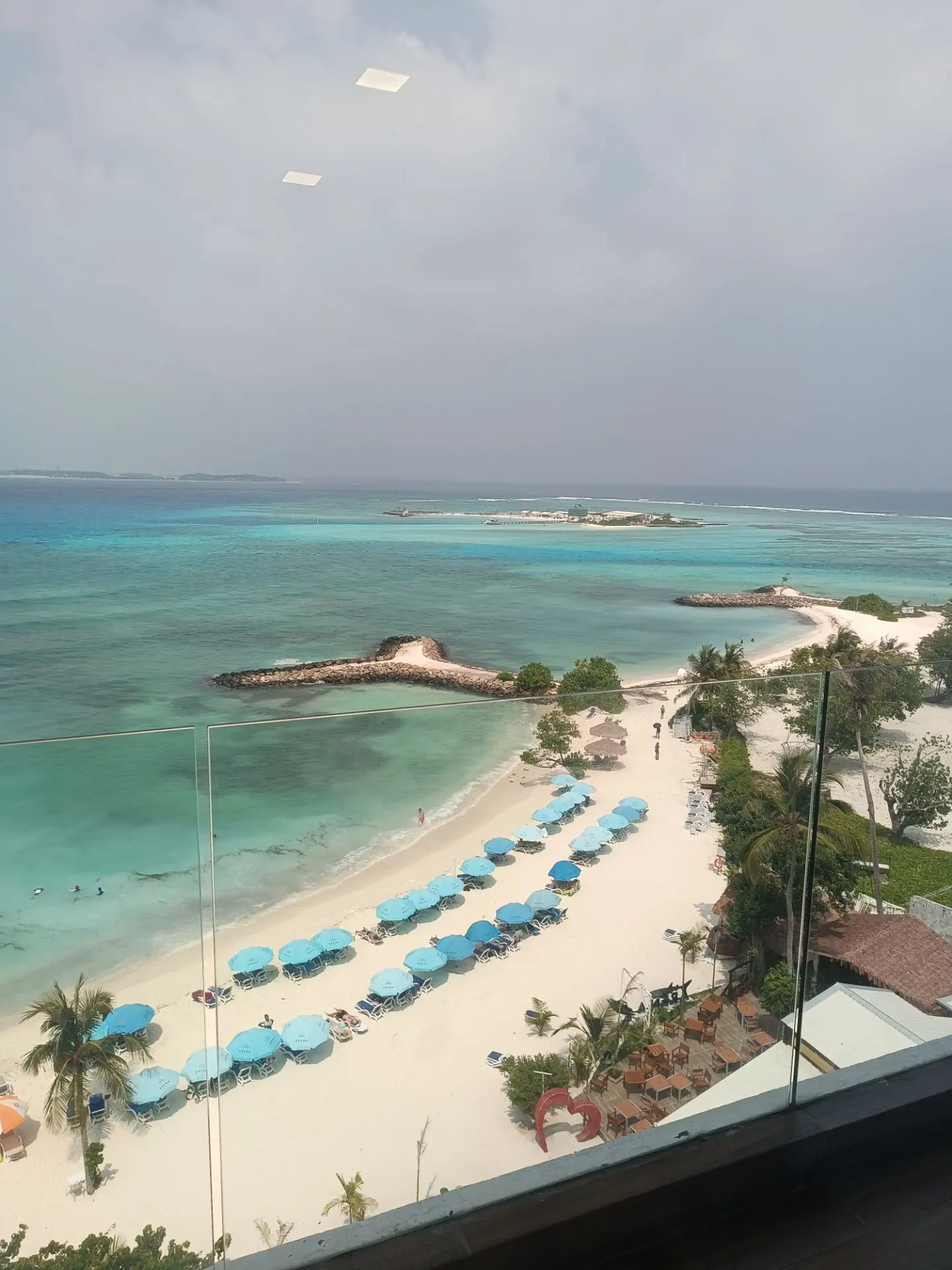
An inhabited island gives you one designated swimwear beach, usually short, often engineered with groynes to hold the sand, and shared with everyone else staying on the island. The water is the same water. The privacy is not the same privacy. Snorkelling generally means a boat rather than a walk, because house reefs adjacent to inhabited islands have taken more pressure and are frequently the weakest part of the offer.
This is the trade-off people most often discover too late. If your image of the Maldives is a private stretch of sand at sunrise, no inhabited island supplies it at any price, and the guesthouse saving buys you something else entirely.

Food, evenings and the thing nobody warns you about
On a resort island you eat where you are. Meal plans exist because à la carte on a private island is expensive by design — half board typically adds USD 50–100 per person per day and all-inclusive more. The food is usually good and occasionally excellent. It is never cheap, and there is no competing restaurant to walk to.
On an inhabited island you eat in cafés that also serve residents. A main course runs USD 5–12 inland and USD 20–30 at the beachfront hotels, and the fish comes off boats you can see. Ask for garudhiya, the clear tuna broth eaten with rice and lime, or hedhikaa, the fried afternoon short eats that cost well under a dollar each. Our guide to Maafushi covers how that works in practice on the busiest of them.
Evenings are the genuine culture shock. A resort has bars, a wine list and something programmed most nights. An inhabited island has a beach, a sky and shops that shut around 22:00. Travellers who need a drink with dinner should book the resort system and stop negotiating with themselves about it — the rule will not bend, and resentment ruins a holiday faster than a mediocre room.

What each system gives you that the other cannot
Set price aside for a moment. These are structural differences, not budget ones.
Only a resort can give you a private beach, a walk-in house reef, alcohol on the island, complete privacy, a room built over water, and a holiday where nothing needs organising after arrival.
Only an inhabited island can give you a Maldivian street and a conversation with someone who is not paid to have it. Excursion prices are set by competition there, not by a single seller, and you can change your mind about tomorrow. Excursions bought from competing desks on an inhabited island routinely cost a third of the resort equivalent for the same reef.
There is also a third option people forget. Safari vessels — liveaboards — carry 23,503 visitors so far in 2026 and dodge the choice entirely: licensed bars, no fixed island, and dive sites reached overnight. They suit divers better than they suit anyone else.
The split stay, and how to do it without wasting a day
The best answer for a large minority of travellers is both, in the right order.
The pattern that works: three or four nights on an inhabited island first, for excursions, food and cost control, then two or three nights at a resort to finish. Book the resort leg second so that a delayed boat costs you guesthouse time rather than villa time, and so the holiday ends on the quieter island rather than the busier one.
Two rules keep it from going wrong. Stay inside one atoll if you can — Kaafu makes this easy, since both systems are dense there — because crossing atolls mid-trip means a second transfer at full price. And avoid a resort that requires a seaplane for a two-night stay, since the daylight window can consume most of both travel days. Our atoll decision guide works through which atolls support the pattern, and South Malé Atoll and Kaafu Atoll are the two pages to read first if you want it simple.
A day pass is the cheaper cousin of the split stay. Guesthouse excursion desks sell resort day passes that include the beach, the pool, lunch and often drinks for a fixed fee. It buys you the resort experience for eight hours without the transfer, and for many people it turns out to be enough.

Which system suits which traveller
The framework below is deliberately blunt. Most people recognise themselves in one row within a few seconds.
| If this describes you | Book | Why |
|---|---|---|
| First trip, one week, want the postcard | Resort island | The image you have in your head is a resort product |
| Honeymoon, privacy matters most | Resort island | Shared beaches undo the occasion |
| Budget under USD 200 a day for two | Local island | The resort floor sits well above this |
| Diving is the point of the trip | Either, or a liveaboard | Compare house reef access against boat-dive cost |
| Travelling with small children | Resort island | Shallow lagoon, kids club, no transfers mid-trip |
| Solo traveller who wants company | Local island | Guesthouses put people in the same boats daily |
| You want to meet Maldivians | Local island | The resort system is not designed for it |
| Two weeks and a flexible temperament | Split stay | Local island first, resort second |
| Alcohol with dinner is non-negotiable | Resort island | It is illegal on inhabited islands |
| You burn easily and hate boats | Resort island | Everything you need is within a short walk |
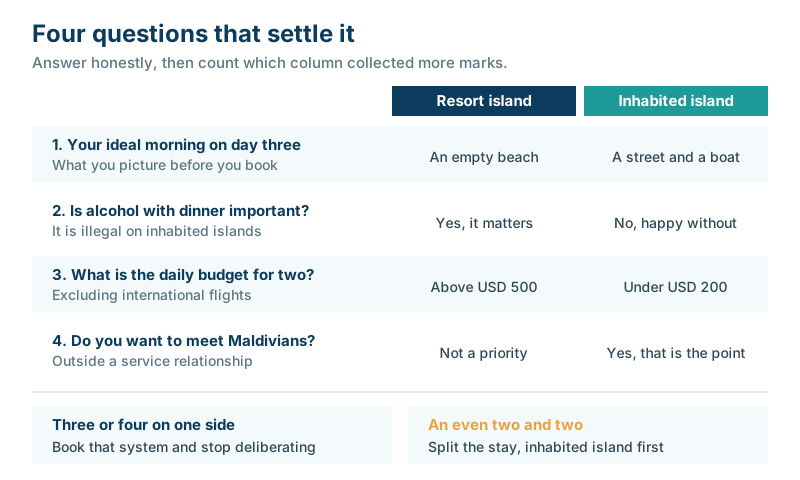
If you are still undecided after that, the deciding question is usually about mornings. Picture waking up on day three. If the picture is an empty beach and coffee brought to a villa, book the resort. If it is a walk past a fish market before a boat leaves at eight, book the inhabited island.
Where each system sits on the map
Geography narrows the choice more than most people expect.
Kaafu Atoll holds both systems at high density: resorts across North Malé and South Malé, and roughly half the country’s guesthouse beds. It is where split stays are easiest and transfers cheapest.
Ari Atoll splits into north and south and carries the country’s second guesthouse cluster, with whale sharks along the southern rim. Rasdhoo is the small-atoll version of the same idea, with hammerheads offshore.
Further out, the balance tips hard toward resorts. Baa Atoll and Vaavu have guesthouses but thin ferry links. Several atolls have no resorts at all, and a few are best skipped entirely unless you have a specific reason. The complete atolls guide maps the whole country, and Malé itself is a third kind of stop that suits a transit night more than a holiday.
When you go changes the answer slightly
The northeast monsoon from December to April brings calm seas and the highest prices in both systems. Boat transfers to local islands are flat and pleasant, seaplane cancellations are rare, and resort rates peak over Christmas and New Year.
From May to October the southwest monsoon brings cloud, rain and choppier crossings. Resort rates fall further in absolute terms than guesthouse rates do, which narrows the gap between the two systems more than most travellers realise — June, July and September are when a resort becomes unexpectedly affordable. February and March are the opposite: the best weather and the worst value.
Ramadan is the one date that changes the inhabited-island experience substantially and the resort experience barely at all. If your dates fall inside it and you want cafés open at lunchtime, that alone may decide your system.

Questions travellers ask before choosing
What is the difference between a resort island and a local island in the Maldives? A resort island is a private, uninhabited island leased to a single company, where alcohol is licensed and swimwear is permitted everywhere. A local island is an inhabited Maldivian town where guesthouses operate under national law: no alcohol, modest dress outside one designated beach, and a resident community.
Can you drink alcohol on a local island in the Maldives? No. Alcohol is illegal on all inhabited islands. The legal alternatives are a floating bar moored offshore in international-style licensing arrangements, or a resort day trip. Do not attempt to bring alcohol through customs; it is confiscated on arrival.
Is a local island much cheaper than a resort? Yes, by roughly seven to one for a comparable week. A realistic seven-night total for two people is USD 1,200–1,600 on an inhabited island against USD 9,000–14,000 at a mid-range resort. Transfers and the tax base account for more of the gap than room quality does.
Can I stay on an inhabited island and visit a resort? Yes. Guesthouse excursion desks sell resort day passes that typically include the beach, pool and lunch for a fixed fee. Confirm whether drinks and the boat transfer are included before paying.
Do I have to cover up on an inhabited island? Outside the designated tourist beach, yes: shoulders and knees covered for both men and women. A T-shirt and shorts is sufficient. Swimwear is fine on the marked beach, on excursion boats and on sandbanks.
Which is better for a honeymoon? A resort island, in almost every case. Local islands are sociable, shared and busy, and none of them offers privacy at any price. A split stay works if you want a few days of island life first, but end the trip at the resort.
Are there resorts on local islands? No. By definition a resort occupies its own uninhabited island. Inhabited islands have guesthouses and hotels, some of them four-star and beachfront, but these are legally a different category and operate under different rules.
Which system is better for the Maldives itself? Guesthouse tourism keeps more revenue on the island where it is spent, which is why the 2009 reform happened. Resorts employ far more people overall and generate the bulk of tax receipts. Both arguments are sound; neither makes the other system illegitimate.
What to take away
- The choice is between two legal systems, not two price tiers. Alcohol, dress and privacy follow from the law, not from the budget.
- Resorts hold 45,115 beds across 179 islands and take 73% of arrivals; 944 guesthouses hold 17,010 beds and take 23%. The resort system is still the default Maldives.
- Check the tax figures in any comparison you read. Green tax doubled in January 2025 and TGST rose in July 2025, and a great deal of published advice is now wrong by a wide margin.
- Transfers separate the systems more sharply than room rates do, and a seaplane’s daylight window can cost you a night you have already paid for.
- If privacy at sunrise is the picture in your head, book a resort. If a Maldivian street is, book a local island. If both are, book them in that order.
Next step: pick your atoll before your property. Decide the system first, then read the atoll guide for the region you are considering, and only then start comparing rooms — that sequence prevents almost every expensive Maldives mistake we see.