Two Currencies, One Country: How Money Actually Works in the Maldives
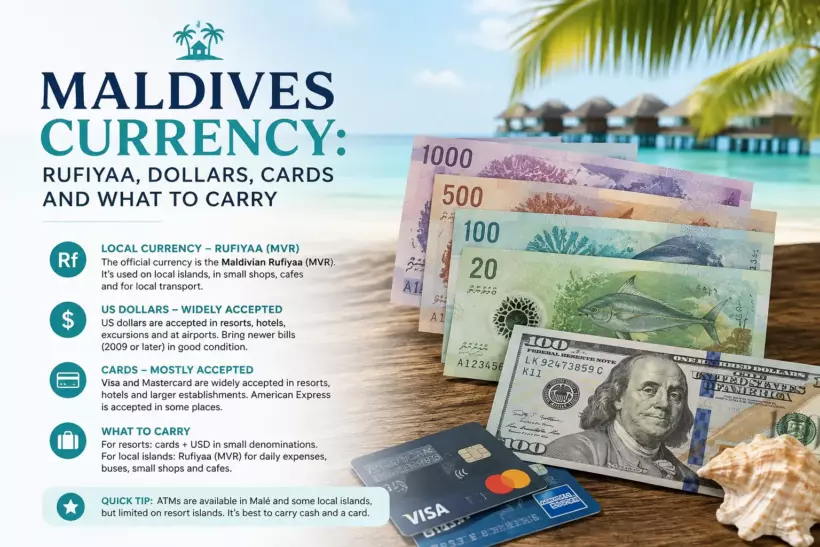
The Maldives runs two currencies at the same time. The rufiyaa is the only legal tender, and the country’s entire tourism economy is priced in US dollars. Which one you need depends almost entirely on what kind of trip you booked.
On a resort island you can spend a week without opening your wallet. On a local island, one afternoon can need dollars for the guesthouse, rufiyaa for the ferry, and small notes for a café that has never seen a card machine.
This guide separates the two, covers a change in Maldivian currency law that most guides missed, and says how much cash to carry.

The rufiyaa in one section
The Maldivian currency is the rufiyaa, code MVR, symbol Rf. One rufiyaa divides into 100 laari. Notes run 5, 10, 20, 50, 100, 500 and 1,000, and the polymer series introduced for the country’s fiftieth independence anniversary is among the more attractive currency in circulation.
Two practical facts matter more than the design. You cannot buy rufiyaa before you travel — it is not sold by exchange bureaus outside the country. And you cannot convert it back once you leave. Those two together produce the single most common money mistake in the Maldives: changing several hundred dollars on arrival and flying home with a fistful of paper that no bank anywhere will take.
The exchange rate is where currency guides get sloppy. You will read that the rufiyaa is “pegged at 15.42 to the dollar”. It is not pegged. Since April 2011 the Maldives Monetary Authority has operated a managed float inside a band of 10.28 to 15.42 rufiyaa per dollar, twenty per cent either side of a 12.85 midpoint. The rate has sat at the ceiling of that band ever since, which makes it behave like a peg without being one.
The distinction is not academic, and the next section explains why.
Why the country runs on dollars at all
For decades the Maldivian economy has had a structural problem: tourism earns enormous quantities of foreign currency, and much of it never entered the domestic banking system. By late 2024 the shortage was severe enough that the Bank of Maldives cut card limits on local accounts, and usable reserves fell to their lowest level in three years.
The government’s answer was the Foreign Currency Act, ratified on 14 December 2024 and in force since 1 January 2025. It does two things travellers should understand.
First, all domestic transactions must now be conducted in rufiyaa — wages, rent, fees, goods and services between residents. Second, tourism businesses must convert a defined slice of their foreign currency earnings through Maldivian banks. Resorts, integrated resorts and resort hotels convert USD 500 per tourist per month, or twenty per cent of gross foreign currency sales. Guesthouses, tourist hotels and safari vessels convert USD 25 per tourist, or the same twenty per cent.
The part that matters to you is the exemption. Transactions with tourists are exempt from the rufiyaa-only rule. You may pay in dollars, and the businesses serving you may quote in dollars, exactly as before. Nothing about your holiday changed on 1 January 2025.
What did change is the pressure behind the scenes, and it explains behaviour you will notice: why guesthouses ask for dollars, why some small operators prefer cash, and why a parallel exchange market exists at all. Which brings us to the rates you will be quoted.
The rate you will be offered, and the one you should decline
Banks and hotels will change dollars at roughly 15.4 rufiyaa. That is the legal rate, at the ceiling of the official band.
You will also find guides — some published in 2026 — advising travellers to seek out private exchangers at the airport at 16.5, banks in Malé at 16 to 17, or shops on certain local islands at 17.5. Those numbers sit above the top of the legal band. They are the parallel market, which the International Monetary Fund has described as a persistent feature of the Maldivian economy with a stable premium, and which the Foreign Currency Act was written specifically to drain.
Our advice is simple and slightly boring. Change at a bank or your accommodation, accept 15.4, and change as little as possible. The premium you are chasing on USD 200 is about USD 13. To capture it you convert more dollars than you need, into a currency you cannot convert back, through a channel the central bank is actively trying to close.
A resort trip: you will barely touch money at all
If you are staying on a resort island, the honest answer to “how much cash should I bring” is: almost none.
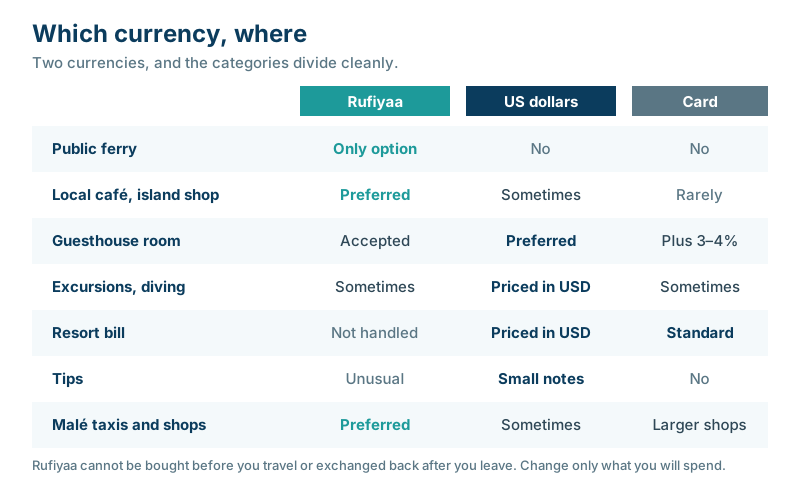
Resorts price everything in dollars, run a tab against your room, and settle once at checkout by card. Restaurants, spa, diving, excursions and the minibar all land on the same bill. Most guests never see a rufiyaa during the entire stay, and many resorts do not handle them at all.
Three things to know about that final bill:
- Service charge and tax compound. A ten per cent service charge is applied first, then TGST at seventeen per cent on top of the total. That is roughly 28.7 per cent above menu prices, not the 27 per cent a straight addition suggests.
- Green tax is separate. USD 12 per person per night at a resort, and it may not appear in the rate you were quoted when booking.
- Decline dynamic currency conversion. When the terminal offers to bill you in your home currency, say no and pay in dollars. The convenience rate is consistently worse than your own bank’s.
The only cash worth carrying is small dollar notes — ones, fives and tens — for the housekeeping envelope and the boat crew. Fifty of those, spread across a week, covers it. Our guide to tipping in the Maldives sets out who is already covered by the service charge and who is not.
A local island trip: cash is the default
Change islands and the working currency changes with it. On an inhabited island like Maafushi — one of more than a thousand islands in the archipelago — you are in a working town where card acceptance is patchy and the two currencies divide by category.
Dollars are used for guesthouse rooms, excursions, diving, private speedboat transfers and anything sold to tourists. Rates are quoted in dollars and many guesthouses prefer them.
Rufiyaa are used for public ferries, local cafés, grocery shops, pharmacies, scooter rental and street-level purchases. The MTCC ferry from Malé costs MVR 22, cash only, sold at the terminal — no card machine, no dollars.
That split produces the practical rule for local island travel. Carry dollars for the big items and a small float of rufiyaa for daily life. Two thousand rufiyaa, around USD 130, covers a week of ferries, cafés and shops for two people.
Card machines exist in guesthouses and larger restaurants, but expect a surcharge of three to four per cent when you use them, and expect the occasional machine to be offline. Cash is not a preference here; it is the fallback that always works.

How much to carry, by trip type
The number that matters is not an exchange rate. It is how much cash you need in each pocket.
| Trip type | US dollars | Rufiyaa | Card |
|---|---|---|---|
| Resort island, one week | USD 50–100 in small notes for tips | None needed | Primary payment method |
| Guesthouse island, one week | USD 400–700 for room, excursions, transfers | MVR 1,500–2,500 for ferries, cafés, shops | Backup, expect a 3–4% surcharge |
| Split stay, resort plus local island | USD 300–500 | MVR 1,000–1,500 | Primary at the resort, backup elsewhere |
| Liveaboard | USD 200–400 for extras, crew tip, marine park fees | None needed | Accepted for the final bill |
| One night in Malé in transit | USD 50 | MVR 500 for taxis, food, ferry | Works in most of the capital |
Two adjustments. Add a hundred dollars if you dive, because gear rental and marine park fees are frequently cash. Subtract almost everything if your resort stay is all-inclusive and prepaid, since the only remaining outgoings are tips.
Getting hold of money once you are there
ATMs. Bank of Maldives machines are the most widespread, with branches now on many inhabited islands and a cluster in Malé and at the airport. They dispense rufiyaa; a few Malé machines also dispense dollars. Daily withdrawal limits typically land between MVR 10,000 and MVR 15,000, roughly USD 650 to USD 970, and your home bank’s foreign transaction fee applies on top.
Banks and exchange counters. Bank of Maldives has a counter at Velana International Airport in Terminal 1, open for international arrivals. Banks in Malé include the State Bank of India, Bank of Ceylon and HSBC, all with longer queues than the airport.
Your accommodation. Guesthouses and resorts will usually change modest amounts of dollars into rufiyaa at something close to the bank rate. For the sums a traveller actually needs, this is the least troublesome option.
One physical detail catches people out: Maldivian banks are fussy about the condition of dollar notes. Torn, marked or heavily creased bills get refused, and pre-2009 series notes can be rejected outright. Bring clean notes in a mix of denominations rather than a stack of hundreds.
If you land late and everything is shut, that is one more reason to read what to do about a late arrival in Malé before you fly.
Cards: what works, and where it stops working
Visa and Mastercard are accepted across resorts, larger hotels, most guesthouses and established restaurants. American Express is patchier and worth checking before you rely on it. Contactless works in resorts and in much of Malé.
Four things to watch:
- Dynamic currency conversion. Always decline. Pay in dollars at a resort, in rufiyaa in Malé, and let your own bank do the conversion.
- Guesthouse surcharges. Three to four per cent is normal on local islands and is often disclosed only when you present the card. Ask when you book.
- Offline machines. Connectivity on smaller islands is real but not guaranteed. A card is a payment method, not a plan.
- Your bank’s block. A first transaction in the Maldives trips fraud detection more often than you would expect. Tell your bank you are travelling.
The dollar restrictions that made news in 2024 applied to Maldivian bank accounts, not to foreign cards. Your card works the way it works anywhere; the shortage was a domestic problem.
What things actually cost
Rough 2026 figures, to calibrate how much of each currency you need.
| Item | Typical price |
|---|---|
| MTCC public ferry, Malé to a nearby local island | MVR 22 (about USD 1.50) |
| Airport ferry to Malé | MVR 15 |
| Bottle of water, local island shop | MVR 10–15 |
| Meal in a local café | MVR 80–200 (USD 5–13) |
| Main course, beachfront hotel restaurant | USD 20–30 |
| Beer at a resort | USD 8–15 |
| Cocktail at a resort | USD 12–20 |
| Sandbank excursion, local island | USD 35–50 |
| Sunbed on a public bikini beach | USD 5–6 |
| Shared airport speedboat, per person each way | USD 20–40 |
| Green tax, per person per night | USD 6 guesthouse, USD 12 resort |
For the full picture of how these stack into a weekly total, our comparison of resort and local island costs runs the arithmetic for seven nights, and the transfer cost comparison covers the line that varies most by atoll. Which atoll you choose moves that line more than any other decision — see the atoll decision guide and the complete atolls guide.
Money situations that catch people out
Seven costs that surprise travellers, in rough order of how often they do it.
The visa costs nothing. The visa on arrival is free, and so is the IMUGA Traveller Declaration. Websites charging for the declaration are reselling a free government form, and that is the one pre-departure payment worth refusing outright.
A SIM card is cheap and needs cash. Dhiraagu and Ooredoo counters sit in the arrivals hall, tourist packages activate immediately, and dollars are accepted. Our guide to SIM cards and eSIM covers which plan suits which trip.
Marine park and diving fees are often cash. Protected sites carry entry fees, and dive centres frequently want cash for gear rental even when the course itself went on a card.
Medical care is not cheap. Clinics on inhabited islands charge modestly, but an evacuation from a remote atoll runs into thousands. That is an insurance question rather than a cash one, and our guide to health and real risks explains what the local system can and cannot handle.
Excursion prices are negotiable on local islands and fixed at resorts. The same sandbank trip sold from two desks a hundred metres apart can differ by USD 15 per person.
Eating outside the guesthouse saves more than it looks. A café meal inland costs a third of the beachfront equivalent, and the fish is the same fish. Our Maldivian food guide covers what to order.
Prices are quoted in Dhivehi in local shops. Not often, but it happens, and numbers are the one part of the language worth learning — see Dhivehi for travellers.
Budgeting around the season
Prices move with the monsoon, and so does the amount you should carry.
The northeast monsoon from December to April is peak season, and rates in both systems are at their highest — December around New Year is the most expensive fortnight of the year, and February and March are close behind. Resort rates fall much further than guesthouse rates in the low season, which is why June, July and September are when a resort becomes unexpectedly affordable.
During Ramadan many daytime cafés on inhabited islands close, so a week’s rufiyaa float goes further than usual and the guesthouse meal plan earns its keep. Bank hours also shorten, which matters if you were planning to change money mid-trip.
Before you fly home
Three things to do in your last two days.
Spend down the rufiyaa. It cannot be exchanged outside the country and cannot be converted back at the airport once you are through security. Buy water, snacks or souvenirs with it rather than carrying it home as a keepsake.
Check the resort bill line by line. Service charge, TGST and green tax should each appear separately. Errors are rare but not unheard of, and the moment to query one is at the desk, not from home.
Keep enough dollars for the last mile. Airport food, the ferry back into Malé and a taxi are easier with cash than with a card, and the departure hall is not where you want to discover a declined transaction.
One last note on the duty-free hall. Prices there are in dollars and cards work normally, but leftover rufiyaa is not accepted past security. If you are holding a few hundred, the island shop before your boat is the last place that will take them.
Questions travellers ask about money
What is the currency in the Maldives? The Maldives currency is the rufiyaa, code MVR, divided into 100 laari. It is the only legal tender, but the tourism economy prices almost everything in US dollars, and both circulate side by side.
Can I pay in US dollars in the Maldives? Yes. Resorts, guesthouses, excursion operators and most tourist-facing businesses accept and often prefer dollars. The Foreign Currency Act of 2024 requires domestic transactions to be in rufiyaa but exempts transactions with tourists.
What is the exchange rate? Around 15.4 rufiyaa to the dollar. The rufiyaa is not pegged; it floats within a band of 10.28 to 15.42 set by the Maldives Monetary Authority, and has sat at the ceiling of that band since 2011.
Do I need rufiyaa at all? Not on a resort island. On an inhabited island, yes — public ferries, small cafés and local shops need it. MVR 1,500 to 2,500 covers a week for two people.
Can I buy rufiyaa before I travel? No. It is not sold outside the Maldives, and it cannot be exchanged back once you leave. Change only what you expect to spend.
Are ATMs widely available? In Malé, at the airport and on larger inhabited islands, yes. They dispense rufiyaa, with daily limits usually between MVR 10,000 and MVR 15,000. Do not rely on finding one on a small island.
Are credit cards accepted? Visa and Mastercard almost everywhere in the tourism sector; American Express less reliably. Guesthouses commonly add a three to four per cent surcharge, and small local businesses are cash only.
How much should I tip? The ten per cent service charge on resort bills is mandatory but does not reach staff the way most guests assume. Small dollar notes handed directly are the norm. Our tipping guide covers the details.
What to take away
- The Maldives runs on two currencies at once: the rufiyaa is legal tender, the dollar is the tourism currency, and tourists are exempt from the rufiyaa-only rule introduced in 2025.
- On a resort island you need almost no cash — just small dollar notes for tips. On a local island you need dollars for big items and rufiyaa for daily life.
- The rate is about 15.4 and the rufiyaa is banded, not pegged. Rates above 15.42 are the parallel market, not a better deal.
- Rufiyaa cannot be bought abroad or converted back, so change small amounts and spend them down before departure.
- Decline dynamic currency conversion every time, and expect a three to four per cent card surcharge on local islands.
Next step: decide which of the two trip types you are actually booking, then take the cash figure from the table above and nothing more. Almost every money problem in the Maldives is the result of converting too much, too early, in the wrong direction.


