
Gan International Airport (GAN): Gateway to Addu Atoll and the Southern Maldives
Most guides to the Maldives assume you’re landing in Malé. Gan International Airport quietly breaks that assumption: it’s a full international port of entry, 540 km south of the capital, built on the runway of a former RAF staging post — and, at roughly 3,500 metres, it actually has the longest runway in the entire country, longer even than Velana International Airport in Malé. If you’re heading to Addu Atoll or exploring the southern Maldives, GAN isn’t a workaround. It’s the fastest way in.
This guide covers what actually matters for planning a trip through GAN in 2026: how the airport got here, what’s changed on the ground this year, how to get to and from it, the one booking mistake that trips up a surprising number of travellers, and what the airport unlocks once you land.
Quick Facts: Gan International Airport
| IATA / ICAO codes | GAN / VRMG |
| Location | Gan Island, Addu Atoll (Seenu Atoll), Maldives |
| Coordinates | Approx. 0°41′S, 73°09′E — just south of the equator |
| Runway | One runway, designated 10/28, roughly 3,500 m long — the longest in the Maldives |
| Elevation | 2 m (7 ft) above sea level |
| Aircraft capability | ICAO Code 4E, including the Boeing 777 |
| Distance from Malé | About 540 km (roughly 300 nautical miles) |
| Status | One of five international airports in the Maldives |
| Operator | Addu International Airport Pvt Ltd (AIA), under a 50-year concession since 2008 |
From Secret Wartime Airstrip to Civilian Gateway
Gan’s runway wasn’t built with tourism in mind. In August 1941, Royal Navy engineers landed on the island and began clearing crushed coral to build an airstrip for the Fleet Air Arm, part of a covert facility known only as “Port T.” Locals living on Gan and neighbouring Feydhoo were relocated so the base could be built. The first RAF aircraft, a Westland Walrus biplane, touched the coral runway on 8 February 1943.
The base had a quiet war. German submarine U-183 did manage one long-range torpedo strike on the tanker British Loyalty in March 1944 — the vessel survived, was patched up, and was later scuttled nearby in 1946. It’s now a well-known wreck dive.
After the war the facility was mothballed, but in 1957, with Britain losing its base in Ceylon, the Royal Air Force reopened the site as RAF Station Gan — a refuelling stop on the route to Singapore and the Far East, staffed by hundreds of servicemen at a time on 12-month tours. The base’s isolation made it notorious among the airmen who served there, even as it became a training ground in English and logistics for the Addu islanders who worked alongside them. When Britain withdrew from commitments “east of Suez,” traffic dried up, and on 29 March 1976 the RAF handed the airfield back to the Maldivian government for good.
For years afterward the strip sat mostly idle. Its second life began in stages:
- 2004 – A new terminal building was constructed as part of the first serious push to bring Gan up to modern airport standards.
- 2008 – The government granted a 50-year concession to Addu International Airport Pvt Ltd (AIA), opening the door to private capital and management expertise.
- 2016 – The runway was extended by roughly 950 m to its current ~3,500 m length, and on 31 December 2016 the airport opened for large-scale international operations, capable of handling Code 4E aircraft including the Boeing 777.
- 2023–2026 – A third redevelopment phase, contracted to India’s Renaatus Projects and financed through India’s Exim Bank, is expanding the terminal, building a new control tower and fire station, and upgrading roads, cargo facilities and the passenger jetty.
Much of the old RAF base survives in a different form. Its former officers’ mess and married quarters are now Equator Village, a resort just a kilometre from the terminal — arguably the only place in the Maldives where you can sleep in a converted Cold War-era barracks.
What’s Actually Happening at GAN Right Now (2026)
If you’re flying through Gan this year, one detail matters more than any history lesson: the airport is mid-construction. On 15 May 2026, the main sections of the passenger terminal were handed over to the contractor to begin the redevelopment project’s next phase. While the work continues, the terminal is running out of its side wings — the East Wing handles check-in, departures and arrivals for international flights, while the West Wing covers domestic departures and arrivals. Some baggage handling is being done manually during this period, which can add a few minutes at the belt.
None of this should derail a trip, but it does mean two practical things worth building into your plans:
- Arrive on the early side of the recommended window. With reduced automation on baggage handling, the standard “three hours before international departure” advice has less slack than usual.
- Don’t be surprised by a smaller, more improvised-feeling terminal. The finished building — with expanded check-in, more retail and dining, and higher capacity — is what you’ll get once the project wraps; the wing-based setup is temporary.
Getting To and From Gan
There is no scheduled service linking Gan directly to Europe, North America or the Gulf at the time of writing — despite what some flight-search aggregators list. The reliable, current picture is simpler than it looks:
| Route | Airline | Approx. distance | Approx. flight time |
|---|---|---|---|
| Malé (MLE) – Gan (GAN) | Maldivian | ~540 km | 70–90 minutes |
| Colombo (CMB) – Gan (GAN) | SriLankan Airlines (Airbus A320) | ~1,149 km | ~1 hr 55 min |
| Gan – Fuvahmulah, Kaadedhdhoo, Kooddoo, Kulhudhuffushi | Maldivian | Varies | 30–90 minutes |
SriLankan Airlines is currently the only foreign carrier serving Gan directly, and it’s genuinely useful: you can fly into the Maldives from Colombo and clear immigration at Gan itself, never setting foot in Malé. Frequencies on this route have varied over the years — from a handful of weekly flights down to just a couple — so always check current schedules before building an itinerary around it. Private jets also use Gan regularly, drawn by that long runway.
The domestic side is where Gan quietly becomes a hub rather than an endpoint. Maldivian’s network out of Gan reaches Fuvahmulah (island famous for tiger shark diving), Kaadedhdhoo (Gaafu Dhaalu Atoll), Kooddoo (Huvadhu Atoll) — and, more surprisingly, Kulhudhuffushi, all the way up in the far north of the country. That last route means you can, in theory, hop between the northernmost and southernmost inhabited reaches of the Maldives without ever transiting Malé.
Which “Gan”? A Booking Mistake Worth Avoiding
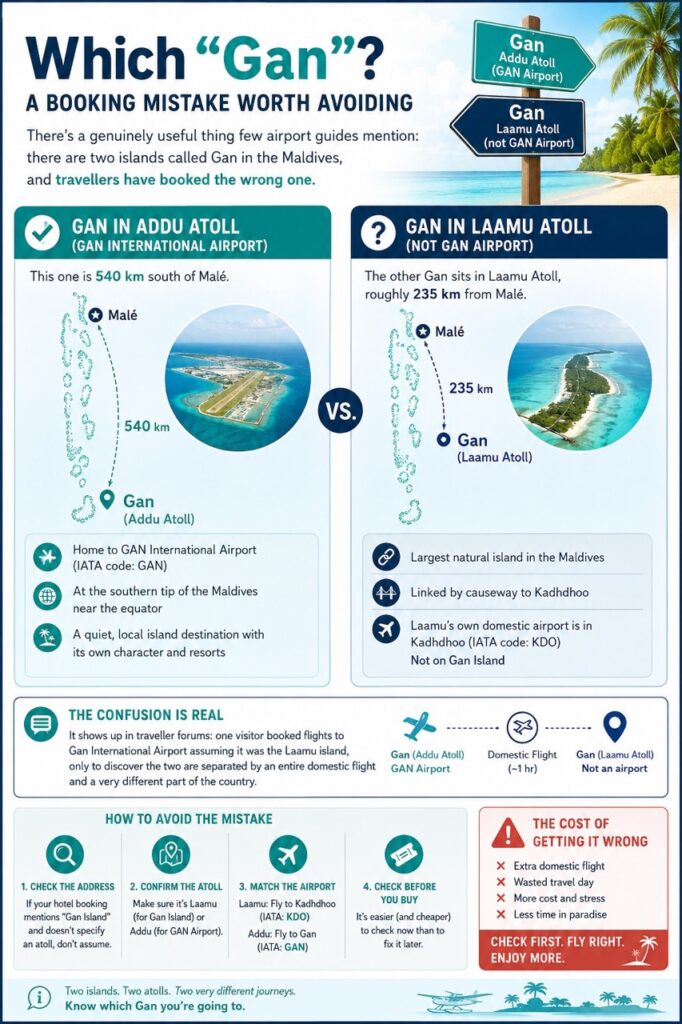
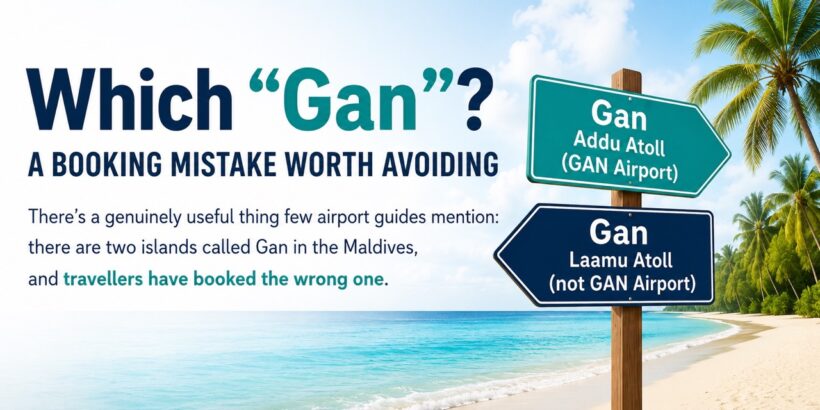
Here’s a genuinely useful thing few airport guides mention: there are two islands called Gan in the Maldives, and travellers have booked the wrong one. This one — Gan in Addu Atoll, home to GAN International Airport — is 540 km south of Malé. The other Gan sits in Laamu Atoll, roughly 235 km from Malé, and is the largest natural island in the country, linked by causeway to Kadhdhoo, where Laamu’s own domestic airport actually is.
The confusion is real enough that it shows up in traveller forums: one visitor booked flights to Gan International Airport assuming it was the Laamu island, only to discover the two are separated by an entire domestic flight and a very different part of the country. If your hotel booking mentions “Gan Island” and doesn’t specify an atoll, check the address against Laamu versus Addu before you buy tickets — the fix afterward involves an extra flight and a wasted travel day.
Gan International Airport as Gateway to Addu Atoll
This is where GAN earns the “gateway” label in earnest. Addu Atoll (also called Seenu Atoll) is structurally unlike almost anywhere else in the Maldives: instead of scattered islands separated by open lagoon, four to six of its islands — Gan, Feydhoo, Maradhoo and Hithadhoo, sometimes extended to Meedhoo — are joined by a causeway system generally referred to as the Link Road. The core Gan-to-Hithadhoo stretch runs about 8.7 km; counting branch causeways and the roads within the islands themselves, most estimates for the connected network run to 14–18 km, making it the longest continuous stretch of drivable road in the country.
That road network changes how you experience a visit. Instead of being confined to a single resort island, you can:
- Cycle or scooter the Link Road, passing mangrove channels, fishing harbours and local cafés — a form of independent, mixed-culture travel that’s rare anywhere else in the archipelago.
- Dive sites most of the Maldives can’t offer. Addu is one of the few areas in the country that escaped the 1998 global coral bleaching event, and its four channels — Gan Kandu, Villingili Kandu, Maa Kandu and Kuda Kandu — are known for manta rays, reef sharks and calmer currents than the northern atolls, making them approachable for less experienced divers. The wreck of the British Loyalty, torpedoed in 1944, is a signature dive.
- Surf a genuinely different break. Addu’s south-facing coastline catches the full force of the SW monsoon swell from roughly April to October, producing fast, powerful, reef-breaking waves (locally known as Shangri-la’s and Kottey) better suited to advanced surfers than the softer breaks up north.
- Walk Addu Nature Park, which protects the Eydhigali Kilhi wetlands and the Koattey area in Hithadhoo — mangroves, a freshwater lake, and birdlife you won’t find on a resort island.
- Stay in the former RAF base itself. Equator Village keeps its Cold War-era bones, while Shangri-La’s Villingili Resort & Spa — closed since 2020, and one of the region’s flagship luxury properties, with the Maldives’ only nine-hole golf course — began welcoming guests again after 31 December 2025, following years of government pressure to reopen it. Its return is a genuine shift in what Addu can offer visitors in 2026, restoring a five-star option a short speedboat ride from the terminal.
Most visitors also cross the equator on the way in — Gan sits at roughly 0.69°S, and airlines and hotels have leaned into this with “equator crossing” certificates, a small but popular souvenir of the trip.
Best Time to Fly Into Gan
Addu Atoll broadly follows the same seasonal rhythm as the rest of the Maldives, rather than an inverted one: the driest, calmest conditions run from around December to April (the Iruvai / northeast monsoon), which is also the best window for underwater visibility. The wetter, windier May to October stretch (Hulhangu / southwest monsoon) brings the region’s biggest surf swells — good news if you’re chasing waves at Shangri-la’s or Kottey, less ideal if calm seas and clear photos are the priority. Either way, temperatures stay in the 25–30°C (77–86°F) range year-round, so there’s no genuinely bad time to land.
Practical Tips for Transiting Gan
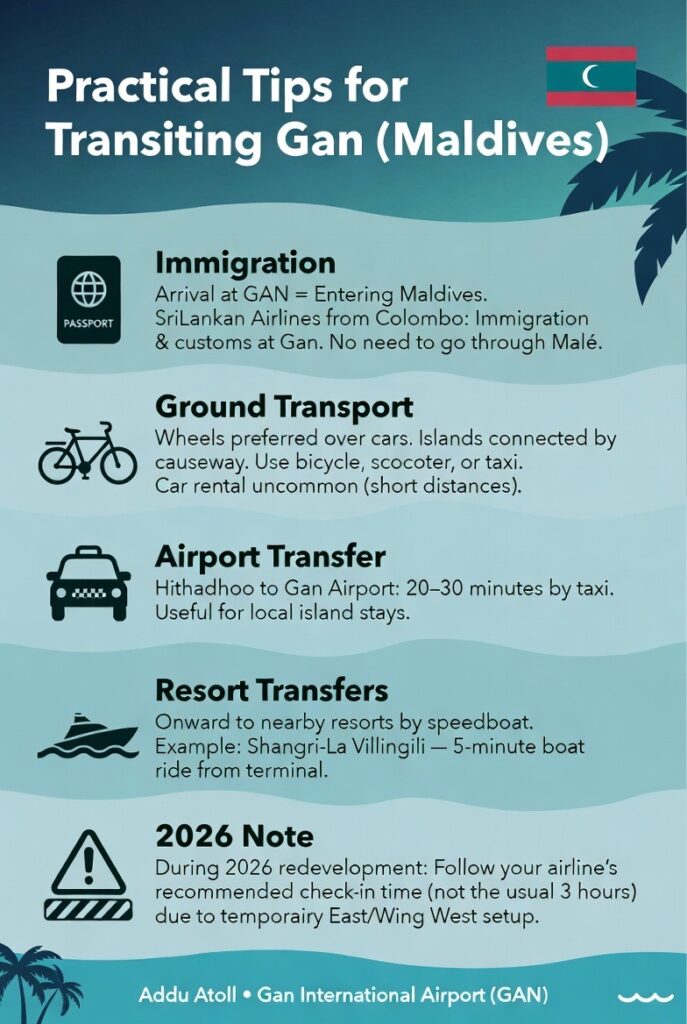
- Arrival at GAN counts as entering the Maldives. If you’re on the SriLankan Airlines flight from Colombo, immigration and customs happen at Gan itself — you don’t need to pass through Malé first.
- Ground transport favours wheels, not cars. With everything connected by causeway, most visitors and locals get around by bicycle, scooter, or taxi; conventional car rental is uncommon given the short distances involved.
- Getting from Hithadhoo (the far end of the Link Road) to the airport takes roughly 20–30 minutes by taxi — useful to know if you’re staying on the local islands rather than at a resort.
- Onward transfers to island resorts near Addu are typically arranged by speedboat; Shangri-La’s Villingili, for instance, is about a five-minute boat ride from the terminal.
- During the 2026 redevelopment, follow your airline’s recommended check-in time closely rather than the general “three hours” rule of thumb, given the temporary East Wing / West Wing setup.
Frequently Asked Questions
Is Gan International Airport the same as Malé Airport? No. Velana International Airport (MLE) near Malé is the country’s main hub. Gan International Airport (GAN) is a separate, smaller international airport roughly 540 km south, serving Addu Atoll and the southern Maldives.
Can I fly to Gan directly from Europe or the US? Not on a scheduled basis at present. The only foreign carrier is SriLankan Airlines, flying from Colombo. Most international travellers connect via Malé on a domestic Maldivian flight, or via Colombo on SriLankan.
Why does Gan have the longest runway in the Maldives? Its 2016 extension, funded to bring the airport up to Code 4E international standards, produced a runway of roughly 3,500 m — slightly longer than Velana International Airport’s 3,400 m runway in Malé, largely because Gan’s original military-era strip and later land reclamation gave it more room to grow.
Is there another airport called “Gan” in the Maldives? There’s another island called Gan, in Laamu Atoll, but its domestic airport is actually on the adjoining island of Kadhdhoo, not Gan itself. It’s a completely different part of the country from Addu’s Gan International Airport — double-check before booking.
What can I do near the airport without booking a resort? Cycle the Link Road across Feydhoo, Maradhoo and Hithadhoo, visit Addu Nature Park, dive or snorkel the atoll’s channels, or explore the WWII-era remnants around Gan itself, including Equator Village.
Gan International Airport was never designed as a tourist gateway — it was a wartime airstrip that outlived its original purpose and found a second one. That history is still visible in the causeways, the converted RAF buildings, and the runway itself. For travellers willing to skip the well-worn route through Malé, it remains one of the more direct ways into a genuinely different side of the Maldives.