Solo Travel in the Maldives: Priced Per Villa, Not Per Person
A Maldivian resort sells you an island, a villa and a boat to reach it. The villa costs the same whether one person sleeps in it or two, which is why a solo week at a resort can cost nearly as much as a couple’s.
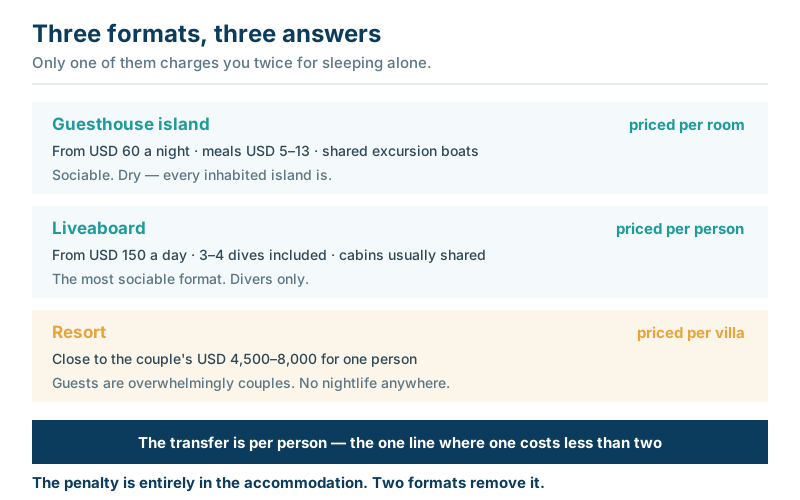
That is the whole solo problem in one sentence, and it has two clean solutions. A guesthouse island charges per room at a fraction of the price and puts you among other travellers. A liveaboard sells berths per person, which removes the penalty entirely.
Neither is a compromise. Both are formats this site recommends to couples as well — the difference is that for a solo traveller the arithmetic makes them obvious.
The cost problem, quantified
Worth being specific, because the Maldives gap is larger than at most destinations.
Resort rooms are priced per villa. Some properties reduce the rate for single occupancy and many do not, and where a single supplement exists it rarely approaches half.
Which means a resort week that costs a couple USD 4,500 to 8,000 costs a solo traveller a substantial share of the same figure — the full itemisation is in our budget guide.
Board is charged per person, so that part scales correctly — the board-basis arithmetic is in our guide to budget and all-inclusive.
The transfer is charged per person too, which is the one line where a solo traveller is not penalised at all — one fare instead of two, on the bands in our transfers guide.
And the 28.7% applies as usual, compounding on whatever the room costs — the mechanism is in our guide to money in the Maldives.
Which produces the practical conclusion: the solo penalty in the Maldives is entirely in the accommodation line, and the two formats that price accommodation per person remove it.
Why the Maldives is priced this way
Worth understanding, because it explains the whole article and is not arbitrary.
A resort island is a fixed cost. Staff, desalination, generators, boats, imported food and a jetty exist whether the villas hold one person or two, and the property recovers that against rooms rather than heads.
Which is the same structure that makes the country expensive generally — a self-contained operation on an island with no economy, as our budget guide sets out.
Board and transfers scale per person because they are genuinely per-person costs: a meal, a seat on a boat.
And the guesthouse islands price differently because there is an economy underneath them. The room is small, the restaurant is a café that serves the village too, and the boat is shared with whoever else wants to go.
Which is the reframing worth carrying into the booking: you are not being penalised for travelling alone. You are being charged for an island, and there are two formats that do not sell you one.
The guesthouse island, which is the answer for most
The Maldives format that changes the arithmetic and improves the trip at the same time.
Rooms from about USD 60 a night, meals at USD 5 to 13, and excursions at USD 25 to 60. A week for two runs USD 1,100 to 1,900, and one person pays proportionally less because the room is cheap enough that any supplement barely matters.
Guesthouses are small and family-run, typically eight to twenty rooms, which produces a different social environment from a two-hundred-villa resort.
There are other travellers. Guesthouse islands attract independent travellers, divers and backpackers, and the boats are shared — which means the excursion minimum problem below largely disappears.
And there is a village. A café at four, a football match at six, and people who are not on holiday — the daily rhythm is in our guesthouse guide.
What you give up is alcohol, seclusion and the villa. Every inhabited island is dry, as our guide to alcohol rules sets out.
Which islands suit a solo traveller best is a question of how much company you want — the busier islands have more of it, and the trade is in our guide to choosing a local island.
The liveaboard, which is the answer for divers
The other Maldives format where the penalty does not exist.
Berths are sold per person, so there is no supplement to pay.
From about USD 150 per person per day, including the cabin, all meals and three to four dives — the full costing is in our liveaboard guide.
Cabins are usually shared unless you pay for sole occupancy, and operators pair solo divers as a matter of routine.
It is inherently social. Ten to thirty guests, all diving, all eating together, for a week. Nobody is alone on a liveaboard whether they want to be or not.
And the diving is the point, with twelve to eighteen dives across a week against six to ten at a resort.
The caveat is that it only works for divers. A non-diver on a liveaboard has a very long week, which our guide to the format states plainly.
The resort, and when it makes sense
Not never, and the conditions are specific.
A short stay. Three or four nights near the airport, where the total is manageable and the point is rest rather than value — the arithmetic is in our guide to staying near the airport, and the flight timing in our guide to choosing a flight.
A property with genuine single rates. They exist and they are worth searching for specifically.
A trip where the isolation is the product. Some people want a week in which nobody speaks to them, and a resort island delivers that better than anywhere.
And a diving-focused resort stay, where the days are structured around a boat and the evenings are short.
What to avoid: a large couple-oriented property for a full week. Dinner alone at a restaurant full of honeymooners on night five is a specific experience, and it is worth knowing about before booking rather than after.
Our guide to choosing a resort by density matters more than usual here, because a quiet island is easier alone than a busy one.
Honest, because it varies enormously by Maldives format and nobody says so.
Resorts are couple-dominated. Honeymooners, couples on milestone trips, and families. A solo traveller is unusual, and the property will be perfectly kind about it while the room remains a room for two.
Adults-only properties are more so, not less — the demographic there is couples almost exclusively, as our guide to adults-only resorts describes.
Guesthouse islands are the opposite. Independent travellers, shared boats, small dining rooms and a village outside the door.
Liveaboards are the most social of the three by a wide margin, because you cannot leave the boat.
And there is no nightlife anywhere, at any property, in any format — the absence our activities overview is explicit about. An island is quiet by eleven.
Which means the Maldives is a poor destination for meeting people in a bar and a good one for meeting them on a dive boat.
The excursion minimum problem
A specific solo issue that catches people, and it has a workaround.
Many excursions require a minimum number of guests to run, and the shortfall is charged to those who go.
Which affects a solo traveller disproportionately at a resort, where the guest pool is small and the trips are private-ish.
On a guesthouse island the boats are shared and fill with other travellers, so the problem largely does not arise — the price difference is in our excursion guide.
Ask before booking: what the minimum is, and what happens if it is not met.
And book on arrival rather than in advance, so you can see who else is on the island and what is running — the general rule in our booking timeline.
Safety, stated plainly
The question asked most often, and it deserves a factual answer about the Maldives rather than a reassuring one.
Violent crime against tourists is not a significant feature of this destination, and the wider picture is in our safety guide.
A resort island is a closed environment with staff, a guest list and no through traffic. It is about as controlled a setting as travel offers.
An inhabited island is a village, where guesthouses are family-run, everybody knows who is staying where, and social visibility works in a visitor’s favour rather than against it.
The things that actually go wrong here are physical rather than criminal — sun, coral, boats and currents — which is why our health guide is longer than this section.
And the one genuine solo constraint is the water. Snorkelling alone off an unfamiliar reef, in current, with nobody watching, is the real risk in this country, and it applies to couples too — our snorkelling guide sets out why current is the thing to respect.
Which produces one instruction: tell somebody where you are going in the water and when you expect to be back. At a resort that is the dive centre; on a guesthouse island it is the guesthouse.
Solo women travellers
A more specific answer, because the question is more specific.
Solo female travellers are common here and the practical reports are consistent: a resort island is straightforward, and a guesthouse island is generally comfortable and family-run.
On inhabited islands the dress code is real, not advisory. Shoulders and knees covered outside the designated tourist beach, including on the walk to it — the rules are in our guide to dress codes.
That is a legal and social norm rather than a safety measure, and it applies equally to everyone. It is worth understanding as respect for where you are rather than as protection.
There is no bar scene on an inhabited island, since every one of them is dry, which removes an entire category of situation that solo women navigate elsewhere.
Choose the guesthouse rather than the island first. Family-run places with visible reviews from solo travellers are the practical filter, and the sector is small enough that reputation carries.
And the ordinary practices apply, as anywhere: share your itinerary with someone, keep the guesthouse’s number, and carry the insurance details offline.
We can describe the structure honestly. We cannot report a solo female experience first-hand, and the section is written to reflect that limit.
What is genuinely good about going alone
The case for a Maldives trip on your own, because it is stronger than the cost section suggests.
The country rewards doing nothing, and doing nothing is easier alone than in company. Nobody is waiting for you to be ready.
Diving is solo-friendly by design. Centres assign a buddy, and a diver travelling alone joins a boat rather than needing a partner — the questions to ask are in our guide to choosing a resort for divers.
Nothing needs coordinating. No negotiating the day, no compromise excursion, no waiting for anybody.
The best hour of the week is free and solitary anyway — the house reef at seven in the morning, before anyone else is in the water.
And a split stay is easier alone. Moving between a village and a resort is one person’s logistics rather than two, and one transfer fare rather than two.
What is genuinely hard
Balanced, because the case runs both ways.
Dinner, at a resort, on night five. Restaurants are configured for couples, and seven consecutive evenings alone in one is a specific experience.
The cost, which is the whole first half of this article.
The excursion minimums.
And the atmosphere at a couple-oriented property, which is not unwelcoming and is unmistakably not aimed at you.
None of that applies on a guesthouse island or a liveaboard, which is the argument this article keeps making.
Choosing a property alone
Five checks, and two of them differ from the couple’s version.
Single rates, searched for explicitly rather than assumed.
Density, because a quiet island is easier alone — villa count divided by usable area, on the method in our guide to island size.
The house reef, which matters more when you are your own entertainment. The satellite check is in our guide to reading a house reef.
The guest mix, which properties will describe if asked directly.
And the dining arrangement. A property with several restaurants and a casual option is easier than one with a single formal dining room.
The two that differ from a couple’s checklist are the guest mix and the dining, and both are worth an email before booking.
A solo week, sketched
One shape that works, and it is not the resort one.
Nights one to four, a guesthouse island. Arrive by speedboat, settle, take two shared excursions, spend one day doing nothing, and eat at the cafés.
Night five, the crossing. A speedboat to a resort in the same atoll.
Nights five to eight, a resort. The house reef twice a day, one excursion, and the isolation you came for — now for four nights rather than seven, at a cost that a solo budget can absorb.
Which gets you both Maldives for less than a week at either, and puts the sociable half first and the solitary half second.
The alternative shape for divers is a liveaboard week, which needs no structuring at all.
The other reason to consider a split
Beyond cost, and it applies particularly to a first Maldives trip alone.
A week is a long time in one social setting. Four nights among other travellers followed by four in near-total quiet is a better shape than seven of either — and it is the pattern our comparison of resort and inhabited islands recommends for its own reasons.
It hedges the format decision. If a village turns out to suit you, you know for next time; if the quiet does, likewise. One trip answers a question that would otherwise take two.
And the order matters here more than usual. Sociable first, solitary second, so the trip ends in the state most people want to fly home in.
The extra cost is one speedboat crossing within the same atoll, which is an hour and a modest fare.
What it needs is ten nights rather than seven to be comfortable, or a willingness to spend four and four — the length arithmetic is in our itineraries guide.
A note on what we can and cannot tell you
Short, and it belongs in an article that makes claims about how a trip feels.
We have stayed on Maafushi, an inhabited island, and day-visited one resort. We have not stayed overnight at a Maldivian resort, and we did not travel alone.
Which means the cost arithmetic here is ours — rooms, meals, boats, the tax, the transfer — and the social description is drawn from how the formats are structured rather than from a solo week we spent in them.
The structural claims are checkable. Rooms priced per villa, berths priced per person, dry inhabited islands, shared excursion boats, no nightlife anywhere. None of that requires having gone alone to verify.
The experiential claims are marked as such, including the section on solo women, which says plainly that we can describe the structure and cannot report the experience.
That is a narrower promise than most articles on this subject make, and it is one we can keep.
Questions travellers ask
Is the Maldives good for solo travellers? Yes, in two of its three formats. Guesthouse islands and liveaboards price per person and are sociable; resorts price per villa and are couple-dominated, which makes them expensive and quiet company for a solo week.
How much does a solo trip cost? On a guesthouse island, a fraction of the resort figure — rooms from about USD 60 a night with meals at USD 5 to 13. A liveaboard runs from about USD 150 per person per day. A resort charges close to the couple’s rate, because the villa is priced per villa.
Do resorts charge a single supplement? Rooms are priced per villa rather than per person, so a solo traveller pays most of the couple’s rate whether it is called a supplement or not. Some properties publish genuine single rates and they are worth searching for.
Is it safe to travel alone in the Maldives? Violent crime against tourists is not a significant feature, resort islands are closed environments, and inhabited islands are villages where guesthouses are family-run. The real risks are physical — sun, coral, boats and currents.
Is it suitable for a solo woman? Solo female travellers are common and the practical reports are consistent. On inhabited islands the dress code is a legal and social norm rather than a precaution, and every one of them is dry, which removes the bar-scene situations common elsewhere.
Will I meet people? On a liveaboard, unavoidably. On a guesthouse island, easily, because the boats are shared. At a resort, rarely — the guests are couples and there is no nightlife anywhere in the country.
Is diving solo-friendly? Very. Centres assign buddies as a matter of routine and a solo diver simply joins the boat.
What is the hardest part? The cost at a resort, and dinner alone in a restaurant full of couples on the fifth consecutive evening. Both disappear on a guesthouse island or a liveaboard.
What to take away
- The solo penalty is entirely in the accommodation line, because resort rooms are priced per villa rather than per person.
- Guesthouse islands and liveaboards both price per person, which removes the penalty and improves the company.
- Resorts still make sense for a short stay, a property with genuine single rates, or a trip where isolation is the point.
- Excursion minimums are a real solo cost at a resort and largely disappear where boats are shared.
- The one genuine safety constraint is the water. Tell somebody when you go in and when you expect to be out.
Next step: price the same week three ways — a guesthouse island, a liveaboard and the resort you were considering. Put them side by side with the transfer and the tax included. The gap will be larger than you expect, and for most people travelling on their own it settles the question before any other consideration comes into it.