


Maldives Itineraries: Arrival Day Is Not a Day
Every Maldives itinerary question is really a question about nights, and every answer starts with the same subtraction.
The day you arrive is not a day. Immigration takes 75 to 90 minutes at peak, a seaplane may not leave until mid-afternoon, and a great many visitors reach their island at four or five in the evening. The day you leave is not a day either, because a morning boat and an evening flight consume it entirely.
So a “seven-night trip” is five full days plus two half ones — and on a four-night trip that arithmetic decides where you can afford to stay.
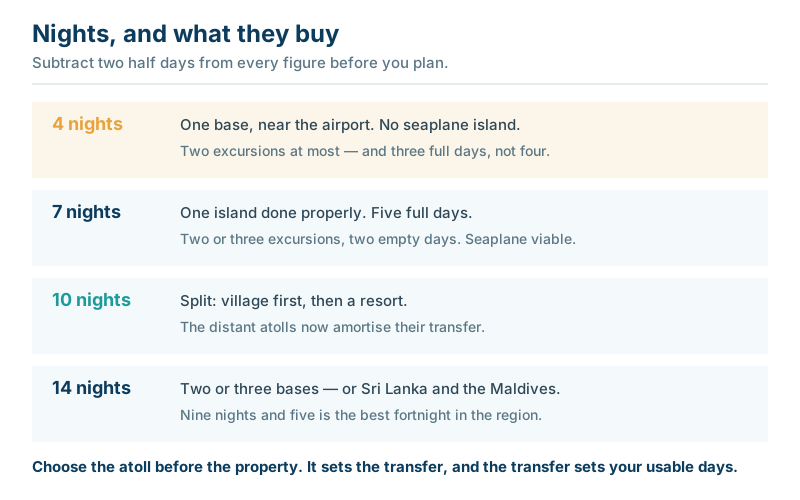
The constraint that shapes every itinerary
Three facts, and together they explain why Maldives itineraries look nothing like itineraries anywhere else.
Nothing is thirty minutes away. Every movement between islands is a boat or an aircraft, priced per person, and scheduled rather than continuous — the modes are in our transfers guide.
Seaplanes fly in daylight only, stopping between about 15:30 and 16:00. An international arrival after roughly 14:00 misses the last one, which costs a day and frequently a night near the airport — the arithmetic is in our guide to missed connections.
And moving between islands costs money as well as time. A second base means a second transfer, charged for everybody travelling.
Which produces the governing rule of Maldives itinerary planning: fewer bases than you think, chosen closer than you think, on trips shorter than you think.
The exception is a longer trip, where the arithmetic reverses and a single base starts to feel long.
Four nights
The shortest trip that justifies a long-haul flight, and the one with the least room for error.
Stay near the airport. Fifteen to forty-five minutes by speedboat, reachable at any hour, with no daylight deadline. A distant transfer takes six to ten hours out of a 96-hour trip and takes them from the two days you would most want — the case is in our guide to staying near the airport.
One base only. There is no time for a second.
Two excursions at most, and one of them should be the house reef, which is free.
The four-night itinerary: arrive and swim. Two full days with one boat trip on each. A last morning, then the transfer.
What to skip: a seaplane island, a distant atoll, and any attempt to see more than one thing.
And be honest about whether it is worth it. Four nights after an eleven-hour flight is two days of holiday. Some people should add three nights rather than travelling this far for this long.
Seven nights
The standard Maldives trip, and the length everything is priced around.
One island, done properly, is the default — and it works. Five full days is enough to establish a rhythm, learn a reef, take two or three excursions and do nothing for two of the days.
The seven-night itinerary that works:
- Day 1 — arrive, swim, eat, sleep.
- Days 2 to 6 — the reef in the morning, an excursion on two or three of them, nothing scheduled on the others.
- Day 7 — a last swim and the transfer.
Two or three excursions is the right number, not five. The commonest first-timer mistake is booking a boat every day and spending the week travelling, as our activities overview argues.
A cautious split is possible — three nights on a guesthouse island and four at a resort — and it works if the two are in the same atoll. Across atolls it costs a day.
A seaplane island is viable at this length, unlike at four nights, provided your inbound lands before about 14:00.
And the best hour of the week is free: the house reef at seven in the morning, before anyone else is in the water.
Ten nights
Where the arithmetic changes and a split stay stops being optional.
One island for ten nights is a long time on a property of four hundred metres. Some people love it; most start to notice by day seven.
The ten-night itinerary that works: four or five nights on an inhabited island, then five or six at a resort. The village first, the resort second, so the trip ends with rest rather than with logistics.
Why that order. A guesthouse island is more interesting and more demanding; a resort is where you stop. Ending on the resort also puts the post-diving no-fly interval where it belongs.
The transfer between them is a speedboat if both are in the same atoll, which most of the near ones are. Budget one extra crossing for everybody.
Or two resorts, if the budget allows — one with a close house reef and one with something else, which is a genuine way to see two different Maldives.
Or a liveaboard week plus three nights on land, in that order, which is what experienced divers converge on.
And ten nights makes the distant atolls worth reaching. A seaplane costs the same whether you stay four nights or ten, so the longer trip amortises it.
Fourteen nights
Where the country opens up, and where most people should stop thinking about one destination.
Three bases is the maximum for a fourteen-night itinerary, and two is frequently better. Every move costs a transfer and half a day.
The strongest fourteen-night patterns:
- Guesthouse island, resort, resort — five, four and five nights, seeing three different kinds of Maldives.
- Liveaboard week plus a resort week, boat first because of the no-fly interval.
- Guesthouse island plus a distant atoll, using the length to justify the seaplane.
But the strongest fourteen-night option is not entirely Maldivian. Nine nights in Sri Lanka and five in the Maldives is the best fortnight available in that part of the world — a short hop, two entirely different trips, and aligned seasons from December to March. Our Sri Lanka comparison sets it out.
Two weeks at a single resort is a legitimate choice and a specific taste. If doing nothing is the objective and the property has a good house reef, it works. If it does not have one, it will not, and no amount of villa quality will rescue the second week.
The test is honest and simple. Imagine day nine on the island you are considering. If the answer is another morning on the reef and you find that appealing, book it. If the answer is a boat trip you have already taken twice, split the trip.
Which atoll for which length
The geography question that follows from the nights question, and it is easily answered.
Under seven nights: Kaafu and the near atolls. North and South Malé, reachable by speedboat at any hour, with no daylight deadline. The itinerary survives a delayed flight.
Seven to ten nights: anywhere reachable by speedboat, plus the seaplane islands if your inbound lands before about 14:00.
Ten nights or more: the distant atolls become worth it. South Ari for whale sharks, Baa for the manta season, Vaavu for channel diving. A seaplane costs the same whether you stay four nights or twelve.
And the far south, reached by domestic flight, needs ten nights minimum to justify the travel — our atoll decision guide matches regions to travellers.
The general principle: the further the atoll, the longer the itinerary needs to be to amortise it.
Which is the same arithmetic as the transfer, seen from the other direction — and it is why the atoll decision belongs before the property decision rather than after it.
A seven-night guesthouse island week, day by day
Written from our own stay, and the rhythm is the point of this itinerary rather than the schedule.
Day 1. Speedboat from Malé, arrive early afternoon, walk the island in twenty minutes, swim at the designated beach, eat at a café for a few dollars.
Day 2. Snorkelling trip — a reef, a sandbank and a wreck for USD 35 to 50 each, on the prices in our excursion guide.
Day 3. Nothing. The beach, the four o’clock café hour, football at six.
Day 4. A full-day trip — dolphins at dawn or a distant reef.
Day 5. Nothing again, and this is the day people remember.
Day 6. A resort day pass, if you want to see the other Maldives — USD 100 to 250 per person, and the honest way to compare the two formats before committing to either.
Day 7. A morning swim, then the boat back.
Total for two, all in: USD 1,100 to 1,900 on the figures in our budget guide.
What makes it work is the two empty days. An island week with something booked every day is a week of boats.
A seven-night resort week, day by day
The same length, a different rhythm, and a different itinerary entirely.
Day 1. Transfer, arrive late afternoon, dinner, sleep.
Day 2. The house reef twice — once at seven and once before sunset. Nothing else.
Day 3. An excursion: a sandbank, a snorkelling trip or a dive.
Day 4. Nothing. The lagoon, a book, the free kayaks that almost nobody uses — the point our guide to water sports makes.
Day 5. A second excursion, or two dives.
Day 6. Nothing, and a spa treatment if the budget allows.
Day 7. A last morning on the reef, then the transfer.
What to protect: the empty days. A resort week with four excursions is a week of early starts, and the reef in front of you is better than most of what a boat will show you.
And what to check before booking any of this: whether the house reef exists. “House reef” covers four different arrangements and one of them is a sandy lagoon with the reef four hundred metres out — the satellite method is in our guide to reading a house reef.
A ten-night split, day by day
The itinerary this site recommends most often, in outline.
Nights 1 to 4, an inhabited island. Arrive, settle, two excursions, one empty day, the café hour every afternoon.
Night 5, the crossing. A speedboat between islands in the same atoll, an hour at most, and it is a half day rather than a lost one.
Nights 5 to 10, a resort. The house reef twice a day, two excursions, three empty days, and the last morning in the water.
What the split buys is contrast. A village and a private island in one trip, which our comparison of resort and inhabited islands argues is the honest way to see the country.
What it costs is one extra transfer and half a day.
And the order matters. Village first. Ending in a resort means ending with rest, and it puts any diving well before the flight home.
The two days nobody counts
Worth its own section, because it is the commonest planning error.
Arrival day is a half day at best, and frequently less. Immigration, the wait for a transfer, the crossing itself, and check-in.
Departure day is worse. A morning boat for an evening flight means leaving the island after breakfast, and a seaplane departure can mean leaving the previous afternoon.
Which means a “five-night trip” contains three full days.
Two ways to recover them. Choose a speedboat property near the airport, which compresses both ends. Or add a night in Hulhumalé at the start, so you reach the island on a first morning rather than a first evening.
And a third for the end: a late checkout, or an airport-area night before a very early departure, which turns a wasted final day into a usable one.
Diving itineraries
Different constraints, and the no-fly interval governs the shape of the whole itinerary.
Standard guidance is 18 to 24 hours between the last dive and altitude, which applies to seaplanes as well as international flights — our diving guide sets it out.
Which makes the last full day a dry one on almost every itinerary. Plan for it rather than discovering it.
Seven nights gives you six diving days and roughly ten to twelve dives at a resort, or twelve to eighteen on a liveaboard.
A liveaboard and resort combination goes boat first, so the interval falls at the end.
And tell the dive centre your departure time on arrival, because a centre that knows your flight builds the week backwards from it — the questions to ask are in our guide to choosing a resort for diving.
Honeymoon shape
A specific request, and the answer is mostly about pacing.
Seven to ten nights, with the overwater villa as two or three nights inside a longer beach stay rather than the whole trip — the premium arithmetic is in our villa comparison.
Fewer excursions than a normal trip, not more.
And a property chosen for density rather than for the villa, because quiet is what the occasion is for — the method is in our guide to island size.
Our honeymoon guide covers the rest, including what to tell the property in advance.
Itineraries by season
The month changes what the itinerary should contain, though not usually its shape.
December to April, the dry season. Best visibility, calmest crossings, highest prices. A boat-heavy itinerary works, and cancellations are rare — the mechanism is in our monsoon guide.
May to November, the wet season. Cheaper, more marine life, and wind that cancels boats. Build slack into the plan: an excursion booked for a specific day may move, and an itinerary with no spare days will break.
Which argues for booking excursions on arrival rather than in advance, in either season but especially the second.
Two seasonal exceptions worth planning around. Hanifaru manta season, roughly June to November, which is worth structuring a trip for. And whale sharks in South Ari, which are year-round and therefore need no seasonal planning at all.
And the price consequence. A wet-season itinerary buys more nights for the same money, which frequently converts a seven-night plan into a ten-night one — the comparison is in our guide to high and low season.
What not to do
Five itinerary errors, in order of how much they cost.
Booking a seaplane island for four nights. The transfer consumes a quarter of the trip.
More than three bases in a fortnight. Each move is a transfer, a check-in and half a day.
Scheduling something every day. Five excursions in seven days is a week of boats, and the reef in front of you goes unswum.
Assuming arrival day is a day. It is not, and the whole plan shifts if you assume otherwise.
And booking the villa before the atoll. The atoll sets the transfer, which sets both the budget and how many usable days you have — the sequence is in our trip planner.
How to build your own
Four steps to your own itinerary, in order.
Subtract two half days from your total. That is what you are actually planning.
Decide the number of bases. One under seven nights, one or two at seven to ten, two or three at fourteen.
Choose the atoll before the property, because it sets the transfer and therefore the usable time.
Then leave half the days empty, deliberately, on paper. They will fill themselves with the thing you came for, and a plan with no space in it is the commonest way a Maldives week goes wrong.
Questions travellers ask
How many nights do I need in the Maldives? Five is the minimum that justifies a long-haul flight, seven is the standard, and ten or more makes a split stay obviously worthwhile. Remember that arrival and departure days are half days at best.
Can I visit more than one island? Yes, and fewer than you think. One base under seven nights, one or two at seven to ten, and a maximum of three in a fortnight. Every move costs a transfer and half a day.
What is the best seven-night itinerary? One island, five full days, two or three excursions and two empty days. The commonest mistake is booking a boat trip every day.
Should I split between a local island and a resort? On ten nights or more, usually yes — four or five nights in a village then five or six at a resort. Village first, so the trip ends with rest.
How long do I need for a seaplane island? Seven nights or more. On a four-night trip a seaplane transfer takes a quarter of the holiday, and a late arrival can cost a day at each end.
How many excursions should I book? Two or three across a week. The house reef in the morning is free and is the best hour of most weeks.
When can I dive before flying? Standard guidance is 18 to 24 hours, and it applies to seaplane transfers as well as international flights. Plan the last full day as a dry one.
Is fourteen nights too long? Not if you split it. Two or three bases, or nine nights in Sri Lanka and five in the Maldives, which is the best fortnight available in that part of the world.
What to take away
- Subtract two half days from any Maldives trip length. Arrival and departure days are not days.
- Under seven nights, one base near the airport. Seven to ten, one or two. Fourteen, two or three at most.
- Two or three excursions across a week, not five. The house reef at seven in the morning is free and better than most boat trips.
- On ten nights or more, split between an inhabited island and a resort — village first, resort second.
- Choose the atoll before the property. It sets the transfer, which sets both the budget and how many usable days you have.
Next step: write down your arrival and departure times, then subtract the two half days. Whatever is left is the itinerary you are actually planning, and it is usually shorter than the number on the booking. Plan against that figure rather than the one on the invoice, and the trip will fit the days you have rather than the days you paid for.