Maldives or Mauritius: One of These Places Has Roads
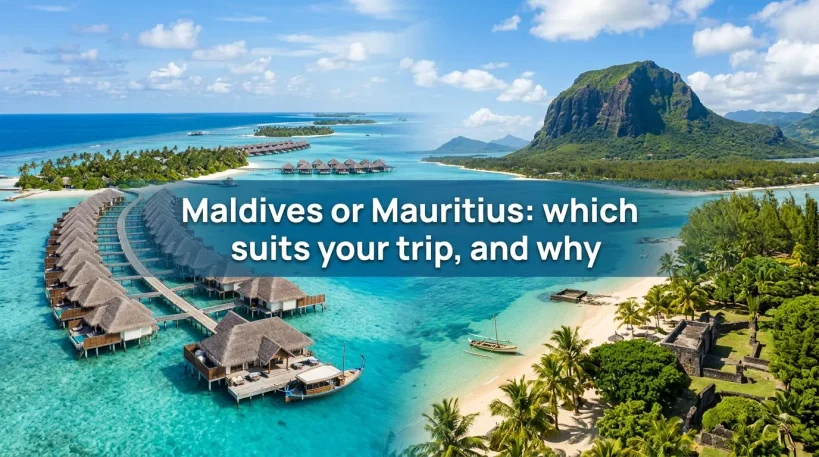
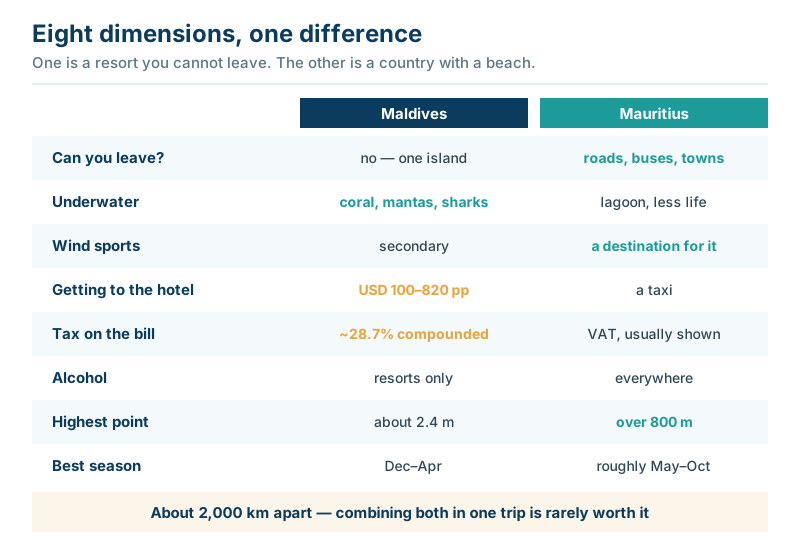
Both are Indian Ocean islands with turquoise lagoons, coral reefs and overwater-villa marketing. The photographs are almost interchangeable. Almost everything else is not, and the differences are structural rather than a matter of taste.
The Maldives is 99% water — about 1,190 low coral islands scattered across 26 atolls, none of them more than a couple of metres above the sea, with no roads between them and one resort per island. Mauritius is a single volcanic island of roughly 2,000 square kilometres with mountains, sugar cane, motorways, buses, a capital city and over a million people living on it.
That is the comparison. Everything below follows from it.
We have been to both, and the photographs on both sides of this article are our own.
1. Can you leave?
The question that decides most of this, and the answer differs completely.
In the Maldives, no. A resort occupies its entire island. There is no second restaurant, no bar down the road, no shop, and nowhere to walk to. If the property disappoints you on day two, it disappoints you for the rest of the week — the point our guide to where to stay makes at length. The alternative is a guesthouse island, which is a village rather than a town, walkable end to end in twenty minutes.
In Mauritius, yes, easily. There are roads across the whole island, buses, taxis and hire cars. You can drive from a beach in the north to a mountain in the south-west in an afternoon, stop in a town on the way, and eat somewhere that is not your hotel.
Which changes what a bad hotel costs you. In Mauritius it is an inconvenience. In the Maldives it is the holiday.
And it changes what a week contains. A Mauritius week can include a market, a temple, a crater, a botanical garden, a rum distillery and three different beaches. A Maldives week contains the island you are on and whatever boat trips you buy.

2. What the water is
Superficially similar, structurally different, and the difference shows up the moment you get in.
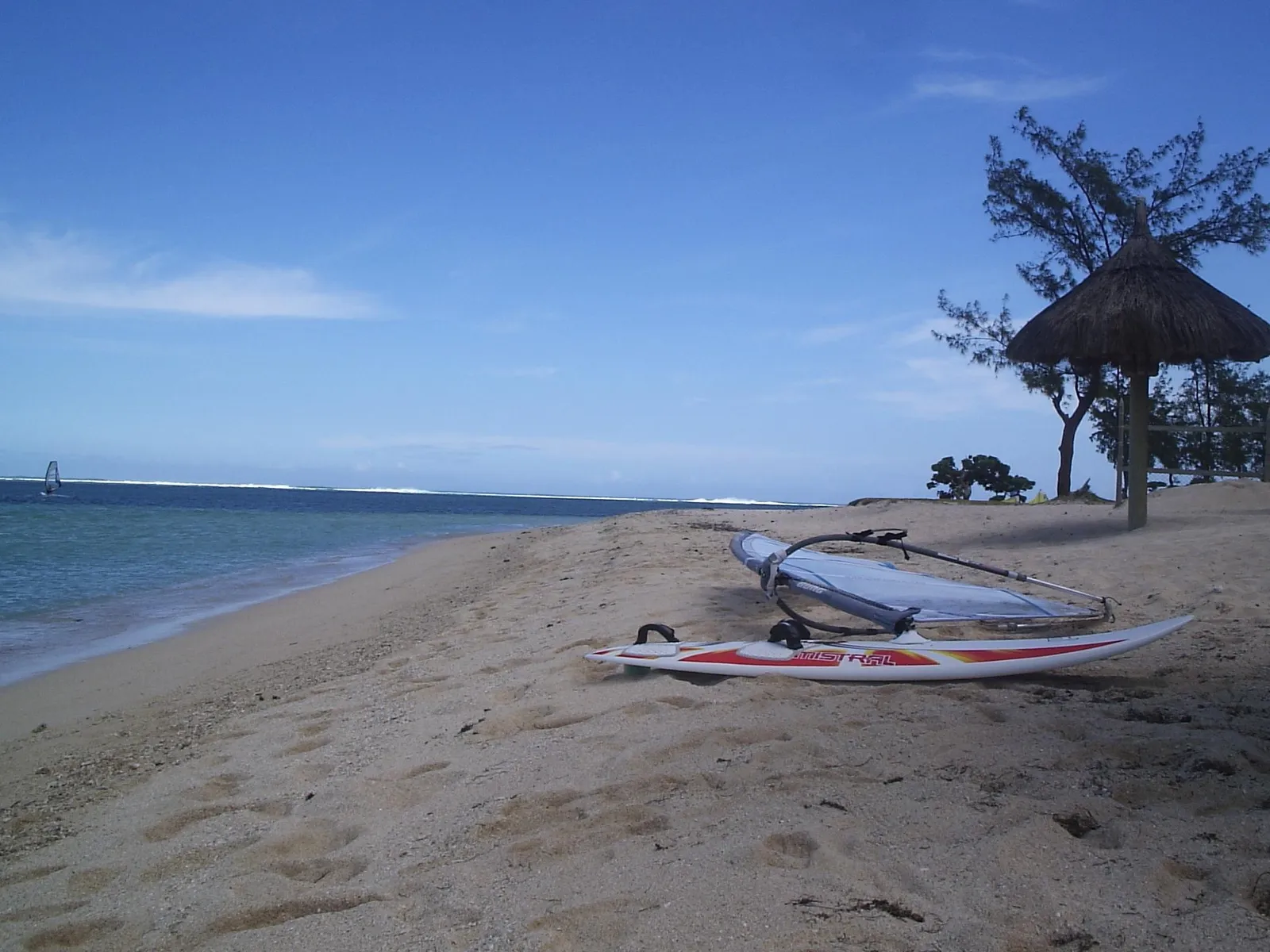
Both have a lagoon inside a reef. Mauritius is almost encircled by a fringing reef with a shallow lagoon between it and the shore; Maldivian islands sit on atoll rims with their own reef edges. From a beach, both look like calm turquoise water with a line of surf in the distance.
The Maldives has the better underwater. More coral — though less than a decade ago, as our guide to reef health records — more reef fish, and the large animals — manta rays, whale sharks, reef sharks and turtles — in numbers and reliability that Mauritius does not match. If the trip is about what is under the surface, this is not a close comparison.
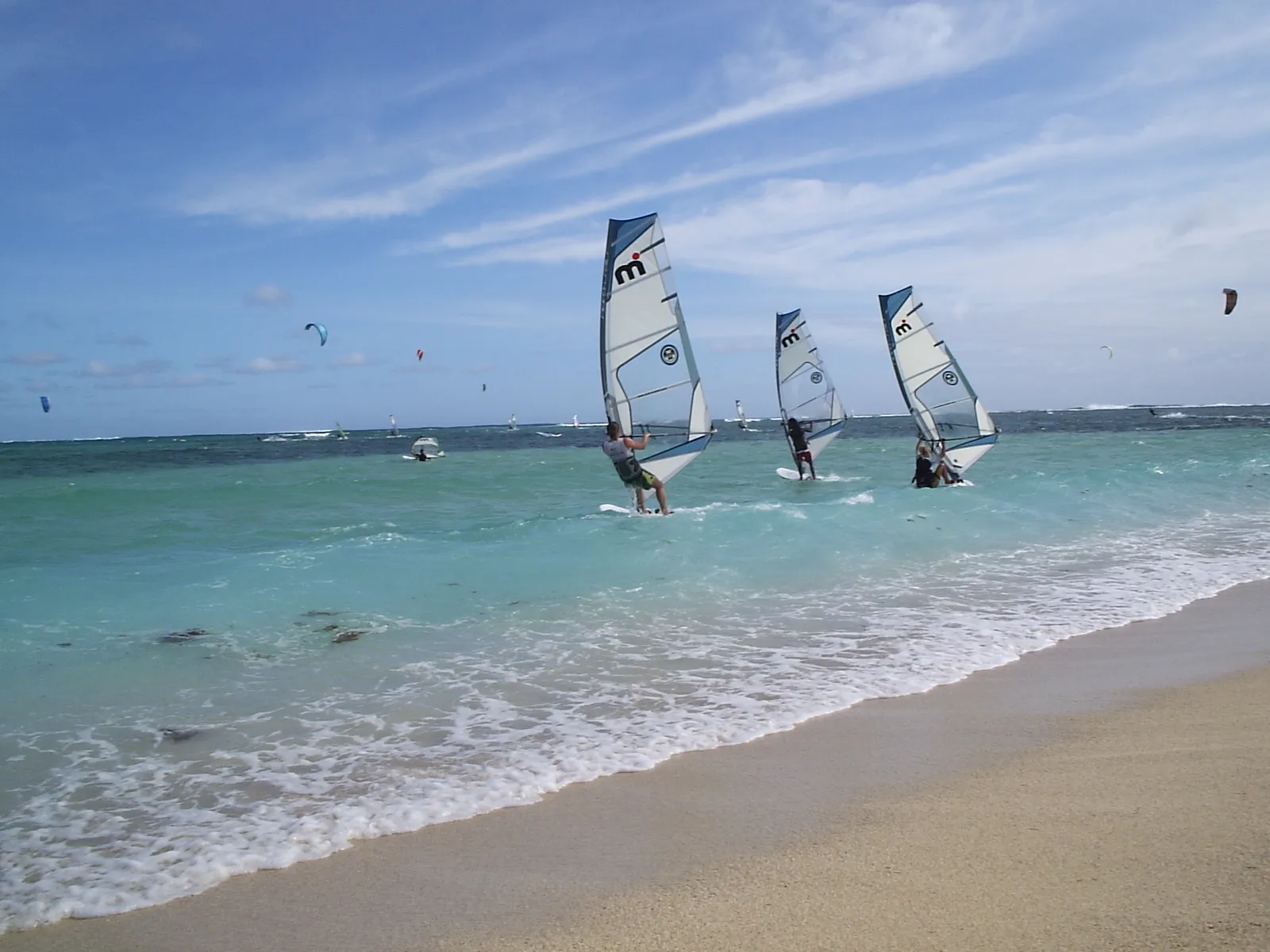
Mauritius has the better wind. The lagoons on the south-west and east coasts are among the better windsurfing and kitesurfing water in the Indian Ocean, with steady trade winds, flat water inside the reef and waves outside it. The Maldives has surf and some kite spots, but wind sports are not what the country is organised around.
And Mauritius has terrain in the water. Sea cliffs, headlands, river mouths and a shoreline that changes character every few kilometres. Maldivian shorelines are sand, reef and lagoon, repeated.
One practical note on Maldivian variability: “house reef” there covers four different geometries, one of which is a sandy lagoon with the reef four hundred metres out. Our guide to reading a house reef explains how to check before booking, and the check matters more in the Maldives than in Mauritius because you cannot drive to a better beach.
3. Getting there and getting around
The dimension where the cost difference is largest and least visible at booking.
Flights. Both are long-haul from Europe, with Mauritius served directly from several European cities and from the Gulf, South Africa and India, and the Maldives similarly. Neither is a short flight from anywhere except South Asia and East Africa.
Then the Maldives adds a second journey. Your resort is on another island, reached by speedboat at USD 100 to 400 per person return, or by seaplane at USD 400 to 820 — priced per person, including children, and covered in our transfers guide. For a family of four that is between USD 400 and USD 3,280 on top of everything else.
Seaplanes fly in daylight only, stopping between about 15:30 and 16:00, which means an international arrival after roughly 14:00 loses a day — the arithmetic in our guide to missed connections.
Mauritius has a road transfer. Airport to hotel by taxi or shuttle, at any hour and a fraction of the cost. No daylight deadline, and no separate contract to fail.
And afterwards you can move. Hire a car, take a bus, get a taxi. In the Maldives every movement after arrival is another boat and another fare.
This is the single biggest hidden cost difference between the two countries, and it does not appear on any accommodation comparison.
4. What a week costs
Indicative bands for two people, excluding international flights. The Maldivian figures come from our own budget work; the Mauritian ones are broad and should be treated as orientation rather than quotation.
| Maldives | Mauritius | |
|---|---|---|
| Budget end | USD 1,100–1,900 on a guesthouse island | Guesthouse or small hotel, comparable or lower |
| Mid-range | USD 4,500–8,000 at a resort | Materially less for equivalent standard |
| Luxury | USD 12,000+ | High, but with more competition |
| Transfer | USD 200–1,640 for two | Taxi fare |
| Eating outside the hotel | Impossible at a resort | Normal and cheap |
| Tax on everything | ~28.7% compounded | VAT, usually shown in the price |
The 28.7% is the Maldivian structure that surprises people. A 10% service charge and 17% goods and services tax compound on almost every line at a resort — the mechanism is in our guide to money in the Maldives. It applies to dinner, drinks, the spa, excursions and diving.
Mauritius has no equivalent trap, largely because you are not captive: if the hotel restaurant is expensive, you go somewhere else.
Where the Maldives competes on price is the guesthouse islands — USD 60 a night, meals at USD 5 to 13, and the same reefs the resorts use. That is a genuinely cheap way to see the country, and it is invisible to most people comparing the two destinations, because the Maldives is marketed exclusively at the other end.
5. The rules you live under
The dimension nobody compares, and it changes a holiday more than any facility.
The Maldives is a Muslim country with two legal regimes. Alcohol is served on resort islands under licence and is unavailable on every inhabited island. Swimwear is for resorts and designated tourist beaches only. Shoulders and knees are covered elsewhere. The detail is in our guides to alcohol and dress codes.
Mauritius has none of that. It is a plural society — Hindu, Christian, Muslim, Chinese and Creole — where alcohol is sold normally, dress is a matter of ordinary courtesy, and there is no separation between where visitors go and where people live.
Which produces a different kind of trip. On a Maldivian resort you are in a licensed enclave. In Mauritius you are in a country, with everything that implies in both directions: more to see, more to navigate, and more chance of an ordinary experience rather than a curated one.
And there is a place to visit. Grand Bassin, the Hindu pilgrimage lake in the crater highlands, is a working religious site with temples, statues and an annual pilgrimage. The Maldives has nothing a visitor can equivalently visit — non-Muslims generally do not enter mosques, and there is no comparable site anywhere in the country.

The overwater villa, which one of them invented as a market
Worth a short section, because it is what many people are actually comparing.
The Maldives owns the category. Overwater villas are the country’s signature product, at a premium of 40 to 100 per cent over a beach villa. As our villa comparison sets out, the water beneath most of them is sand rather than reef.
Mauritius has very few, because a fringing reef close to a populated shoreline is a different building proposition from an empty atoll lagoon. What Mauritius offers instead is beachfront at a wide range of prices, with the sea a few metres away and a road behind you.
Which is the whole trade in miniature. The Maldives sells a structure suspended over water on an island with nothing else on it. Mauritius sells a room by the sea in a place where other things exist.
If the overwater villa is the point of the trip, the Maldives is the answer and the comparison ends here. Our guides to what the luxury tier buys and to island size and density cover how to choose one well.
If it is a photograph you want once, two or three nights inside a longer stay costs a fraction of a week of it — and that is true whichever country the rest of the trip happens in.
6. The land, which one of them does not have
Worth its own section, because it is the difference the photographs make instantly obvious.
The Maldives has almost no elevation. The country’s high point is around 2.4 metres. There are no hills, no rivers, no forests beyond island vegetation, and no interior — because there is no inside to an island four hundred metres wide.
Mauritius has mountains. Le Morne Brabant rises straight out of the sea in the south-west and the island’s high point is over 800 metres. The central plateau is cool enough to need a jumper in winter, and Trou aux Cerfs in Curepipe is a dormant volcanic crater with a lake in it, inside a town.
Which produces things to do that have nothing to do with the sea: hiking, waterfalls, botanical gardens, tea estates, viewpoints. The Maldivian equivalent of a day off the beach is a boat trip.
And a terrestrial ecology. Mauritius has land mammals, forests and endemic birds. It also has introduced species that have made themselves at home — the tailless tenrec, native to Madagascar and introduced here, forages in gardens after dark and is a common sight at night. The Maldives has essentially no land fauna beyond birds, bats and rats, because there is no land for it to live on.
7. Season, and what the trade is
The seasons do not align, which matters if you are choosing between them for fixed dates.
The Maldives runs on the monsoon: December to April is the dry season with the best visibility and the highest prices; May to November is wetter, cheaper, and brings the plankton that draws the big animals. The mechanism is in our monsoon guide and the price picture in our guide to high and low season.
Mauritius has a warmer, wetter summer roughly from November to April, which is also the cyclone-risk window, and a cooler, drier winter from about May to October. Winter is windier, which is why it is the wind-sports season and why the east coast can be blustery.
Which means the good windows are different. Mauritius in the European summer is dry and pleasant; the Maldives at the same time is in its wet season. Mauritius in January is hot, humid and carries cyclone risk; the Maldives in January is at its best and its most expensive.
The practical consequence: if your dates are fixed by school holidays or work, the season may make the decision for you, and it is worth checking that before comparing hotels.
One caution on both: these are patterns rather than guarantees, and a fortnight of rain happens in the dry season in either country.
8. Who each one suits
The honest allocation, and it is not close in either direction.
Choose the Maldives if: the point is the water. Diving, snorkelling, big animals, an overwater villa, complete isolation, and doing nothing in a place where nothing is required of you. Nowhere does that better, and our activities overview covers what a week can hold.
Choose Mauritius if: you want a holiday with a country attached. Somewhere to drive, a market to walk through, mountains to look at, restaurants to choose between, and the ability to change your mind about where to spend the day.
Families: Mauritius is the easier trip. No per-person transfer, more to do on a rainy day, and somewhere to go when everybody is tired of the beach. Our guide to choosing a Maldivian resort for a family explains what to check if you choose the Maldives anyway.
Divers: the Maldives, and it is not a contest.
Wind sports: Mauritius, though the Maldives has more than visitors expect — our guide to water sports covers what is free and what is not.
Honeymooners: both work, and the Maldives is the more romantic in the specific sense of being completely undisturbed. Our honeymoon guide covers the rest.
Short trips: Mauritius, because there is no second transfer eating the arrival and departure days — the arithmetic is in our guide to staying near the airport.
Long trips: the Maldives becomes better value with time, particularly on a split stay between an inhabited island and a resort.
And travellers who get restless: Mauritius, without hesitation. A week on a small island with nowhere to walk is a specific pleasure and a specific ordeal, depending entirely on who you are.
9. Can you do both?
Geographically possible, practically awkward, and worth knowing before somebody sells it to you.
They are about 2,000 kilometres apart across open ocean, with no direct short hop of the kind that makes a Sri Lanka and Maldives combination easy.
Which means a third flight, and a routing that usually goes back through a hub.
And the two are not complementary. A combination trip pairs two things that differ usefully — a city and a beach, a safari and an island. Two Indian Ocean beach destinations in one fortnight is a lot of similar water and two long transfers.
If you want a genuine pair with the Maldives, Sri Lanka is the obvious one: short hop, completely different trip, and the two fit together in a fortnight.
And if you want a pair with Mauritius, Réunion is next door and is a mountain island that makes the point of the pairing obvious.
What we know first-hand, and what we do not
Stated plainly, as this site does throughout.
We have been to both countries, and every photograph in this article is our own. The Mauritius frames are from 2007, which is why they are dated in the captions: the mountains, the crater and the pilgrimage lake have not changed, and anything price-related from that far back would be worthless and is not used.
On the Maldivian side we have stayed on Maafushi, an inhabited island, and day-visited one resort. We have not stayed overnight at a Maldivian resort, which is why this article compares structures — transfers, rules, geography, cost mechanics — rather than judging service, food or atmosphere at either end.
And the Mauritian figures are looser than the Maldivian ones, because we have published price work on one country and not the other. Where a Mauritian number appears it is a band, and it is labelled as orientation.
That is a narrower promise than most comparison articles make. It is one we can keep.
Questions travellers ask
Which is better, the Maldives or Mauritius? Neither, and they are different products. The Maldives is one island, one resort and the best water in the Indian Ocean. Mauritius is a country with mountains, towns, roads and restaurants, where the beach is one part of the trip rather than all of it.
Which is cheaper? Mauritius, for equivalent standard, mainly because there is no per-person boat or seaplane transfer and no 28.7% service charge and tax compounding on everything. The Maldives competes at the very bottom through guesthouse islands, which most comparisons ignore.
Which has better snorkelling and diving? The Maldives, clearly. More coral, more fish, and reliable encounters with mantas, whale sharks, reef sharks and turtles.
Can you leave your hotel in the Maldives? Not on a resort island — the property occupies the whole island and there is nowhere else to go. On an inhabited island you can walk the village. In Mauritius you can drive across the country.
Is alcohol available in both? In Mauritius, normally and everywhere. In the Maldives, only on resort islands and floating bars; every inhabited island is dry.
Which suits families better? Mauritius, generally. No per-person transfers, more to do off the beach, and somewhere to go on a wet day.
Do the seasons overlap? Not neatly. The Maldives is at its best December to April; Mauritius is drier and cooler from about May to October, with cyclone risk in its summer. Fixed dates may decide the choice for you.
Can I visit both in one trip? You can, and few should. They are about 2,000 kilometres apart with no short hop, and they offer similar water. Sri Lanka pairs far better with the Maldives; Réunion pairs better with Mauritius.
What to take away
- One of these places has roads. Mauritius is a country you can drive across; a Maldivian resort is an island you cannot leave.
- The Maldives wins underwater — coral, fish and reliable big animals — by a margin that is not close.
- Mauritius wins on cost for equivalent standard, mostly because there is no per-person transfer and no 28.7% compounding on every bill.
- Mauritius has mountains, a crater, a pilgrimage lake and a terrestrial ecology. The Maldives high point is about 2.4 metres.
- The seasons do not align. If your dates are fixed, check that before you compare hotels.
Next step: answer one question honestly before comparing anything else. Do you want to be somewhere, or do you want to be nowhere? The Maldives is the best nowhere on earth, and Mauritius is a somewhere with a very good beach attached — and almost every disappointed review of either was written by somebody who wanted the other one.