
Resort Island Size in the Maldives: Count the Villas, Measure the Island
Two resorts at the same price, in the same atoll, with the same house reef, can feel completely different. The reason is usually density.
One is 400 metres long with 60 villas. The other is 1,200 metres long with 60 villas. The first is a property where you know the staff by day three and cannot leave the path. The second is a property where you can walk for twenty minutes and see nobody.
Nobody publishes this figure. You can calculate it yourself from a satellite image and a room count, in about two minutes, and it predicts the feel of a stay better than any photograph or star rating.

The range
Maldivian resort islands are all small, and the differences within “small” are large.
The smallest are around 300 to 400 metres end to end — a five-minute walk, and you can see one shore from the other through the trees.
Typical mid-size islands run 600 to 900 metres, walkable in ten to fifteen minutes — most of Kaafu and Ari sits in this band.
The larger ones reach 1,500 metres or more, with buggies, several restaurants and parts most guests never visit — more common in Baa and the outer atolls where land was available.
Villa counts range from about 40 to over 400, and they do not correlate neatly with island size — which is exactly the point.
For scale: the largest island in the entire country is 7.3 square kilometres, as our guide to how many islands there are notes. A “large” resort island is small by any other standard.
The metric that actually matters
Not length. Density.
Divide the villa count by the island area and you get guests per hectare, which is the number that predicts whether a property feels private or busy.
How to calculate it in two minutes:
- Open the island on a satellite map with a measuring tool.
- Measure the length and the width in metres. Multiply and divide by 10,000 for a rough hectare figure — islands are rarely rectangular, so take about 70% of that as usable land.
- Find the villa count on the property’s own site.
- Divide.
What the numbers mean, roughly. Under 5 villas per hectare feels spacious. Five to ten is normal. Above fifteen is dense, and you will hear your neighbours.
Two caveats. Overwater villas sit on water rather than land, so a property with a long jetty row has lower land density than the raw arithmetic suggests. And staff accommodation, back-of-house and the arrival jetty occupy land that guests never see.
Even approximate, the figure is more informative than anything on the booking page, because it is the one thing a property has no incentive to publish.
Why the numbers are not published
Worth a short section, because it explains why this calculation is necessary at all.
No property publishes its guest density. Villa counts appear on booking pages; island dimensions do not. The two are never presented together, and the reason is obvious: a dense property has nothing to gain by saying so.
Photography compounds it. Resort images are shot with long lenses from angles that exclude neighbouring villas, at hours when the beach is empty. Every property in the country photographs as though it were empty.
Booking platforms do not carry the figure either, because their categories are built for hotels in cities where land area is irrelevant.
Which leaves the satellite image as the only honest source, and it is a good one: it shows the whole property at once, without a photographer choosing the frame.
The same logic runs through this whole block. The useful facts about a Maldivian property are the ones nobody volunteers: the distance to the drop-off, the density, the transfer cost, what all-inclusive excludes. Each is answerable by a reader who knows to ask, which is what our where to stay pillar argues.
What a small island gives you
Everything is close. The restaurant, the dive centre, the spa and the beach are all a two-minute walk. On a large island this is a buggy call.
You learn the staff, and they learn you. By day three you are recognised, which is the thing people describe afterwards when they say a property felt personal.
Fewer guests, usually, and a quieter island — which is what the luxury tier is frequently selling.
You can see the water from most of it, which sounds trivial and is not.
And the reef is close by definition, because there is less island between you and the edge — a point our guide to reading a house reef makes about geography.
What it costs you
One or two restaurants. By day five, the menu is familiar. Some properties rotate themes; many do not.
Nowhere to walk. A five-minute circuit is not a walk, and for people who like moving this becomes noticeable.
You see the same guests constantly. At breakfast, at the pool, on the boat, at dinner. On a small island with sixty rooms this is intimate; with a hundred and twenty it is crowded.
Less privacy on the beach, because there is less beach per room.
And limited escape. If the other guests are wrong for you, a small island offers nowhere to go. A wedding party or a large group changes the whole property for a week.
What a large island gives you
Variety. Several restaurants, more than one bar, multiple beaches, a proper spa and space for a kids’ club.
Actual privacy. A beach villa at the far end of a large island can be genuinely secluded in a way no small island can offer.
Somewhere to walk, which matters more across a week than people expect, and space for water sports away from the swimming beach.
Different aspects. Sunrise on one side, sunset on the other, and a sheltered side when the monsoon turns — the seasonal point our monsoon guide explains.
More guests, absorbed better. Two hundred rooms on a large island can feel emptier than eighty on a small one, and the excursion boats run more often.
What it costs you
Buggies. Which sound convenient and mean a five-minute wait in heat, every time, several times a day.
Distance to everything. Breakfast is a journey. So is the dive boat at seven in the morning.
Less staff familiarity. With four hundred guests, nobody learns your name.
A longer walk to the reef, in most cases, and a jetty that runs further over sand.
And a resort atmosphere rather than an island one, which is what some people are buying and others are trying to escape.

A worked example
Two properties, invented to show the arithmetic, because the abstract version is hard to hold onto.
Property A. 420 metres long, 180 metres at its widest. Rough area: 420 × 180 = 75,600 square metres, take 70% for usable land, call it 5.3 hectares. Sixty villas, of which twenty are overwater. Forty land villas over 5.3 hectares is about 7.5 per hectare — comfortably normal, and the jetty row takes a third of the guests off the island entirely.
Property B. 380 metres by 160. Rough usable area: 4.3 hectares. A hundred and ten villas, all on land. That is about 26 per hectare — dense, and you will hear your neighbours.
Both are “small islands” with “60 to 110 villas” on a booking page, in the same atoll, possibly at similar prices. The satellite map separates them in two minutes and nothing else does.
Do the same for beach frontage. Property A has roughly 1,200 metres of perimeter and forty beach villas: thirty metres each, generous. Property B has 1,080 metres and a hundred and ten: under ten metres each, before you subtract the jetty, the arrival area and the restaurant frontage.
The lesson is not that dense is bad. It is that dense is a price point, and you should know which one you are paying.
What density feels like in practice
Translating the number into a week, because the arithmetic on its own is abstract.
Low density, under 5 villas per hectare. You do not hear neighbours. The beach has gaps. At breakfast there are empty tables. You can find a stretch of sand with nobody on it at any hour, which is a genuine luxury and part of what the top of the market sells.
Normal density, 5 to 10. The property feels populated but not busy. Sunbeds are available in the morning and scarce by eleven. You recognise the other guests without knowing them.
High density, above 15. Villas are close enough to hear conversation. The main beach has a sunbed line rather than gaps. Restaurants have sittings rather than tables, and the boat is full.
None of these is wrong, and the third is frequently the accessible end of the market, which is a legitimate product at a legitimate price.
What matters is knowing which you booked. The complaints that begin “it felt crowded” are almost always density complaints, and almost always predictable from a map.
One softener: a property with a large overwater row spreads guests off the land, and a property with several beaches spreads them along it. Both make a dense island feel less dense than the arithmetic suggests.
Shape matters as much as size
The variable nobody thinks about, and it is visible on the same satellite image.
A long, thin island has more beach per unit of area than a round one. It also has two distinct sides, which means a sheltered aspect in every season and a sunrise and a sunset beach.
A round island has less coastline for its size, and the interior is dead space — usually staff areas, plant and back-of-house.
A very long, very thin island — some are barely a hundred metres wide — is effectively all beachfront, which is why several of them are among the most photographed properties in the country.
Which to prefer: long and thin, at almost any size, if the beach and the water are the point.
What to look for on the map: the ratio of coastline to area, and whether both long sides have villas or only one.
Vegetation, which is age
A mature island and a new one look different from above and feel different on the ground.
Mature palms and dense planting mean shade, privacy between villas, and a cooler island. They also mean mosquitoes at dusk, more than on a bare island.
New planting — young palms, sparse cover, visible ground — means a recently built or recently reclaimed island. Hot, exposed, and it will be better in ten years.
How to tell from a satellite image: dense, irregular green with shadow is mature vegetation. Regular rows of small dots on pale ground is new planting.
Reclaimed islands are frequently flat, rectangular and sparsely planted, because they were dredged into existence rather than grown. The country builds them, as our guide to whether the Maldives is sinking describes, and several resorts sit on them.
Neither is wrong. A new island can have superb infrastructure and a poor microclimate; an old one can have wonderful trees and tired rooms.
Beach frontage per room
A second calculation, and it is the one that predicts whether the beach feels busy.
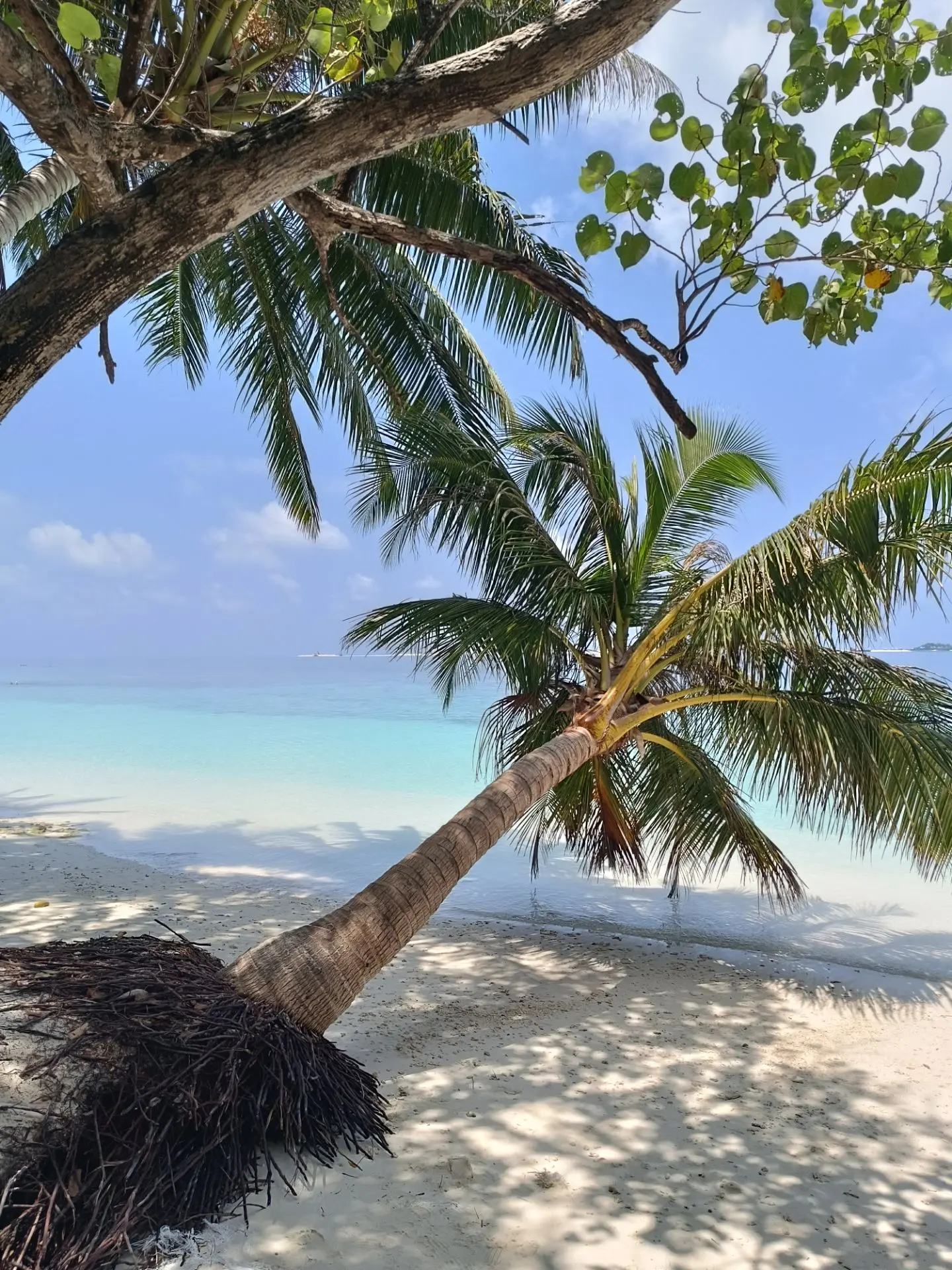
Measure the island’s perimeter roughly, subtract the parts occupied by jetties, the arrival area and back-of-house, and divide by the number of beach villas.
Fifteen metres of frontage per beach villa is generous. Eight is normal. Under five and you will hear the neighbours’ conversation from your sunbed.
Overwater villas do not consume beach, which is one of the underrated arguments for a property with a large jetty row: it takes guests off the sand.
And the public beach areas matter too. A property with one main beach concentrates everybody; one with three spreads them.
On the map: count the sunbeds if the imagery is sharp enough. It is a crude proxy and a surprisingly good one.
Which size suits whom
Honeymooners and couples: small to mid. Intimacy is the product, and limited restaurant choice matters less across five nights than ten — our honeymoon guide covers the rest.
Families: mid to large. Space, a kids’ club, more than one place to eat, and room for children to be children without disturbing everybody.
Divers: irrelevant, mostly. You will be on a boat. What matters is the dive centre and the sites, as our diving guide and the atoll decision guide set out.
Long stays — ten nights or more: larger. Variety stops being a luxury and becomes the thing that makes the second week work.
Short stays — three or four nights: small. No time is wasted on distance, and familiarity arrives faster — which also suits the split stay pattern.
People who like walking: large, or a guesthouse island, where you can walk through a village rather than round a perimeter.
Anyone who has been disappointed by a resort before: check the density figure. It is frequently the thing that was wrong.
How this interacts with everything else
Island size is not an independent variable, and three interactions matter.
Size and reef. Small islands are more likely to have close water on at least one side, simply because there is less land between the beach and the edge.
Size and villa type. A long jetty row on a small island puts a large share of guests over water, which lowers land density and takes pressure off the beach — the trade our villa comparison describes from the other direction.
Size and transfer. No relationship at all. A tiny island can be a seaplane away and a large one a thirty-minute speedboat — the geography is set by the atoll, as our transfers guide explains.
And size and price. Also no reliable relationship. Some of the most expensive properties in the country are very small, and some large ones are among the most accessible.
What to check on the map
Seven things, and the whole exercise takes five minutes.
Length and width in metres, using the map’s measuring tool.
The villa count, from the property’s own site.
The density figure, from the division above.
The shape — long and thin, or round.
Where the villas are. One side, both sides, or a jetty row.
The vegetation — dense and irregular, or sparse and regular.
The colour of the water, while you are there — the other five-minute check, covered in our guide to reading a house reef and applied to snorkelling generally.
Do both checks in the same sitting. Together they tell you more about a property than an hour of reading descriptions, and they cost nothing.
The questions the map cannot answer
Three, and they go in the same email as the reef questions.
How many guests are typically on the island? Occupancy varies, and a hundred-room property at 60% feels different from one at 95%.
Are there buggies, and what is the wait? The answer tells you the real distances.
Do you host weddings or large groups? On a small island, one large group changes the whole property for a week. Properties are usually honest about this if asked directly, and it is not a question anyone thinks to ask.
A fourth, if it matters: are there quiet areas or adults-only sections? Larger properties frequently have both.
Guesthouse islands, for comparison
Different arithmetic entirely, and worth a paragraph.
An inhabited island is not sized for you. It has a population, a harbour, a school and a mosque, and the tourism part is a share of it — our guide to choosing a local island covers what varies.
Which means density is irrelevant in the resort sense. What matters instead is how many guesthouses there are, because that is what determines how much of the island is tourism.
And you can walk. A village of two thousand people has streets, a harbour and a football pitch — more to walk through than any resort island of the same size, as our guide to local island visits describes.
The comparison that matters: a small resort island can feel confining by day five. A small inhabited island rarely does, because it contains a community rather than a property.
Questions travellers ask
Does resort island size matter in the Maldives? More than most people expect. It determines how far everything is, how often you see the same guests, how many restaurants there are and whether the island feels private — and it varies from about 300 metres to over 1,500.
How do I find out how big a resort island is? Measure it on a satellite map using the measuring tool. Then find the villa count on the property’s site and divide, which gives you a rough density figure that predicts the feel of the stay.
Is a small island better? For short stays and couples, usually. Everything is close and the staff learn your name. Against that: one or two restaurants, nowhere to walk, and no escape if the other guests are wrong for you.
Is a large island better? For families, long stays and anyone who likes walking. Against that: buggy waits, distance to breakfast and the dive boat, and less personal service.
What is a good guest density? Roughly speaking, under 5 villas per hectare feels spacious, 5 to 10 is normal, and above 15 is dense. Overwater villas lower the effective land density because they sit on water.
Does island shape matter? Yes. A long, thin island has more beach per unit of area and two distinct sides, which means a sheltered aspect in every season and both a sunrise and a sunset beach.
Can I tell the island’s age from the map? Roughly. Dense, irregular vegetation with shadow means mature planting and shade. Regular rows of small trees on pale ground means a new or reclaimed island.
Does a bigger island cost more? No. There is no reliable relationship between island size and price — some of the most expensive properties are very small.
What to take away
- Density, not length, is the number that predicts the feel of a stay: villa count divided by island area, calculable in two minutes from a satellite map.
- Under 5 villas per hectare feels spacious, 5 to 10 is normal, above 15 is dense.
- Small islands give closeness and familiarity, and cost you restaurant variety, somewhere to walk and any escape from other guests.
- Large islands give variety, privacy and walking, and cost you buggy waits, distance and personal service.
- A long, thin island beats a round one at almost any size, because it has more beach per unit of area and a sheltered side in every season.
Next step: open the satellite map, measure the island, count the villas on the property’s site, and divide. Then look at the colour of the water while you are there. Two checks, five minutes, and between them they tell you almost everything a booking page will not.