Adults-Only in the Maldives: Quiet Is Density, Not a Policy
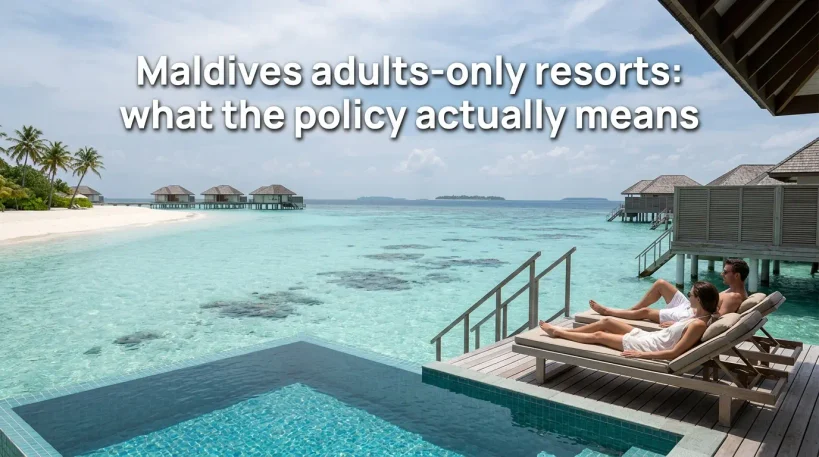
Adults-only sounds like a single thing. It is at least three, with age thresholds ranging from twelve to eighteen depending on the property, and some islands apply the rule in parts rather than in whole.
More usefully: if what you want is quiet, an age policy is a poor proxy for it. A dense child-free island with a hundred and twenty villas on four hectares is noisier than a spacious family property at half the density. Noise on a Maldivian island is people, and people are arithmetic rather than policy.
This guide covers what the policies actually say, what they buy, what they do not, and the measurement that predicts quiet better than any of them.
The three adults-only models
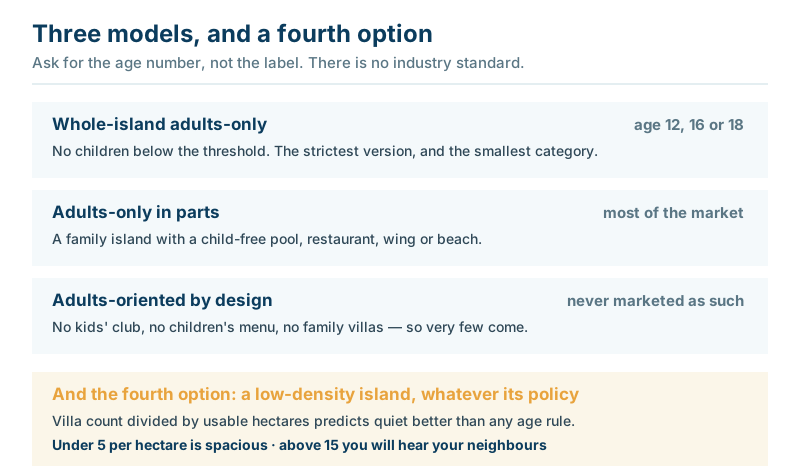
Whole-island adults-only. Children are not accepted at all below the threshold. The strictest version, and the smallest category.
Adults-only in parts. A family island with a child-free pool, restaurant, wing or beach. Increasingly common, and where most of the market actually sits.
Adults-oriented by design. A property with no kids’ club, no children’s menu, no family villas and no shallow pool — which does not exclude children but is not built for them, so very few come. Frequently the quietest option of all, and never marketed as adults-only.
So the question to ask is not “is this adults-only” but “what is the policy, and where does it apply”. The answers differ more than the label suggests.
The adults-only age threshold, which varies
The detail that catches people out, particularly on multi-generational trips.
Twelve, sixteen and eighteen are all in use across the market. There is no standard.
A fourteen-year-old is excluded from some properties and welcome at others, which matters if you are travelling with one.
Some properties apply different thresholds to different areas: children permitted on the island, excluded from one restaurant, and excluded from the spa entirely.
And the threshold applies at the time of stay, not at booking, which occasionally catches families whose child has a birthday mid-trip.
Ask for the number, not the label. “Adults-only” is a marketing term; “sixteen and over” is a policy.
What adults-only actually buys
Four things, and they are real.
No children in the pool, at breakfast or on the beach. For some travellers this is the entire product, and there is no need to be defensive about wanting it.
Adult dining hours. No early sitting, no queue at six, and restaurants that stay calm through the evening — which changes what the food is like as much as the menu does.
A different guest mix. Couples, honeymooners and older travellers, which changes the atmosphere of a bar considerably.
And no kids’ club noise, which is specific rather than general: a kids’ club at the centre of a small island is audible from most of it, and adults-only islands have none.
What it does not buy is covered below, and it is a longer list.
What it does not buy
Silence. Weddings, celebrations and large groups all happen at these properties, and a group of twenty on a small island changes the week regardless of anybody’s age.
Exclusivity. You still share the island, the restaurant, the beach and the boat with everybody else staying there.
A better reef. Reef quality is geography rather than policy, and the check in our guide to reading a house reef applies identically — as does the snorkelling it leads to.
Better weather, better food or better service, none of which correlate with the age policy.
And crucially, not low density. One of these properties can be packed. The measurement is in our guide to island size, and it predicts quiet far better than the policy does.
The measurement that matters more
If quiet is the reason you are looking at adults-only properties, do this calculation first.
Villa count divided by usable island area gives guests per hectare. Under 5 villas per hectare feels spacious. Above 15 is dense enough to hear neighbours.
Both numbers are obtainable in two minutes — the island from a satellite map with a measuring tool, the villa count from the property’s own site.
What this exposes. A 40-villa child-free property on a small island can sit at 15 per hectare. A 60-villa family property on a large one can sit at 5. The second is quieter, and the label says the opposite.
Which does not make the adults-only policy worthless. It means the two are separate variables, and the one nobody measures is the one that decides the outcome.
The best combination is low density plus the policy, or low density plus a child-free section — and it exists at the upper tiers, which our guide to what the luxury tier buys describes as space being the first thing money purchases.
Who it suits
Honeymooners, obviously, and the largest single market for these properties — our honeymoon guide covers the rest of that decision.
Couples on a milestone trip, where the point is that nothing is required of you — including a wedding or vow renewal, which these properties host frequently.
Anyone with a low noise tolerance, said without judgement. Some people find children on holiday delightful and some find them exhausting, and a Maldivian island offers nowhere to escape either way.
Older travellers, for whom the guest mix matters as much as the policy.
Writers, readers and people who want to do nothing, for whom an island with no scheduled entertainment is the product — and for whom the free activities matter more than the paid ones.
And anyone travelling in school holidays who wants to avoid the resulting demographics — which is also when prices and crowds peak together.
Who it does not
Families, by definition, and the exclusion is worth planning around rather than discovering.
Multi-generational trips. Grandparents, parents and children need a property that takes all three, and this category removes a slice of the market — the family considerations are in our guide to choosing a resort for a family.
Anyone who wants a lively island. Adults-only frequently means quiet in the evening too, and a property with no children can also have very little happening.
Divers travelling with a non-diving partner, where the partner’s week depends on there being something to do — the problem our guide to choosing a resort for diving sets out.
And anyone on a budget. The category skews expensive, for reasons in the next section.
What the evening is actually like
Worth describing, because it is where the difference from a family property is largest and least documented.
Dinner runs later. No six o’clock sitting, no queue of families at the buffet, and a main restaurant that fills at eight rather than emptying by then.
The bar has people in it after ten, which is not true of a family island where everybody is putting children to bed.
There is frequently live music, and it is frequently the same three musicians all week. This is a genuine feature at some properties and wallpaper at others.
The island is dark and quiet by midnight either way. There is no nightlife in the Maldives, at any property, of any kind — the absence our activities overview is explicit about.
And the difference at breakfast is bigger than the difference at dinner. A family island at eight in the morning is the loudest it will be all day, and a child-free one at the same hour is silent. If quiet mornings matter more to you than late evenings, that is the comparison to weigh.
Why adults-only costs more
Three reasons, and only one of them is about quality.
Excluding children removes a market. A property that cannot sell to families is competing for a smaller pool of guests, and it prices accordingly.
The demographic pays more. Honeymooners and couples on milestone trips are less price-sensitive than a family of four watching four transfer fares.
And the properties skew upmarket anyway, because low density and adults-only tend to appear at the same tier — the correlation the previous section warns about, and which our guide to what the tiers include unpicks.
What this means practically: you are paying a premium for the policy, and a second premium for the space that frequently comes with it. Separating the two is the point of the measurement above.
The value alternative: a family property in low season, at low density, in a beach villa away from the pool. Substantially cheaper, and frequently quieter than a mid-tier adults-only island in August — the seasonal picture is in our high and low season guide.
Booking and timing
Four practical points.
The adults-only category is small, which means less choice and earlier booking than the family market — six months for peak season is reasonable.
School holidays are when the difference is worth most and when the price gap is widest. Outside them — and outside the dry-season peak — a family property can be genuinely empty of children.
Check the adults-only policy in writing, because booking-platform filters are unreliable and occasionally list a property with one restricted section as adults-only outright.
And check the transfer, which is unaffected by any of this but decides the day. A speedboat property lets you arrive at any hour; a seaplane one commits you to a daylight window, as our guide to missed connections explains.
One more, for couples travelling in the wet season: a property with an indoor bar, a spa and more than one restaurant handles a grey afternoon far better than a small one with a single buffet, as our rainy day guide explains.
Adults-only sections on family islands
The compromise that suits more people than either extreme, and it is worth understanding properly.
What exists: child-free pools, restaurants, wings and, at a few properties, a beach.
What that gives you: somewhere to be at three in the afternoon that is calm, without excluding yourself from a property that has more restaurants, more staff and better facilities because it serves a wider market.
What to check: how far the restricted area is from the family one, whether it has its own bar and food service, and whether the rule is enforced. Island geometry decides this, as our guide to island size explains.
The failure mode is a child-free pool twenty metres from the family one with no barrier, which achieves nothing.
And the honest observation: these sections work well in the afternoon and matter less at breakfast, which is when a family island is at its most audible.
The guesthouse island question
There is no equivalent, and it is worth saying why.
Inhabited islands do not have this category at all, because they are villages. Children live there, play there and are on the beach.
Which makes a guesthouse island the wrong choice if avoiding children is the goal, whatever else recommends it.
Some guesthouses are quiet in the sense of being small and having few guests, and none is quiet in the sense of being child-free.
And the bikini beach is shared, which is where everybody goes — see our guide to choosing a local island.
If quiet is the priority and budget is a constraint, the better answer is a low-density resort in low season rather than an inhabited island — the comparison is in our where to stay pillar.
Liveaboards, briefly
The other genuinely child-free option, and it is rarely considered in this context.
Most liveaboards are effectively child-free, because the format does not suit children and few operators accept them.
Ten to thirty guests, all diving, which is a specific demographic rather than a general one.
It is not quiet in the resort sense — a boat has engines, compressors and briefings — but there are no children on it.
And it costs a fraction of a resort week in this category, from about USD 150 per person per day all in.
Only for divers, obviously — the constraint our guide to choosing a resort for diving covers from the other side.
The demographic question nobody asks
Worth raising, because it decides whether the atmosphere suits you and nobody writes it down.
Adults-only properties attract two distinct groups: honeymooners and couples on milestone trips, and older travellers who want calm. The mix varies by property, by season and by price point.
Which produces very different islands. A property full of honeymooners is quiet in a particular way. Everybody is in pairs, nobody is looking for company, and conversations do not carry.
A property with an older demographic is sociable in a different way: the bar has conversation in it, and travellers find people to talk to — including on excursions, which fill differently.
Neither is better, and the mismatch is what produces the reviews that say “lovely resort, wrong crowd”.
Ask the property, in the same email as the density questions. Reservations teams know their guest mix and honest ones will describe it. “What is the typical guest profile this time of year” is a normal question and the answer is frequently candid.
And read reviews for atmosphere rather than facilities. Decor photographs; a room full of the wrong people does not, and that is what reviews are actually useful for — the same approach our guide to choosing a local island recommends for noise and construction.
Four ways to get the same outcome
Ranked by how well they work, and only one of them is a filter setting.
1. A low-density property, whatever its policy. Under 5 villas per hectare, measured from a map. This is the most reliable route to quiet in the Maldives and it is available at every tier.
2. A property with a child-free section, which gives you a calm afternoon without excluding you from a better-resourced island.
3. A genuine whole-island adults-only policy, which delivers exactly what it says and costs a premium for it.
4. Low season at a family property. Outside school holidays, in a beach villa away from the pool, at a fraction of the price. Frequently quieter than a mid-tier child-free island in August.
And the fifth that is not on the list: a liveaboard, which is child-free by nature and only works for divers.
What all four have in common is that none of them buys silence. They buy fewer people, at different prices, and the honest question is which route to fewer people fits your budget.
The questions to ask
Six, by email.
What is the exact adults-only minimum age, and does it apply to the whole property or to parts?
Which areas are restricted, and how are they separated from the rest?
How many villas are there, and how large is the island? The density calculation.
Do you host weddings and large groups, and are any booked during my dates? The single most useful question in this article, and nobody asks it.
Is there scheduled entertainment in the evening, and how late does the bar run? Quiet cuts both ways.
And what is the typical guest mix in this season? Properties know, and honest ones will tell you.
A note on the word “exclusive”
Worth separating from the age policy, because the two get bundled in the same marketing.
Exclusive, in a Maldivian context, is arithmetic — how many other people are on the same island, which is measurable.
The age policy is a demographic filter, which is a different thing.
A property can be one without the other, in both directions, and the combination is what the upper tiers sell.
What you cannot buy at any price is an island with nobody else on it, short of a private island charter. Every guest arrives through the same jetty and eats in the same restaurants.
Which is why the useful question is the density one. It answers “how many people will I see” rather than “who is allowed to be here”, and the first is the one that shapes a week.
Questions travellers ask
What does adults-only mean in the Maldives? It varies. Some properties exclude anyone under a threshold from the whole island, some are adults-only in parts — a pool, a restaurant, a wing — and some are simply not set up for children without excluding them. Thresholds range from twelve to eighteen.
What is the minimum age at adults-only resorts? There is no standard. Twelve, sixteen and eighteen are all in use, and some properties apply different thresholds to different areas. Ask for the number rather than the label.
Does adults-only mean quiet? Not reliably. Weddings, groups and celebrations happen at these properties, and a dense child-free island can be noisier than a spacious family one. Villa density predicts quiet better than the age policy does.
How do I check how busy a resort will feel? Divide the villa count by the island’s usable area. Under 5 villas per hectare feels spacious, 5 to 10 is normal, above 15 is dense. Both numbers take two minutes to find.
Are these resorts more expensive? Generally yes. Excluding families removes a market, the remaining demographic is less price-sensitive, and the properties skew upmarket. You pay for the policy and often for the space separately.
Is there a child-free option on a budget? Rarely as a policy. The cheaper route to the same outcome is a low-density family property in low season, in a villa away from the pool.
Can I find one on a local island? No. Inhabited islands are villages with children living on them, so the concept does not exist there.
What should I ask before booking? The exact minimum age and where it applies, which areas are restricted, the villa count and island size, and whether any weddings or large groups are booked during your dates.
What to take away
- Adults-only is at least three different models, with age thresholds from twelve to eighteen and no standard. Ask for the number, not the label.
- If quiet is the goal, density predicts it better than the policy. Villa count divided by usable hectares: under 5 is spacious, above 15 is dense.
- A dense child-free island can be noisier than a spacious family one, and the label says the opposite.
- The category costs more for three reasons, only one of which is quality — and you frequently pay separately for the policy and for the space.
- Ask whether any weddings or large groups are booked during your dates. It is the most useful question here and almost nobody asks it.
Next step: before filtering a booking site by that label, measure two or three properties on a satellite map and divide by their villa counts. If quiet is what you are buying, that number will tell you more than the policy — and it may point you at a property the filter would have hidden.