

Maldives Resorts Near the Airport: On a Short Trip, the Transfer Is a Quarter of It
A ninety-minute boat each way costs three hours. Add the wait at the terminal, the counter, the luggage and the crossing itself, and a distant resort takes most of the arrival day and most of the departure day.
On a two-week trip that is a rounding error. On a four-night trip it is a quarter of the holiday — and the strongest argument in the country for choosing a property close to the airport.
This guide covers what “near the airport” actually means in minutes and dollars, when it is the deciding factor, what you give up, and the one thing to check that nobody mentions.
What “near” means
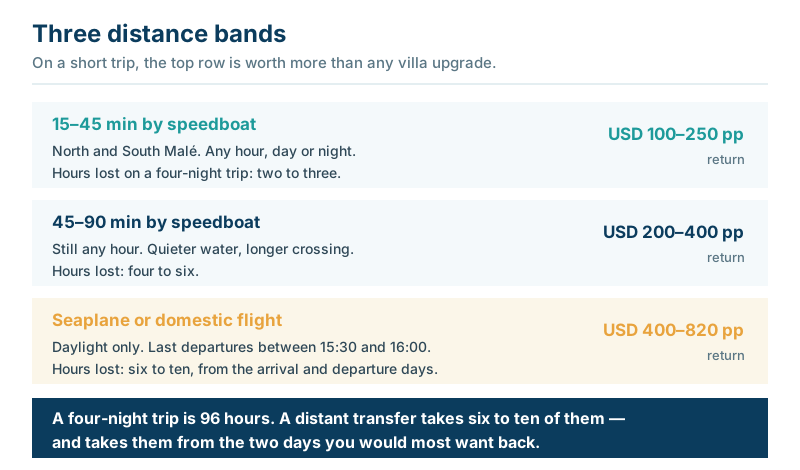
Three bands of distance from the airport, and the difference between them is the whole article.
Fifteen to forty-five minutes by speedboat. The near band: properties across North Malé and South Malé in Kaafu Atoll, reachable at any hour, at roughly USD 100 to 250 per person return.
Forty-five to ninety minutes by speedboat. Still Kaafu and the nearer parts of the surrounding atolls, at USD 200 to 400 per person return, and still available at night.
Seaplane or domestic flight. Everything else: USD 400 to 820 per person return by seaplane, daylight only, with a departure window that closes between about 15:30 and 16:00.
The band decides three things at once: the cost, the number of usable hours in your trip, and whether a late-arriving flight strands you for a night — the arithmetic our guide to missed connections sets out.
And it is set by geography rather than by the property. A modest resort forty minutes out and an expensive one forty minutes out have the same transfer.
The time arithmetic
Worth doing explicitly, because the time saved is the whole argument for the airport band.
A four-night trip has roughly 96 hours in it. A ninety-minute transfer each way, plus the terminal waits either side, consumes six to eight of them — and it does so at the start and end, which is where the good hours are.
A seaplane island costs more than time. Land at 13:00, clear immigration by 14:30, wait for a flight that may not leave until 15:15. You reach the villa at half past four, and arrival day is gone.
Fifteen minutes by speedboat puts you on a beach ninety minutes after the aircraft door opens.
Which means on a short trip you are buying hours, and the near band delivers more of them than any room category does.
On a longer trip the calculation reverses. Ten nights absorbs a transfer easily, and the more distant atolls are where the emptier water is.
The rule of thumb: under five nights, stay near. Over ten, go where you actually want to be. Between the two, decide on the other factors in this article.
When proximity is decisive
Six situations where an airport-adjacent property wins on its own.
Short trips, as above.
A late international arrival. Land after roughly 14:00 and a seaplane resort is unreachable that day. A speedboat property is not, at any hour.
A pre-dawn departure. International flights leave in the small hours, and a resort that can deliver you at four in the morning is a resort with a boat rather than an aircraft.
Families. Transfers are charged per person from about two years old, so four people pay four fares. A tired child on a ninety-minute crossing is the memory nobody wants from day one, and our family guide makes the same recommendation.
Anyone nervous about small aircraft, which is a larger group than the industry acknowledges.
And a stopover. Two or three nights on the way somewhere else is only worth doing in the near band.
Which islands are actually in the near band
Not a property list, and the geography is worth knowing.
North Malé Atoll holds the largest cluster: a chain of islands running north from the airport, most of them fifteen to fifty minutes by speedboat, and the densest concentration of resorts in the country. It also holds the surf breaks and a great many dive sites.
South Malé Atoll runs south from the capital, slightly quieter, with transfers typically twenty-five to fifty minutes and the guesthouse islands of Maafushi, Gulhi and Guraidhoo in the same water.
Both are parts of Kaafu, which is one administrative atoll rather than two — the naming problem our atolls guide untangles.
The edge of the band reaches into Ari and Vaavu at ninety minutes or more, where some properties run speedboats and others use seaplanes for the same distance.
Which is worth checking, because a property at the boundary may offer both, and the choice between them is yours rather than fixed.
What determines the mode is the property’s arrangement rather than pure distance. Some islands within speedboat range still fly guests in, because it suits their schedule.
What you trade
Honestly, because staying near the airport is not free of costs.
Kaafu is the busiest atoll in the country. More resorts, more boats, more traffic on the popular dive sites, and more of everything — which is a genuine drawback and also the reason there is so much choice.
Boat and aircraft movement is visible. Seaplanes overhead, speedboats crossing, and the shipping into Malé. On the closest islands this is a constant background rather than an occasional one.
Some islands sit under a flight path. Not many, and it is worth asking about specifically — see below.
The sense of remoteness is diluted. If the point of your trip is being nowhere near anything, fifteen minutes from an international airport is the wrong choice, and no amount of villa quality fixes it.
What you do not trade is reef quality, which is island-level geography rather than distance from Malé. The check in our guide to reading a house reef applies identically in every atoll.
The thing nobody mentions
Ask whether the property is under a flight path or a seaplane route.
Velana handles international jets, domestic aircraft and one of the largest seaplane operations in the world. The seaplanes fly low, they fly all day in daylight, and their routes fan out across the near atolls.
Most properties are unaffected. A few are directly beneath a corridor, and the difference between the two is not something a booking page will tell you.
How to ask: “Do aircraft pass over the island, and how frequently during the day?” A property that is not affected answers immediately and cheerfully.
Recent reviews mention it if it is a problem — search them for “plane”, “noise” and “seaplane”.
And note the asymmetry: seaplane noise stops at dusk, because they do not fly after dark. An island under a route is quiet from four in the afternoon.

What it saves
| Near band | Seaplane island | |
|---|---|---|
| Transfer, per person return | USD 100–250 | USD 400–820 |
| A couple | USD 200–500 | USD 800–1,640 |
| A family of four | USD 400–1,000 | USD 1,600–3,280 |
| Arrival window | any hour | daylight only, ends 15:30–16:00 |
| Hours lost on a 4-night trip | 2–3 | 6–10 |
For a family of four the difference is over a thousand dollars, which buys several nights of villa upgrade, a week of diving, or two extra nights.
And the near band is not a budget category. Properties across every tier sit within forty-five minutes of the airport, from the accessible end to the top of the market — as our guides to budget and luxury tiers both note.
What the boat itself is like
Rarely described, and it decides whether the crossing is pleasant or endured.
A modern enclosed speedboat has air conditioning, forward-facing seats, a toilet on the larger ones, and luggage stowed properly. Forty minutes in one is comfortable.
An open boat is faster to load, wetter in swell and considerably less comfortable for anyone prone to motion sickness.
Shared or private changes the wait rather than the crossing. A shared transfer may hold for other arrivals — twenty minutes to three hours in the worst case — while a private one leaves when you do. The comparison is in our guide to shared and private speedboats.
Ask about the wait, not just the crossing. Ninety minutes of waiting plus thirty of boat is a worse arrival than sixty minutes of boat with none.
Spray happens in the southwest monsoon, and phones and cameras belong in a bag rather than a pocket — the wind pattern is in our monsoon guide.
And the night crossing is fine. Boats run in the dark routinely and crews do it several times a week. The only thing you lose is the view, and on the way in you would have been looking at your phone anyway.
The departure day, which is the harder one
Arrival gets the attention and departure is where trips actually go wrong.
International flights leave in the small hours, mostly between midnight and four, with check-in opening two to three hours before.
A seaplane cannot deliver you at that hour. You leave the resort the previous afternoon and sleep near the airport — a night of your holiday spent in a city hotel, and it is not always disclosed at booking.
A speedboat can, at any hour, which converts the last day into a full day on the island.
Build the buffer anyway. Three hours before an international departure is the minimum, four in the southwest monsoon if any part of the journey is by sea.
And check late checkout. A four o’clock boat with an eleven o’clock checkout means five hours without a room. Some properties solve this gracefully and others do not.
The failure mode to avoid is a cancelled transfer meeting a fixed flight, which our guide to missed connections covers — and which the airport band largely removes, because boats have alternatives that aircraft do not.
The day-pass product
A category that exists only near the airport, and most visitors have never heard of it.
Several near-airport resorts sell day passes — arrive by boat in the morning, use the beach, the pool and frequently a meal, and leave in the afternoon.
What it costs: typically USD 100 to 250 per person, depending on the property and what is included.
Who it is for: anybody with a long layover, anybody staying in Malé or Hulhumalé, and anybody curious about a resort island without paying for a night on one.
What to check: whether alcohol is included, whether the pass covers a meal, and what the boat times are — the return is frequently mid-afternoon rather than at sunset.
And the honest note: a day pass shows you a resort island rather than the Maldives. It is a good use of a spare day and not a substitute for a stay.
Our own resort observations in this block come from a day visit of exactly this kind, which is stated plainly in the where to stay pillar.
Combining with the capital area
The itinerary an airport-adjacent property makes possible and the distant atolls do not.
A night in Hulhumalé, then a short boat to a resort removes the arrival-day risk entirely, and costs a fraction of what an unplanned night costs.
Or the reverse at the end. Off the island in the morning, a day in Malé, and a night flight out with a proper buffer rather than a scramble.
Or a split with a guesthouse island. The inhabited islands with the best transport are in the same atoll, so moving between them is an hour and a modest fare. That is what makes the split stay logistically easy.
None of these work from a seaplane island, where every movement is a flight and a daylight window.
Which is the underrated argument for the near band: it keeps your options open all week, rather than committing you to one island and two flights.
Does near mean worse?
The question underneath the whole airport-proximity question, answered directly.
No, and the assumption is worth examining. Distance from the airport is not a quality signal. It correlates with remoteness and with transfer cost, and with nothing else.
Reef quality is island-level geography. Some near-band properties have excellent house reefs and some distant ones sit in lagoons.
Density is island-level too, and measurable — the method is in our guide to island size.
Service and food follow the tier, not the map.
What genuinely correlates with distance is how many other boats you share a dive site with, and how empty the water feels. That is real, and it matters most to divers — our guide to choosing a resort for diving covers how to assess it.
So the honest framing: you are trading emptiness for hours and dollars, and which is worth more depends entirely on the length of your trip.
One more argument, for longer trips
Worth stating because this article has been arguing one way and the exception matters.
On a ten-night trip, spend two nights near the airport and eight further out. Arrive, take a short boat, sleep on a beach the same evening — and do the reverse at the end, so the departure is not a race.
It costs one extra transfer and removes both the arrival-day risk and the departure-day risk, which are the two points where a Maldives trip most often goes wrong.
And it gives you two islands, which is more interesting than one however good the second is. The wider case for that pattern is in our where to stay pillar.
The version that costs nothing extra: a night in Hulhumalé at either end instead of a resort night, which is cheaper than both and solves the same problem.
Either way, the principle holds. Proximity is worth most at the beginning and the end of a trip, which is exactly where a distant transfer does its damage.
Who should still go further
Fairness requires this section.
Divers. The channel atolls, the whale sharks of South Ari and the mantas of Baa are worth the transfer, and a serious diving week is not a short trip.
Anyone on a long stay. Ten nights absorbs a transfer without noticing it.
Anyone whose priority is emptiness, which the near band cannot deliver at any price.
Honeymooners with the budget, for whom the seaplane arrival is part of the occasion rather than a cost — and it is genuinely one of the best aerial views available anywhere, as our underwater photography guide notes about the flight in.
And repeat visitors, who have done the near band and want somewhere else.
The questions to ask
Five questions for any property in the airport band, and they take one email.
How many minutes is the transfer, and by what mode? Minutes, not “a short boat ride”.
What does it cost per person each way, and are children charged?
What are the first and last boat times? This decides whether your flights work.
Do aircraft pass over the island? The question from earlier.
And what happens if my flight is delayed? A property with boats running all day answers this easily; one with a fixed shuttle does not.
A sixth if you dive: how many dive sites are within thirty minutes, and how many other resorts use them?
Questions travellers ask
Which Maldives resorts are closest to the airport? Properties across North and South Malé in Kaafu Atoll sit fifteen to forty-five minutes away by speedboat, reachable at any hour. Everything beyond roughly ninety minutes is a seaplane or a domestic flight.
How much does a near-airport transfer cost? Roughly USD 100 to 250 per person return in the near band, against USD 400 to 820 by seaplane. For a family of four the difference is over a thousand dollars.
Is it worth staying near the airport? On trips under five nights, almost always — a distant transfer consumes six to ten hours of a 96-hour holiday, at the start and end. On trips over ten nights, the calculation reverses.
Are near-airport resorts worse? No. Distance from the airport correlates with remoteness and transfer cost, not with reef quality, density, service or food. What does correlate is how many boats share your dive sites.
Will I hear aircraft? At most properties, no. A few sit under a seaplane route, which is worth asking about directly — and seaplane noise stops at dusk, because they do not fly after dark.
Can I visit a resort for the day? Yes. Several near-airport properties sell day passes at roughly USD 100 to 250 per person, which suits a long layover or a stay in the capital area.
What if my flight lands late? A speedboat property can collect you at any hour. A seaplane island cannot after about 16:00, which means a night near the airport.
Should divers stay near the airport? Not necessarily. The channel atolls, South Ari and Baa are worth the transfer, and a serious diving week is rarely a short trip.
What to take away
- On a four-night trip, a distant transfer costs six to ten hours of a 96-hour holiday — and takes them from the arrival and departure days.
- The near band is fifteen to forty-five minutes by speedboat, at USD 100 to 250 per person return, available at any hour.
- For a family of four, choosing the near band over a seaplane island saves over a thousand dollars before anything else changes.
- Near does not mean worse. Reef quality, density and service are island-level and tier-level, not distance-level.
- Ask whether aircraft pass over the island. A few properties sit under a seaplane route and no booking page mentions it.
Next step: count the nights before anything else. Under five, filter for speedboat transfers under forty-five minutes and choose within that set — you will get more hours on a beach than any villa upgrade could buy. Over ten, ignore this article entirely and go where the water is emptiest, because at that length the transfer stops mattering and the emptiness starts to.