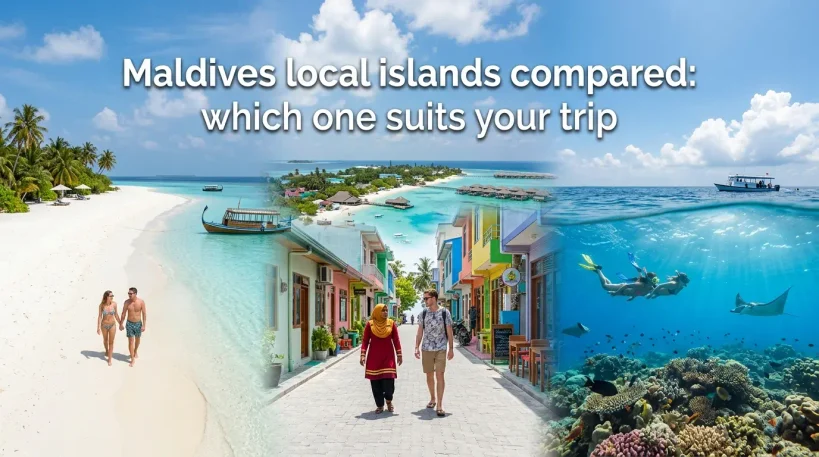
Choosing a Local Island in the Maldives: Not a Ranking
There is no best local island, and anyone who publishes a numbered list of them is ranking communities against each other on criteria they have not stated.
What there is: about a dozen inhabited islands with enough tourism infrastructure to stay on comfortably, each with a different reason to go, and a set of four or five characteristics that actually differ between them. Match those to your trip and the choice makes itself.
This guide sets out the characteristics first, then the islands grouped by what they are for — surf, whale sharks, hammerheads, quiet, or ease. We have stayed on one of them, and the article says which.
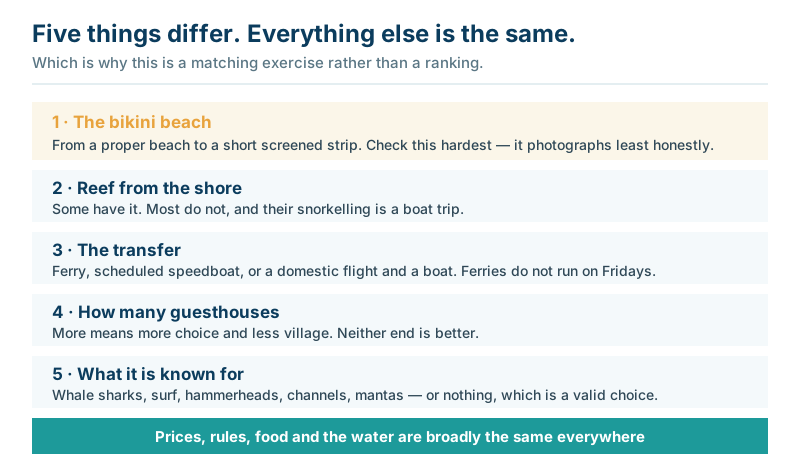
The five things that actually differ
Everything else — the guesthouse, the food, the excursion prices — is broadly comparable across the category.
1. The bikini beach. Islands with tourism designate a stretch where swimwear is permitted, and they vary enormously: from a proper beach with room to spread out, to a short screened strip beside a harbour. This is where you will spend the hours you are not on a boat, and it is the single most consequential difference.
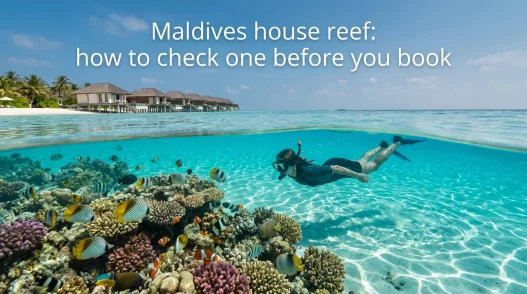
2. Whether there is reef from the shore. Some islands have a swimmable house reef reached from the tourist beach. Most do not, and their snorkelling is a boat trip. Our snorkelling guide explains how to read this from a satellite image before booking.
3. The transfer. Public ferry, scheduled speedboat, or a domestic flight and a boat. This decides the cost, the travel time and how fixed your dates are — ferries do not run on Fridays, as our ferry guide sets out.
4. How many guesthouses there are. More means more choice, more competition on excursion prices, more English spoken and more restaurants. It also means less village and more tourism economy.
5. What the island is known for. Whale sharks, surf, hammerheads, channel diving, mantas, or nothing in particular — which is itself a legitimate reason to choose one.
What does not meaningfully differ: the rules. Every inhabited island is dry, swimwear is beach-only, and shoulders and knees are covered elsewhere — the detail is in our guide to dress codes and our guide to alcohol.
The trade that runs through the whole category
Stated once, because it applies to every island below.
The more guesthouses an island has, the easier the stay and the less it feels like a village. Maafushi has dozens of properties, several dive centres, souvenir shops and a tourism economy that dominates it. A small island with three guesthouses has none of that convenience and considerably more of the thing people came for.
Neither end is better. A first visit, a short trip or a nervous traveller is well served by the easy end. A second visit, a longer stay or someone who has done this before is better served by the quiet end.
And the position moves. Islands open to guesthouse tourism regularly and existing ones keep building, so the quiet island of five years ago is frequently the busy one now. Read reviews from the last six months rather than the last three years.
The easy end
Maafushi, in South Malé Atoll, is the largest and most developed guesthouse island in the country: dozens of properties, multiple dive centres, restaurants, a water sports centre, souvenir shops and boats leaving all day.
What that buys you. Choice, competition on excursion prices, people who speak English, and the ability to arrange anything at short notice. Our Maafushi guide covers it in detail, and it is the island we stayed on.
What it costs you. It is the least village-like island in the category. The main street is a tourism street.
The transfer is the easiest in the country: a short speedboat from Malé, running several times a day, plus the public ferry.
Who it suits: first-time visitors, short trips, anyone who wants options, and divers who want a choice of centres.
Nearby and quieter, in the same atoll and reachable on the same routes: Gulhi, Guraidhoo and Himmafushi each have a handful of guesthouses and a fraction of the traffic, with the same water and the same excursion sites.
For surf
Thulusdhoo, in North Malé, sits beside two of the country’s best-known waves — Cokes and Chickens, described in our surfing guide.
What that means practically: a guesthouse island where the day is organised around the tide and the swell, with boats to the surrounding breaks at USD 10 to 25 per person.
It is also a working place with a Coca-Cola bottling plant, which is where the wave’s name comes from.
Himmafushi, nearby, gives access to Jailbreaks and is quieter.
Who these suit: surfers, obviously, and anyone travelling with one who is happy to snorkel while the other paddles out.
Who they do not: non-surfers looking for a beach holiday, since the surf islands are organised around the water rather than around lying beside it.
For whale sharks
Dhigurah, in South Ari, sits inside the whale shark protected area — the only year-round aggregation of its kind in the world, covered in our whale shark guide.
Dhigurah itself is long and thin, with a beach running for kilometres and a quieter atmosphere than Maafushi despite a solid guesthouse scene.
Getting there: a domestic flight to Maamigili and a short boat, or a longer speedboat from Malé. The flight is covered in our domestic airlines guide.
Dhangethi, in the same atoll, is smaller and quieter with the same access.
Who they suit: anyone for whom the whale sharks are the point of the trip, and divers generally — South Ari is strong beyond the protected area.
For hammerheads and reliable diving
Rasdhoo, north of Ari, is small, walkable and has one of the country’s best-known dawn dives: hammerheads in the blue, in the dry season.
It is a diving base rather than a beach one, with several centres and a routine built around early departures.
Ukulhas, in North Ari, is the other well-known island in the region and has a reputation for waste management that is genuinely unusual in the country — the island runs a serious recycling and cleanliness programme, and it shows.
Who they suit: divers, and travellers who want a small island without giving up infrastructure entirely.
For channels and nurse sharks
Fulidhoo, in Vaavu, is small, quiet and beside the channel diving that experienced divers name when pressed.
Alimatha’s nurse sharks are nearby and are one of the more startling things in Maldivian water.
Fulidhoo is genuinely a village with a small guesthouse scene, and one of the clearest examples of the trade described above: less convenience, more place.
Who it suits: experienced divers, second-time visitors, and anyone who found Maafushi too busy.
For something different
Thoddoo, in North Ari, is the agricultural island: watermelon, papaya and vegetable farms covering much of the interior, supplying Malé. It is the only one in this category where the economy is not primarily fishing or tourism. Walking through farmland to a beach is not an experience the rest of the country offers.
Fuvahmulah is not part of an atoll at all — a single island forming its own administrative division, with an inland lake and a reputation for tiger sharks that draws divers from everywhere. Our guide to Fuvahmulah covers the diving, which is not for beginners.
Dharavandhoo, in Baa, is the gateway to Hanifaru Bay and the manta aggregation described in our manta guide — seasonal, roughly June to November.
Hanimaadhoo, in the far north, has an international airport and almost no tourism, which is either the point or the problem.
Who these suit: repeat visitors, people travelling for one specific thing, and anyone who has already done the standard version.

What daily life is like on any of them
The parts that are the same everywhere, and which are the actual reason to stay on one.
Mornings start early. The first call to prayer is around five, boats leave at six or seven, and by eight the island is awake.
The middle of the day is empty. Between about noon and three, nothing happens anywhere. Shops close, streets are empty, and the sensible response is to do the same.
Four o’clock is the hour. Cafés fill for hedhikaa — short eats and sweet tea — and this is the most sociable moment of the day on every island in this article. Two dollars, and it is the thing we remember most clearly from our own stay. Our food guide covers what to order.
Six o’clock is football, on the pitch every island has, and the light goes gold twenty minutes later.
Evenings are early. Dinner at eight, and the island is quiet by eleven.
There is no nightlife, anywhere, on any of them — the absence our activities overview is explicit about.
And the water is the same water. The reefs, the channels, the sandbanks and the animals do not care which island you slept on, which is the whole argument for choosing on character rather than on brochure quality.
How to actually choose
Four questions, in order, and they narrow it quickly.
What is the trip for? Whale sharks, surf, hammerheads, mantas, channels — or nothing specific. If it is something specific, the island chooses itself from the sections above.
How long is the trip? Under five nights, take the easy end: the transfer is shorter and nothing is wasted on travel. Ten nights or more, the quiet end repays the effort, or split between two islands.
How much travel are you willing to do? A speedboat from Malé to Maafushi is thirty minutes. A domestic flight plus a boat to Dhigurah or Fuvahmulah is most of a day each way.
How much do you need the beach to be good? If the answer is very, check the bikini beach specifically, because this is the characteristic that varies most and photographs least honestly.
And one question worth asking yourself honestly: do you want a village, or do you want a cheap version of a resort? Both are available, they are different islands, and the disappointment reports almost all come from people who wanted one and booked the other.
Two islands rather than one
An underrated option for trips of ten nights or more.
Split between an easy island and a quiet one. Four nights on Maafushi for the excursions and the choice, five on Fulidhoo or Thoddoo for the place.
Or split between regions. South Ari for whale sharks, then North Malé for the transfer home — which also removes the risk of a long transfer on departure day, a problem our guide to missed connections covers.
The logistics are the constraint. Islands in the same atoll are an hour and a few dollars apart. Islands in different atolls are a ferry chain or a flight, and the public ferry network is built for residents rather than for itineraries.
And a third option: an island plus a resort, which is the split stay this site keeps recommending.
When to go, and what it changes
The seasonal picture is the same as everywhere in the country, with two island-specific wrinkles.
The dry season, December to April, gives calm crossings and the best visibility. It is also when the ferry and speedboat runs are least likely to be cancelled, which matters more on a far island than a near one — the pattern our monsoon guide explains.
The wet season, May to November, is cheaper, and the guesthouse category discounts less steeply than resorts do because the base price is already low. Our high and low season comparison covers the difference.
The two wrinkles:
Ramadan changes the rhythm of an inhabited island completely — cafés close during daylight, the evening comes alive, and guesthouses continue to serve guests. It is a more interesting time to be on one of these islands and a less convenient one. The dates move each year, as our Ramadan guide sets out.
Eid fills the ferries and the domestic flights, because Maldivians travel between islands. Book internal transport early around those dates — the public holidays calendar has them.
What to check before booking any of them
Seven things, and none of them takes more than a minute.
The bikini beach, on a satellite image and in recent reviews. Look for the words “small”, “seaweed”, “crowded” and “far”.
Whether there is reef from the beach. Dark blue-green close to shore means yes.
The transfer options and their days. Speedboat schedules and ferry days both matter, and Friday removes the ferry.
How many guesthouses. A booking platform search on the island name gives you the number in five seconds, and the number tells you what kind of island it is.
Whether there is a dive centre, if you dive, and how many.
Recent reviews for construction noise. These islands are building constantly.
And what it is near. The excursion sites are the reason for the island, and a good guesthouse an hour from the whale sharks is worse than an ordinary one twenty minutes away.
What we know first-hand, and what we do not
Stated plainly, because this article compares places.
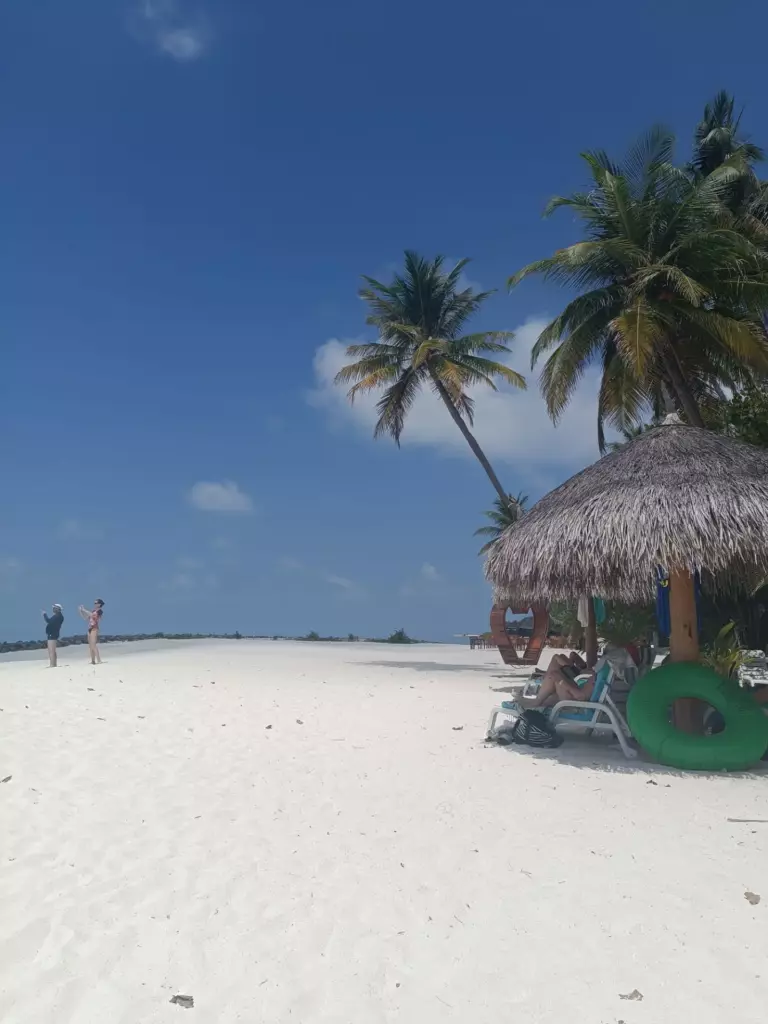
We stayed on Maafushi, and the photographs here are ours. What we say about it — the four o’clock café hour, the tourism-dominated main street, the ease of arranging anything — is from having been there.
We have not stayed on the other islands in this article. What is said about them is structural and checkable: which atoll, what the diving is, how the transfer works, roughly how many guesthouses. It is not a judgement about which is nicer, because we are not in a position to make one.
Which is why this is not a ranking. A numbered list would require exactly the comparative experience we do not have. The honest alternative is to set out what differs and let you match it to your trip.
That is a narrower promise than most sites make, and it is one we can keep.
A note on where the money goes
Worth thirty seconds, because it is one of the genuine arguments for this whole category.
A guesthouse stay puts money into a Maldivian household, not into an international hotel group. The room, the boat, the café and the dive centre are frequently owned by people who live two streets apart.
That was the point of the 2009 reform that legalised guesthouses on inhabited islands. Before it, tourism revenue flowed past these communities entirely — the history is in our guide to what the country runs on.
What a visitor controls: eating in cafés rather than only at the guesthouse, booking excursions from the shopfront as well as through the property, and buying from the shop rather than the souvenir stand.
And behaving well, which is not a moral flourish. These communities are still deciding what they want from visitors, and access to the quieter places is a function of how the people who got there first conducted themselves.
The rules, once more
They are the same on every island in this article and they are not negotiable.
No alcohol, anywhere on an inhabited island.
Swimwear on the designated beach only — including the walk there and back.
Shoulders and knees covered elsewhere, for men and women.
Friday closes the island for the main prayer, roughly 11:30 to 13:30.
Ask before photographing people, particularly women and children — the point our guide to local island visits makes at length.
And behave like a guest, because on the quieter islands you are one of very few visitors and how these communities feel about tourism is still being decided.
What it costs, wherever you go
Broadly consistent across the category, which is why the island choice is about character rather than price.
| Typical | |
|---|---|
| Guesthouse room | From USD 60 a night |
| Meals | USD 5–13 |
| Excursions | USD 25–60 |
| Speedboat transfer from Malé | USD 25–50 each way |
| Public ferry | USD 1.50–3 each way |
| A week for two, all in | USD 1,100–1,900 |
The full comparison against resorts is in our guesthouse guide and the where to stay pillar, and the excursion figures are in our price reference.
The one real cost variable is the transfer: a domestic flight to a far island adds USD 250 to 600 per person return that a thirty-minute speedboat does not.
Questions travellers ask
Which local island is best in the Maldives? There is no single best one. Maafushi is the easiest and most developed, Dhigurah is for whale sharks, Thulusdhoo for surf, Rasdhoo for hammerheads, Fulidhoo for channel diving and Thoddoo for something agricultural and quiet.
Which island is best for a first visit? Maafushi or one of its South Malé neighbours. The transfer is short, there is choice in everything, and nothing about the trip depends on planning you have not done.
Which is the quietest? Fulidhoo, Thoddoo, Dhangethi and the smaller South Malé islands such as Gulhi and Guraidhoo. Quiet means fewer guesthouses, fewer excursion options and less English spoken.
Do all local islands have a bikini beach? Islands with established tourism do. The size and quality vary enormously, and it is the characteristic worth checking hardest before booking.
Can I see whale sharks from a local island? Yes — Dhigurah and Dhangethi sit inside the South Ari protected area, where whale sharks are resident year-round.
How do I get to them? Speedboat or public ferry from Malé for the nearer islands, and a domestic flight plus a boat for the far ones. Ferries do not run on Fridays.
Is it cheaper than a resort? Substantially. A week for two runs roughly USD 1,100 to 1,900 all in, against USD 4,500 to 8,000 at a mid-range resort, for the same reefs and the same excursions.
Should I stay on more than one? On a trip of ten nights or more, yes — an easy island and a quiet one, or an island and a resort. Under five nights, one island.
What to take away
- There is no best local island. Five characteristics differ — the bikini beach, reef from the shore, the transfer, how many guesthouses, and what the island is known for — and everything else is broadly the same.
- The more guesthouses an island has, the easier the stay and the less it feels like a village. Neither end is better; they suit different trips.
- If the trip is for something specific — whale sharks, surf, hammerheads, mantas, channels — the island chooses itself.
- Check the bikini beach hardest. It varies most between islands and photographs least honestly.
- Prices are broadly the same everywhere. The one real variable is the transfer, and a far island adds USD 250 to 600 per person return.
Next step: answer the first question honestly — do you want a village, or a cheap version of a resort? Both exist, they are different islands, and almost every disappointed review in this category was written by somebody who booked the wrong one for what they wanted.