

Maldives Domestic Airlines: Three Carriers, Three Different Networks
Three carriers fly the Maldivian domestic network, and most visitors never choose between them. Your resort books the transfer, the contract decides the airline, and you find out which one at check-in.
That is fine until it is not. If you are travelling independently, the choice is yours — to a guesthouse island in the far south, to Fuvahmulah for the tiger sharks, or on a multi-atoll trip you assembled yourself. The three airlines differ genuinely in network, aircraft, baggage and price.
This guide compares them properly, and starts with the fact that reframes the whole mode: domestic flights operate after dark, and seaplanes do not.
The thing nobody puts first
Domestic flights are routinely described as the budget compromise — what you take when the seaplane is too expensive. That framing is wrong, and the reason is operational.
Regional airports have runways, lighting and instrument approaches. Seaplanes land on open water under visual flight rules, which is why they stop between roughly 15:30 and 16:00. A domestic flight does not care what time your international arrival lands.
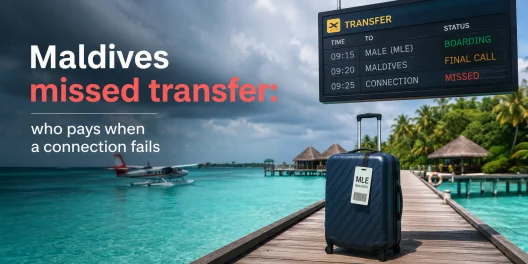
That removes the single most expensive failure in Maldivian travel — the missed seaplane window and the unplanned night near the airport, covered in our guide to missed connections.
The baggage allowance is more generous, usually 20 to 22 kg checked against the seaplane’s 20, and the aircraft are larger, so weight-and-balance refusals are rarer. Our guide to seaplane baggage rules covers the difference.
It is often cheaper, though not always, as the transfer comparison sets out.
What you lose is the view, and it is a real loss. What you gain is a transfer that works with an evening flight.
Maldivian: the national network
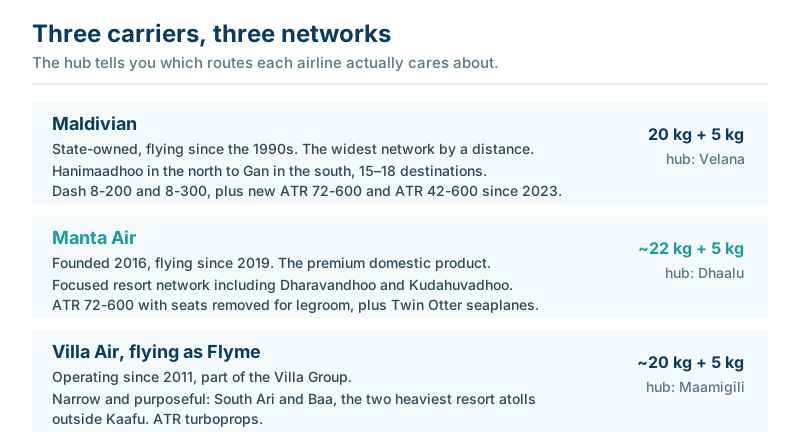
Operated by Island Aviation Services, wholly state-owned, and the backbone of domestic aviation since the 1990s.
Network: the widest by a distance, reaching from Hanimaadhoo in the far north to Gan in Addu, with somewhere between 15 and 18 domestic destinations depending on how you count seasonal and low-frequency routes. If an atoll has an airport, Maldivian probably flies there.
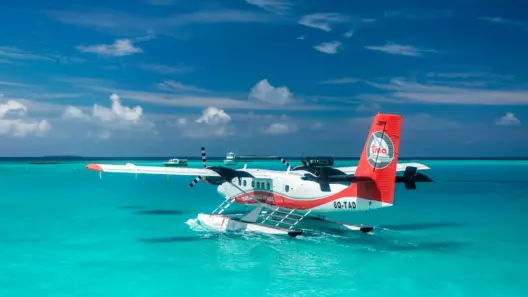
Fleet: Dash 8-200s and Dash 8-300s, progressively joined since 2023 by new-generation ATR 72-600 and ATR 42-600 aircraft. It also runs Twin Otter seaplanes and, since 2025, widebody international equipment.
Baggage: 20 kg checked on domestic routes, economy only — there is no domestic business class. Carry-on is 5 kg on Dash 8 and ATR aircraft.
Excess is charged per kilogram and rises with distance, from around MVR 30 per kilo on short sectors to roughly MVR 70 per kilo on the long run to Gan. Five kilos over on that route, for a family of four, is a meaningful number.
One genuine curiosity: passengers on Dash 8-200 aircraft are weighed at check-in. It is a safety requirement on that type rather than a comment on anyone’s luggage, and it applies to everybody.
Reputation: reliable, unglamorous, and the default. It is the airline that serves the routes nobody else wants because they are thin, which is precisely what a national carrier is for.
Founded in 2016, flying since 2019, and positioned deliberately at the top of the domestic market.
Network: focused rather than comprehensive, built around its hub at Dhaalu Airport and serving a set of resort-heavy destinations including Baa via Dharavandhoo and Dhaalu via Kudahuvadhoo.
Fleet: ATR 72-600s with seats deliberately removed to increase legroom, plus a fleet of Twin Otter seaplanes for resort transfers. It is the newest cabin product in the country.
Baggage: around 22 kg checked plus 5 kg cabin on its fixed-wing services — slightly more generous than the national carrier.
Fares: the airline publishes a Comfort Class fare on the Malé–Dharavandhoo route at USD 849 one way, which is far above what a resort transfer package costs on the same sector. That gap is worth understanding: published walk-up fares and resort-contracted transfer rates are different products, and you will normally be travelling on the latter.
Reputation: the comfort and punctuality option, and the one travellers mention by name afterwards.
Villa Air, flying as Flyme: the atoll specialist
Operating since 2011, part of the Villa Group, with its hub at Villa International Airport on Maamigili in South Ari.
Network: narrow and purposeful, concentrated on South Ari and Baa — the two atolls with the heaviest resort and liveaboard demand outside Kaafu.
Fleet: ATR turboprops.
Why it exists: Maamigili is the gateway to the whale shark waters of the South Ari marine protected area, described in our whale shark guide, and the airline was built around the group’s own resort interests. That focus makes it the fastest route into a specific part of the country and irrelevant everywhere else.

Where they fly
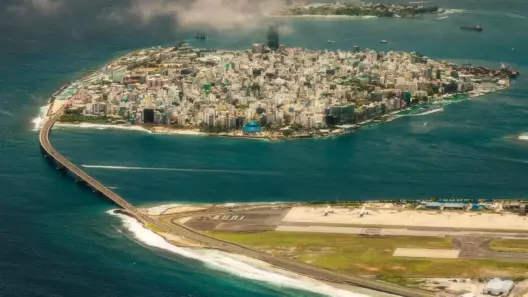
The domestic airport network reaches most of the country, and the count itself is contested — 17 licensed land aerodromes plus Velana is the figure for 2025–26, while other sources say 19 including Velana. Our guide to how many airports the Maldives has explains why the numbers differ.
The airports that matter to visitors, north to south:
| Airport | Atoll | Why you would use it |
|---|---|---|
| Hanimaadhoo | Haa Dhaalu | The far north, and an international airport in its own right |
| Maafaru | Noonu | Luxury resorts in the north-central belt |
| Ifuru | Raa | Raa Atoll resorts |
| Dharavandhoo | Baa | Hanifaru Bay and the Baa resorts |
| Kudahuvadhoo | Dhaalu | Dhaalu resorts, Manta Air’s hub |
| Maamigili | Alifu Dhaalu | South Ari, whale sharks, Villa Air’s hub |
| Thimarafushi | Thaa | Central atolls and the surf charters |
| Kadhdhoo | Laamu | Laamu resorts and surf |
| Kooddoo | Gaafu Alifu | The far south and the southern surf breaks |
| Kaadedhdhoo | Gaafu Dhaalu | Huvadhu Atoll access |
| Fuvahmulah | Gnaviyani | Tiger shark diving |
| Gan | Addu | The deep south, and the country’s second international gateway |
Flight times run from about 20 minutes to the nearest fields to 95 minutes for Gan. Our guide to airports by atoll maps the whole network.
What it costs
Round trip: roughly USD 250 to 600 per person for most resort-relevant routes, with the far south at the top of that band.
Resort packages differ from published fares. The transfer your resort quotes is a contracted rate, not the walk-up price on the airline’s website. Comparing the two and concluding the resort is overcharging is usually a mistake — though comparing two resorts’ transfer quotes for the same airport is worthwhile.
Independent booking is straightforward on all three carriers’ websites, and it is how you travel to a guesthouse island, to Fuvahmulah or on a multi-atoll itinerary. Pay by card; our guide to money covers what else to have on you.
The domestic flight is only half the transfer. Every route ends with a speedboat from the regional airport to your island, 15 to 60 minutes, arranged and billed separately — a chain covered in our shared versus private speedboat comparison.
Baggage, compared
| Carrier | Checked | Cabin | Excess |
|---|---|---|---|
| Maldivian | 20 kg | 5 kg on Dash 8 and ATR | From about MVR 30 per kg, rising to about MVR 70 on the Gan route |
| Manta Air | around 22 kg | 5 kg | Per kilogram, subject to aircraft limits |
| Villa Air / Flyme | around 20 kg | 5 kg | Per kilogram |
| Seaplane, for comparison | 20 kg | 5 kg | About USD 5 per kg, and subject to space |
Two points that matter more than the numbers.
Turboprops have limited hold space, and the rules are enforced. Sports equipment and oversized items need declaring in advance on domestic flights just as they do on seaplanes.
Excess pricing rises with distance on Maldivian, which is unusual and catches out anyone assuming a flat rate. The long southern routes are where it bites.
When the domestic flight is the right answer
Five situations where it beats the alternatives outright.
Your international flight lands in the evening. Domestic flights operate after dark. This alone decides it.
You are going further than about 130 kilometres from Malé. Beyond seaplane comfort range, the flight-plus-boat combination is standard.
You are carrying gear. Divers and surfers get more allowance and larger aircraft, and our guides to the diving and surf seasons both point south, where flights are the only realistic route.
You are travelling independently. Guesthouse islands in the outer atolls, Fuvahmulah, Addu through Gan — none of these has a resort arranging your seaplane.
You are prone to motion sickness. A turboprop in cloud is generally kinder than a floatplane in thermals.
When it is not
Short hops. Under about 90 minutes by boat, the speedboat wins on time, cost and simplicity — most of Kaafu, which is where the majority of resorts sit.
When the view is the point. The seaplane flight is genuinely one of the better things in a Maldives trip, and a turboprop at altitude is not the same experience.
When the connection is tight. Two flights and a boat is more links in the chain than one seaplane, and each is a place to fail.
When the resort does not offer it. Many properties are contracted to a single mode, and what you are sold is what they run.
Booking a domestic flight yourself
Straightforward, and worth walking through because independent travellers do it more than they expect.
Book directly on the airline site. All three carriers sell online, in dollars or rufiyaa, by card. Prices are lower booked in advance and rise close to departure in the ordinary way.
Use the airport code, not the island name. Maamigili is VAM, Dharavandhoo is DRV, Gan is GAN, Kooddoo is GKK, Kadhdhoo is KDM. Island names and airport names diverge often enough to send people to the wrong atoll.
Check the aircraft type if it matters to you. A Dash 8-200 at 37 seats is a different experience from an ATR 72-600 at 64, and the smaller types run the thinner routes.
Allow a real connection window at Velana. Two hours between an international arrival and a domestic departure is tight once you add immigration and a bag reclaim. The two tickets are separate contracts, as our guide to missed connections explains.
Confirm the onward boat before you fly. The airport is not the island. On guesthouse islands the property arranges it; ask for the time and the cost in writing.
Keep it in the same name as your passport. Domestic check-in matches documents, and a booking made in a shortened first name creates a conversation nobody needs at 06:00.
Practical notes for the day
The domestic terminal is a short walk from international arrivals at Velana, not a shuttle ride like the seaplane terminal.
Check in early. Turboprop operations run tight turnarounds and counters close promptly.
Expect to be weighed on Dash 8-200 services. It is routine.
Schedules move. Aircraft availability and weather shift departures, and the airline will not know your onward boat exists.
Confirm the boat at the far end. The regional airport is not your destination, and the speedboat meeting you is the resort’s arrangement rather than the airline’s.
Times are in Malé time, always — including when your resort’s clock says otherwise, as our guide to the time zone explains.
What the flight is actually like
Setting expectations, because a domestic flight in the Maldives is not a domestic flight anywhere else.
The terminal is small and functional. No lounges to speak of on most routes, limited food, and a boarding call that means the aircraft is already waiting.
You walk to the aircraft. Across the apron, in equatorial heat, usually with a cabin bag you are carrying rather than wheeling.
The cabin is a turboprop cabin. Noisier than a jet, propellers audible throughout, and the climb is short because the cruise is short.
The view is good, not spectacular. Higher than a seaplane, so the atolls read as shapes rather than as individual reefs. On a clear day the ring structures described in our islands guide are genuinely visible in a way no other transfer shows you.
Service is minimal. A bottle of water on most routes, nothing on the shortest.
Arrival is immediate. Small airports, no jet bridges, bags on a trolley within minutes. From landing to standing on the jetty is often under twenty minutes, which is the mode’s quiet advantage over a seaplane consolidated from four flights.
Where the network is going
Worth a short section, because it changes what is reachable.
New airports keep opening. Runway construction continues across the atolls, including a 1,800-metre runway under development at Vilufushi in Thaa, and each new field converts a long boat transfer into a short one.
Fleet renewal is underway. Maldivian’s shift from Dash 8s to new-generation ATRs since 2023 has improved cabin comfort and reliability on the routes that previously felt the most basic.
The competitive picture is stable. One national carrier with universal coverage, one premium operator with a focused network, one atoll specialist. Nothing suggests that changing soon.
For travellers the practical effect is that the outer atolls get steadily easier to reach, which is slowly undermining the assumption that the far south is only for people with a week to spare. Our atoll decision guide and the complete atolls guide reflect the current position.
A note on safety and reliability
Briefly, because travellers ask and the answer is reassuring.
Turboprop operations in the Maldives are routine and well established. Short sectors, benign terrain, professional crews and aircraft types — the Dash 8 and the ATR 72 — that are among the most widely operated regional airliners in the world.
Weather delays happen in the southwest monsoon, and they are delays rather than the outright cancellations that ground seaplanes, because these aircraft fly on instruments into lit runways.
The fleet is getting newer. Maldivian’s ATR renewal since 2023 and Manta Air’s aircraft, delivered from 2018, mean the average domestic cabin is considerably younger than it was a decade ago.
Baggage handling is manual and quick, which is a mixed blessing: fast on arrival, and hard on soft cases loaded in the rain.
Our guide to risk in the Maldives covers the wider picture, in which domestic aviation does not feature among the things worth worrying about.
Multi-atoll trips, and what the network makes possible
The domestic network is the only reason a multi-region Maldives trip is realistic, and it is underused.
The hub-and-spoke shape means Malé is unavoidable. Almost every domestic route radiates from Velana, so moving from Baa to Laamu means flying back through the capital. Direct inter-atoll services exist but are the exception.
That costs a day per move, once you account for the flight, the connection and the boat at each end. Two regions in ten days is comfortable; four is a travel itinerary rather than a holiday.
The combinations that work pair a northern or central atoll with a southern one: Baa for mantas in the wet season with Gaafu Dhaalu for surf, or South Ari for whale sharks with Fuvahmulah for tiger sharks. Both are two flights and are worth it.
The alternative is a liveaboard, which covers several atolls without any of this and is the better answer for divers, as our diving season calendar sets out.
Book the internal legs early around Eid, when Maldivians travel between islands and domestic flights fill — the dates are in our public holidays calendar.
One practical warning. On a self-assembled multi-atoll trip, nobody is coordinating the chain for you: no resort is holding a boat, no operator is watching your connection. That is the situation our guide to transfers generally is written for, and it is why buffers matter more here than on a single-resort booking.
Questions travellers ask
Which airlines fly domestic routes in the Maldives? Three: Maldivian, the state-owned national carrier with the widest network; Manta Air, the premium operator with newer ATR 72-600 aircraft; and Villa Air, flying as Flyme, which specialises in South Ari and Baa.
Can I choose which airline I fly? Only if you are booking independently. Resort transfers are contracted, and the resort’s arrangement decides the carrier.
Do domestic flights operate at night? Yes. Regional airports have runways, lighting and instrument approaches, so evening operations are normal — unlike seaplanes, which stop between roughly 15:30 and 16:00.
How much does a domestic flight cost? Roughly USD 250 to 600 per person return on resort-relevant routes. Resort-contracted transfer rates and published walk-up fares are different products, and the resort rate is usually lower.
What is the baggage allowance? About 20 kg checked with Maldivian and around 22 kg with Manta Air, plus 5 kg cabin on turboprop aircraft. Excess is charged per kilogram and rises with route distance on Maldivian.
Why was I weighed at check-in? On Dash 8-200 aircraft, passenger weighing is a safety requirement for weight and balance. It applies to everyone on that aircraft type.
How long are the flights? From about 20 minutes to the nearest airports up to 95 minutes for Gan in Addu Atoll.
Is the domestic flight the cheap option? Often cheaper than a seaplane, but that is not the main argument for it. It flies after dark, carries more baggage and uses larger aircraft, which makes it the more robust choice for awkward flight timings.
What to take away
- Three carriers: Maldivian nationwide, Manta Air premium and focused, Villa Air specialising in South Ari and Baa.
- Domestic flights operate after dark. That single fact makes them the right answer for any evening international arrival.
- Baggage is 20 to 22 kg checked plus 5 kg cabin, more generous than a seaplane, with excess rising by distance on Maldivian.
- Every domestic flight ends with a speedboat. Confirm that leg separately, because the airline does not know it exists.
- Most travellers do not choose the airline. If you are booking independently, the hub tells you which carrier actually serves your region.
Next step: if your inbound lands after two in the afternoon, look for a resort reachable by domestic flight or speedboat rather than seaplane. It is the same country and the same water, and it removes the one failure that costs a night and a day.