
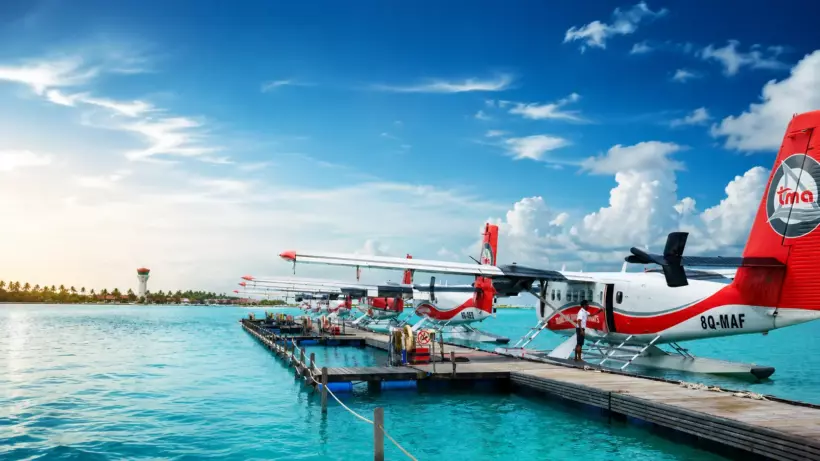
Ask how many airports the Maldives has, and you’ll get a different answer depending on which website you land on. Some travel guides say 14. Others say 15. A few say 18. And the most current data puts the real number at 20 — with more than a dozen additional airports somewhere between a signed contract and an open runway. None of these figures are lies, exactly. They’re just snapshots taken at different moments of one of the fastest-moving airport-building programs of any small nation on Earth.
For a country made up of 1,192 islands scattered across 26 atolls, an airport isn’t a luxury — it’s the difference between a two-hour transfer and a two-day boat trip. That’s why the number keeps climbing, and why anyone researching a Maldives trip in 2026 deserves an answer that’s actually current, not one copied from a 2021 blog post.
How Many Airports Does the Maldives Have Right Now?
As of 2026, the Maldives operates 20 airports. That figure comes from recent aviation data compiled by Grokipedia, which counts four fully international gateways plus 16 domestic airports, alongside a fifth semi-international facility that handles limited regional charter flights. Put another way: there is now roughly one airport for every 25,000-odd residents of the country, a density almost no other nation comes close to.
That 20-airport total is a meaningful jump from where the country stood even a few years ago. Older but still widely circulated guides cite 14 or 15 airports — figures that were accurate around 2020–2022, before a wave of new domestic strips opened in Haa Dhaalu, Gaafu Alifu, Shaviyani, and Lhaviyani atolls. Other sites, including several general travel directories, settled on 18 as a middle-ground figure sometime in 2023–2024. All of them were correct when they were published. None of them account for what’s opened, or is about to open, since.
The practical takeaway: if a source doesn’t tell you when its count was taken, treat the number as a rough guide rather than gospel. The Maldives’ airport map is genuinely being redrawn in real time.
Why Every Source Gives You a Different Number
The discrepancy isn’t sloppy journalism — it’s a byproduct of three things happening at once.
Different counting rules. Some lists count only airports with scheduled commercial service. Others include every certified aerodrome, including small strips that see just a handful of charter or cargo flights a month. A count of “14” and a count of “20” can both be technically true depending on which definition the author used.
A genuinely fast construction pipeline. Airports here don’t take a decade to build the way major hub expansions do. Many of the Maldives’ domestic strips are single-runway facilities on reclaimed or naturally flat islands, and several have gone from groundbreaking to first flight in under three years. A source published even 18 months ago is likely to be missing two or three airports that have since opened.
Inconsistent international/domestic labels. A handful of airports — Hanimaadhoo, Maafaru, and Villa (Maamigili) among them — carry “International” in their name but run limited or seasonal international routes rather than daily scheduled international service. Depending on whether a source counts them as international or effectively domestic, the sub-totals shift even when the overall count doesn’t.
Even Grokipedia’s own entry illustrates the problem: one section of its Maldives aviation page cites 15 operational domestic airports as of November 2025, while another section, discussing the network as a whole, arrives at 20 total facilities once the international gateways and a more recently updated domestic count are folded in. That’s not a contradiction so much as a snapshot problem — the kind that affects every source on a topic this fast-moving, including this one. Always check the “as of” date before you treat a number as current.
The Five International Gateways Anchoring the Network
Whatever the domestic count, the international side of the network is more stable and easier to pin down.
- Velana International Airport (MLE), on Hulhulé Island near Malé, remains the country’s primary gateway, handling the large majority of arriving tourists and connecting to more than 30 international airlines. A nine-year, roughly $1 billion terminal expansion — funded through Saudi, Kuwaiti, Abu Dhabi, and Chinese development financing — finally opened in phases starting in July 2025, lifting capacity toward 7 million-plus passengers a year.
- Gan International Airport (GAN), in the far-southern Addu Atoll, is the country’s second-largest airport and the main air gateway for southern resorts.
- Hanimaadhoo International Airport (HAQ), in Haa Dhaalu Atoll, just completed a $136 million redevelopment financed by an Indian line of credit, extending its runway to handle Airbus A320 and Boeing 737 aircraft for the first time.
- Maafaru International Airport (NMF), in Noonu Atoll, was built specifically to give luxury resorts direct international and private-jet access without routing guests through Malé.
- A fifth facility, Villa International Airport (Maamigili), rounds out the group, though its international service is comparatively limited.
Together these five form the backbone that domestic flights, seaplanes, and speedboats all feed into.
The Domestic Airport Network Across the Atolls
The remaining airports — somewhere between 13 and 16 depending on the count and the date — are small domestic strips built to shrink travel time within the archipelago, not to receive international arrivals. Typical examples include Dharavandhoo (Baa Atoll), Ifuru (Raa Atoll), Thimarafushi (Thaa Atoll), Kudahuvadhoo (Dhaalu Atoll), Kooddoo (Gaafu Alifu Atoll), Kaadedhdhoo (Gaafu Dhaalu Atoll), Kadhdhoo (Laamu Atoll), Kulhudhuffushi (Haa Dhaalu Atoll), and Fuvahmulah (Gnaviyani Atoll).
These airports share a similar profile: runways around 1,000–1,500 meters, elevations of just one to three meters above sea level, and service almost entirely from ATR 42/72 turboprops operated by Maldivian, the national carrier, plus smaller competitors like FlyMe and Manta Air. Flight times to Malé from these strips typically run 20–90 minutes — a fraction of the multi-hour ferry journeys they replace.
What’s Coming: The New Airports in the Pipeline for 2026–2027
This is where most existing guides stop — and where the real story is. The Maldivian government has two overlapping airport-building programs running in parallel, and between them they account for roughly 15 additional airports at various stages of planning, land reclamation, or construction.
The larger tranche traces back to a 2024 presidential decree that designated nine islands for new airport development: Dhidhdhoo (Haa Alifu Atoll), Dhiguveli and Milandhoo (Shaviyani Atoll), Vihafaru (Noonu Atoll), Fainu (Raa Atoll), Mathiveri (Alifu Alifu Atoll), Nilandhoo (Faafu Atoll), Maalhendhoo (Gaafu Alifu Atoll), and Guraidhoo (Thaa Atoll), alongside an opening for a second airport in Laamu Atoll at a location still to be finalized. Each project carries a minimum investment threshold set by the government to attract private developers.
Running alongside that is an older cross-subsidy program, first announced around 2022 and reissued since, targeting six more islands: Thulhaadhoo and Bilehffahi (Baa Atoll), Vilufushi (Thaa Atoll), Makunudhoo (Haa Dhaalu Atoll), Magoodhoo (Faafu Atoll), and a still-undetermined site in southern Raa Atoll. That program alone was budgeted at roughly $133 million.
Some of these are moving faster than others. In January 2026, the government signed a formal agreement with the Maldives Airports Company Limited (MACL) to reclaim land and build the Mathiveri airport, with the president committing to full completion — reclamation, infrastructure, and runway — within two and a half years, putting a realistic opening somewhere in 2028 rather than 2026. Other islands in the decree are still at the tender or feasibility stage. None of this is likely to be finished simultaneously, and a portion will almost certainly slip past their original target dates — infrastructure delays have been the norm rather than the exception in Maldivian airport projects, including the decade-long Velana terminal saga.
The practical upshot for anyone planning ahead: if you’re researching flights to a specific atoll and the nearest existing airport feels inconveniently far, it’s worth checking whether a new strip is already under construction closer to your destination before booking a longer seaplane or ferry transfer. Several of the islands named above will have scheduled domestic service within the next two to three years.
Maldives Airport Count by Source
| Source / snapshot date | Airport count cited | International | Domestic |
|---|---|---|---|
| Thrillophilia (older guide) | 12 | 4 | 8 |
| Maldives Magazine | 14–15 | 5 | 9–10 |
| Dreaming of Maldives (2021 update) | 18 | 5 | 13 |
| IndiGo airport directory | 18 | 5 | 13 |
| Curious Expeditions (Mar 2026) | 18 | — | — |
| Grokipedia (Nov 2025–Jul 2025 data) | 20 | 4–5 | 15–16 |
The pattern is consistent: the further back a source’s data was gathered, the lower its number — not because anyone was wrong, but because the Maldives simply had fewer airports when they wrote it.
Frequently Asked Questions
So what’s the correct number — 14, 18, or 20? Twenty is the most current confirmed total as of early 2026. Fourteen and eighteen were accurate at earlier points and are still repeated by guides that haven’t been updated.
How many international airports does the Maldives have? Four to five, depending on whether Villa International Airport’s limited service counts as full international status. Velana, Gan, Hanimaadhoo, and Maafaru are the consistently cited four.
Which airport should I fly into for a Maldives holiday? Velana International Airport (MLE) near Malé, since it carries the overwhelming majority of international flights and the widest choice of onward seaplane, domestic flight, and ferry connections.
Will the Maldives really have more than 30 airports eventually? If every airport currently in planning or under construction is completed — roughly 15 projects across the 2024 decree and the earlier cross-subsidy program — the total would approach 35. Realistically, expect a rolling set of openings through 2028–2030 rather than a single milestone date, with some projects delayed or shelved along the way.
Why do some domestic airports have “International” in their name? It usually reflects a limited or seasonal international route (often to Sri Lanka or India) rather than daily scheduled international service — a legal and marketing distinction as much as an operational one.