
The Maldives Surf Season: Same Swell, Three Different Calendars
Every wave in the Maldives is born in the Southern Ocean. The same swell reaches all three surf regions within hours of each other.
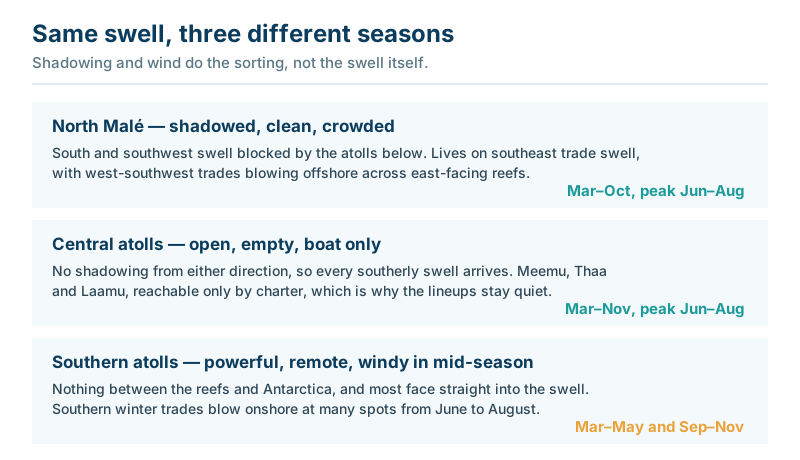
They do not have the same season. North Malé is shadowed from southerly swell by the atolls below it and lives on southeast trade swell. The central atolls sit open to everything. The far south takes the full force, then loses half its season to onshore wind.
So “the Maldives surf season runs March to October” is true and useless. This guide sets out what each region gets, month by month, and the access rules that decide whether you can surf a break at all.
Where the swell comes from
Low-pressure systems spinning across the Southern Ocean, in the latitudes sailors call the Roaring Forties, generate the groundswell that reaches the Maldives. The country sits in open ocean with nothing between it and Antarctica, which is why waves arrive with the long period and clean lines that make reef passes work.
Two swell directions matter.
Southeast trade swell arrives from April to October, generated by the same trade-wind belt that produces the dry-season surf in Indonesia. Mid-period, consistent, and the backbone of the North Malé season.
South and southwest groundswell comes from Southern Ocean storms, arrives with more power and longer period, and reaches the central and southern atolls unobstructed.
The southwest monsoon supplies both the swell and the wind, which is the tension running through this entire calendar: the months with the most swell are also the months with the most wind.
Why three regions have three seasons
The geography does the sorting.
North Malé is shadowed. Southerly and southwesterly swell is blocked by the atolls further south, so the region depends on the southeast trade swell. That gives it the narrowest swell window of the three and, conveniently, west-southwest trade winds that blow offshore across its east-facing reefs. Narrow window, clean conditions.
The central atolls are open. Far enough north that the southern atolls do not shadow them, and far enough south to catch everything out of the south. The most swell-exposed region with reliable wind.
The southern atolls take everything. Nothing between those reefs and Antarctica, and most of them face directly into the swell rather than taking it at an angle. The most powerful waves in the country — and a different trade-wind regime, where the southern-hemisphere winter winds blow onshore at many spots through the peak swell months.
That last point is the one most calendars miss. The far south gets its best surf in the shoulder months, not in the peak-swell months, because June to August brings size and wind together.
How the Maldives became a surf destination
Short, and worth knowing because it explains the access rules.
In 1973 an Australian sailor named Tony Hinde was shipwrecked in the Maldives. He found perfect uncrowded reef passes, settled, converted to Islam and took the name Tony Hussein. For close to fifteen years he surfed North Malé essentially alone, keeping the location vague in a surf press that would have filled the lineup within a season.
The secret held until the late 1980s. By the 1990s a resort had built a surf operation around a single left-hander, and the model that produced today’s exclusive-access breaks was established: a property buys the right to a wave, caps the numbers, and sells the scarcity.
Two things follow from that history. The Maldives was mapped by surfers rather than by the tourism board. That is why the break names are Anglophone jokes — Cokes for the bottling plant on Thulusdhoo, Chickens for the birds on the island behind it — rather than the Dhivehi place names the dive sites kept.
And the country’s surf infrastructure grew up separately from its resort infrastructure, which is why surf trips here look more like Indonesian charter trips than like a Maldivian holiday.
North Malé Atoll
Season: March to October, peaking June to August.
The classic zone, the closest to Velana International Airport, and the region that made Maldivian surfing famous after Tony Hinde was shipwrecked here in the 1970s and quietly surfed it alone for years.
The breaks: Cokes, Chickens, Sultans, Jailbreaks, Honky’s, Ninjas, Pasta Point, Lohis. Mostly right-handers over shallow reef, with several of the country’s longest rides.
Who it suits: intermediate and above. The takeoffs are reef takeoffs and the water over the shelf is shallow.
The catch: crowds. This is the accessible region, with resorts, guesthouses and day boats all drawing from the same lineups. On a small day at Cokes or Sultans the crowd is the problem rather than the wave. On a big day it sorts itself out.
Guesthouse-based surf trips out of Thulusdhoo and its neighbours have made the region far cheaper to surf than a decade ago. That is also why the lineups have filled.
South Malé Atoll
Season: April to September, and a couple of feet smaller than everywhere else.
Genuinely good when a bigger swell arrives, quiet when it does not, and shadowed enough that the season is shorter. One resort in South Malé is properly set up for surfing, and the region is more often surfed in passing on a charter heading south than as a destination.
The central atolls
Season: March to November, peaking June to August.
Meemu, Thaa and Laamu — the region that surf charters exist to reach.
Why it works: open to all southerly swell, no shadowing, and lineups that stay empty because nothing here is reachable from a resort jetty.
The breaks: Mushrooms, Veyvah, Muli, Yin Yang, Finnimas, Antiques and others across Meemu, Thaa and Laamu. A mix of lefts and rights, several of them world-class on the right swell.
Access is by boat. Charter vessels running week-long trips out of Malé, or a domestic flight to meet a boat further south. There is no walking down to the beach.
Who it suits: all levels in the right conditions, and adventurous intermediates generally. It is the region where the trade-off between crowd and convenience most clearly favours the boat.
The southern atolls
Season: March to May and September to November, with bigger and windier surf between.
Roughly 350 miles from the capital, and the most committed surf trip in the country. Gaafu Dhaalu is the heart of it, with Addu further south again, reached through Gan.
The waves are the most powerful in the Maldives. Full exposure, less refraction, reefs facing directly into the swell. Breaks like Beacons, Blue Bowls, Castaways, Love Charms and Tiger Stripes are the reason people fly the extra hour.
The wind is the constraint. In the southern-hemisphere winter — June to August — the trade winds blow onshore at many spots, which is why the shoulder months deliver cleaner conditions despite smaller swell.
Almost nobody is there. One resort in the region and very few charters, because of the distance and expense. The lineups are quiet in a way North Malé has not been for twenty years.
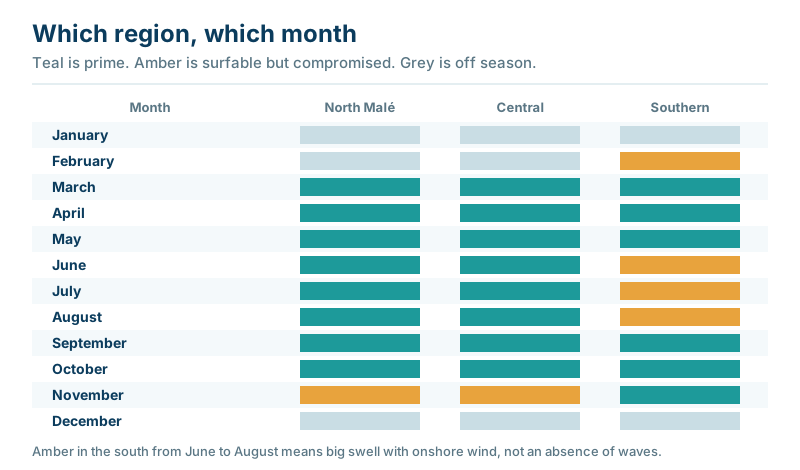
The month-by-month picture
| Month | North Malé | Central atolls | Southern atolls |
|---|---|---|---|
| January | Off season | Off season | Occasional swell |
| February | Early, inconsistent | Early, inconsistent | Season opening |
| March | Season opens, clean | Season opens | Excellent — clean and uncrowded |
| April | Consistent, moderate | Building | Excellent |
| May | Building, bigger | Strong | Good, wind increasing |
| June | Peak swell, windier | Peak | Big and windy |
| July | Peak swell | Peak | Big and windy |
| August | Peak swell, competitions | Peak | Big and windy |
| September | Consistent, cleaner | Very good | Excellent — the wind eases |
| October | Fun-sized, clean | Good | Excellent |
| November | Smaller, light winds | Season closing | Good, closing |
| December | Off season | Off season | Occasional swell |
The pattern in one line. North Malé and the central atolls want June to August. The southern atolls want March to May and September to November.
For a first Maldives surf trip, September and October are the most forgiving compromise — swell everywhere, wind moderating, and the low season pricing still in effect.
The breaks you cannot surf
An access rule that exists nowhere else in surfing at this scale, and it catches people out.
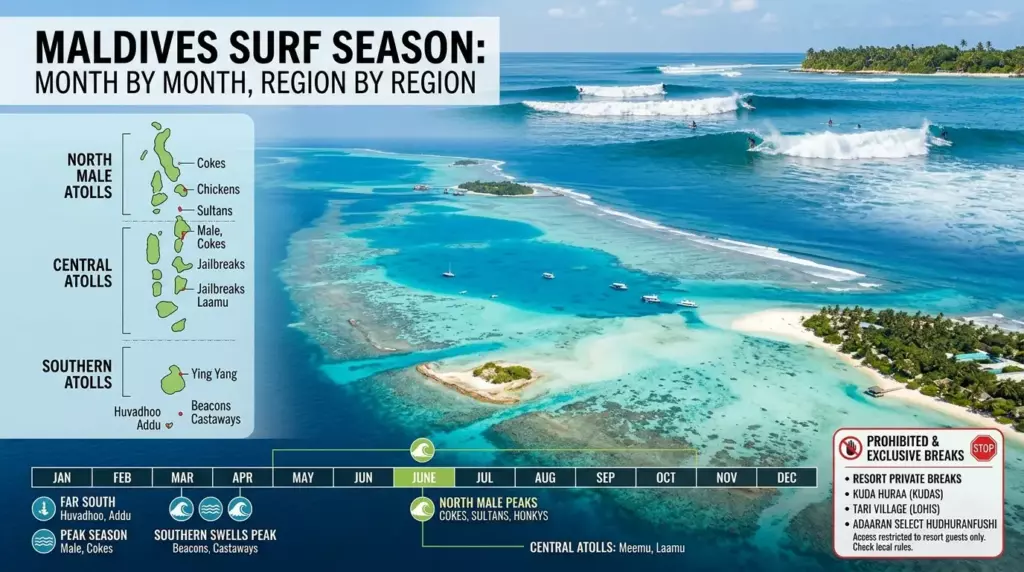
Pasta Point is surfed only by guests of the resort on the island it breaks in front of. The regulation position is one thing and the practice is another: if you are not staying there, you are not surfing it.
Lohis operates the same way for another property, with a daily cap on the number of surfers in the water — around forty-five — which is the reason the wave stays rideable on a good day.
Both arrangements exist because a resort built its entire proposition around a wave, and both are effectively enforced. If a specific break is the reason for your trip, the accommodation decision and the surf decision are the same decision.
Everything else is open. Cokes, Chickens, Sultans, Jailbreaks, Honky’s and the central and southern breaks are surfed from boats, guesthouses and resorts alike.
Boat, resort or guesthouse
Three ways to surf the Maldives, and the region decides more than the budget does.
Surf charter. The only realistic way to reach the central atolls, and the most flexible everywhere. If the wind turns, the boat moves. A week aboard covers several atolls, and the guides read the same forecast you do but know which reef handles which swell direction.
Surf resort. Fixed location, a house break, and a boat for nearby options. Excellent if the break in front is the one you want and limiting if the swell direction does not suit it.
Guesthouse island. The budget route, concentrated in North Malé around Thulusdhoo and neighbours. Day boats to nearby breaks, prices closer to the inhabited island economics described elsewhere on this site, and the crowds that come with cheap access.
The costs differ by an order of magnitude between the three, in the way our guide to money in the Maldives sets out for travel generally.
Reef, tides and getting hurt
The Maldivian bottom is coral, and it is unforgiving.
Shallow takeoff zones. Several of the best breaks work over a reef shelf with very little water on it at low tide. Reef booties are a matter of taste; reef cuts are not.
Tides matter break by break. Some spots need mid-to-high water to be safe, others improve as the tide drains. Local knowledge is the entire value of a guide here.
Coral cuts infect fast in warm water. Clean them immediately and properly — our guide to health and medical care covers what the medical system can and cannot do, including the distance to a hospital from an outer atoll.
There is no lifeguard, anywhere. The nearest help is the boat you arrived on.
And a point that connects to the rest of the site: the reef you are surfing over is the same structure covered in our piece on coral reef health. Standing on it, anchoring on it and breaking it damages the thing that makes the wave.
What to bring
Short list, because the constraints are unusual.
Boards. Bring your own. Rental exists at surf resorts and is limited everywhere else, and quivers on charter boats are for emergencies rather than choice. A shortboard plus something with more volume covers the range, since the same trip can serve four-foot Cokes and eight-foot Sultans.
Reef protection. A rash vest at minimum. Booties divide opinion and reef cuts do not.
Repair kit. Solarez or equivalent. There is no surf shop on a charter boat, and dings happen on reef.
Sun. Equatorial UV, reflective water and a session that runs three hours. Zinc, a hat between surfs, and the reef-safe formulations resorts increasingly ask for.
A first aid kit with proper antiseptic. Coral cuts infect quickly in warm water, and the nearest pharmacy may be an atoll away.
Cash in small notes. Charter tips, island purchases and boat crew — the mechanics are in our guides to money and tipping.
What you can leave behind: a wetsuit of any thickness, and a booking made on a forecast more than a week old.
Competitions and the local scene
Maldivian surfing is no longer only a visitor sport, and two events are worth knowing about.
The Four Seasons Surfing Champions Trophy brings a small invitational field of past world champions to Sultans in August, surfed across single-fin, twin-fin and thruster formats. It is the highest-profile surf event in the country and it lands squarely in peak swell season.
The Dhivehi Surf League is the domestic competition circuit, and the more interesting of the two if you want to see where Maldivian surfing actually is. The national scene has grown substantially, with local surfers now dominating lineups that were once entirely foreign.
Both are worth timing a trip around if you are travelling anyway — and neither is a reason to change your dates, since the swell is the swell.
Getting there and getting around
North Malé is a speedboat transfer of thirty to ninety minutes from the airport. The easiest surf trip in the Indian Ocean to organise.
Central atolls mean a charter boat from Malé, or a domestic flight to join one. Allow a full travel day at each end.
Southern atolls mean a domestic flight, usually to Kaadedhdhoo or Gan, and a boat from there. Two travel days out of a week, which is why trips there run long.
Board bags fly as sports equipment and airline policies vary, so check the allowance before you book the international leg — and read the arrival sequence if you are landing late with oversized baggage. Our guides to transfers and to the seaplane network cover the connections, though surf trips rarely involve seaplanes — boats and domestic flights do the work.
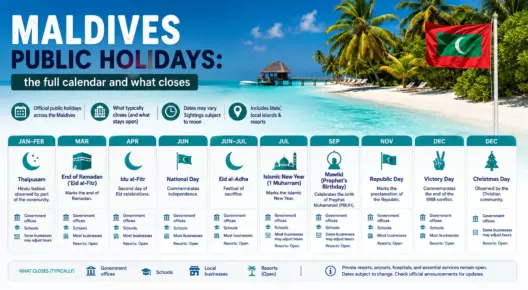
One scheduling note: check your dates against the public holidays calendar if you are travelling around Eid, when domestic flights and ferries fill with Maldivians going home.
Forecasting a Maldives trip
The country is unusually forecastable, which changes how you should book.
Groundswell is visible days out. Southern Ocean systems generate swell that takes four to seven days to arrive, so a reliable forecast window exists — long enough to be useful and short enough that it cannot inform a booking made months earlier.
Book the season, watch the week. Choose your region and month from the calendar above, then follow the forecast in the final week to decide which breaks to prioritise. Charter guides do exactly this.
Wind is the harder call. Swell forecasts are good; wind forecasts at atoll scale are approximate, and wind is what decides whether a break is surfable that morning.
Tides are published and exact. The one variable you can plan around precisely, and it matters more here than in most destinations because of how shallow the takeoff zones are.
Do not chase a forecast on a two-week booking window. The Maldives is not a destination you fly into on three days’ notice unless you live in the region — the international connections and the transfer chain do not support it.
Choosing your month, honestly
Four profiles cover most surfers.
First trip, want waves without drama: September or October in North Malé. Consistent swell, moderating wind, warm water and easy logistics.
Chasing size: June to August in the central atolls, on a charter. Peak swell with the wind manageable if the boat can move.
Chasing empty perfection: March to May or September to November in the southern atolls, accepting two travel days and real remoteness.
Learning: the smaller shoulder months, on a resort or guesthouse with a mellow house break — the atoll decision guide helps narrow the region first. The Maldives is not a beginner destination in general, but there are gentle reef waves in it.
Whatever you pick, remember the underlying constraint: the same swell hits all three regions, and what differs is whether the wind ruins it and whether anyone else is there.
Questions surfers ask
When is the Maldives surf season? Broadly March to November, with the biggest swell from June to August. The useful answer differs by region: North Malé and the central atolls peak June to August, while the southern atolls surf best in March to May and September to November because the peak months bring onshore wind.
Where does the swell come from? Southern Ocean low-pressure systems, plus southeast trade swell from April to October. The Maldives has an open-ocean fetch all the way to Antarctica.
Which region should I choose? North Malé for accessibility and a first trip, the central atolls for uncrowded quality by boat, and the southern atolls for the most powerful and emptiest waves with the longest journey.
Can I surf Pasta Point or Lohis? Only as a guest of the resort that controls access to each. Both are effectively private, and Lohis operates a daily cap on surfer numbers.
Is the Maldives good for beginners? Not generally. Most breaks are reef waves with shallow takeoff zones. There are mellow options, but a first-ever surf trip is better spent somewhere with a sand bottom.
How crowded is it? North Malé can be genuinely crowded on small days, particularly at Cokes and Sultans. The central and southern atolls are quiet because access requires a boat.
Do I need a wetsuit? No. Water sits at 26 to 30°C year-round. A rash vest for sun and reef protection is the only thing worth packing.
What about the wind? It is the deciding variable. West-southwest trades blow offshore across North Malé’s east-facing reefs, which is why the region works in the monsoon. In the far south the same season brings onshore wind at many spots.
What to take away
- The same swell reaches all three surf regions, and shadowing plus wind gives each one a different season.
- North Malé: March to October, peaking June to August, accessible and crowded.
- Central atolls: March to November, peaking June to August, boat access only and largely empty.
- Southern atolls: best in March to May and September to November, because the peak swell months bring onshore wind.
- Pasta Point and Lohis are surfable only by guests of the resorts controlling them, so the accommodation choice is the surf choice.
Next step: pick the region before the month. The month follows from it, and every surf trip that goes wrong in the Maldives goes wrong because someone booked peak season in the wrong third of the country.