
Public Ferries in the Maldives: Two Systems, and Visitors Ride the Old One
The Maldives has been building a national high-speed ferry network since 2021: air-conditioned vessels, reclining seats, an app with QR tickets. It is good, and it has reached most of the country.
It has not reached Kaafu Atoll — the airport, the capital and almost every guesthouse island a visitor books. As of mid-2026 the government still lists Kaafu, Vaavu, Meemu and both Alifu atolls as the last unconnected atolls.
So the ferry you will ride is the old one: a wooden dhoni, cash tickets at the jetty, no Friday service, no bookable schedule online. This guide covers both systems, the routes that matter, and how to verify a departure.

The two systems
Traditional public ferries. Wooden dhoni-style vessels, benches or padded seats, no assigned seating, open sides, slow. Operated on scheduled routes by MTCC, ticketed in cash at the terminal, and running for decades. This is the network that connects most inhabited islands to their atoll capital and to Malé.
RTL high-speed ferries. The Raajje Transport Link, launched in 2021 under the Integrated National Public Ferry Network programme. Purpose-built air-conditioned vessels seating around 48 to 50, with reclining airline-style seats, charging points, toilets, luggage space and wheelchair and stretcher provision. Booked through the RTL app or website with real-time availability and QR e-tickets.
Both are MTCC. Both are subsidised. They are not the same experience, and which one you get depends on the atoll.
The six zones, and where the rollout has reached
The country was divided into six zones for the rollout, delivered in three phases.
| Zone | Atolls | Status |
|---|---|---|
| Zone 1 | Haa Alifu, Haa Dhaalu, Shaviyani | RTL live since 2022 |
| Zone 2 | Noonu, Raa, Baa, Lhaviyani | RTL live |
| Zone 3 | Kaafu, Alifu Alifu, Alifu Dhaalu, Vaavu | Expansion in progress |
| Zone 4 | Meemu, Faafu, Dhaalu, Thaa, Laamu | Partial, expansion in progress |
| Zone 5 | Gaafu Alifu, Gaafu Dhaalu | RTL live since 2023 |
| Zone 6 | Fuvahmulah, Addu | RTL live |
Phase one covered the far north. Phase two covered Zone 2, Zone 5 and Zone 6 — the north-central belt and the deep south. Phase three, covering Zone 3 and Zone 4, is the one still being delivered.
The consequence is the opposite of what a traveller would expect. The parts of the country with the fewest tourists got the modern ferries first, because the network was built as decentralisation infrastructure for Maldivian communities rather than as tourist transport. The atolls with resorts and guesthouses were left until last precisely because they already had commercial speedboat operators serving them.
If you are travelling in Baa, Lhaviyani, Addu or the Huvadhu atolls, you may well ride an RTL boat and book it on your phone. If you are going to Maafushi, you will not.
How the routes are numbered
MTCC publishes a consolidated network, and the numbering follows geography. Understanding it saves a great deal of confusion when someone tells you to take “route 309”.
| Range | Region |
|---|---|
| 101–118 | Haa Alifu, Haa Dhaalu, Shaviyani — the far north |
| 201–202 | Noonu Atoll, hub at Manadhoo |
| 203–310 | The central belt: Raa, Baa, Lhaviyani, Alifu Alifu, Alifu Dhaalu, Vaavu and Kaafu |
| 401–505 | Meemu, Faafu, Dhaalu, Thaa, Laamu |
| 601–607 | Gaafu Alifu and Gaafu Dhaalu, hub at Thinadhoo |
The 200s and 300s are the range that matters to most visitors, because they include the direct connections between Malé and the guesthouse islands: Thoddoo, Rasdhoo, Ukulhas, Kaashidhoo, Dhiffushi, Guraidhoo, Rakeedhoo, Mahibadhoo and Maafushi among them.
Three types of service run within those numbers. Intra-atoll routes circulate within one atoll, calling at several islands and returning. Inter-atoll routes link islands in different atolls. Direct services run Malé to a single island without stops.
The routes visitors actually use
Below is what we can verify, and it is deliberately short. The reason for that is in the next section.
Malé to Maafushi. Route 309, departing the capital in the afternoon, calling at Gulhi, and reaching Maafushi in roughly 100 minutes. Return sailings leave Maafushi early morning. Route 306 runs on alternate days at mid-morning and continues to Fulidhoo in Vaavu — the only single-ticket way to combine the two islands.
Malé to Guraidhoo and Gulhi. Served on the same corridor as Maafushi, with Gulhi as an intermediate stop.
Malé to Dhiffushi. The eastern rim of North Malé Atoll, and the easternmost stop on the national network.
Malé to Rasdhoo, Ukulhas and Thoddoo. Direct connections into Rasdhoo and North Ari, the routes that make a cheap Ari Atoll trip possible.
Malé to Mahibadhoo. The hub of South Ari, and a connection point for onward island-hopping.
Malé to Rakeedhoo. Into Vaavu, for divers heading toward the channel sites.
Greater Malé services. Frequent direct crossings between Malé and Villingili, Hulhumalé, Gulhifalhu and Thilafushi, running without intermediate stops.

Why we do not publish a full timetable
An honest section, because this is the one subject where confident publishing does more harm than good.
There is no reliable official online schedule for the traditional ferry network. Operators working in the country say so directly. MTCC publishes consolidated network documents that change — the current consolidation took effect in March 2026 — and individual departure times shift with season, weather, vessel availability and holidays.
Published times contradict each other. Take the best-documented tourist route in the country, Malé to Maafushi. One source gives a 15:00 departure and no Friday service; another gives 14:30 and calls it the only ferry that does run on Fridays. Both are recent, and we have not been able to reconcile them from sources we trust.
A wrong timetable is worse than none. A traveller who arrives at a jetty at 14:45 for a 14:30 departure because a website said so has lost a day, and possibly a night’s accommodation.
So this article gives you the network structure, the route corridors, the fare bands and a verification method. It does not give you departure times we cannot stand behind. If we build a verified schedule database later, it will be from primary collection rather than from aggregating other people’s guesses.
How to verify a departure before you travel
Five steps, in order of reliability.
Ask your guesthouse. The single best source. They watch the ferry from their window, they send guests to it weekly, and they know when it changed. Ask in writing, and ask the day before as well as at booking.
Check the RTL app. If your route is in a zone where RTL operates, the app has real-time availability and you can book. If it is not, the app will not show it, which is itself a useful answer.
Ask at the terminal. Cash-ticket routes are sold on the day at the jetty. The staff there know the actual departure.
Cross-check two independent sources if you are relying on the internet at all, and treat any single unsourced timetable as a rumour.
Build in a buffer. Never plan a ferry as the last connection before a flight. Our guide to transfers explains why a speedboat is the right answer on departure day even if a ferry got you there.
Island-hopping by ferry, realistically
The network is hub-and-spoke, and the hub is Malé. That shapes every multi-island itinerary.
Most routes radiate from the capital. Getting from one guesthouse island to another frequently means returning to Malé and going out again, even when the two islands are visible from each other. There are honourable exceptions — route 306 links Maafushi and Fulidhoo directly — but they are exceptions.
Each hop can cost a day. A single afternoon departure in one direction and a single morning departure in the other means an island-to-island move often consumes both mornings and an overnight in between.
Three islands in a week is realistic. Five is not, unless you are paying for speedboats between them.
Atoll capitals are the connection points. Within an atoll, intra-atoll routes circulate through the capital, so a move between two small islands usually routes through it.
The practical shape of a ferry-based trip is therefore two bases rather than five, chosen from the routes that exist rather than from a map. Our atoll decision guide and the complete atolls guide cover which regions have usable connections, and our guide to guesthouse islands covers what you find when you arrive.
If a chain of islands is genuinely the trip you want, price a shared or private speedboat for the awkward legs and use the ferry for the rest.
What it costs
Ferry fares are the cheapest transport in the Maldives by a wide margin, and they are subsidised.
| Service | Typical fare |
|---|---|
| Traditional ferry, short hop within an atoll | MVR 20–30 (about USD 1.50–2) |
| Traditional ferry, Malé to a Kaafu guesthouse island | around MVR 22 (about USD 1.50) |
| Traditional ferry, Malé toward Vaavu | around MVR 53 (about USD 3.50) |
| RTL high-speed, one way | MVR 30–93 (about USD 2–6) |
| RTL high-speed, return | MVR 62–205 |
| Airport ferry into Malé | MVR 15 |
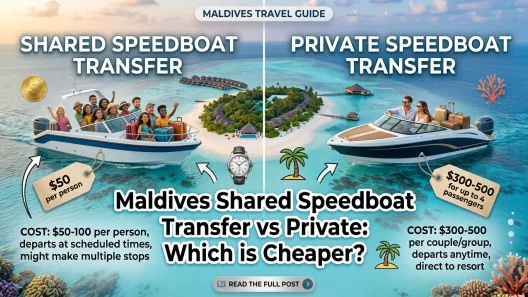
Set that against USD 20–40 per person for a shared speedboat and USD 150–300 for a private one. The case for the ferry is obvious, right up until you look at the timetable and discover it does not fit your flight.
Children under three travel free on RTL services, as do passengers with disabilities. Payment is in rufiyaa, and our guide to money explains why you should be carrying small notes rather than dollars for exactly this kind of purchase.
Tickets, changes and baggage
Cash at the terminal for traditional ferries. No online booking, no seat reservation, no card machine. Arrive early on busy routes; seating is unassigned and boats do fill.
App or website for RTL routes, with QR e-tickets and reserved seats.
Tickets are non-refundable. A trip can generally be changed once, up to 24 hours before departure.
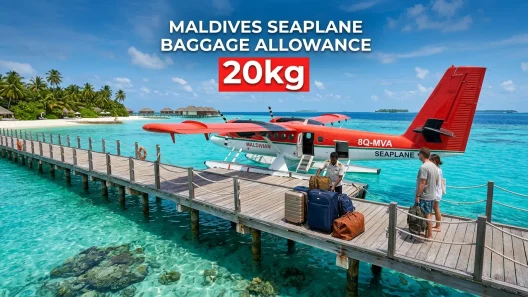
Baggage: one piece of hand luggage plus one item up to 20 kg. Additional bags require a separate ticket. This is more generous than a seaplane allowance and considerably less generous than it sounds when you are loading a dhoni by hand across a wet gunwale.
There is no luggage handling. You carry your own bags aboard, and on a traditional ferry that means a step down onto a moving deck. Divers with equipment and families with hard cases should think about this before choosing the cheap option.
The ferry is also a lorry
Something visitors notice and misread as inefficiency.
Public ferries carry cargo as well as people: building materials, gas cylinders, refrigerated goods, mail, school supplies and the week’s produce for a shop. On many islands the scheduled ferry is the supply line, not a convenience.
That explains two things. Loading takes time, and a departure can slip while a pallet is manhandled aboard. And the route exists for the cargo as much as the passengers, which is why services run on the days they do rather than the days a tourist would choose.
It also explains the deck space. Bench seating with an open middle is a cargo layout, and the reason your bag ends up next to a crate of onions is that the crate paid for the sailing.
None of this is a complaint. It is the difference between public transport built for a country and a shuttle built for visitors, and it is worth understanding before you judge the timetable.
The Malé terminal problem
The single most common practical failure on the ferry network is arriving at the wrong jetty.
Malé has multiple ferry terminals, serving different destinations, and they are not adjacent. Guides written years ago send travellers to the Villingili terminal in the southwest of the city for island ferries that have not departed from there in a long time.
The departure point has moved recently. As of mid-2026 the terminal usually used for southern island routes was itself temporarily relocated, which means even a correct 2025 guide can now be wrong.
Google Maps labels are unreliable for these terminals, with some pins carrying names that do not match current use.
The fix is unglamorous and it works: ask your guesthouse to name the terminal, the night before you travel, and take a photograph of the answer. If you are arriving into Velana, remember the airport ferry to Malé is a separate service and a separate ticket, running roughly every fifteen minutes.

Friday, and the days that do not run
Most traditional ferry routes do not operate on Fridays. Friday is a statutory non-working day and the network largely stops, as our guide to the working week explains.
Several routes run on fixed days rather than daily. Noonu’s two routes, for example, run Saturday to Thursday. Others run three days a week in each direction, which means an island can be easy to reach on Tuesday and impossible on Wednesday.
Public holidays disrupt the network, sometimes without notice. Our public holidays calendar covers which dates to watch, and around the two Eids the boats that do run fill with Maldivians travelling to family islands.
The planning rule follows directly. If your flight lands on a Friday, the ferry is not part of your plan. No amount of arriving early changes that, and the only answer is a speedboat.
What a ferry journey is actually like
Worth setting expectations, because the price attracts people who then discover the product.
Slow. A traditional ferry covering 26 kilometres takes around 100 minutes. A speedboat does it in 30. The ferry is not a slower version of the same thing; it is a different journey.
Open and warm. Sides are open, there is no air conditioning, and it can be hot at the dock and breezy at sea. RTL vessels are the opposite — enclosed and cooled.
Sociable. You are travelling with residents, schoolchildren, cargo and occasionally livestock. Several travellers report less seasickness on a heavy wooden hull than on a speedboat slamming through chop.
Scenic, genuinely. The slow pace is the point if you have the time. Passing reefs, sandbanks and islands at eight knots is a better introduction to the country than a covered speedboat cabin at thirty.
Basic. No refreshments on most services, limited or no toilet on traditional vessels, and no announcements in English. Bring water, and ask the crew to tell you when your island is coming.
What ferries cannot do
Five hard limits, and they decide whether the ferry is an option at all.
They do not go to resorts. Resort islands are private and are served by the property’s own boats or by seaplane. The ferry network connects inhabited islands only, a distinction our guide to resort and inhabited islands sets out in full.
They do not fit most flight schedules. A single afternoon departure does not accommodate a morning landing, and an early-morning return does not accommodate an evening flight.
They do not run on Fridays, on most routes.
They do not wait. No connection guarantee, no rebooking, no liability if you miss it.
They do not reach everywhere. Plenty of inhabited islands sit off the scheduled network entirely, reachable only by private boat.
Where the ferry does work, it is superb value. Where it does not, forcing it is how a cheap transfer becomes an expensive night in Malé — see our guide to a late arrival for what that costs.
Greater Malé: the exception
The one part of the network that behaves like urban transport rather than island transport.
Malé to Hulhumalé ran as a frequent ferry for decades and now competes with the Sinamalé bridge, which carries buses and taxis directly. Both options exist and the road is usually faster.
Malé to Villingili remains a short, frequent crossing with no bridge alternative.
Malé to Gulhifalhu and Thilafushi serve industrial destinations rather than tourist ones.
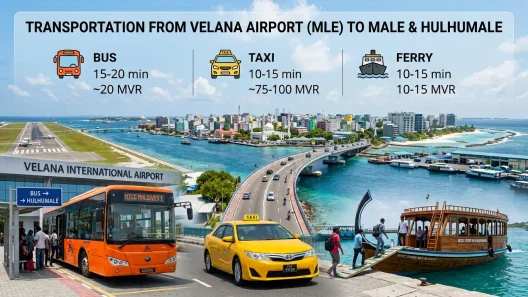
The airport ferry between Velana and Malé runs roughly every fifteen minutes for MVR 15, and is the cheapest way into the capital for anyone with time and a small bag.
If your plan involves a night in the capital, our guide to Malé covers what to do with the time.
The bridge changed the capital
One route that no longer works the way older guides describe.
The Sinamalé bridge connects Malé to the airport island and on to Hulhumalé by road. Buses and taxis now cross it directly, which has taken most of the traffic that used to ride the Malé–Hulhumalé ferry.
For arriving travellers this is the important change. Getting from Velana International Airport into the capital or to a Hulhumalé hotel no longer requires a boat at all, and the road is usually quicker. Our guide to the airport transfer into Malé and Hulhumalé covers the options and what each costs.
The ferry still runs, and remains the cheapest crossing for anyone travelling light and unhurried.
Guides that describe the Greater Malé area as ferry-only are describing the situation before the bridge, and it is the clearest example on this site of travel content aging badly against infrastructure.
Who the ferry is right for
Four profiles, honestly assessed.
Budget travellers with flexible dates. The obvious case. A week on a guesthouse island reached by ferry costs a fraction of the same week reached by speedboat, and the difference over two crossings is real money against the totals in our cost comparison.
Slow travellers and island-hoppers. The ferry network is the only affordable way to move between multiple inhabited islands, and it is how Maldivians actually travel.
Anyone arriving with a whole day to spare. The ferry is a fine first afternoon if your flight lands in the morning and your island is on a suitable route.
Nobody on a tight schedule. If you have a fixed flight home, a resort booking or a dive course starting tomorrow, pay for the speedboat.
Questions travellers ask
Can tourists use public ferries in the Maldives? Yes. Public ferries carry anyone, and foreign visitors ride them routinely between inhabited islands. They do not serve resort islands.
How much does a Maldives ferry cost? Traditional ferry fares run roughly MVR 20 to 55, about USD 1.50 to 3.50. RTL high-speed fares run MVR 30 to 93 one way. The airport ferry into Malé costs MVR 15.
Can I book Maldives ferries online? Only on RTL routes, through the RTL app or website with QR e-tickets. Traditional ferry routes, including those serving most guesthouse islands near Malé, are cash-only at the terminal.
Do ferries run on Fridays? Most traditional routes do not. Friday is a statutory non-working day and the network largely stops. Reports conflict on individual routes, so verify locally rather than relying on a published timetable.
How long does the ferry to Maafushi take? Around 100 minutes from Malé, calling at Gulhi. A shared speedboat covers the same distance in about 30 minutes for USD 20 to 40 per person.
How much luggage can I take? One piece of hand luggage plus one item up to 20 kg. Additional bags need a separate ticket, and you carry everything aboard yourself.
Where do the ferries leave from in Malé? It depends on the destination, and the terminals are not adjacent. Departure points have changed recently, so ask your accommodation to name the terminal the night before you travel.
Is the ferry safe? Yes, in normal conditions. Vessels are licensed and crews are experienced. Sailings are suspended in genuinely bad weather, which is a feature rather than a fault.
What to take away
- Two systems run in parallel: modern RTL high-speed ferries with app booking, and traditional cash-only dhoni ferries. Which you get depends on the atoll.
- The RTL rollout reached the far north and deep south first. Kaafu, Vaavu, Meemu and the Alifu atolls are the last, and expansion there is still in progress.
- Fares are extraordinary value: about USD 1.50 for a crossing that costs USD 20 to 40 by shared speedboat.
- There is no reliable published timetable for the traditional network. Verify with your guesthouse the day before, and never plan a ferry as your last connection before a flight.
- Most traditional routes do not run on Fridays, and several run only on fixed days of the week.
Next step: before you book a guesthouse island, ask the property two questions in writing — which ferry route serves them and on which days, and which Malé terminal it leaves from. Those two answers decide whether your transfer costs two dollars or forty.